
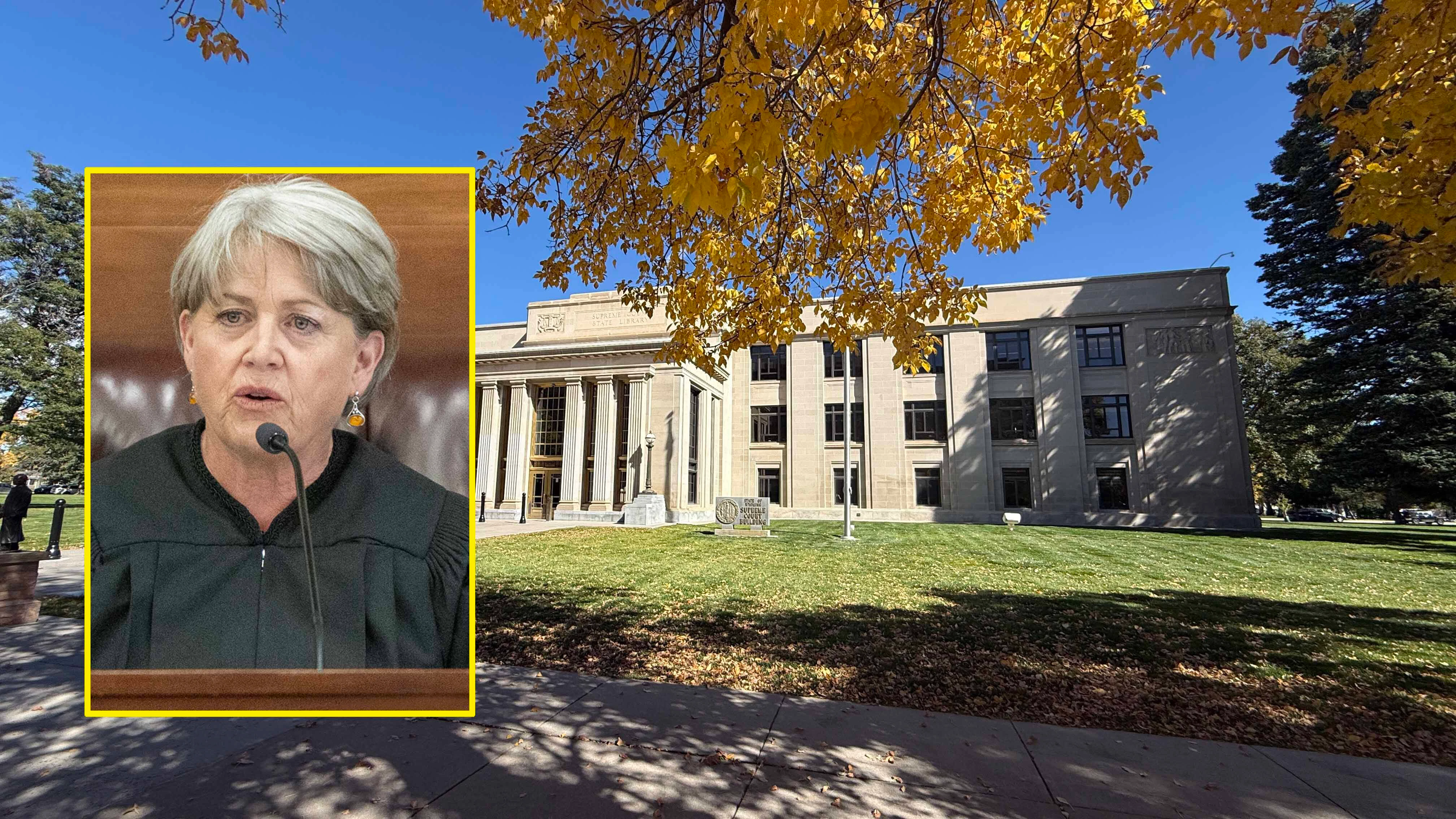
The Wyoming Supreme Court on Tuesday considered a possible future in which the state won’t let transgender people edit their birth certificates to show a new gender – except for one, last, transgender person from Laramie.
That’s because in one high-profile case a standard appeal is unfolding over whether the 2025 What is a Woman Act applies to the Wyoming Department of Health’s treatment of birth certificates.
The act requires state agencies to keep records according to biological, not altered, sex.
Natrona County District Court Judge Joshua Eames ruled that a male-to-female transgender person, whose initials are KR, could not secure a birth certificate change because of the What is a Woman Act, and because the Wyoming vital statistics act describes birth certificates as a record of the “facts at birth.”
Meanwhile, another high-profile appeal touching the birth-certificate question reached the high court under unusual circumstances:
Albany District Court Judge Misha Westby ordered the Department of Health to change the birth certificate of a female-to-male transgender person, formerly of Laramie, whose initials are EW.
Due to what attorney general senior assistant Jackson Engels called a back-and-forth with the transgender person over missing application information, the state didn’t appeal Westby’s order within a 30-day deadline.
Still, fearing it was about to break the law, the department launched a post-judgment argument saying it should be brought into the case, and Westby was wrong to order it to change a transgender person’s birth certificate without first considering the What is a Woman Act.
Engels now asks the high court to consider the whole question “de novo,” or anew, rather than using a lighter test of whether Westby did well enough under the circumstances.
Wyoming Supreme Court justices during oral arguments Tuesday indicated that the state’s unorthodox method of appeal in the second case could fail. Chief Justice Lynne Boomgaarden called the approach “awkward at best.”
Judging the first case on the merits of the What is a Woman Act, and the second on whether the state ran its appeal correctly, the justices grappled with the possibility the outcome of the first might bar a transgender person from getting a birth-certificate change, while the second might not.
“I struggle with that inconsistency,” said Justice John Fenn. “You know ultimately, for a layperson looking at it, there’s an inconsistent application of law: One individual can’t change a birth certificate, and in another case an individual was successful in changing their birth certificate.”
Fenn asked Engels to resolve that.
Engels urged the court to make two decisions that are “consistent.”
Justice Kari Jo Gray countered, saying the cases are different. The first is about whether the What is a Woman Act applies to birth certificates, the second is about the state’s unique efforts to make Westby rethink her own order.
“This case is just, if you get a re-do or not,” said Gray.
She later emphasized that “finality of judgment” is an important concept in judicial decision-making.
Engels said the high court could interpret the What is a Woman Act on its own, superseding Westby’s order. He said Westby made a mistake by not considering the What is a Woman Act in her initial order for a birth-certificate change, though the law is “directly on point.”
District Court Judges Ed Buchanan and Kate McKay also heard this case as temporary justices, filling in for recused Supreme Court Justices Bridget Hill and Robert Jarosh.
Buchanan noted that Westby had analyzed the What is a Woman Act in a way the state called “tortured.”
She had, but that was after the state petitioned to join the case post-judgment, said Engels.
The justices also pressed for clarity on whether Engels meant to claim a “re-do” because the case was extraordinary, or because he believes Westby abused her decision-making role.
Engels said he was arguing both points.
Lucas Buckley, who represents EW, said Engels left off the second part of that argument in his original appeal.
Buckley said he thinks the court should strike down the state’s appeal over the procedural concerns the justices voiced. But he also agrees with KR’s lawyers that the What is a Woman Act shouldn’t bar the Wyoming Department of Health from issuing amended birth certificates for transgender people.
Both Buckley, and KR’s counsel A.D. Sean Lewis, argued the state can still keep sex-accurate data using the original birth certificate while letting the transgender person have an alternate, amended birth certificate.
Lynne Boomgaarden rebutted them both, and circled back to the text of the What is a Woman Act.
“Notwithstanding any other provision of law, with respect to the application of a person’s biological sex under any law, rule or regulation in this state, the following definitions and standards shall apply,” read Boomgaarden from the law. “A person’s sex means the person’s biological sex, either male or female, at birth.”
Boomgaarden told Buckley, “I really struggle with your limited argument on the purpose of (the later section on data-keeping), and similarly, Judge Westby’s argument on the purpose of (it).”
The original case in Westby’s court is sealed, so the public cannot view it. Only the documents submitted in the appeal are publicly visible in the EW birth certificate case.
KR’s case, in Eames’ court, is not sealed.
Buckley said the What is a Woman Act should only apply to laws that include the word “sex.”
Lewis had said there’s nothing wrong with the department issuing amended certificates as “additional information.”
Engels disagreed with both.
He said giving the transgender petitioners the victory in these cases would mean that, “Some birth records in Wyoming will reflect sex, others will reflect gender identity.”
The Wyoming Constitution
KR’s other attorney Peter Renn argued that the What is a Woman Act violates the Wyoming Constitution.
Renn said it targets transgender people by pushing them into a “class.” Renn also said the Constitution contains a right to privacy.
The state Constitution does not list a right to privacy. But courts have applied a right to privacy in limited contexts in past cases.
Engels said that presumed right doesn’t exist here.
Gray pointed to the Skrmetti case, a landmark U.S. Supreme Court case upholding state bans on sex-change treatments for kids.
The majority in that case said the bans centered on prohibited medical treatments and purposes linked to them, rather than isolating transgender people into a class.
“Everyone who ever had a birth certificate is treated exactly the same” under the What is a Woman Act, said Gray. “I think that’s your problem. I don’t understand how you get (us to safeguard a) protected class under that.”
Renn said this case is different from Skrmetti, because it doesn’t hinge on diagnosis types. The attorney also said states can’t simply rephrase discriminatory laws under “neutral” language to sneak them through judicial review.
KR is being treated differently, Renn asserted, because “she’s not able to hold herself out as a natural woman like other women who aren’t transgender are able to do.”
Clair McFarland can be reached at clair@cowboystatedaily.com.


