
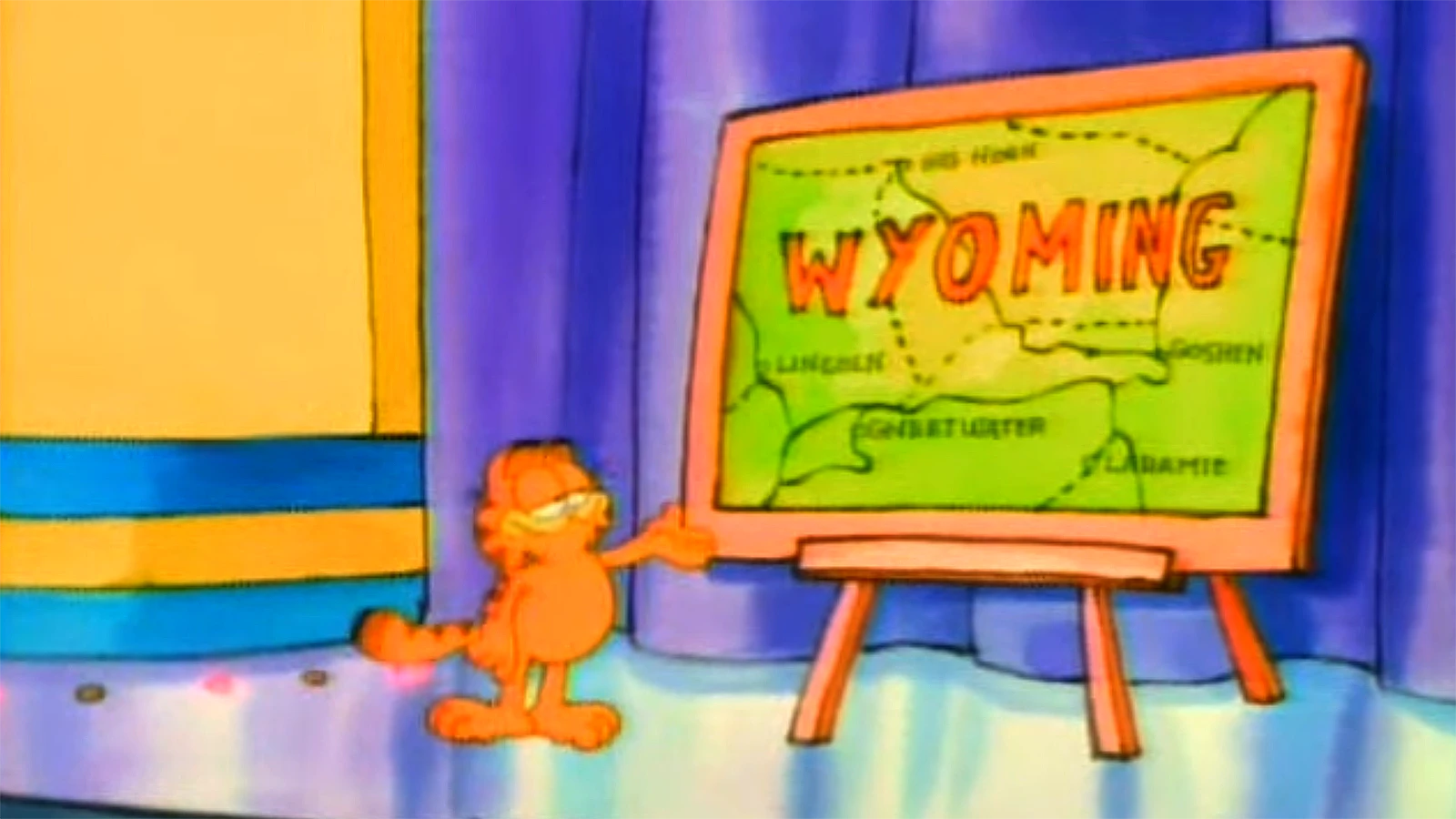
Ever wondered why Wyoming doesn’t exist?
Blame Garfield, the cartoon cat. It must be true because he said so on television.
One of the numerous conspiracy theories that have taken hold in the 21st century is that Wyoming, as a state, doesn’t exist. Whether it’s because of its low population or its own desire to fly under the radar, many people enjoy poking at Wyoming as a mythical realm of nothingness.
Who’s responsible for this strange theory?
Garfield the cat.
In a 1989 episode of “Garfield and Friends" titled “It Must Be True,” the lasagna-loving, Monday-hating orange cat revealed the truth: There’s no such place in Wyoming.
The idea has lingered in pop culture in the nearly 40 years since. The Urban Dictionary lists Wyoming as "a distortion of space-time that only appears to exist," and anyone who says they've been or lived there is lying.
Nobody’s more confused by that than Mark Evanier, the professional television and comic book writer who wrote the joke for Garfield in a segment where he admits he’s lying.
“It's a cartoon show,” Evanier told Cowboy State Daily. “How could anyone see Garfield the cat in an episode that's all about how television gets things wrong and take that seriously?”
'No State Here'
“It Must Be True” aired on Nov. 4, 1989, during the second season of the seven-season series “Garfield and Friends.”
“Yes, ‘It Must Be True,’ the show that tells you all sorts of incredible things which, since they’re on television, must be true,” says the chipper announcer before introducing the feline host.
Garfield opens with his “first incredible revelation”: There’s no such place as Wyoming.
“Think about it,” he tells the astounded cartoon audience. “Have you ever met anyone from Wyoming?”
The audience murmurs as they consider it: “Now that you mention it, I don’t think so.”
“Well, there you are,” says Garfield wryly, even as he stands next to a fairly accurate map of Wyoming with Lincoln, Sweetwater, Goshen, Big Horn, and Laramie counties all labeled in close to their respective locations.
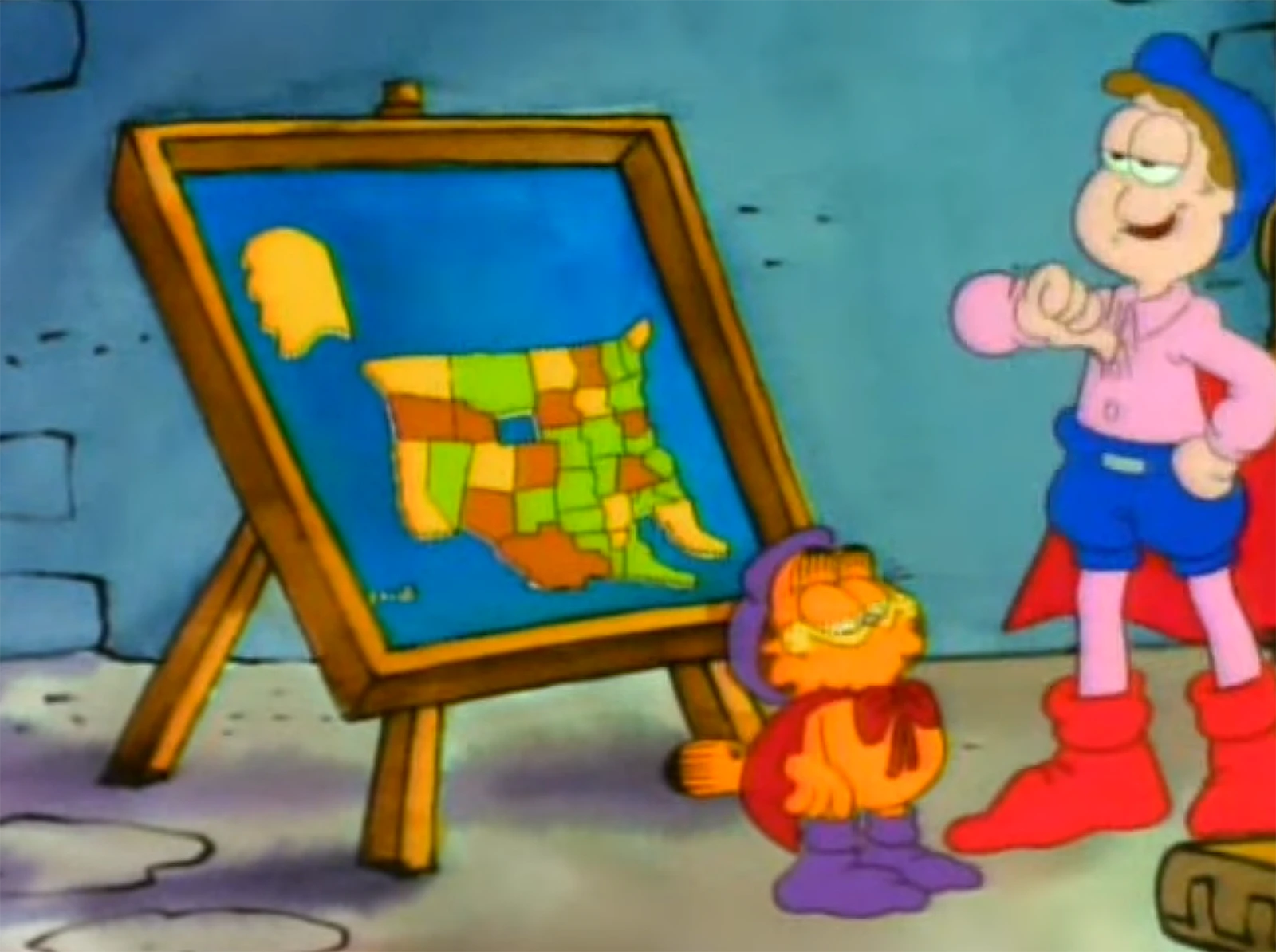
According to Garfield, the “myth” of Wyoming originated in 1789 with Italian explorer and mapmaker Arbuckle Vespucci and “his faithful and handsome cat” (actually Garfield and his eternally exasperated owner, Jon, in historical costumes) as they ran out of states while “designing the United States.”
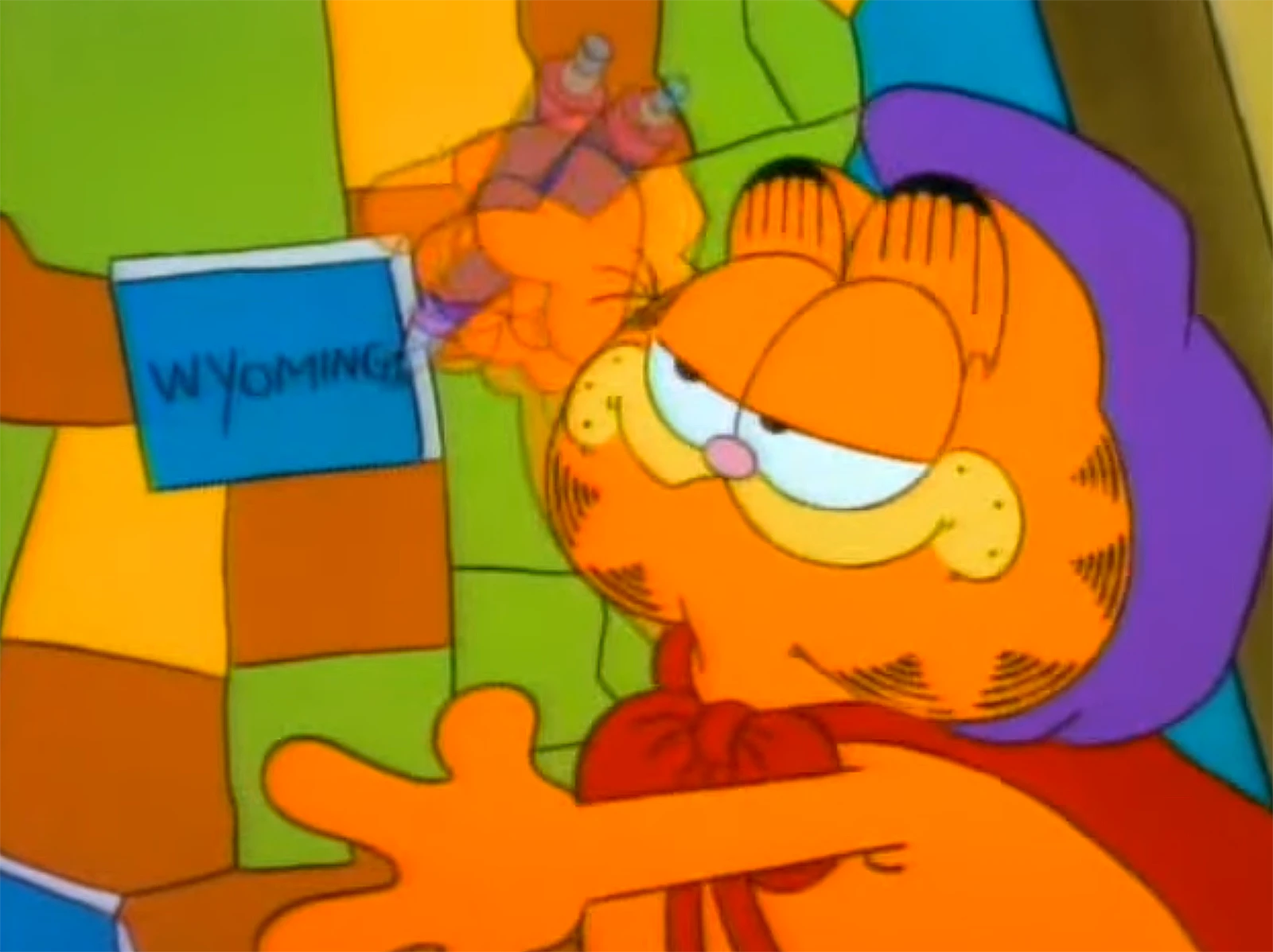
After Garfield tosses the final two states, Alaska and Hawaii, off the West Coast, Vespucci realizes there’s a little square-shaped hole in the middle of the United States and has no states to put there.
After ruling out another Carolina, Garfield decides to write “Wyoming” into the empty space. It’s Italian for “no state here," he reasons.
“So, there’s no Wyoming,” Garfield concludes. “And remember ...”
“... if they said it on television, it must be true,” the announcer chimes in.
Wyoming ceased to exist at that point. Although, according to Garfield, it never really existed in the first place.
'We Did Whatever We Wanted'
In the 1980s, Jim Davis, the creator of the Garfield franchise, didn’t think his characters would work on a Saturday morning television show.
Eager to win him over, CBS hired Evanier to convince Davis someone could pay homage to his characters in an episodic format.
“Jim wrote all sorts of stuff himself, and he was skeptical that anyone could write his character the way he did,” Evanier said. “The people at CBS said to Jim, ‘If we can find a writer you trust, will you let us do a Saturday morning show of Garfield?’ And he said, ‘Sure, but I'm skeptical you can find anyone.’”
Evanier, whose television animation work includes “Scooby Doo and Scrappy Doo,” “Dungeons and Dragons,” and “Superman: The Animated Series,” wrote a sample script for a hypothetical Garfield show and sent it to Davis for approval.
“Next thing I know, I was hired,” he said. “I wrote almost every episode of the show for the run of 'Garfield and Friends' on CBS Saturday Morning.”
Evanier and Sharman DiVono wrote all 121 episodes of “Garfield and Friends.” Because each episode contained two segments, they did twice the work, with two unique Garfield stories in each episode for a total of 242 Garfield cartoons.
“We wanted it to be silly,” Evanier said. “The mood of it was that I wrote down what I thought was funny, and the network trusted us and didn’t micromanage the show.
"We did whatever we wanted, and we wanted it to be outrageous. I really had a good time.”
That trust paid off, as “Garfield and Friends” was CBS’s top-rated show for the majority of its run.
Evanier credits much of the show’s success to Davis, who won Emmy Awards as a writer for previous “Garfield” specials, and to the “excellent” executive producer Lee Mendelson, best known for his Emmy Award-winning work on the “Peanuts” specials, including 1965’s “A Charlie Brown Christmas.”
Evanier saw himself as a steward of a well-established character. Davis created Garfield, Odie, and the entire entourage, and his job was to bring those characters to life in animation.
“That's my job,” he said. “Before this, I wrote comic books for Bugs Bunny, Daffy Duck, Superman, and Tarzan. I’ve written jokes for stand-up comedians. You get yourself familiar with a character, and then you write for that character. That’s what the job involves.”
Even so, Evanier said it takes a special kind of commitment to write good material for Garfield.
“With a character like Garfield, you either get him or you don't,” he said. “You either understand what's funny about him and the way he acts and the way he thinks, or you don't.
"I happened to be able to pick up on what Jim wanted to do with it, they let me do it, and we did it for seven years.”
When Truth Meets Reality
“It Must Be True” was a memorable outing for Garfield, but Evanier said the episode came from a genuine place. It’s Garfield’s commentary on the dangers of media consumption in the late 1980s, which is still remarkably relevant nearly four decades later.
“When you’re writing 242 cartoons, you try a little bit of everything,” he said. “Often, I would base an episode on something that was annoying me.”
In 1989, what was annoying Evanier was people saying untruthful things on television and their audiences taking them at their word. That would be excellent fodder for a Garfield cartoon.
Garfield’s other claims in “It Must Be True” include all fire hydrants contain compressed water from Walla Walla, Washington, that cows discuss English literature when no one is around, raisins are shrunken bowling balls rather than dried grapes, and dogs have no brains (because Garfield never misses an opportunity to mock his dim-witted pet pal).
Garfield has never been a “role model” type of character, but Evanier admitted he was trying to communicate something to the show’s young audience in “It Must Be True.”
“We don't send a lot of messages in our shows, but I thought this would be a good message for kids,” he said. “Television will sometimes tell them things that are not true, and the fact that it's on television doesn't mean it's true, especially when it comes to politics.”
The show ends with Garfield's offended audience of dogs thrashing him for calling them brainless, after which the cat admits the show was a lie.
Small Enough & Quiet Enough
So, how did Wyoming end up in “It Must Be True?” Evanier said it was almost, but not entirely, random.
“I picked a state that wasn't heavily populated,” he said. “It wouldn't have been funny to say New York or Los Angeles didn't exist, but Wyoming is a state that is not as densely populated as the other ones are.”
Wyoming became an even funnier option when Evanier realized that Wyomingites “aren’t as loud” as residents of other states.
“People aren't as loud on television saying, ‘Hey, we're all from Wyoming.’ It's not a state that seems to be desperate for attention," he said.
That made Wyoming simultaneously solid and obscure enough for the Garfield gag. For Evanier, it captures the episode’s point perfectly.
“I didn't want to pick something that the kids would think wasn't true, so when we say there's no Wyoming, they know the TV is lying to them,” he said. “But also, you don’t meet people who are from Wyoming every day.
"A lot of people haven't met anyone from Wyoming because maybe the people who live in Wyoming like to stay there and don't travel as much.”
Evanier also admitted he wasn’t the first person to make that joke on television. While he wasn’t fully aware of it while writing an episode, comedian Jack Parr had made a similar “Wyoming doesn’t exist” joke when he hosted NBC’s “The Tonight Show.”
“Maybe I subconsciously knew that, or maybe we just happen to think the same way,” he said.
But the joke didn't go mainstream until Garfield.
Either way, Evanier said Wyoming worked in a way few states could for the joke to work.
“The joke would have worked with some other state that didn't have a hugely visible profile, but Wyoming was at the top of my head,” he said.
Voices Of Authority
While Evanier gets the writing credit for the “Wyoming doesn’t exist” joke, he praised the voice actors for selling it.
Evanier was the voice director for “Garfield and Friends,” but Davis had already found the voices he wanted for the main cast when the show started.
Gerald David "Lorenzo" Music voiced Garfield from the first television special, “Here Comes Garfield,” in 1982.
He provided Garfield’s voice in “Garfield and Friends,” 11 other Garfield specials, and countless commercials and other media until his death in 2001.
“Lorenzo had a great deadpan delivery,” Evanier said.
The other notable voice in “In Must Be True” came from Gary Owens, one of the most revered voiceover artists of the last century.
Born in Mitchell, South Dakota, Owens started as a radio news reporter at KORN before moving to Los Angeles in 1961.
His resume includes announcing “Rowan & Martin’s Laugh-In,” voicing “Space Ghost,” and a long list of movies and television shows where his deep baritone enhanced whatever mood the production needed.
“Gary was a friend of mine, and he sounded so sincere in everything he said,” Evanier said. “Gary was an amazing guy who could sell you anything because you believed him. He had such a commanding presence.”
Owens voiced the overeager announcer of “It Must Be True,” nicely contrasting with Music’s monotone Garfield until the very last moment, after the dogs beat up Garfield and he vows never to lie again.
“That’s right, he will never lie again,” Owens says. “And remember, it they said it on television, it must be . . .”
“Oh, shut up,” Garfield says before passing out.
Evanier believes the contrast between Music and Owens made all the gags in “It Must Be True” work.
“I like to think that, someplace, there are some kids who, by watching that episode, learn not to trust everything they hear from their television sets,” he said.
It’s A Cartoon
Evanier has continued to write for comic books and television since the seven-season run on “Garfield and Friends” ended in 1994. He returned to Garfield by writing scripts for “The Garfield Show,” which ran from 2009 to 2016.
His latest book, “The Essential Peanuts by Charles M. Schulz: The Greatest Comic Strip of All Time,” was published in October 2025.
Evanier was also among the first to attend the first Golden State Comic Con in 1970, which has since become Comic-Con International in San Diego. He remains one of the “main guests of honor” at the annual event, where he hosts panels on a variety of topics.
People still bring Evanier their DVD collections of “Garfield and Friends” to autograph at Comic-Con. Many recognize him for his work on Garfield, but it depends on the person.
“It's my experience that most people associate you with the first thing they knew you for, whatever it was,” he said. “If you played a dumb talking pig on a TV show and then you cured cancer, when you die, they’ll still say, ‘The dumb pig TV show guy dies.’”
For as much as he’s worked within the Garfield franchise, Evanier doesn’t see himself as anything more than the man who wrote good scripts for Davis’ great characters.
“I feel I wrote a TV show that was on the air for seven years, earned enough money, and had enough episodes to be perpetually in syndication,” he said. “It wouldn't exist if not for Jim. My job was not to reinvent the character, but to write it the way Jim would write it. And since Jim liked it, I felt I succeeded at least in pleasing him.”
“It Must Be True” is one of hundreds of Garfield stories Evanier wrote. He’s more surprised than anyone that it’s become the genesis of the “Wyoming doesn’t exist” conspiracy.
“I can't believe anyone takes it seriously,” he said. “The joke right before it was an obvious lie. The joke right after it was an obvious lie. I don’t know how anyone takes it seriously, because Wyoming obviously exists. It’s a cartoon show.”
You never know what will resonate with an audience. Evanier said he’s been writing jokes since he was a child, and the principles of good comedy haven’t changed.
“I've been a professional writer since I was 17, and I’m 74 years old now," he said. "The job is to be funny and entertaining, and you do whatever is funny and entertaining."
The key to good comedy, according to Evanier, is finding something people will find amusing and enjoy, building it into a storyline that makes some sense, and filling that story with colorful characters who say funny, interesting things. Funny is funny, even when he doesn't get recognized for the jokes.
“I have things I write that are mine, and I have things I write that are other people, but it’s all very rewarding,” he said. “I've had all those years of doing something I enjoy, and if other people enjoy it, that's a bonus.”
It Is True
Nobody knows if Garfield has met anyone who lives in Wyoming. Evanier confirmed that he has, at least.
“I met some people who weren't from Wyoming, but they retired there,” he said. “They wanted to get away from New York or Hollywood. They decided, ‘Oh, how about if I buy a big ranch in Wyoming, because it’s a much more peaceful place,’ and they have.
"I didn't know anyone like that when we did the episode, but I've since met a few people who retired there, and they love it. I don't think they ever leave it.”
So yes, Garfield, there is such a place as Wyoming. Just because you said it on television doesn’t make it true.
Andrew Rossi can be reached at arossi@cowboystatedaily.com.


