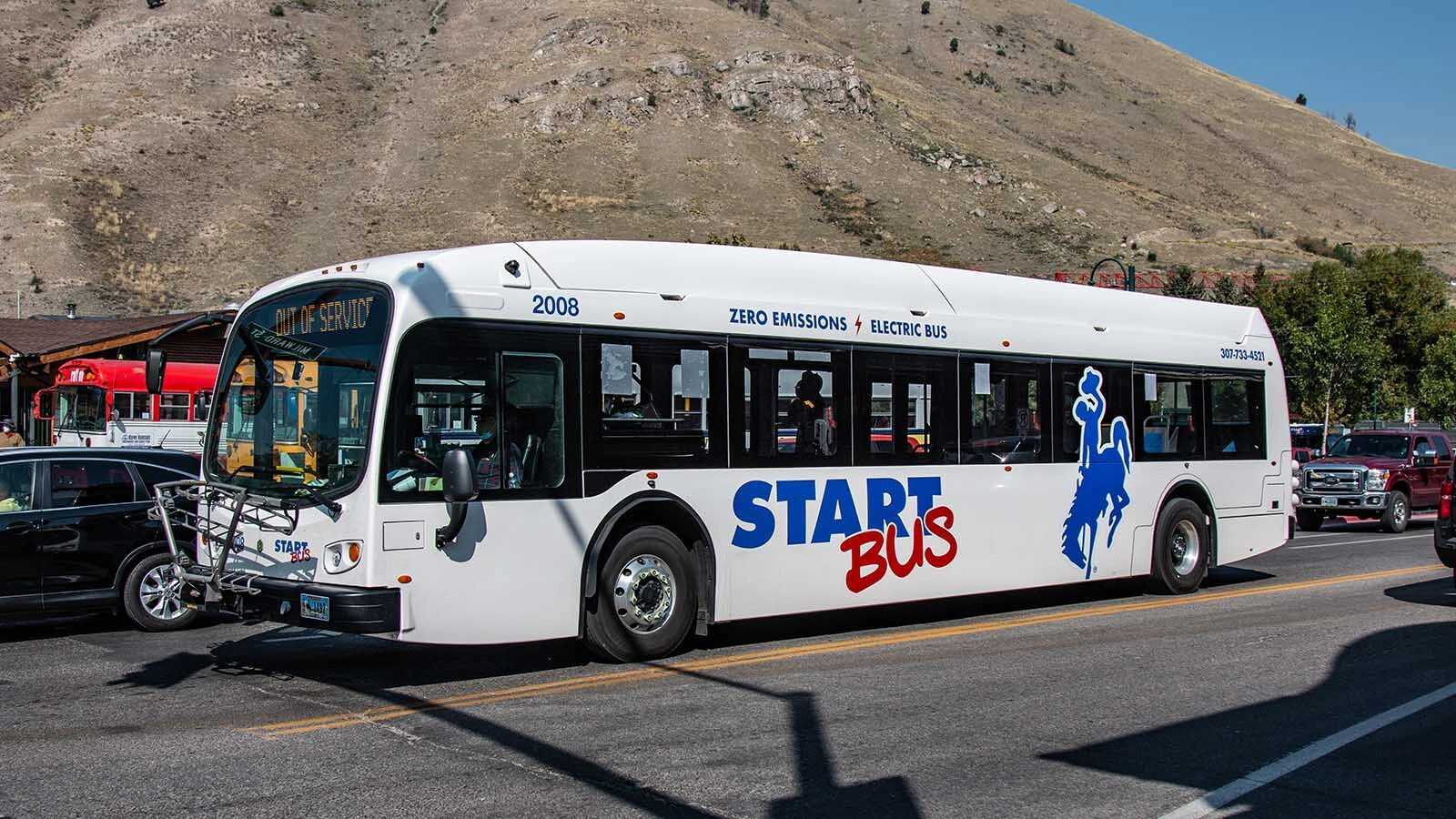
Jackson’s push to electrify its public buses failed, and eight are still parked unused at the bus barn. But the city’s transit system is now off the hook for about $3 million it could have owed the federal government for not using the buses long enough.
The buses were bought in 2020 using 85% federal funding.
Mike Toronto, director of START, the town and county’s bus system, told Cowboy State Daily that because the transit system took the electric buses out of service when they began breaking down in 2023, the local government would have been on the hook to repay a prorated portion of that grant.
“So it is a loan, but it kind of isn’t,” Toronto said.
START avoided the bill by winning a federal waiver, Toronto said, after making the case that the buses couldn’t be repaired and that fixing them would cost too much.
The buses were built by Proterra, a California electric bus maker that went bankrupt in 2023, leaving START unable to get parts to fix them when they started breaking down a few years after purchase. Other cities, such as Des Moines, Iowa, and Philadelphia also had to retire their Proterra buses for the same reason.
Even with the waiver, the city still spent almost $750,000 to purchase the buses. That money cannot be reimbursed, Toronto said.
Still, he said Jackson made the best decision possible. He pointed to other towns that still have Proterra buses in operation and are still paying for the revolving door of repairs.
“They didn't sink a bunch of taxpayer money into fixing up a lemon,” Toronto said. “We parked them because we saw the writing on the wall, and then we went through proper federal and government channels to get the forgiveness so that the taxpayers didn't have to bear more of that burden.”
Warning Signs
Not everyone in Jackson was surprised by how the buses turned out. Former Teton County Commissioner Paul Vogelheim said in 2023 the county should have bought natural gas buses instead of electric.
“We missed the boat there with our electric bus purchases, and obviously a bad choice of vendor,” Vogelheim previously told Cowboy State Daily.
Teton County’s school district passed on an electric bus of its own the year before Proterra went bankrupt.
In 2022, the district said it would return a federal grant of more than $200,000 from the EPA’s Clean School Bus Program because it had no indoor space to store an electric bus, and a district spokesperson said keeping one outside in the cold wasn’t feasible.
Toronto took the position as START director in August 2025 and had no decision-making power when the buses were initially purchased. If he were, he’s not sure what he would have done because START’s board had committed to making 40% of its fleet electric by 2022 as part of the community’s climate goals.
“It kind of depends on the goals and what you have to accomplish at the time,” Toronto said. “Sometimes those goals are not yours.”
That goal has not been completely abandoned. Toronto said START recently bought two new hybrid buses that will arrive in December.
“Hybrid buses actually have a really good proven track record,” Toronto said. “So that’s an alternative.”
Toronto said he has confidence in how the hybrid buses will perform and in the company that sold them to START.
Left to his own judgment, though, Toronto said he wouldn’t have gone for an all-electric option.
“My professional opinion is that I would not generally buy a fully electric bus for a cold climate such as ours,” Toronto said.
‘They Can Work’
Alicia Cox, executive director of Yellowstone-Teton Clean Cities, told Cowboy State Daily the failure was unfortunate but doesn’t mean the end of electric buses.
“I believe battery technology for electric buses can work in Wyoming,” Cox said. “They can work in cold climates, they can work where it’s snowy. This was just a very unfortunate set of circumstances.”
Cox emphasized that the problem traced back to the manufacturer, not the technology, and that Proterra’s collapse hit transit agencies far beyond Jackson.
As of 2023, the Philadelphia area’s transit authority had 25 Proterra buses sidelined for three years, according to the Philadelphia Inquirer. The transit agency in Des Moines eventually abandoned its Proterra fleet as well.
Though the number of registered electric vehicles has spiked in Wyoming in recent years, the state has long trailed the rest of the country. Jackson’s failed buses, Cox said, will likely feed that skepticism.
“I think it has definitely impacted people’s willingness to participate in future electric projects,” Cox said. “But I don’t think it was a poor choice of START or the town or the county. If you’re trying to stay with the times and meet your emission goals, you have to try.”
She pointed to other cold-weather towns where a similar initiative has succeeded. In Missoula, Montana, for example, more than half of the transit agency’s fixed-route fleet is electric.
“It works,” Cox said. “I still feel very confident in electric vehicles in the state.”
Still, Cox said any setback offers lessons, and watching Proterra’s bankruptcy ripple across the country, has made her look harder at the organizations she partners with. Whether it’s a clean-energy project or anything else, she said, trouble upstream always lands on the communities at the end of the line.
"It could have been anything,” Cox said. “This could have happened even if they went with a new diesel bus manufacturer.”
Emma Jane Jackson can be reached at emma@cowboystatedaily.com.