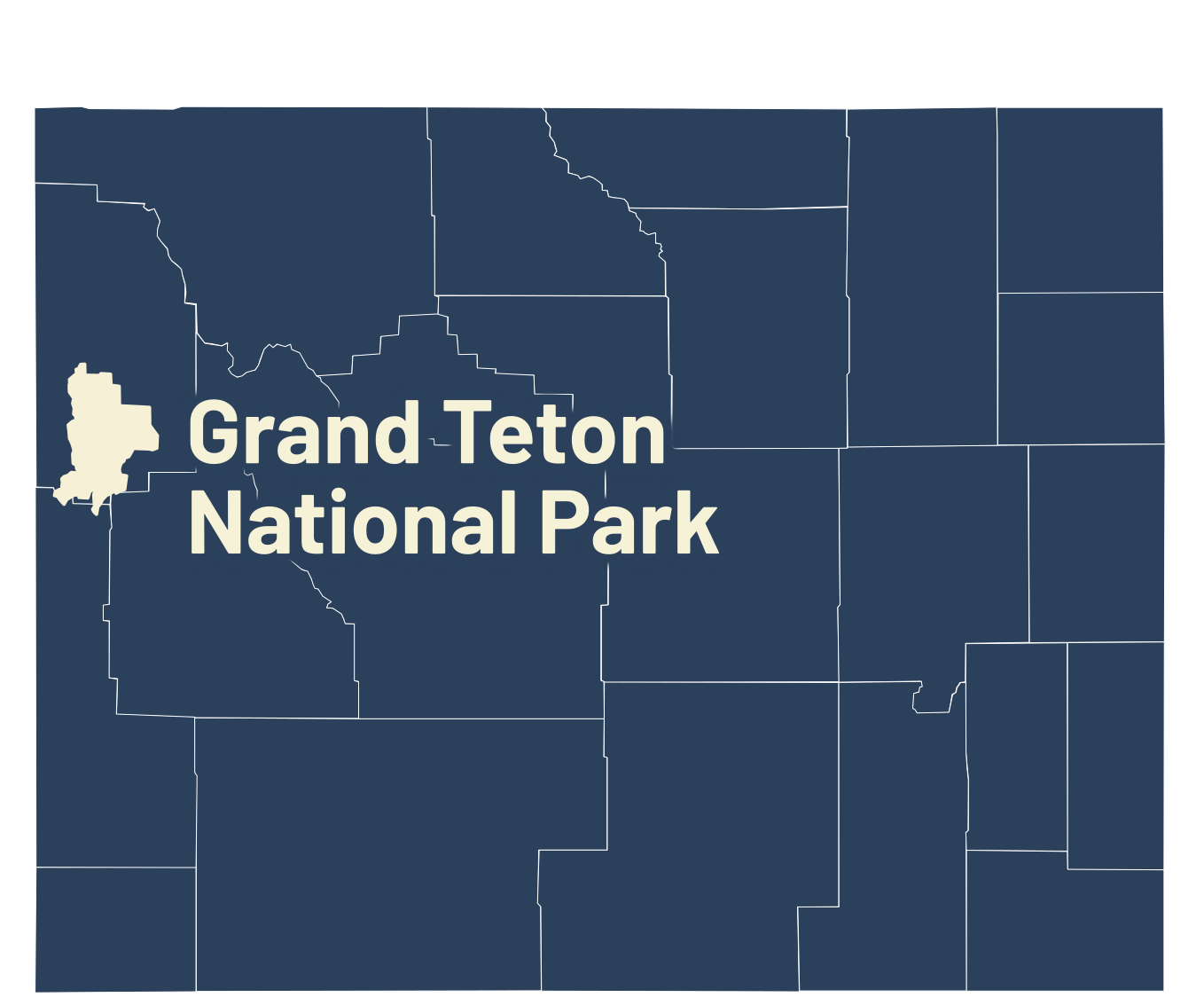
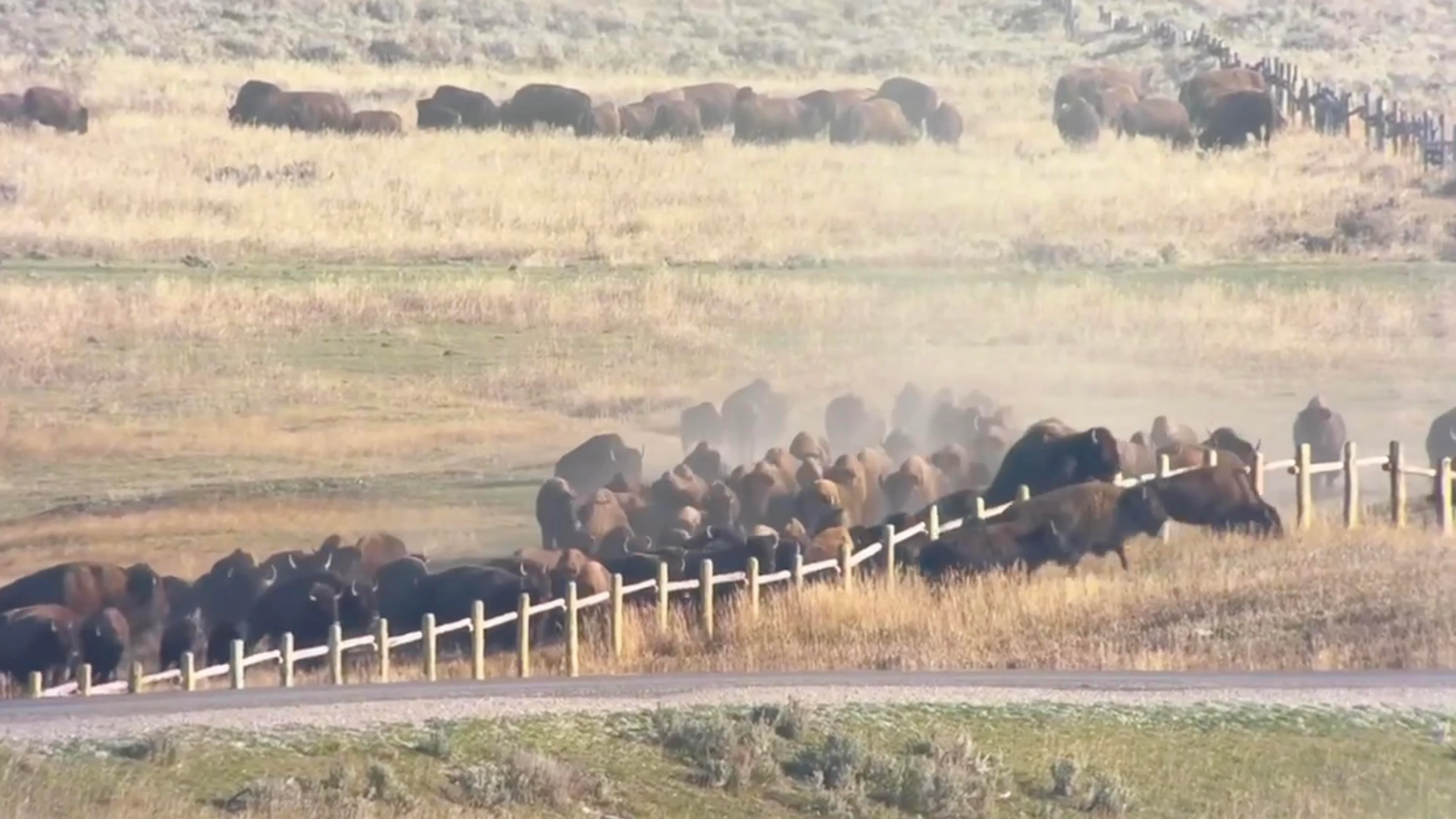
Frustration with a fence led to a bison stampede in Grand Teton National Park on Monday morning.
Bill Fabian, a wildlife guide with Jackson Hole Eco Tour Adventures, was overlooking the Elk Ranch Flats when he witnessed the scene.
“The herd was standing by the fence, looking a little bit frustrated that they couldn't get through and cross the road,” Fabian told Cowboy State Daily. “I watched as they moved farther into the field and the pasture.”
Fabian turned his attention elsewhere as the bison seemed to move on. When he looked back, the situation had escalated.
“A large group of them was already charging toward the fence,” he said. “They did a couple of laps back and forth along the fence before I started filming.”
Through a spotting scope, Fabian captured the moment when the stampeding bison reached the breaking point. As they surged toward the fence, individuals began breaking through, one at a time.
“They started to go through, go under, and go over,” he said. “It seemed like the press of the herd coming behind started to force some of them through, and they just went for it.”
Fabian was too far away to hear the stampeding bison. People who were closer described it to him as “pretty thunderous.”
“I've never seen that many bison running at that speed for that sustained amount of time,” he said.
Herd Mentality
Bison are big but fairly placid, excluding bulls during the breeding season. Nevertheless, they can get spooked or incited into massive stampedes.
“They don’t stampede for no reason,” said biologist and bison advocate George Wuerthner. “If they’re anxious or fleeing from anything, there has to be a motivation.”
Fabian wasn’t sure what started Monday’s stampede. The herd’s frustration with the fence might have been enough, but it was hard to tell, he said.
“There were some people and horses around, so that might have spooked them,” he said. “I’m not totally sure what happened.”
Apparently, it wasn’t enough to incite all the bison at Elk Ranch Flats into a stampede. Fabian noted that a sizable group of nearby bison on the same side of the fence elected not to participate.
“The smaller group never really participated,” he said. “They kept eating grass and watched while the main group stampeded.”
Organized Chaos
Bison herds have a matriarchal structure. Older females lead large herds because they have the most valuable knowledge of the landscape.
“Those females know the terrain, migration routes, and where to go calving,” Wuerthner said. “There may be a number of leading females within a bigger herd, and that gives the herd cohesion. They follow their appointed leaders.”
That said, it doesn’t take much to start a stampede. According to Wuerthner, it takes only one individual with an impulsive reaction to set it off.
“One animal can get stimulated or motivated to run, and the rest of the herd figures there must be a reason for it, so they start running, too,” he said.
That’s how bison stampedes quickly become chaotic. Hundreds of individuals can start running as fast as they can without knowing whether there’s a threat, where it is, or which direction they need to run to avoid it.
Fabian saw some of that chaos Monday. The bison that stampeded over or through the fence seemed to do it impulsively.
“In those chaotic, panicked situations, the herd collectively takes a mind of its own,” he said. “It’s still a herd collective, but the leaders aren’t guiding the chaos.”
The stampede slowed as individual bison started pushing through the fence. That might have been the collective signal that the herd would be OK.
That made the moment even more special for Fabian. Bison at Elk Ranch Flats rarely get that riled up.
“They cross that road multiple times a day,” he said. “It’s pretty common behavior for them to want to move from one side to the other, but usually not in a big stampede like that.”
Stampede Slaughter
Stampeding isn’t unique to bison. It’s a common behavior among many animals with a group mentality.
Throughout history, humans have observed and exploited those behaviors to their benefit. Archaeological evidence of this exists in North America’s buffalo jumps, like the Vore Buffalo Jump near Sundance.
“Native Americans would try to get a herd to stand near a cliff or very steep slope, then run them off as they blindly followed their leaders,” Wuerthner said. “The bison would either die or get seriously injured from the fall, and the people were able to kill them readily.”
Archaeologists have discovered several buffalo jumps across North America. They believe multiple tribes used good spots multiple times over hundreds of years.
According to Wuerthner, some tribes used a particularly brave individual to help guide bison to their doom.
“Younger men would be ‘volunteered’ to wear a bison head and hide,” he said. “At the appropriate time, a group would scare the herd from the rear, and that guy would start running and lead them right off the cliff. It was considered great status to be chosen, but also very dangerous, for obvious reasons.”
Humans can still be imperiled by bison stampedes.
In February 2025, a pack of wolves caused a snowy stampede in Yellowstone National Park’s Lamar Valley. One panicked bison ran straight at a group of tourists on a winter wildlife tour.
“I attribute that little stampede to that situation that was going on below,” said wildlife photographer Jeff Vanuga. “I haven’t seen bison running toward people before, but in this case, they were really hyped up because of the wolf attack.”
Something Special
About 600 bison live in Grand Teton National Park and they aren’t hard to find. Tourists can see them on or near roads, where they can back up traffic for several miles before moving on.
In the 1800s, bison roamed the western U.S. in herds in the tens of millions. Historical accounts from individuals such as William “Buffalo Bill” Cody discuss observing massive stampedes across the plains and herds so large they blocked rail lines for days.
Today, it’s rare to see a bison stampede, let alone a prolonged one with dozens of individuals at full speed. For Fabian, Monday’s stampede was an incredible moment.
“I'm not sure I've ever seen anything quite like that, in my time out here or really anywhere,” he said. “I was fortunate to have seen it. It was pretty awe-inspiring.”
Andrew Rossi can be reached at arossi@cowboystatedaily.com.