

Grizzlies aren’t picky eaters. They’ll eat pretty much anything available to them, but there are some exceptions.
One of those exceptions, at least for a Yellowstone National Park grizzly, is skunk.
Tara Ross, a retired Yellowstone ranger, saw that firsthand when she watched a grizzly curiously chase a skunk. It might have been a first encounter for both creatures.
“I had never seen a skunk inside Yellowstone, and haven’t since,” Ross told Cowboy State Daily.
First Time For Everything
It was April 2014. Ross, who was still working as a Yellowstone ranger, stopped in Hayden Valley to watch a young grizzly.
“It was when the roads were closed to the public, before the season starts, when you don't have millions of people on the road,” she said. “Rangers love to see bears, too. Anytime we don’t have to provide traffic control, which is rare, we can just sit and watch.”
Ross watched as the grizzly crested a hill, then she realized it was chasing something. As the bear got closer, she realized it was following a skunk.
“That’s what got my attention more than anything,” Ross said. “It was very unusual that there was a skunk there. I had never seen a skunk in the interior of the park.”
The grizzly seemed similarly intrigued.
“He didn't seem aggressive,” she said. “He didn't look like he was about to attack it for a food source. He just seemed very curious.”
Ross stopped filming when the skunk got too close and decided to roll up her window instead. Given how skunks defend themselves when threatened, she didn’t want to risk it.
It was a company car, after all.
“They were heading in my direction, and if that thing was going to spray, I did not want to get that in my vehicle,” she said. “What was shocking to me was that the skunk didn’t put up that tail and spray. He just went on his way.”
The grizzly stopped pursuing the skunk but still seemed intrigued. It watched the skunk scamper off, then turned its attention elsewhere.
Special Scent
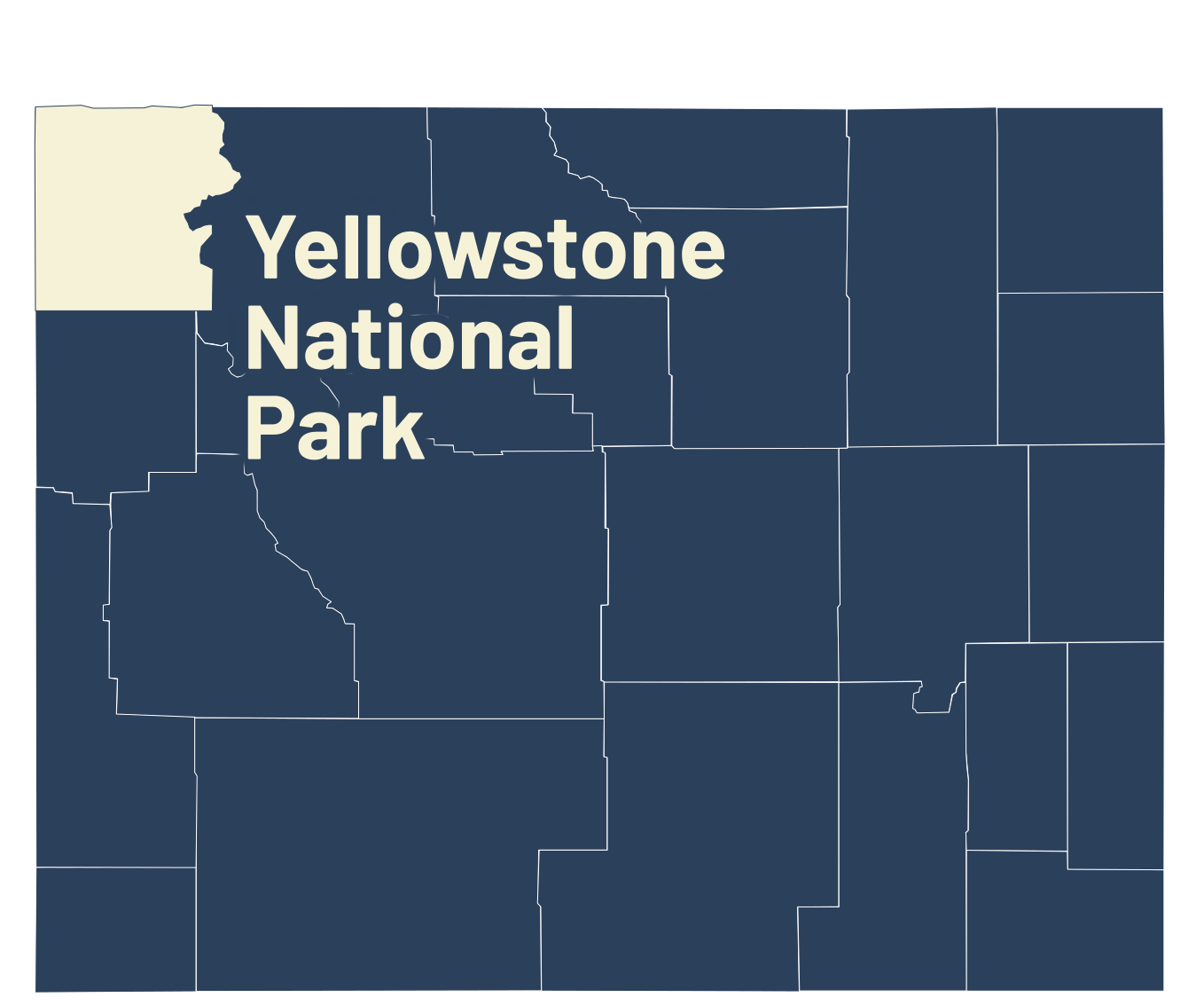
Striped skunks are common throughout North America, but they’re hardly ever seen in Yellowstone. According to the National Park Service, a skunk sighting in the park is “a rare treat.”
Skunks are rare in Yellowstone for many reasons, but elevation is the main factor.
Most of Yellowstone is over 7,000 feet. Skunks prefer habitats below 5,900 feet, so the park is less than ideal.
Striped skunks are also mostly nocturnal. The few that reside in Yellowstone are more likely to be seen foraging for insects, worms, and larvae at night.
Ross lives just outside Yellowstone, near where the Wyoming, Montana, and Idaho state lines converge. The area is low enough that skunks are plentiful, but they’re completely absent just a few miles away.
“We live just under 6,000 feet, so we get skunks all the time in our yard,” she said. “My husband spent 20 years as a backcountry ranger around the Bechler Ranger Station, which is just over 6,000 feet. He’d only seen a few skunks and not that deep into the backcountry.”
Skunks certainly don’t avoid Yellowstone because of predators. Because of their specialized musk glands, they have few natural predators and are primarily hunted by owls and other raptors with poor senses of smell.
Still, they’re a rare sight in Yellowstone. That was Ross’ only encounter with a Yellowstone skunk.
“I've worked all over the park, and in 30 years, I never saw a skunk anywhere else,” she said.
10 Feet Tall And Bulletproof
Wildlife photographer Julie Argyle was looking for bears in May when she found a mother grizzly and her cubs. She was watching them through a spotting scope when she saw a striped stranger instigate a conflict.
“We noticed this skunk coming across the face of the hill, and sure enough, it walked right over to the bears as if it was telling them, ‘This is my territory. You guys need to leave,’” she said. “It was like it thought it was 10 feet tall and bulletproof.”
The grizzly cubs stayed behind their mother, who confronted the much smaller skunk. The skunk was undaunted, charging toward the sow until it turned tail and ran.
The sow tried to chase the skunk but quickly changed her mind. The trio of grizzlies moved on while the skunk stuck around.
“We saw that skunk in that particular area several times within the next couple of weeks,” Argyle said. “I don't know much about skunk territories or if they just travel wherever or how that works, but it was in that area for a while.”
Not Quite So Apex
One would think a skunk taking on a grizzly would be a one-sided fight. The largest skunk can weigh up to 14 pounds, compared to the average female grizzly, which weighs between 250 and 350 pounds.
In a one-on-one fight, a skunk wouldn’t stand a chance. In Argyle’s experience, grizzlies seem keen to avoid conflicts.
“Everybody thinks grizzlies are these big beasts that don't back down from anything, but they do,” she said.
Argyle is accustomed to seeing grizzlies avoid bison, the only animal other than moose in the Greater Yellowstone Ecosystem larger than they are. One unexpected opponent that can send a grizzly running is the sandhill crane.
“Grizzlies back down from them all the time,” she said. “I don't know if it’s how big they look when they spread their wings way wide, or if it’s their beak that they’re actually afraid of, but I’ve watched several grizzlies back away from them.”
Skunks are small in stature but can have a big attitude – and an even bigger smell. Argyle wasn’t surprised to see the grizzlies exercise extreme caution as the small striped creature charged at them.
Many people and animals are wary of skunks because of their spray, whether they’ve heard about it or experienced it. However, Argyle thinks these grizzlies were more curious than anything. It might have been the first time any of them ever saw a skunk.
“They were very curious about it,” she said. “You don’t see many of them. I’ve been visiting or working in Yellowstone for 50 years, and that was only the fourth skunk I’ve seen.”
Andrew Rossi can be reached at arossi@cowboystatedaily.com.


