The National Oceanic and Atmospheric Administration’s Space Weather Prediction Center has issued a G2 geomagnetic storm watch for Thursday night and Friday.
That means an aurora could be visible in Wyoming's night sky for anyone who wants to wake up and find a suitably dark spot to see it.
This aurora won’t be the most spectacular. It might not even be visible to the naked eye, except from the state's darkest skies, and only for a few moments.
But it could be the last for a long time.
“I'm certainly going to set up tonight,” said Jan Curtis, retired meteorologist and former Wyoming state climatologist. “The next one could be six or seven years from now. That’s how nature works.”
Deep Sky Aurora
Auroras occur when a massive surge of energy from the sun's surface reaches and interacts with Earth’s atmosphere. These surges are called coronal mass ejections.
The intensity of CMEs ranges from G1 to G5. The incoming CME is expected to reach G2 for "isolated periods," producing moderate storm conditions and a potential aurora.
According to the Space Weather Prediction Center, an aurora “may be visible over some northern and upper Midwest states from New York to Idaho.”
“We expect the CME to impact between 9 p.m. and probably midnight,” Curtis said. “There may be a very brief period where it's clearly visible to the unaided eye, but I would still think you'd have to be in fairly dark skies to see it.”
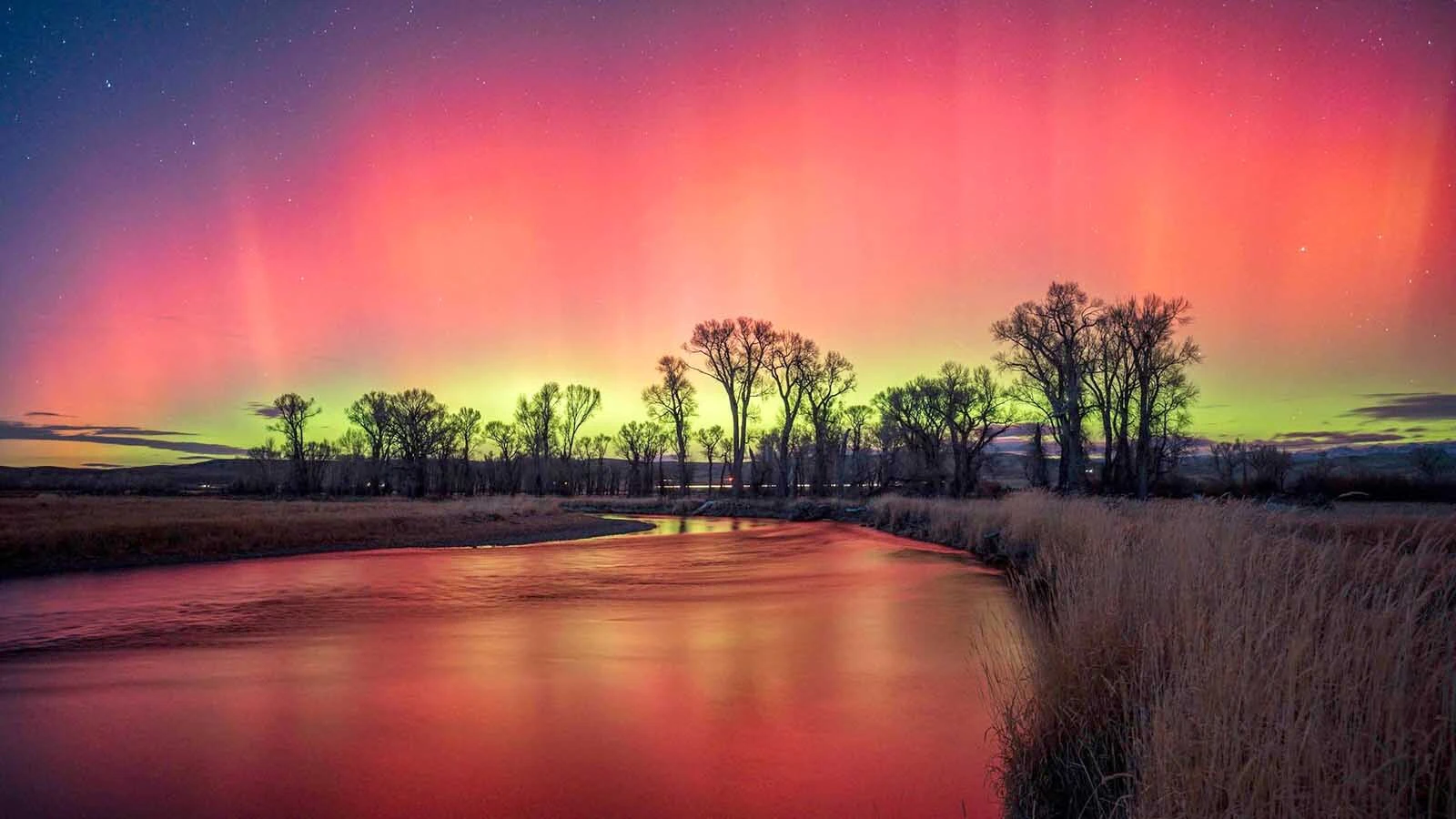
Curtis described this as a “deep sky aurora.” It might not be easily visible to the naked eye, but a long-exposure camera could capture incredible color.
“If you take time exposures, 5 to 15 seconds, with a digital camera, you can get some nice pictures of it,” he said. “That’ll make it sensitive to red colors, which is what normally occurs when auroras get down to the mid latitudes.”
Powerful auroras, like those in May 2024 and November 2025, have so much energy you can see them without a camera. Those events were caused by G4 geomagnetic storms from multiple CMEs that collided once they reached Earth.
A G2 geomagnetic storm is significantly less intense than a G4, so it’d be hard to see much without a long-exposure camera.
Still, Curtis said he thinks the incoming CME is worth the time and energy, especially for Wyoming’s aurora enthusiasts. It might be their last chance for a while.
Maxing Out
The solar cycle is the 11-year cycle of change in the sun’s activity. During the cycle, the sun goes through more active and less active periods, which directly impacts what we can see and experience from Earth.
The sun reached the climax of its solar maximum in October 2024. During the solar maximum, there’s much more activity in the form of sunspots, solar radiation, and CMEs.
Since then, the sun has been cycling out of its solar maximum and into its solar minimum.
The number of sunspots on the sun’s surface has been steadily decreasing in the past two years. Because CMEs erupt from sunspots, the likelihood of CMEs reaching Earth has been decreasing “exponentially,” according to Curtis.
Auroras aren't impossible during the solar minimum, but they're extremely rare due to the lack of sunspots. The number of sunspots will continue to decline until there are almost none.
“We’ve reached the end of the two-year buffer after solar maximum,” he said. “If we see anything tonight, we should consider ourselves lucky.”
See You In 2035
Solar Cycle 25, the current cycle, started in December 2019. It’s expected to end right when Solar Cycle 26 officially begins in 2030.
If astronomers are correct, the next solar maximum should peak sometime in 2035. That’s when CMEs will get frequent and strong enough to reach Wyoming.
Until then, Wyomingites will have to take what we can get, Curtis said, and the incoming CME might be all they get for the next several years.
“If aurora enthusiasts set up their equipment to record over the course of several hours this evening and tomorrow morning, in the darkest spot they can find, they might capture something,” Curtis said. “For the casual observer, you might get up in the middle of the night and hope for the best, but it’ll be a while before we get another one.”
Andrew Rossi can be reached at arossi@cowboystatedaily.com.