American Indian tribe after tribe has turned away data centers this fall, from Montana to South Dakota to Oklahoma.
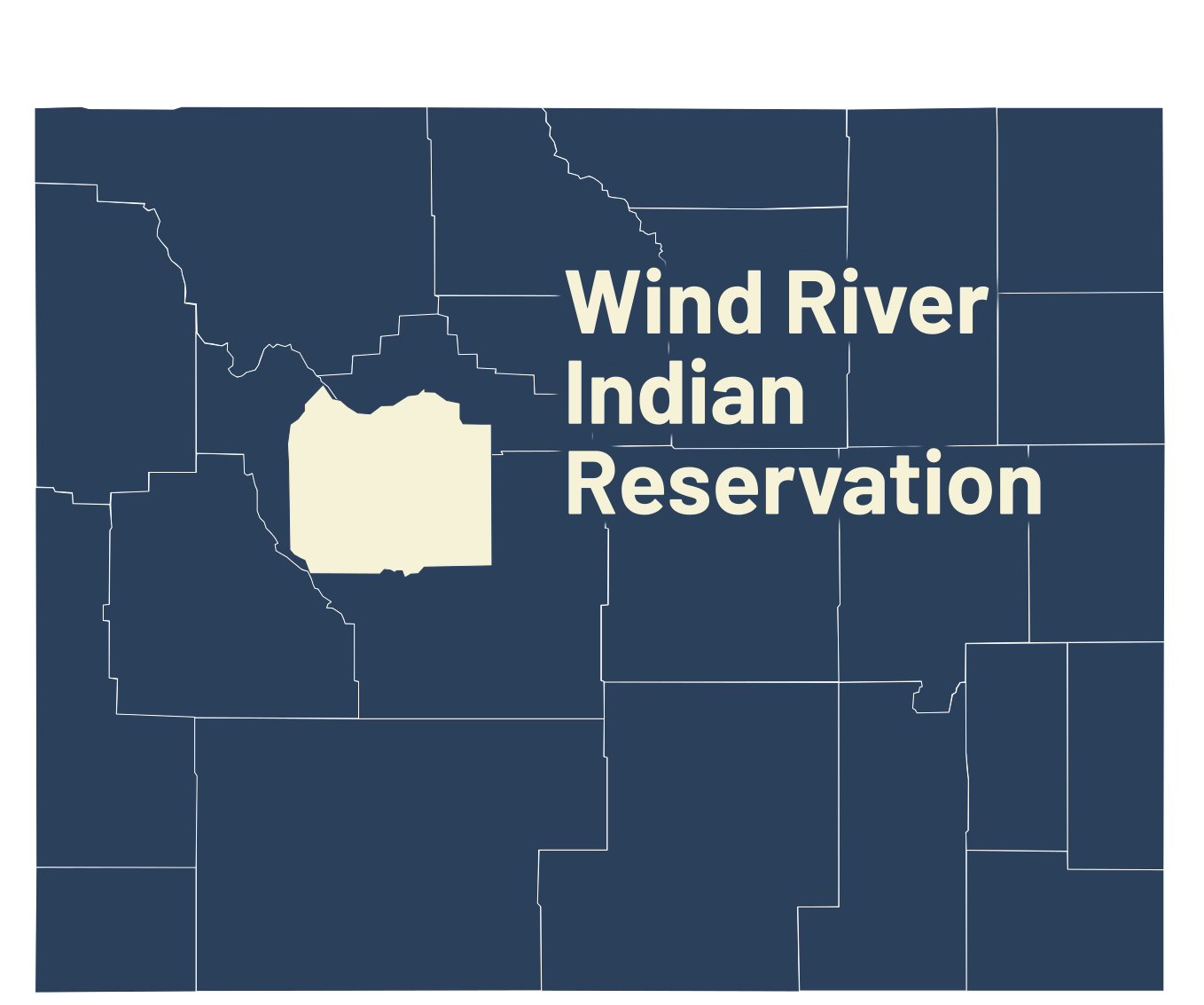
On Wyoming's Wind River Reservation, a study funded with Wyoming money was conducted to learn whether the community would say yes.
The study was funded by a $50,000 Wyoming Business Council planning grant, approved in 2024 for the Northern Arapaho Tribe and run through its business arm, Northern Arapaho Tribal Industries.
Patrick Lawson, executive manager of Northern Arapaho Tribal Industries, told Cowboy State Daily on Tuesday the study wrapped up in April with promising results.
“There's a lot of options here,” Lawson said. “The area is actually pretty decent for data centers.”
Lawson said the reservation can offer builders a unique advantage because a sovereign nation sets its own building codes, which can move permits along faster than elsewhere.
He emphasized the study looked at a smaller data center measured in megawatts, not the hyperscale projects in the headlines, and that it could generate its own power.
But the study couldn't clear one significant hurdle.
“The community's not really open for that,” Lawson said. “So the project's not really going forward at this point.”
1,000 Jobs
Lawson saiid much of that resistance comes from people not seeing the difference between hyperscale and megawatt projects.
“These hyperscale data centers are multiple mega gigawatts of power, and we were studying to do something that's multiple megawatts of power,” Lawson said. “Which is still significant -- like as much power as a town. But we were looking at generating our own electricity.”
Generating its own power was less a design choice than a necessity, Lawson said. Fremont County doesn't have much electricity to spare, so the study concluded any large project would have to bring its own supply, and the tribe's version was designed to be net zero and run on renewable energy.
While he’s heard fears about a new data center driving up power bills for homes and businesses, Lawson said the generation plan could have had the opposite effect.
“It would have been a microgrid system, and we'd use it to actually power parts of the reservation,” he said. “Potentially could have lowered everybody's bills or even provided free power for low-income individuals.”
Beyond power bills, Lawson said the project could have paid off in other ways, such as creating construction jobs and about a thousand permanent positions after the campus was built.
“They can bring a lot of revenue into a community, a lot of tax income,” Lawson said. "And believe it or not, depending on how you power them, the data centers themselves don't create a significant amount of jobs, but the supporting infrastructure and power generation does.”
Ultimately though, part of the study was to gauge community interest, and Lawson said that answer came through clearly. Regardless of political affiliation, he found his community was unified in its opposition to a new data center.
“We were trying to answer all the questions that people really hated about them and turn them into positives,” Lawson said. “But I think there's so much distrust of big corporations coming in and buying everything out.”
‘No Different Than the Pipeline’
For Eastern Shoshone tribal member Bobbi Shongutsie, the objection is less about big tech and more about protecting a traditional way of life. Shoshone people are land stewards, she said, and guarding water is part of that duty.
“We're supposed to honor life and honor water,” Shongutsie told Cowboy State Daily. “Water is life. A data center is no different than the the Standing Rock oil pipeline.”
In a resolution last week, the Lower Brule Sioux Tribal Council in South Dakota put a similar sentiment into law.
“The Kul Wicasa Oyate has a sacred responsibility to protect Unci Makha (Grandmother Earth),” the resolution states. “Accordingly, we honor that responsibility by protecting water, air, land, soil, wildlife, ecosystems, and natural resources, for our current and future generations.”
Shongutsie said many in her community share that view, but some see a data center as a financial lifeline.
“It's about half and half still,” Shongutsie said. “Because the community has been without economic development for so long. So they're like, ‘Well, it's something.’”
To Shongutsie, any promise of economic benefit is shortsighted. She acknowledges a data center would bring an influx of construction jobs, but she doubts it would create many permanent ones.
Wind River residents might be short on financial wealth, she said, but the land holds a different kind of wealth, and she believes a data center would put it at risk.
“Where we sit and on our reservation, there's 365 lakes,” Shongutsie said. “It's concerning because I would say about 300 of those lakes are not touched by too much human interference. They're up so high that there's not much recreation there.”
Those lakes, she said, are part of what makes the reservation special, and future generations deserve to have them.
“No other reservation has 365 lakes, but we do,” Shongutsie said. “And we want to choose a data center over 365 lakes? I'm fine choosing 365 lakes because that's a lot of life compared to just the data center.”
Development and Pressure
While the data center study is shelved, development has not stopped on the reservation.
The Eastern Shoshone Business Park on Riverton's north end was planned as a roughly 305-acre mix of shopping, housing, offices, an event center and light industrial space, according to its marketing brochure.
A newer proposal would add to that. AllDreams, a company registered in Wyoming this year, wants to develop AI-supported film production, gaming, retail and housing on about 250 acres of the park, the Riverton Ranger reported in September.
The company has said it is not a data center operator, the Ranger reported, but Shongutsie said rumors are already circulating about what the park could hold down the road.
“We're still just trying to dig and trying to figure out what exactly our tribe is doing,” Shongutsie said.
Lawson sees the current rush as a bubble, similar to the early internet or crypto mining, and expects the largest AI-driven projects to hit a tipping point before long.
“I think after everything settles down there will be a more reasonable norm that everybody will follow,” Lawson said. “And it'll just be not such a big deal anymore.”
Shongutsie worries about what that normalization could carry with it. Reservations are often the first to face these threats, she said, because rules can change faster than her people can gather and agree, and if the community and the tribal government aren't aligned, a project could be settled before anyone has a say.
“I think as more development happens, more things pressure the reservation for change,” Shongutsie said.
The Eastern Shoshone Business Council, Northern Arapaho Business Council and Inter Tribal Council did not respond to a request for comment from Cowboy State Daily by publication.
Emma Jane Jackson can be reached at emma@cowboystatedaily.com.