
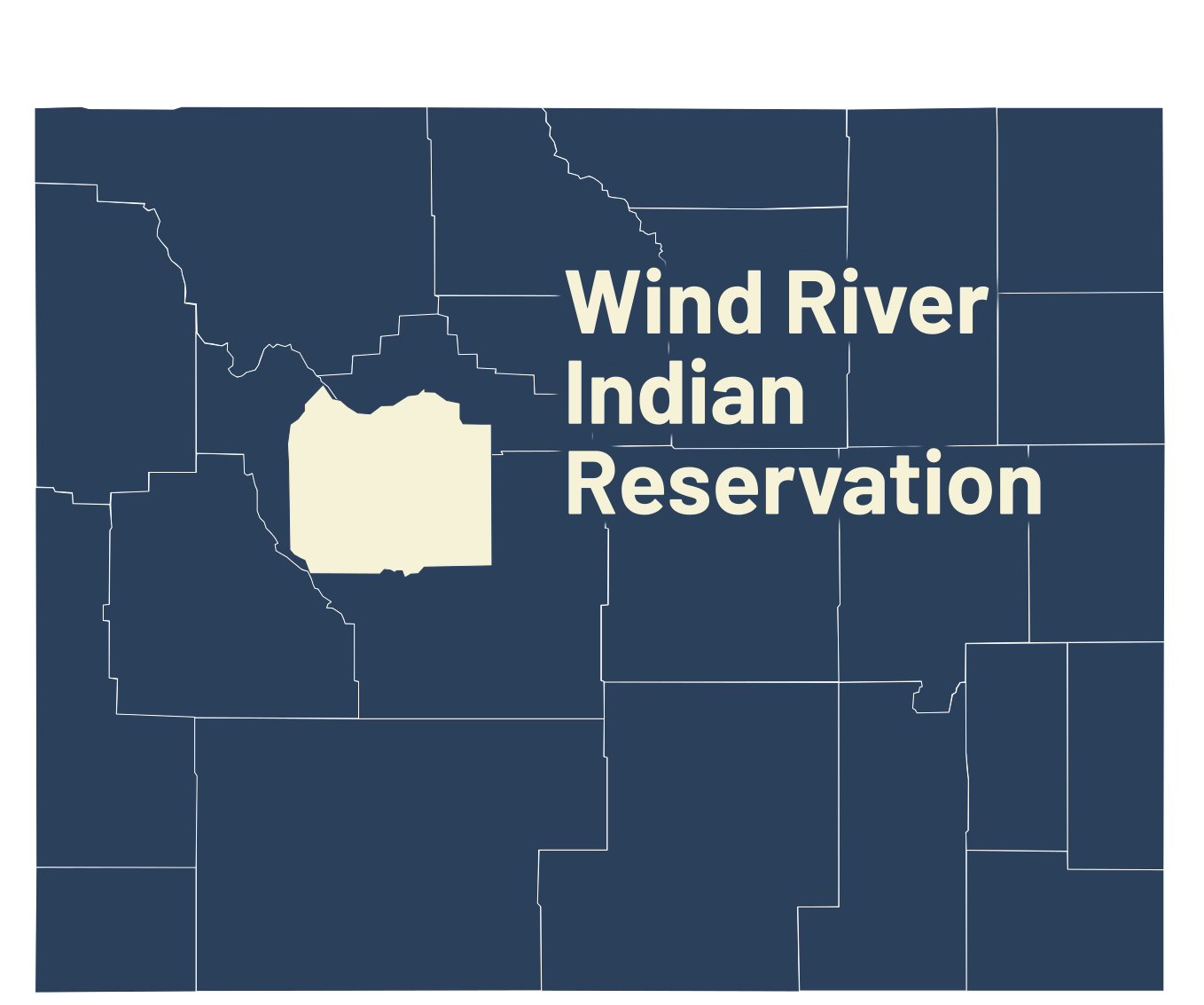
The Wyoming Business Council has awarded a $50,000 grant to the Northern Arapaho Tribe to study the feasibility of putting a data center in the Wind River Indian Reservation area, after the project was approved in 2024.
The tribe’s grant application says it wants to study the creation of a “large climate-controlled data center on the Wind River Indian Reservation to house and traffic the critical applications and data of companies and corporations.”
Not everyone is happy about the study or potential for data centers on the reservation.
Proponents say the study is merely a preliminary step, gauged to estimate the reservation’s capacity to hold a data center — one that would bring much-needed jobs to the area.
Detractors point to the concerns of electricity shortages, water and noise that are issues with data centers nationwide.
“Hell no,” said Wade LeBeau of the project.
LeBeau chairs one of the two Eastern Shoshoni Business Councils, or panels of governors, vying for control of the tribe in a controversial court case.
“That data center is going to be funded by a big Forbes company — a trillion-dollar company — and they’re going to … make it so that the land is theirs, and they’re going to tie in water rights,” he said.
The other Eastern Shoshone Business Council, which predates LeBeau’s governing board, did not respond by publication to a Monday-morning request for comment.
LeBeau calls the older council the “ousted” because many of the people voted to oust them at a meeting where they held democratic votes on tribal matters.
The tribal court case determining which council shall control the tribe is ongoing.
Meanwhile the Wyoming Business Council, which is a state agency that gives grants and loans to communities and businesses, is already embroiled in controversy as several lawmakers who decried it as a boondoggle tried to eliminate it in the recent legislative session.
Wyoming Business Council CEO Josh Dorrell did not respond to a Monday afternoon voicemail request for comment on the data center study by publication.
What About The Water?
In the meantime, LeBeau disputes the pursuit of a large data center, has concerns about how much water it would use, and questions whether the Northern Arapaho Tribe plans to pursue this without Eastern Shoshone involvement.
Data centers are large warehouses full of servers that power parts of the internet and increasingly artificial intelligence.
They may use a closed-loop cooling system, which proponents tout as a water-conservative way of keeping the equipment from overheating.
In a closed-loop system, water still should be flushed periodically because its quality can degrade and cooling chemicals can break down over time, USA Today reported.
LeBeau said because water is still evaporating and still needing to be replenished, perfect closed-loop cooling is a “myth.”
The Northern Arapaho Business Council did not respond by publication to a request for comment on the data center project.
Jobs, Jobs, Jobs
But Patrick Lawson, executive manager of Northern Arapaho Tribal Industries (NATI), which is an outgrowth of the tribal government, told Cowboy State Daily that the study itself may address people’s concerns.
The tribal group applied for the grant ahead of the February 2024 application deadline, Wyoming Business Council documents show.
“Like, the whole point of the operation was to try to help with the community and the economic development: bring jobs and money into the community,” said Lawson. “There wasn’t a big stigma about all the downsides at the time, when we started all this.”
Lawson said he hopes to tailor the study to address that outcry.
As for whether internet, artificial intelligence or other data mining companies have been courting the tribe to pursue the center, Lawson said, “I can’t say. That’s something we can talk about at the public meeting. But we don’t have anything signed or anything to disclose.”
How To Power It
The original project description says the study would seek to find a potential “carbon neutral energy matrix.”
That could mean a significant wind or solar farm near the center, Lawson confirmed.
The reservation town of Arapahoe has a per capita income of $14,606, says the project description, adding that Ethete’s per capita income is $14,433 and Fort Washakie’s is $14,938.
The towns’ unemployment rates range from 16.4% to 22.9%.
“Additionally, there is very little private sector activity on the reservation, and traditional employment sectors such as government, mining and agriculture sectors have been declining,” says the project description.
The area needs economic diversification and boasts low humidity and a lack of natural disasters, “making it an ideal location for a data center,” says the description.
While Lawson at first told the Wyoming Business Council that he envisioned a site located between two well-established power grids, on Monday he wasn’t sure where the proposed data center would sit.
On one hand, the edges of the reservation are the best place to have “redundancy” from different grid power suppliers. On the other hand, if the data center can feed itself with its own standalone renewables, it could sit deeper within the reservation, said Lawson.
All that’s conceptual at this point, as is the size of the center, he said.
Lawson said his group is planning to hold an informational meeting sometime in May with the exact date to be announced.
To Affect Everyone
Felicia Alvarez, an Eastern Shoshone Tribal member living in Colorado who said she has a strong connection to her tribe’s reservation, has been outspoken against the data center project.
“I would like everybody to know that, whatever the decision is on something like that, it’ll affect our water resources,” said Alvarez. “It’ll use up the costs of energy for everybody – not just our tribal members.”
She pointed to nationwide controversy over data centers and the drought conditions Wyoming has endured this year.
Triple This Thing
Jon Mayes, CEO at High Plains Power in Riverton, did not take a stance on the issue in his own Monday interview.
But he gave a detailed account of data centers’ pros and cons generally, and said he wants to learn more about the tribe’s goals.
“I’ll say, even three years ago, a data center used to be 10-20 megawatts,” said Mayes. “Now they’re talking gigawatts. Two-plus gigawatts on some of these data centers.”
Lawson had stayed noncommittal on the size of the tribe’s potential data center, saying that detail will firm up as the study answers capacity questions.
He said the tribe already runs five small data centers on the reservation.
Mayes narrowed large data centers’ controversies down to four big issues: the land they occupy, the water they consume, the fiber lines they require and the power they consume.
“We’ve been working with (power supplier) Tri-State on different options for how to interconnect these very large loads,” said Mayes. “To give you a scale, some of these data centers are asking for 2 gigawatts.
"Right now Tri-State has 8 gigawatts of requested interconnection from data centers.”
The peak for Tri-State’s entire system is 2.5 gigawatts, said Mayes.
So if Tri-State were to serve its region’s proposed data centers on its own, it would need to roughly triple its capacity by the time the data centers became grid connected, Mayes said.
That region comprises mostly rural areas in New Mexico, Colorado, Wyoming and part of Nebraska.
Some data centers, said Mayes, establish themselves with a standalone power source — comparable to a jet engine turned on its side — while racing to connect to the grid for better reliability.
Generation is one challenge, and transmission is another. Spikes in people’s electrical rates, if the data center uses their grid, is a third.
“A key consideration for you and me as members is to make sure that this data center — if it’s going (into the grid) — that we don’t have rate shock for everybody else,” Mayes said, adding that Tri State and High Plains Power have been working to navigate those issues.
On the other hand, said Mayes, large data centers bring numerous jobs to communities, like skilled labor trades and technicians.
Rocky Mountain Power also provides power on the reservation. The company did not respond by publication to a Monday-afternoon email request for comment.
County Government
The tribal governments are separate entities from the Fremont County Commission. But the entities often address overlapping issues.
Fremont County Commission Chair Larry Allen did not respond by publication to a voicemail request for comment.
Vice-Chair Mike Jones told Cowboy State Daily he’s pro-business, and believes the feasibility study may be a good route to answering questions people have about data centers.
“Hopefully that would be a public process,” said Jones.
Commissioner Clarence Thomas said it’s too early to address the issue, especially from a county government standpoint.
Commissioner Ron Fabrizius, of Riverton, raised questions about whether the county has enough housing to accommodate a potential influx of workers. And he hinted at the potential for intertribal tension.
“I think the tribes, if they’re doing it, they need to do it together,” said Fabrizius, “and not just the Arapaho doing it by themselves – because of the land and what else is really going to be a big issue with that kind of project, is water.”
The agriculture community’s water needs are another valid consideration, said Fabrizius.
“But you know, for the tribes, I could understand why they’d want to do it. That would provide some jobs for a while, sure,” said Fabrizius.
And after that, he added, having “that thing sitting on their land” could give the tribe passive income.
“I know that would be a big plus for them – it’s just, how would it affect the irrigation of the agricultural community?” he asked.
Fabrizius also pointed to reports that data centers throw a noise or vibration. How that would affect people or wildlife is a valid point for study; and the center’s power needs are another, he said.
Clarification - an earlier version of this story said the WBC had approved the funding, when it has awarded it instead.


