A partial but perfect Tyrannosaurus rex skeleton from eastern Wyoming is poised to upend everything the world thought it knew about the Tyrant Lizard King.
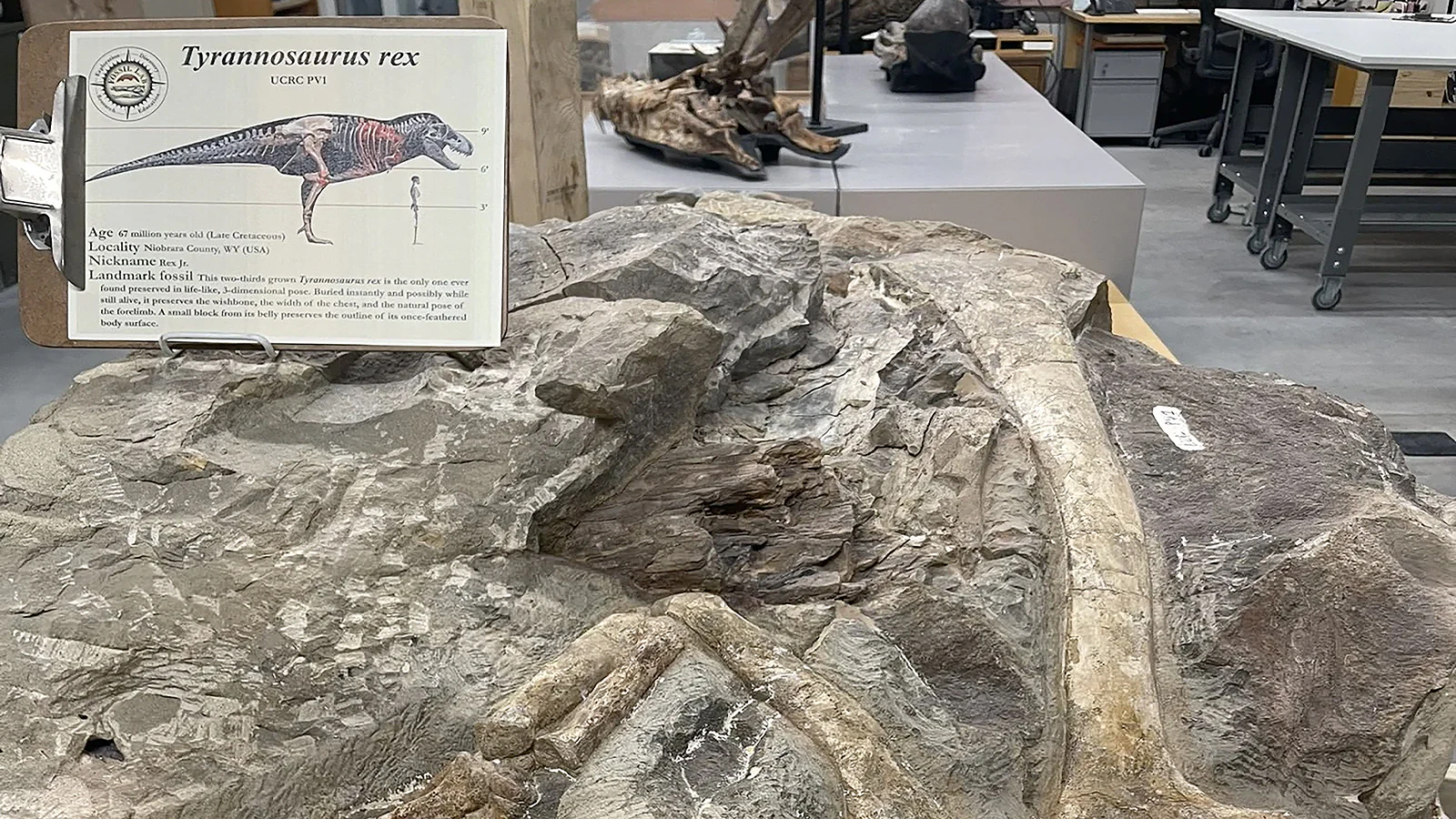
“Rex Junior” is one of the many spectacular fossils currently being studied at the University of Chicago’s Fossil Lab. It’s the partial skeleton of a sub-adult T. rex found on the legendary Zerbst Ranch near Newcastle.
Outwardly, Rex Jr. isn’t that exciting. There’s no skull, most of the tail is missing, and its skeleton is encased in some of the hardest rock imaginable.
Now that the fossils have been exposed after 67 million years, it could be the most important T. rex that has or will ever be found.
“I was told this might be an extraordinary specimen,” paleontologist Paul Sereno told Cowboy State Daily. “I would ultimately realize two decades later how extraordinary it was.”
Many details on Rex Junior are still secret, pending publication, but Sereno said this specimen from the newly discovered "mummy zone" will redefine what we know about T. rex, inside and out.
“All I’ll say is we don't see scales,” he said.
The Big Block
Sereno encountered Rex Junior at the top of a hill near Newcastle in the 1990s. It eroded out of the Lance Formation, a 67-million-year-old layer of rock dating to the end of the Late Cretaceous Period, when T. rex and Triceratops roamed Wyoming.
This T. rex wasn’t so much excavated as wrapped up and hauled off the Zerbst Ranch. The Zerbsts have been assisting paleontologists with that for generations.
William Zerbst helped paleontologist Charles Sternberg excavate a mummified Edmontosaurus from the ranch in 1910. His son, Leonard, encouraged paleontologists to explore the ranch his entire life, leading to the discovery of spectacular Triceratops specimens and other Edmontosaurus mummies.
That’s how Sereno zeroed in on “the big block.”
“I worked on the Zerbst Ranch and got to know the family quite well,” he said. “They know the land, as many ranchers do, and they knew there was something in a big block on the top of a hill.”
Kristen Zerbst, Leonard’s daughter, mentioned the block to Sereno. It wasn’t a new discovery, as the family had been finding broken scraps of fossilized bone lying beside it for decades.
“I found an interview with Leonard Zerbst where he talked about the dinosaur at the top of a hill,” Sereno said. "It was from 1952."
Other paleontologists had visited the mysterious block over the years, thinking it might contain another mummified Edmontosaurus. Sereno was the first one tenacious enough to recover it, and what an effort it was.
It Could Only Be
In the early 1990s, Sereno brought graduate and high school students from Chicago to eastern Wyoming for a field trip. Once they got situated on the Zerbst Ranch, thanks to the hospitality of the Zerbst family, their first day was spent reaching the big block.
“I'm charging ahead, because I’ve got a lot of energy, while trying to get the undergrads to move their butts up the hill,” he said.
Once he reached the big block, Sereno picked up a few fossil-containing pieces scattered around it. In an instant, he knew it was something unique.
“I could see a cross-section of two little bones, and two more little bones, and two more little bones,” he said. “I understood it was a T. rex. It could only be a T. rex.”
More important, Sereno recognized he was looking at bones that had never been found intact in any other T. rex skeleton.
“Those little bones were gastralia, part of the stomach ribs, and they were in place,” he said. “I could see a line connecting them in the sediment.”
With these clues, Sereno deduced that the big block could contain the articulated skeleton of a T. rex. There was no question it was going back with him to Chicago.
I Haul The U-Haul
Because the rock of the block was impossibly hard, the entire block was removed intact. Once again, the Zerbsts lent a hand — and several hundred horsepower.
“The main concretion was over 5,000 pounds, with several subsidiary pieces that weighed around 2,000 pounds,” Sereno said. “We wrapped them in plaster, put some wood on them, and Kristen's husband, Chad, lifted them with a backhoe.”
Since Sereno didn’t have a vehicle with enough space and torque to get the block out of the field, he improvised by renting a 17-foot U-Haul truck.
“When we pushed it into the back of the U-Haul, the flaps went right down to the ground,” he said. “With 7,000 pounds in the back, and realizing the tires could blow within 50 yards of driving down the gravel road, I got in the cab and started driving.”
Sereno turned onto the highway at a modest 45 mph. After checking the tires to ensure the truck could handle the load, he bumped it up to 60 mph for the 988-mile trek back to Chicago.
“I don't think that U-Haul was ever quite the same,” he said.
Perfect
Once the big block was back at the University of Chicago, the laborious process of preparing the specimen began. Rex Junior didn’t give up its secrets easily.
“It’s the hardest rock we've ever encountered,” Sereno said. “Every once in a while, the bones of something will attract the groundwater in such a way that an ironstone concretion forms around them. It’s just about the hardest rock I think I've ever seen.”
Millimeter by millimeter, the ironstone was etched away, and the fossilized skeleton slowly revealed. It was immediately worth every laborious inch of struggle.
The first big revelation was the articulated right arm. Every bone was there, from the long, thin scapula to the very tips of the claws, perfectly articulated as they would have been when Rex Junior was alive.
“It was the only complete T. rex hand and forearm ever found,” Sereno said. “Every single bone, in place outside of the ribcage. I was totally shocked.”
As of 2026, the preparation of Rex Junior continues. The primary 5,000-pound concretion has been mostly prepared on one side, revealing the right arm and most of the ribcage.
“It looks like we’ve got both arms, the torso, and the base of the neck,” Sereno said. “There are five or six small blocks that fit into it, and you can see the knee coming up to the chest, so we’re probably going to get most of the (right) leg.”
What about the tail and the highly coveted skull?
“Unfortunately, those have been lost to erosion,” Sereno said. “Those weathered away through doubtless centuries, and probably a millennium of time. That block had been weathering for centuries before we got to it.”
It’s unfortunate that time decapitated this dinosaur, he said, but Rex Junior doesn’t need a pretty face to be one of the best T. rex specimens ever found.
No Wishful Thinking
As Rex Junior's preparation continued, another first was revealed: An articulated furcula, better known as “the wishbone,” was found attached to the shoulder at the midline of the body, right where it should be.
That discovery had an immediate impact, leading to the world’s most famous T. rex getting a somewhat extreme makeover.
Sue the T. rex, found in South Dakota a few years before Rex Junior, had a litigious journey before ending up at Chicago’s Field Museum of Natural History in 1997.
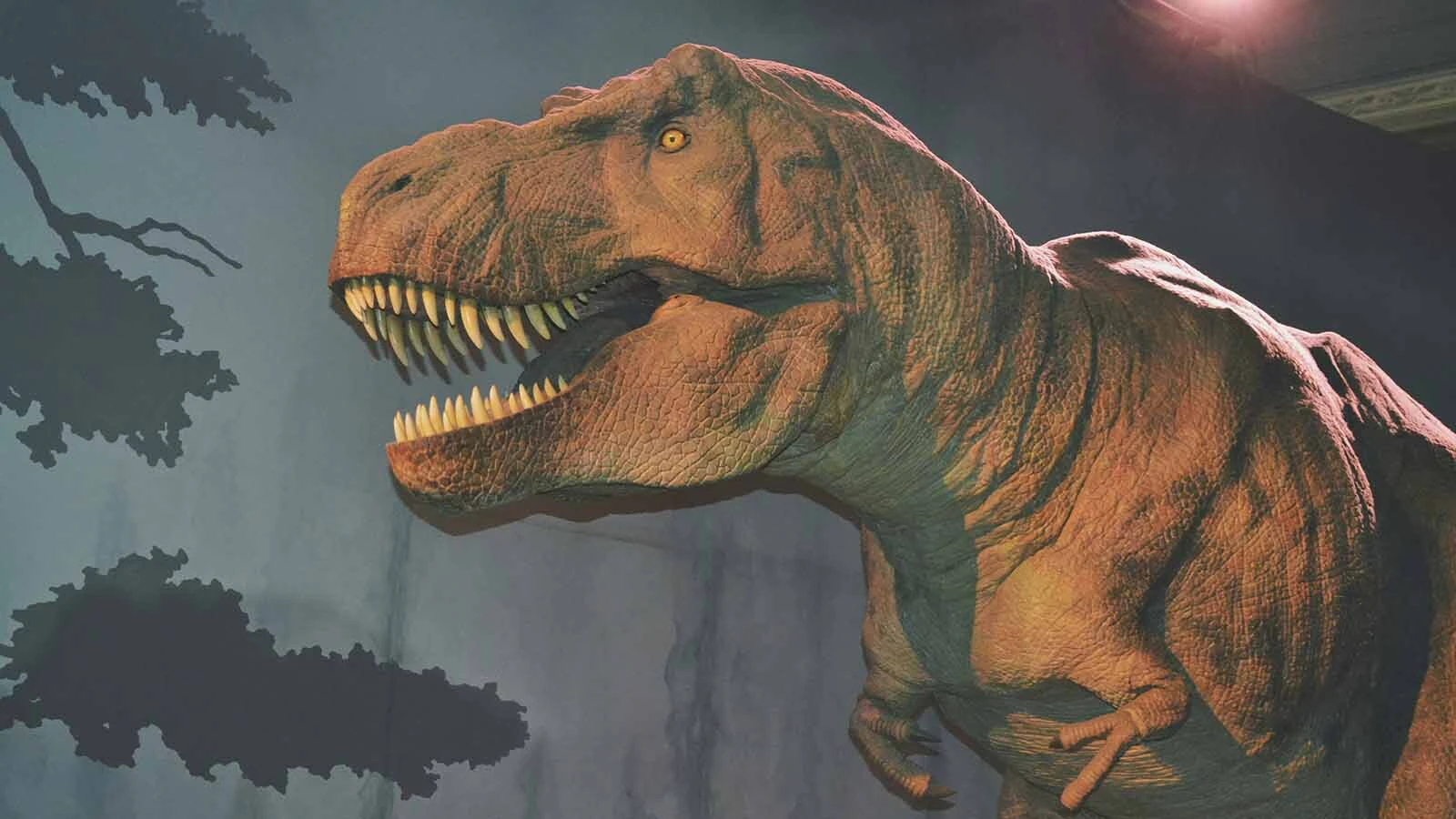
Sue remains the most complete T. rex ever found, with over 90% of its skeleton recovered.
“Sue was quite complete, and, very fortunately, there have been even more T. rex skeletons that they've been able to piece together to know what they looked like,” he said. “But they did make a mistake with Sue.”
When Sue was excavated and sold at auction, nobody knew she had a wishbone, too. The U-shaped bone was thought to be one of her stomach ribs until it was “rediscovered.”
When the world-famous T. rex was remounted for a new display at the Field Museum, she got some scientifically accurate beauty tips from Rex Junior.
“When they originally mounted Sue, she was barrel-chested,” Sereno said. “T. rex is a big animal, around 50 feet long, so you want to give it a little bit of a barrel-shaped chest.”
Despite the inclination of generations of paleontologists to make T. rex barrel-chested, the articulated shoulders and wishbone of Rex Junior revealed something different.
“This specimen shows the furcula sits right in between on the crest of the coracoids, connected to the scapulae, just like it does in a modern bird,” Sereno said. “Everything joins together at the midline.”
That articulation makes the chest of T. rex much slimmer. The remounted skeleton of Sue reflects this discovery from Rex Junior — almost.
“Remounting is a big, expensive procedure, and they've got it almost right,” Sereno said. “It's certainly a lot closer than it once was.”
Buried Alive And Mummified
In October 2025, Sereno and several other paleontologists published a paper on the newly discovered “mummy zone” in western North America. It’s an unusually thick section of the Lance Formation that was predisposed to pristinely preserving dinosaur bodies
Rex Junior is a mummified dinosaur skeleton. It was found at the top of the mummy zone that also produced other mummified dinosaurs from eastern Wyoming, including several Edmontosaurus from the Zerbst Ranch.
However, simply calling Rex Junior “mummified” isn’t doing the specimen justice, from Sereno’s perspective.
What immediately stood out to him was that Rex Junior was three-dimensionally preserved. None of the articulated bones are squashed, distorted, or scattered.
It was like the dinosaur went to sleep, completely undisturbed.
“It’s a particularly interesting case because (the body) does not look dried,” Sereno said. “The mummies that we described in the paper look dried, like they’d been exposed for several days or weeks before being covered by a flood. (Rex Junior) doesn’t look like that.”
Sereno noted that Rex Junior isn’t just three-dimensionally preserved – it’s perfectly three-dimensionally preserved. The articulated arm, in particular, is preserved in what he called “a lifelike position.”
This is one instance where Sereno said “lifelike” is unnatural.
“When you die as a carcass, there's skin sagging. The hands are pulled up in a deathlike pose. The body dries out like beef jerky. I think the position of the hands and ribs is too natural. It’s preserved in a lifelike position.”
That’s exactly what Sereno speculates might have happened. Rex Junior couldn’t be buried as a carcass, because the dinosaur wasn’t dead when it was buried.
“I personally believe that it was buried alive in a flood,” he said. “I don't think it was a carcass. This looks like it was breathing when it was suddenly buried, like it didn’t have a chance to escape.”
No Scales
Sereno has additional clues supporting the “buried alive” theory, along with other incredible insights revealed by Rex Junior. Those will have to wait for the in-progress publication that will bring Rex Junior into the international limelight.
Ongoing work is focusing on preparing the remaining ironstone concretion blocks while exposing more of the primary block. An unexpected find was a well-preserved tree trunk, pressed against the dinosaur’s chest.
Sereno did give one big hint about another revelation from Rex Junior that could change T. rex forever.
Modern scientists accept that there is an unbroken evolutionary lineage between prehistoric dinosaurs and modern birds. Rather than being closely related to each other, today’s birds are all on a surviving branch of the dinosaur family tree.
Fossils found and reexamined over the last 30 years have revealed that many non-avian dinosaurs, like Velociraptor, were covered in feathers or feather-like integuments.
Because Wyoming’s mummified dinosaurs are covered with skin impressions, the same might be expected for a mummified T. rex from Wyoming’s mummy zone.
“We have an extraordinary chance, with a mummy of the largest predator to grace the face of the earth, to understand more about its body position and, maybe, its integument,” Sereno said.
Sereno isn’t revealing anything about what has or hasn’t been found on or around Rex Junior's fossils. He did confirm that there are some spots they’re studying with great interest, for what might or might not be there.
“I’m not going to let slip the secret, but I'll say this: there are no scales,” he said.
The Triumvirate
Sereno is working on new research that he hopes to publish in early 2027, focusing exclusively on dinosaurs from the mummy zone on the Zerbst Ranch.
It takes a lot for someone like Sereno, who’s traveled around the world to find several new, one-of-a-kind dinosaurs, to get excited.
That said, he’s really excited about what’s coming. The research will include new insights on Wyoming’s state dinosaur, Triceratops.
“We’re working on another dinosaur mummy that the Zerbsts found 150 feet away from this one,” he said. “It’s going to be an incredible discovery once it hits the newsstands.”
That specimen, “Lane,” is on display at the Houston Museum of Natural History in Texas. In addition to being one of the most complete Triceratops ever found, the fossils were recovered with enormous skin impressions.
“We’re giving Triceratops a facelift early next year,” he said. “It’s going to be wild.”
With Rex Junior, Lane, and the mummified Edmontosaurus specimens, Sereno has “the triumvirate” of Late Cretaceous dinosaurs, all collected from the Zerbst Ranch.
Such discoveries, and the rigorous research and review to get them ready for publication, take time and tenacity. That’s what led Sereno to Rex Junior in the 1990s, and what could lead to a whole-new view of T. rex.
“Science works like a breadcrumb trail,” he said. “(Rex Junior) was like a red flag. It was there for a century, and the story is only now being understood. It takes a while for these stories to come out, but if you’re dogged, you can do it.”
That’s what makes Rex Junior even more remarkable. Sereno said he is “very, very, extraordinarily lucky” to have a T. rex, let alone one as perfectly preserved, to study and share with the world.
“You’ll hear geologists say the fossil record is 59 seconds of boredom and 1 second of action,” Sereno said. “What's preserved in the fossil record is that 1 second of action, and that’s what we’re looking at with this T. rex.”
All this is possible, in no small part, to the ongoing legacy and enthusiasm of the Zerbst family. Five generations of Zerbsts have opened their hearts and homes to science, and the riches from their ranch are poised to change T. rex, Triceratops, and other dinosaurs forever.
“We’ve got the triumvirate of Triceratops, Edmontosaurus, and Tyrannosaurus from the Zerbst Ranch, and they're all giving us new information about what these animals were like when they were alive,” Sereno said.
Andrew Rossi can be reached at arossi@cowboystatedaily.com.