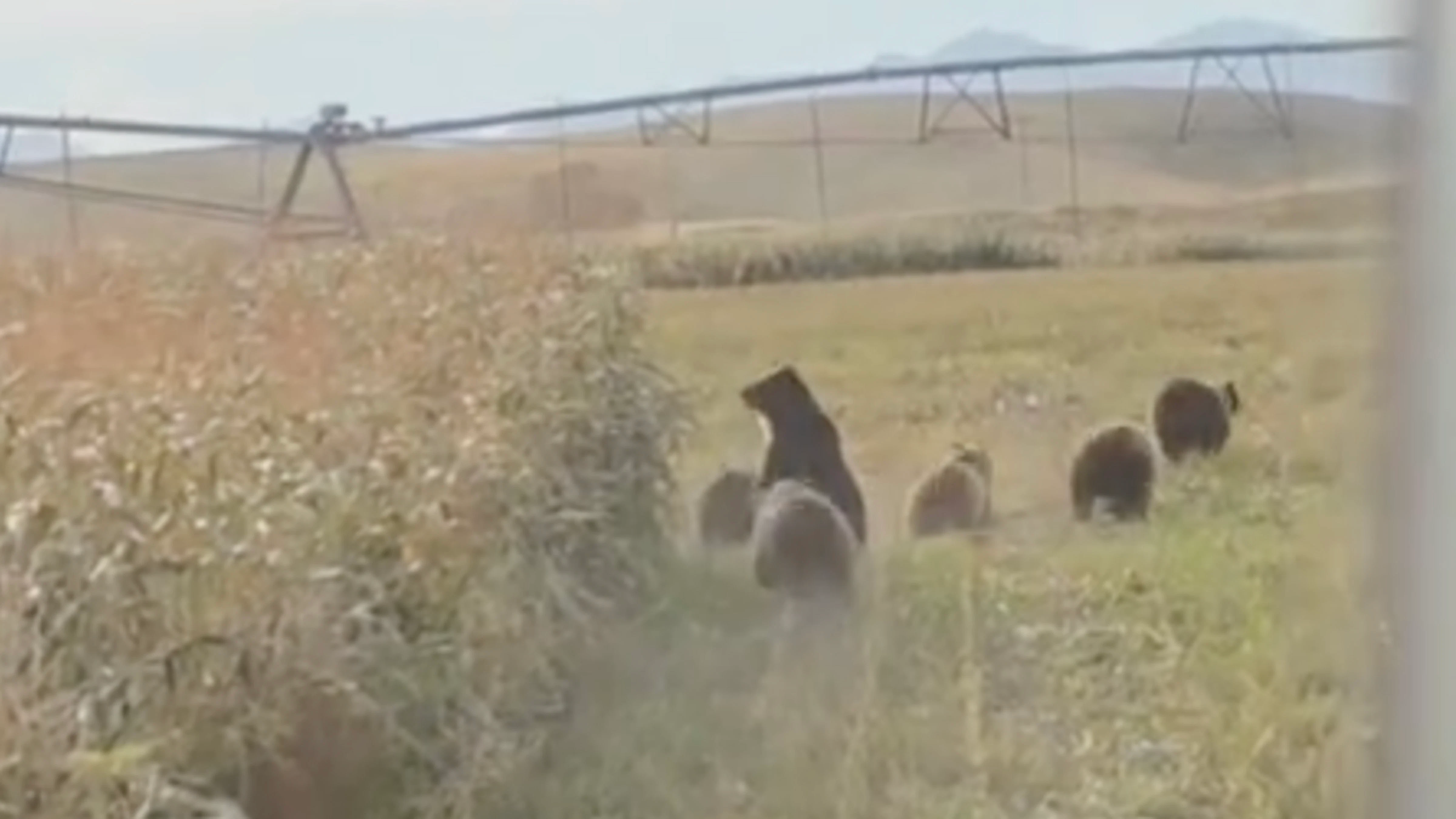
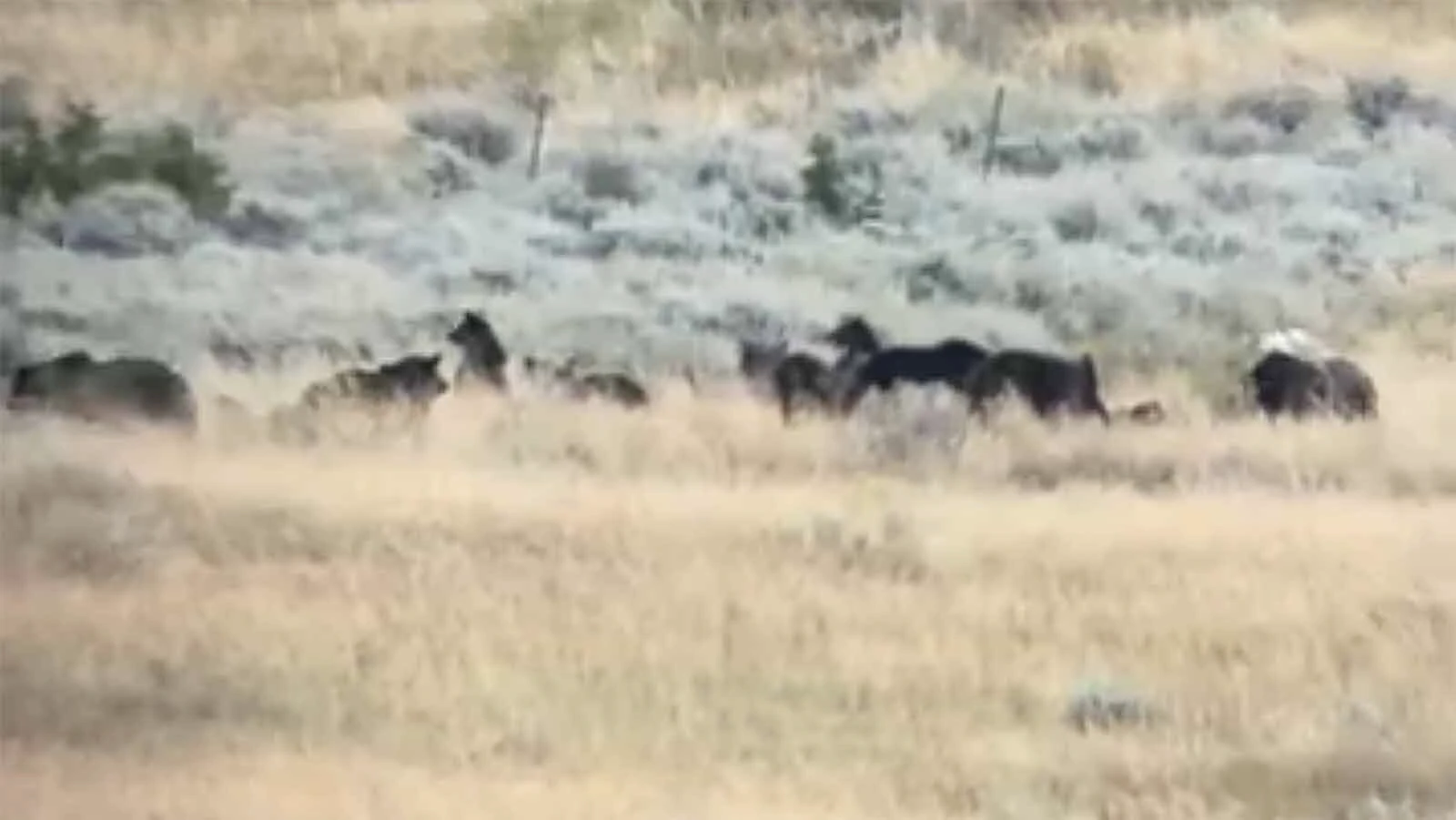
Some visitors to Yellowstone country were worried they wouldn’t get to see many bears, but then they struck gold late Sunday when they found up to 19 grizzlies feasting together on one carcass.
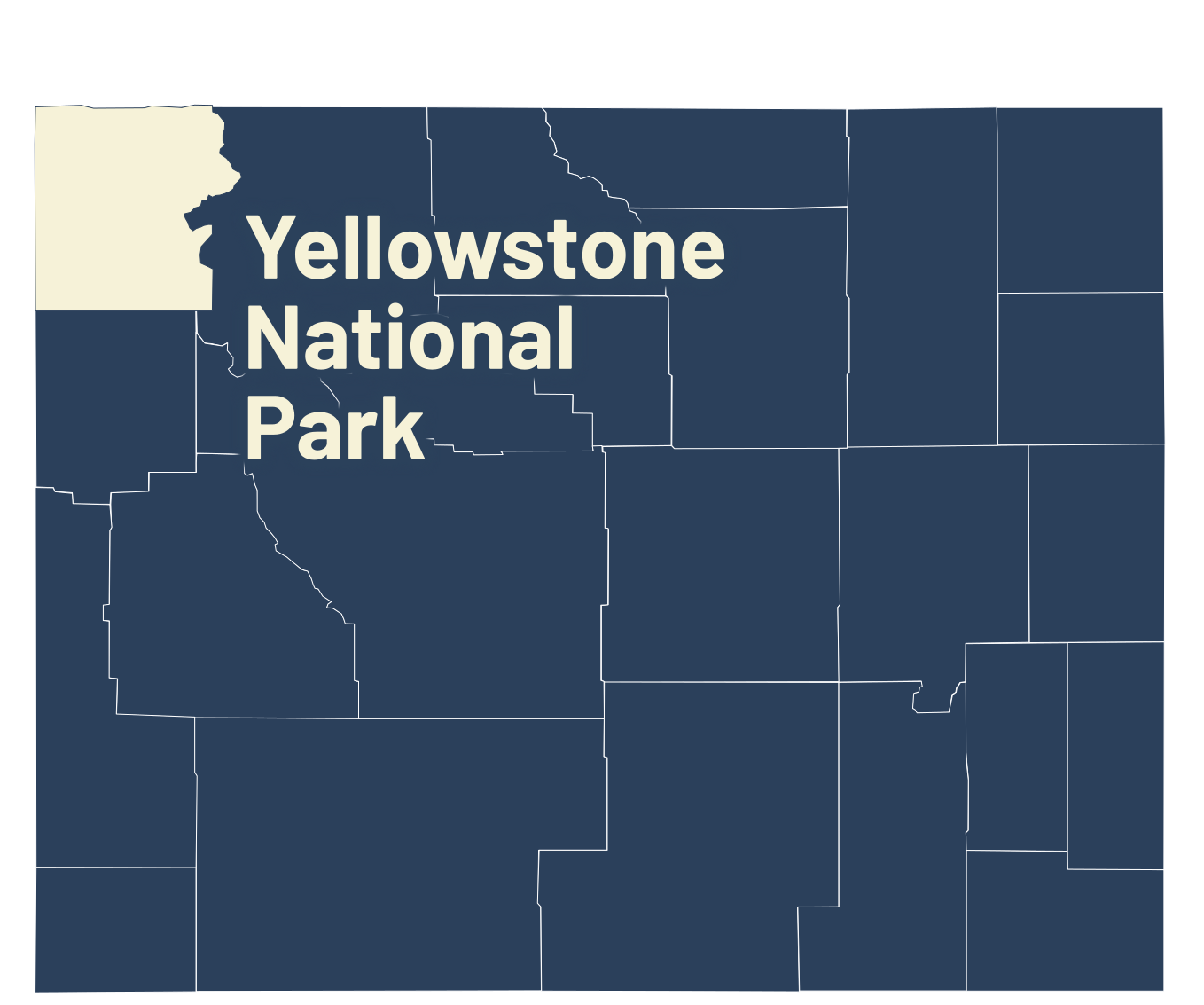
The spectacle unfolded late Sunday north of Yellowstone National Park, Florida resident Janet Zaloga said. She was hesitant to give an exact location because she doesn’t want the mob of bears getting mobbed by gawking people.
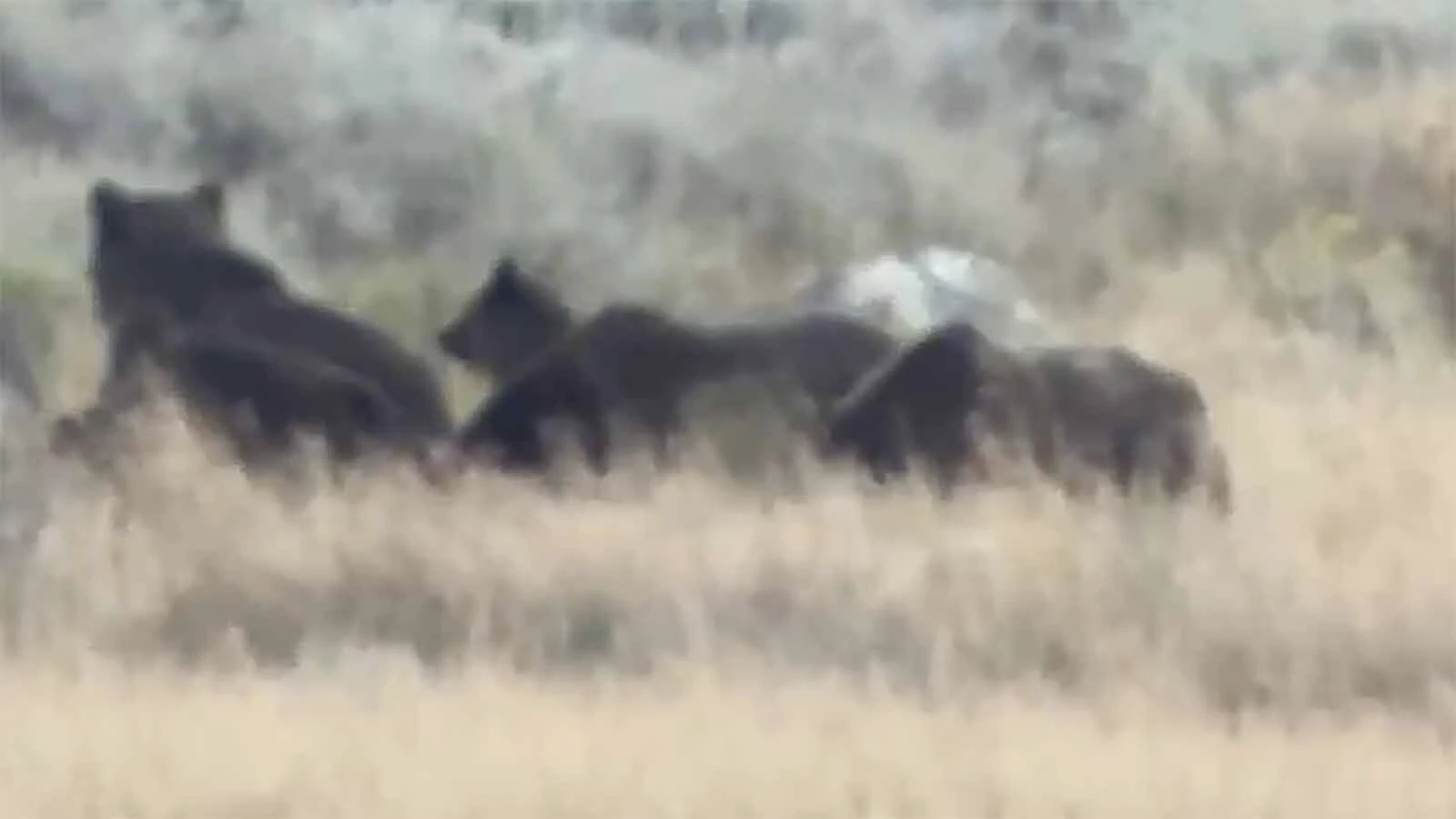
"At one point, I counted 19 grizzlies on or around the carcass,” she told Cowboy State Daily.
As to what to properly call such a gathering of bears, terms such as "mob," "gaggle," or "gang" might come to mind. Previously, a Montana rancher half-jokingly called seven bears that showed up all at once on his property “a herd” of grizzlies.
However, a group of bears is properly called a sloth. Also acceptable is an older variation: a sleuth of bears.
What Were They Eating?
Zaloga, her husband, and others lucky enough to witness the bear sloth (or sleuth) buffet couldn’t determine the carcass’ species.
They were watching and taking video from a safe distance. And the carcass was concealed behind tall grass and brush.
“Much of the time, all you could see were grizzly heads and humps," as they were feeding, Zaloga said.
Biologist Cecily Costello told Cowboy State Daily that given the general location and the sheer number of bears, it was likely a bison or elk carcass that drew in the bears.
“I don’t think that many bears would be gathering around a deer carcass,” said Costello, the statewide grizzly research biologist with Montana Fish, Wildlife & Parks.
‘Pecking Order’
Zaloga said she and her husband were having a great time in Yellowstone last week, enjoying the scenery and wildlife.
Upon finding out that they were keenly interested in seeing more bears, and perhaps some wolves, another visitor recommended an area north of the park, so they decided to make a road trip out of it.
At first, the sort-of secret bear viewing area didn’t meet expectations, Zaloga said. There just weren’t many grizzlies showing up to be admired.
Then, as they were driving out along a side road, “we saw a guy with a spotting scope looking out into a field,” she said.
Figuring that was a good sign, they pulled over and soon spotted a grizzly. And then another, and another, and then even more.
They’d found what they were looking for, and then some.
Zaloga said as they sat and watched they noticed an interesting behavior pattern.
“There were no fights, but there was definitely a pecking order,” she said.
“The big males got to go first. Once they had their fill and started ambling off, the mama bears with the cubs moved in,” she said.
Although carcasses can sometimes bring different species together, this seemed to be an all-bear show, Zaloga said.
“Wolves and coyotes weren’t showing up, at least not during the daytime,” she said.
There were a few birds that darted in to grab scraps, but as near as she could tell, none of them were turkey vultures, one of Yellowstone country’s most prominent scavenger species.
Grizzly Etiquette
Costello said that a description of what Zaloga and other witnesses saw tracks with grizzly behavior this time of year.
It’s normal for multiple bears to gather on a carcass, although 19 bears at once is “maybe a little bit on the high side,” she said.
It makes sense that the largest, most dominant males got first dibs, followed by females with cubs and other smaller bears, Costello said.
Bears that live in the same general area are familiar with each other and usually respect one another, she said.
“Even though they are usually solitary animals, that doesn’t mean they don’t live in a community of bears, which they’ve established a hierarchy with,” Costello said.
And so, when a food source pulls many bears to the same spot, they might already know who's who and what place each animal occupies in the hierarchy, she said.
Despite their fierce reputation, grizzlies try to avoid fights, she said.
Fights come with a risk of getting injured, and an injury can greatly decrease a bear’s odds of survival, Costello said.
When it comes to challenging the status quo at a feeding site, “they push when they know they can push, and they don’t push when they can’t. For the most part, evolution caused them to be cautious when they needed to be,” she said.
“The really reckless bears don’t make it very far,” she added.
Time To Bulk Up
Grizzlies in the Greater Yellowstone are entering a phase of near-constant eating called hyperphagia.
For adult bears, that usually kicks in after the tail end of mating season, which can run into late August or early September.
“I think they are starting to think about bulking up,” Costello said. “Once they’re not mating, they start eating.”
In mid- to late summer, some grizzlies climb high into the mountains to feast on army cutworm moths sheltering under rocks above the timberline.
Even so, “moths aren’t a resource that every bear feeds on,” she said. “Different resources are available for bears in different locations.”
So, in some places, a huge, ripe carcass is just the thing to draw in a sloth/sleuth of grizzlies.
Mark Heinz can be reached at mark@cowboystatedaily.com.