
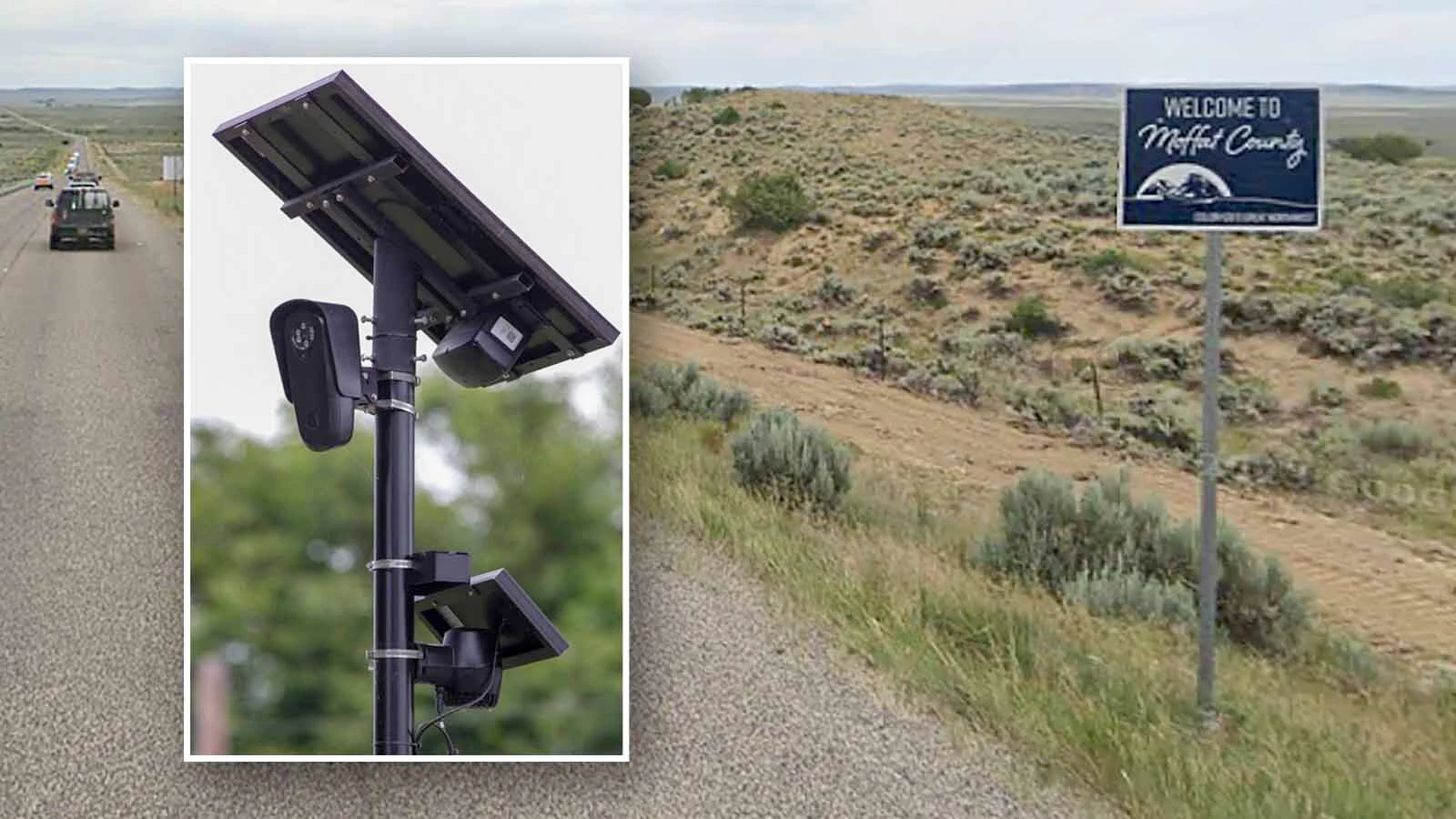
A Colorado sheriff’s department took matters into its own hands earlier this month, dismantling 10 Flock license plate reader cameras after it said Flock Safety would not come to remove them as asked.
“Our patience has officially run out,” according to a Moffat County Sheriff’s Office report.
So, deputies in the county just south of the Wyoming border solved the problem themselves.
The sheriff’s office reports it made “multiple attempts” to have Flock Safety remove the cameras after announcing last month the department would not renew its contract with the company, which ends Dec. 31.
When Flock failed to show up, “we took care of it,” the MCSO reports.
The sheriff’s office addressed Flock Safety directly in its report: "Come get your equipment. We have it safe and sound.”
Calls and emails to the Moffat County Sheriff’s Office and Flock Safety were not returned before publication Thursday.
Contract That Isn’t Quite Over
Moffat County Sheriff Chip McIntyre announced Aug. 13 the county would not renew its Flock contract when the current agreement expires, and the agency stopped using the controversial camera surveillance system immediately.
McIntyre acknowledged Flock cameras were a useful investigative tool, but said the county needed to consider the technology’s cost, how often it was used and how the information collected in the community was stored, shared and controlled.
Once the sheriff’s office stopped using the cameras, it asked Flock to remove them.
After multiple attempts to get the company to retrieve its equipment, the county decided to remove the cameras — saying it wanted to protect the equipment from possible vandalism or damage while waiting for Flock to pick it up.
The cameras are now sitting safely at the sheriff’s office.
Exactly what Flock plans to do is unclear.
Moffat County Isn’t Alone
The equipment-removal situation comes as communities across the country are reconsidering their relationships with Flock Safety, an Atlanta-based company whose automated license-plate readers allow law enforcement agencies to collect and search information about vehicles traveling through their communities.
At least 56 municipalities have deactivated, canceled or rejected Flock contracts in 2026, according to DeFlock, an advocacy organization that tracks the technology.
And getting rid of the contract has not always meant getting rid of the cameras.
In some communities, officials have had to wait for Flock to collect its equipment.
Syracuse, New York, for example, waited more than three months after ending its agreement. Police moved to unplug cameras when Flock's deadline for retrieval passed without action.
In Oshkosh, Wisconsin, cameras reportedly remained in place four months after the city revoked its agreement.
Officials in some communities have resorted to a decidedly low-tech solution: Garbage bags.
Evanston, Illinois, and Dayton, Ohio, have covered Flock cameras with trash bags while waiting for the equipment to be removed.
In Florida, Gov. Ron DeSantis announced his administration’s decision to remove Flock cameras from all state roads.
Flock Out, Axon In?
There is another wrinkle to the growing Flock backlash.
In some communities, ending a Flock contract has not meant ending automated license-plate surveillance.
Instead, another company has moved in.
Axon, a large law-enforcement technology company, has replaced Flock in at least seven municipalities across five states, according to reporting cited by The Guardian and other outlets. Longmont, Colorado, allowed its Flock contract to expire before later approving Axon automated license-plate readers.
That has prompted privacy advocates to argue that changing companies does not necessarily answer the larger questions surrounding automated license-plate surveillance, including how much information is collected, how long it is retained and who can access it.
Some residents applauded the Moffat County sheriff department’s actions. Many are asking whether Axon is moving in.
So far, the sheriff’s office has not publicly announced any plance to replace Flock with another automated license-plate-reader system.
Flock did not respond to Cowboy State Daily’s email or phone call prior to publication, leaving questions unanswered such as what the company policy is on the removal of its cameras from communities and how long agencies should expect to wait after a discontinued contract for Flock to come and take the cameras down.
Wyoming Flock Questions
The debate has been playing out in Wyoming, too.
Glenrock has been wrestling with whether to continue using five Flock cameras — four in Glenrock and one in nearby Rolling Hills — under a proposed $30,000, two-year renewal.
After residents raised questions about the cameras, how they were approved and how information collected by the system can be accessed, the town received a 30-day extension. Police Chief Colter Felton has said he wants clearer language in the contract spelling out what Flock does and does not allow.
Green River went in a different direction.
The city had been considering a nearly $112,000 federal grant to install about four license-plate readers. After residents turned out in force to oppose the proposal, the City Council and mayor voted 6-1 against accepting the grant.
Jackson already has a much larger system, with 28 license-plate-reading cameras. Those cameras have prompted questions about surveillance, privacy and how the data is managed.
And in Kemmerer, officials recently found themselves explaining that cameras that looked like Flock cameras were, in fact, not Flock cameras at all.
Moffat County is one of at least 10 Colorado municipalities that have recently dropped Flock systems amid public backlash over surveillance and data privacy concerns, Colorado’s 9 News reported.
'We're Just Done Flocking Around'
The Flock debate has also reached the national stage.
President Donald Trump shared his opinion of the surveillance system earlier this week, saying he likes them because they help law enforcement.
“I sort of like them, because of that, because of law enforcement,” he said from Air Force One on Sunday.
It was his first public comment endorsing the technology, the Washington Post reported.
At the same time, a recent Reuters/Ipsos poll found that Americans remain divided over the technology, with privacy and surveillance concerns increasingly part of the national conversation.
Flock says its cameras help law enforcement investigate crimes, locate stolen vehicles and find missing people. But concerns about privacy, data sharing and misuse have fueled opposition.
For Moffat County, the debate has moved beyond the question of whether to use the cameras.
For now, the question is much simpler: When is Flock coming to get its stuff?
“No hard feelings,” the sheriff’s office said. “We’re just done flocking around.”
Kate Meadows can be reached at kate@cowboystatedaily.com.


