

Wyomingites have some thoughts about President Donald Trump’s comment earlier this week that American communities that reject data centers risk becoming “backwards and poor.”
“I don’t associate a community being ‘backwards or poor’ with why they may not desire a data center,” Cheyenne LEADS Executive Director Betsey Hale told Cowboy State Daily on Thursday.
“Classy,” quipped Laramie Business Alliance President Brad Enzi of Trump’s assertion.
Cheyenne LEADS works directly with site selectors and tech giants such as Meta and Microsoft to steer them through the logistical, geographic and municipal advantages of establishing operations in southeast Wyoming.
Hale said communities must consider numerous when deciding whether they want a data center.
“Each community in Wyoming is unique and extraordinary,” she said. “Data centers may work well in some Wyoming communities and not be a good fit in others.”
Enzi called the comment a flashpoint, adding that much of what Trump says is exactly that.
“A lot of communities in Wyoming right now are trying to figure out how you approach (data-center development) and manage all the other issues at the same time,” he said. “Good policy doesn’t exist in a flashpoint.”
Heather Madrid, a Cheyenne resident who has been vocal against the city’s prolific data-center buildout, told Cowboy State Daily she sees a power imbalance in the business model for data centers that promise to be good neighbors.
“Low-income areas across the country are being targeted and disproportionately impacted by this buildout,” Madrid said. “Residents are being priced out of their homes. It’s harder to find what I need at Safeway. Prescription medications are regularly on back order. Wait times at urgent care are longer.
“I’ll take backwards and poor any day if I get to keep my rights and my freedom.”
What and How Much in My Backyard?
Trump’s criticism of communities that reject data centers is landing in a state that has appeared to embrace data-center development.
Yet Wyoming is seeing increasing pushback as well.
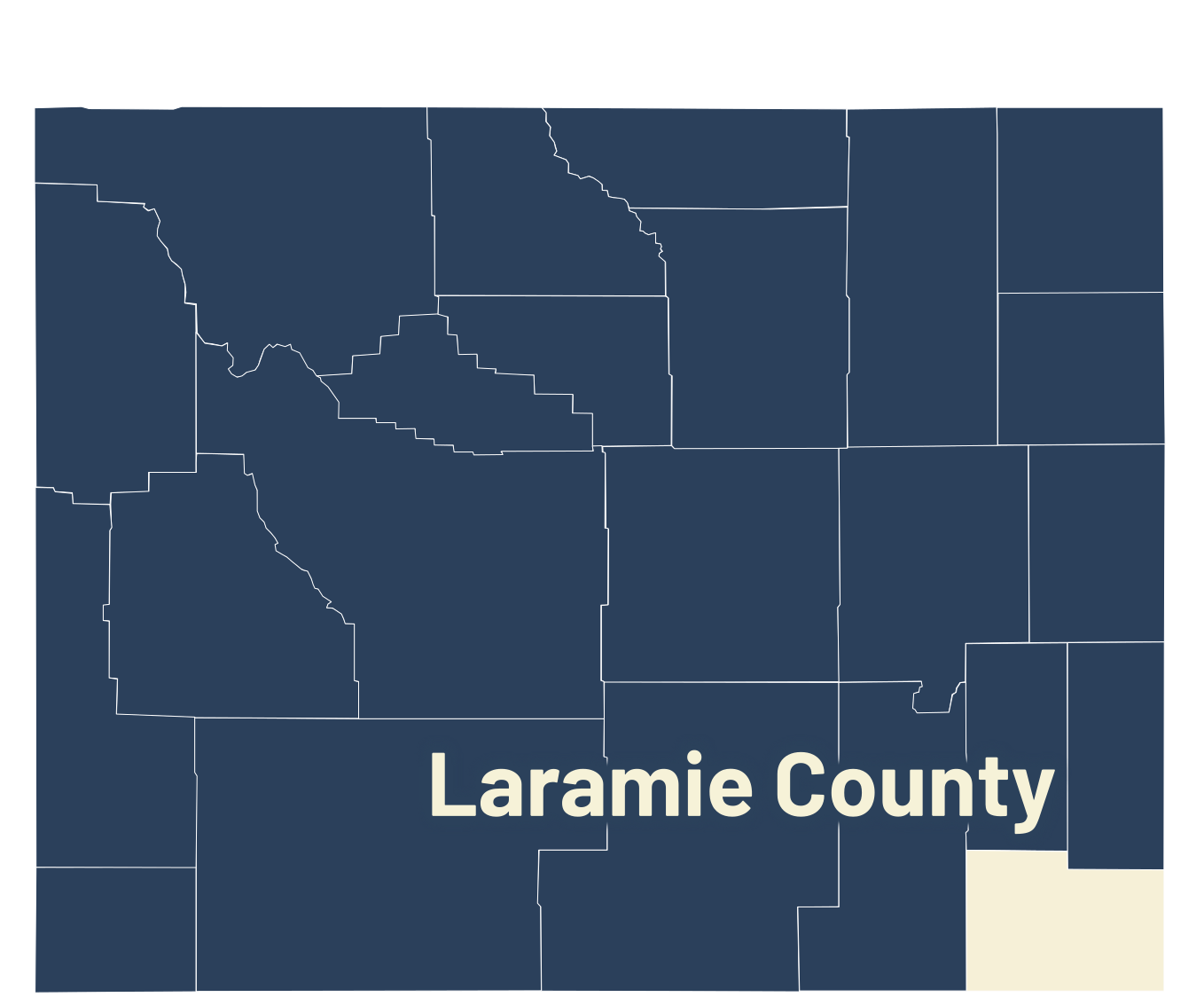
Cheyenne already has 10 operational data centers, five under construction and nine more in the planning stages, according to Hale.
Local residents have packed city council meetings, often drawing out lengthy discussions over the concerns and questions they have over the scale and pace of the industry’s development.
A proposed moratorium on new data centers generated hours of emotional testimony before the Cheyenne City Council. The proposal, brought forward by Councilman Mark Moody, ultimately failed.
"Like most Wyomingites, I agree President Trump's overall job performance has been a net positive for our state and the country, though it does not mean I agree with The President 100% of the time," Moody wrote in an email to Cowboy State Daily.
"The topic related to data centers, is the main disagreement. I do think the comment was quick to judgement, ignoring the People's concerns along with potential long-term impacts," Moody wrote. "That is why a couple months ago, I proposed a 12-month temporary moratorium on new data center construction to study these impacts."
"Presently the only talk I hear around Cheyenne are regarding the data centers; nothing related to manufacturing finished products such as firearms, Western clothing, and goods related to agriculture," he wrote.
While the bulk of the state’s data-center activity is centered on Cheyenne, other major projects are emerging. Prometheus Hyperscale is pursuing a 1.25-gigawatt campus near Evanston, with Uinta County commissioners approving its conditional-use permit in June, and the company also has plans for a 1.5-gigawatt campus in the Casper area that would use natural gas and carbon-capture technology.
On Wednesday, Platte County Commissioners approved a 5,344-acre rezone of private ranchlands to industrial, though not without hours of hard questioning to the developer, paving the way for developer Site Layer 4 to eventually build utility-scale energy generation, energy storage and a data center campus.
Trump’s comment on Truth Social shines a spotlight on a key question: How much say should Wyoming communities have in deciding whether – and how much – of the industry they want in their own backyards?
Wyoming Sees The Benefits
According to Cheyenne LEADS, data centers have generated millions of dollars in Laramie County property taxes and more than $111 million in sales and use taxes overall. The organization estimates about $27 million in sales tax on electricity from 2018 through 2024.
Cheyenne LEADS also attributes nearly $7 billion in purchases to the data-center industry.
Data-center developers do not pay taxes on equipment. Industry proponents say that’s an incentive for developers to come to Wyoming. Opponents say the state is losing millions of dollars in potential tax revenue as a result.
Wyoming had a law for about a decade that directed its Department of Revenue to compile reports on the unrealized sales taxes data centers would have paid without the exemption.
But few data centers reported their tax savings and they received no consequences for ignoring the law, Department of Revenue Director Brett Fanning previously told Cowboy State Daily.
Madrid acknowledged that the state receives tax revenue from data centers, but she told Cowboy State Daily those earnings don’t trickle down to the everyday person.
Schools in disrepair strain families and school transportation, she said. Sixth-penny property tax funds in Cheyenne are paying for a new fire station and an overhaul of the jail, she added.
“I wonder when the community will start to reap the benefits of the promise of prosperity,” she said.
What Trump Said
In his Truth Social post, Trump argued that communities should embrace data centers because of the economic benefits.
“The only reason that communities throughout the U.S.A. should not want Data Centers is if they want to end up being backwards and poor,” Trump wrote. “If we kill the Golden Goose, you will only have yourselves to blame. If they want to be successful and rich, with far lower taxes and jobs all over the place, let Data Reign.”
The remarks came less than three months before the November midterm elections. The debate over the nation's rapidly expanding data-center industry has increasingly become a political issue.
But Wyoming's experience with the industry illustrates why the question isn't necessarily as simple as supporting or opposing data centers.
“We need to create opportunities for responsible development and not have everything be a simple ‘yay’ or ‘nay,’” Enzi said. “We need to manage so many issues from power to water to community impacts.”
The Costs Are Part Of The Debate
Trump's own vice president, JD Vance, acknowledged some of the controversy Monday, saying data centers should be putting power back into the grid rather than taking it out.
In a June guest column published by Cowboy State Daily, Wyoming Sen. Cheri Steinmetz argued that the state needs to be careful about how it approaches large-scale development.
“When projects could reshape entire regions, the danger is not moving too slowly. The danger is getting it wrong,” Steinmetz wrote.
Her concerns included electricity rates, water, infrastructure, land use and local control.
Steinmetz did not return Cowboy State Daily's calls or emails seeking comment on Trump's remarks.
‘The Wyoming Way’
In June, Gov. Mark Gordon issued an executive order establishing a “Data Centers the Wyoming Way” framework. The order made clear that Wyoming intends to compete for data-center investment while also addressing concerns about water, grid reliability, transparency, community engagement and other impacts.
Gordon has repeatedly said Wyoming welcomes investment, jobs and economic opportunity but wants to make sure new development doesn't impose unintended costs on residents or communities.
In a statement emailed to Cowboy State Daily, Gordon said Wyoming is positioning itself to benefit from the infrastructure needed to support artificial intelligence, advanced computing, national security and the digital economy.
“Wyoming continues to be a leader,” Gordon said. “We do this by tailoring this emerging industry to meet our needs on the ground in Wyoming – which has always been ‘the Wyoming way.’”
More Than Economic Development
The debate also extends beyond taxes and jobs.
At a June Republican gubernatorial forum, candidates argued that data centers aren't merely economic development projects but are connected to America's competition with China and national security.
And Trump explicitly invoked China in his Truth Social post, arguing that data-center infrastructure is tied to America's technological and economic future.
That adds another dimension to the debate for a state that has long viewed its energy resources as a strategic asset.
Is The Goose Golden?
Trump called data centers the “Golden Goose,” warning communities that reject them will have "only themselves to blame.”
But Wyoming's experience suggests the question is more complicated.
A community considering one data center might face a very different set of questions than one considering a dozen.
They are questions about how the industry fits into a state whose identity and economy are built around abundant natural resources, relatively small communities, and a strong tradition of local control.
"It seems like it's a bigger deal to have something to be a flashpoint," Enzi said, "than create good policy that supports responsible development."
Kate Meadows can be reached at kate@cowboystatedaily.com.


