
Gov. Gordon’s executive order on data centers follows a familiar pattern: promises of economic opportunity today and assurances that government and industry will protect Wyoming later. Wyoming citizens have heard that before.
From support for Green New Deal-style policies, carbon capture mandates, industrial wind and solar expansion, and other initiatives aligned with national carbon-reduction goals, the governor has too often been out of step with the values Wyoming citizens consistently defend—affordable and reliable energy, private property rights, agriculture, local control, and responsible stewardship of our natural resources.
Now, despite growing public concern over water, electricity rates, land use, infrastructure impacts, and the lessons from other states already struggling with unchecked data center growth, the governor appears determined to fast-track data center development under the banner of doing it “the Wyoming way.”
But when we look closely at the executive order, it does not read like a protection plan. It reads like a development plan.
The order talks about stewardship and transparency, but it prioritizes coordination, efficiency, workforce development, investment attraction, and faster recommendations.
State agencies exist to protect Wyoming citizens—not serve as a concierge service for billion-dollar corporations. Their job is to ask hard questions, demand proof, and ensure the public is protected before permits are granted.
When projects could reshape entire regions, the danger is not moving too slowly. The danger is getting it wrong.
National Security Is No Excuse For Carelessness
Supporters of rapid data center expansion often point to national security and America’s competition with China. President Trump has expressed support for expanding America’s artificial intelligence and data center infrastructure, and Wyoming should take those national priorities seriously.
But supporting America does not require sacrificing Wyoming.
Reliable energy infrastructure, secure water supplies, productive agricultural lands, and resilient rural communities are themselves matters of national security. Weakening those assets in the name of development does not make America stronger. It shifts the cost onto Wyoming citizens.
We should also be honest about the facts. America is not losing the race to China when it comes to data center development. Public industry data shows the United States already leads the world by a wide margin, with more than 4,000 to 5,400 data centers compared to fewer than 500 in China. America is already the global leader.
That does not mean we should stop building. It means Wyoming should not be stampeded into approving projects without meaningful protections under the argument that we must rush at any cost.
Wyoming should not confuse patriotism with recklessness. If these projects are truly beneficial, they should be able to meet strong Wyoming standards. They should prove water sustainability, ratepayer protection, and a clear net benefit to Wyoming citizens. They should prove that agriculture, energy production, and existing industries will not be harmed.
America does not become stronger by weakening Wyoming.
Legislature Must Act
Before discussing specific risks, we must recognize the executive order’s central flaw: rather than creating meaningful new protections for Wyoming, it appears to weaken safeguards by prioritizing faster development over stronger protections.
It does not strengthen permitting standards. It does not establish new groundwater safeguards. It does not protect ratepayers from future cost shifting. It does not require proof that existing industries will not be harmed. It does not create new statutory authority to safeguard Wyoming’s resources.
The most revealing section of the executive order may be its implementation clause, which states that nothing in the order alters existing statutory authority, permitting requirements, property rights, water rights, local land-use authority, or regulatory obligations established under Wyoming law.
That raises an obvious question: if the order changes none of the protections, what exactly does it do—and why is it necessary at all?
It does not strengthen water protections. It does not protect ratepayers. It does not create a new burden of proof. It does not establish new groundwater safeguards. It does not require mitigation. It does not create new standards for approval or denial.
What it does appear to do is change the posture of state government. It aligns agencies to coordinate with applicants, streamline reviews, promote workforce development, attract investment, improve interagency cooperation, and provide recommendations within sixty days to further the goals of the framework.
In plain English, it does not strengthen the guardrails—it lines up the agencies.
And when government lines up the agencies before it strengthens the protections, Wyoming citizens have every reason to ask whether the outcome has already been predetermined.
The message is clear: development is mandatory; protection is optional.
There is also a constitutional question Wyoming citizens should not ignore: why is a statewide data center policy being set by executive order at all?
Under Wyoming’s separation of powers, the legislature writes the laws and sets public policy; the executive branch carries those laws out. If Wyoming is going to decide how much water, power, infrastructure, and public risk should be committed to data centers, shouldn’t that decision be debated publicly by the people’s elected legislators?
Did Wyoming legislators know about this before it was announced? Wyoming citizens should ask that question. I can only speak for myself: as a sitting Wyoming state senator, I did not learn about this executive order from the governor’s office.
I learned about it from a constituent who directed me to a news article. I was not consulted, nor was legislative input sought before a statewide framework affecting data centers, water use, energy demand, and economic development was unveiled.
If this issue is important enough to warrant an executive order, why were legislators excluded from the discussion? Several legislative committees are already studying these issues and preparing recommendations through the normal legislative process. Why bypass that work?
Data centers, artificial intelligence infrastructure, water consumption, electrical demand, and long-term economic policy are not minor administrative matters. They are major public policy decisions that will shape Wyoming for decades. Those decisions belong in the open legislative process, where Wyoming citizens can be heard through their elected representatives.
Good policy benefits from debate, scrutiny, and public participation. It is weakened when legislators and citizens learn about major initiatives only after they have already been announced.
The question is not whether the governor has authority to issue an executive order. The question is why an executive order was necessary at all if it changes none of the laws, none of the protections, none of the permitting standards, and none of the regulatory requirements established by the legislature.
That is a question Wyoming citizens deserve to have answered.
Wyoming Must Protect Resources
Wyoming’s future depends not just on attracting investment, but on protecting the resources and industries that have sustained this state for generations.
Water must come first. Water is not simply another resource. It is the foundation of Wyoming itself. Without water, there is no agriculture. Without agriculture, there is no rural Wyoming. Without rural Wyoming, there is no Wyoming way of life.
Yet this executive order creates no enforceable requirement that data centers prove long-term water sustainability before permits are issued. It does not require protection of static groundwater levels. It does not require replacement water if aquifers decline. It does not require proof that existing agricultural users will not be harmed. It does not prohibit large industrial withdrawals in sensitive groundwater areas.
Encouragement is not protection. Good intentions are not protection. Press releases are not protection.
Only law does that.
The same is true for electricity. These facilities are not ordinary businesses. Some proposed projects may consume hundreds of megawatts—or even gigawatts—of electricity. Supporters often argue that certain facilities will generate their own power. But what happens when those facilities seek grid connections, require backup power, expand operations, or need transmission upgrades?
Those costs do not disappear. Transmission lines, substations, generation resources, and reliability upgrades cost real money. Wyoming families, ranchers, retirees, and small businesses should not be asked to subsidize infrastructure built primarily to serve massive outside corporations.
Before any large industrial project is approved, it should be required to prove that it will not harm existing water users, strain the electric grid, increase costs for ratepayers, or place Wyoming’s core industries at a competitive disadvantage.
Agriculture, energy production, manufacturing, mining, and small businesses built this state. They should not be forced to compete with heavily incentivized industrial developments for water, power, labor, land, and infrastructure.
The question is not whether data centers are good or bad. The question is whether Wyoming’s leaders will put Wyoming first.
Development should serve Wyoming—not the other way around.
If data centers are truly beneficial, they should be able to meet strong standards. They should prove water sustainability. They should prove ratepayer protection. They should prove that agriculture, energy production, manufacturing, mining, and small businesses will not be harmed. They should demonstrate a clear net benefit to Wyoming citizens before approvals are granted.
The legislature should act now by requiring large industrial users to prove they will not harm Wyoming’s water, electric grid, taxpayers, or existing industries before permits are issued.
That is not anti-development. It is responsible government.
The Wyoming way is stewardship, accountability, and protecting what God has entrusted to us before it is lost. Our water, our land, our communities, and our way of life are not for sale. They are our responsibility to protect—for ourselves, for our children, and for generations yet to come.
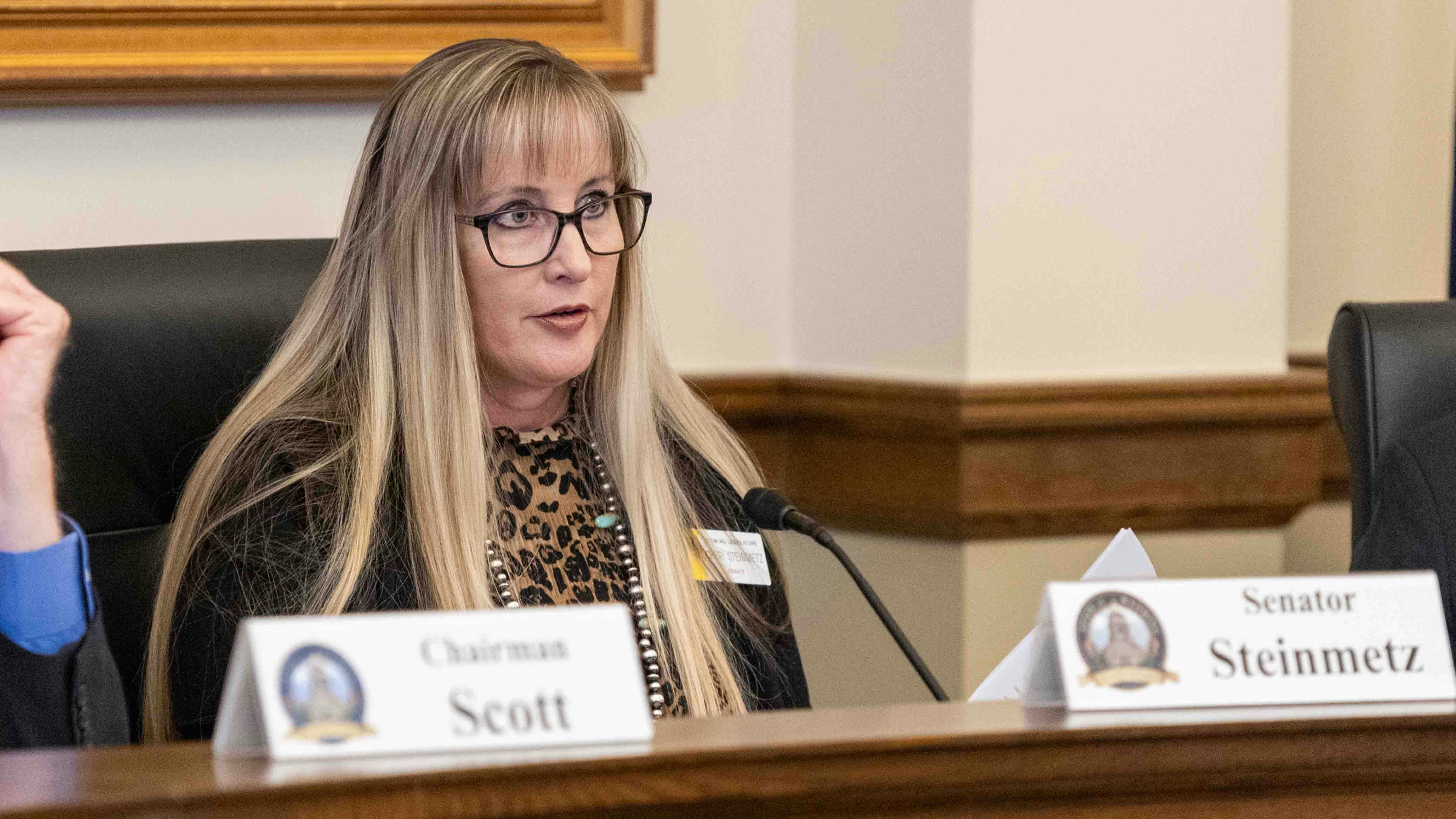
Cheri Steinmetz represents Goshen, Niobrara and Weston counties.


