
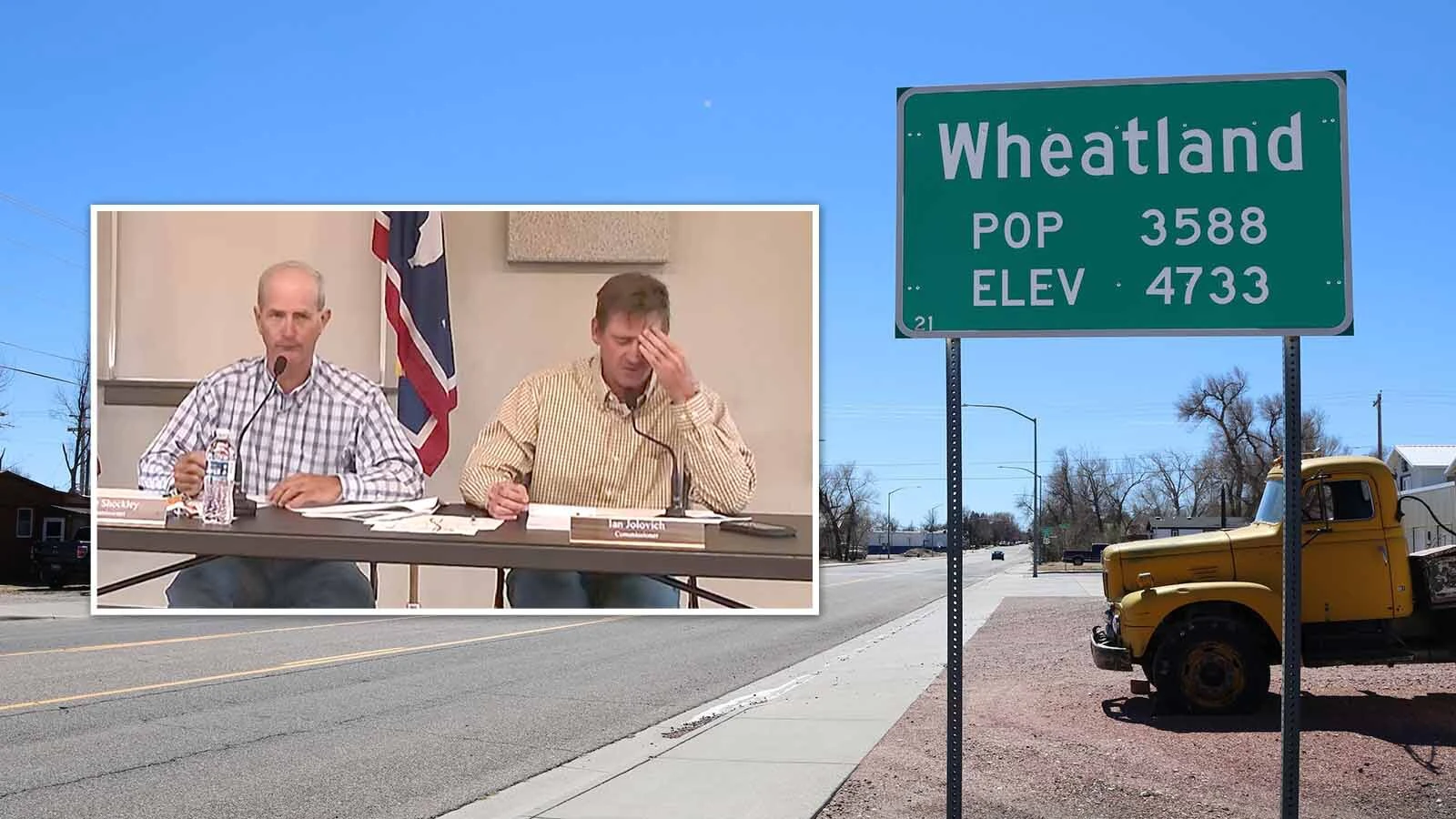
After nearly four hours of questions, debate and tense exchanges, the Platte County commissioners unanimously approved a controversial request Wednesday to rezone 5,344 acres of private ranchland for industrial use for a data center.
But they attached four conditions.
Ian Marcus, the project applicant for developer Site Layer 4, LLC, faced a barrage of questions from commissioners, particularly Commissioner Ian Jolovich, who said he still did not understand significant aspects of the proposal.
“There are a lot of questions I have that, to be honest with you, haven’t gotten answered,” Jolovich said.
Jolovich repeatedly questioned whether rezoning such a large tract before the county knew the full scope of the project could leave the community carrying risks it had not anticipated.
“What does this look like?” he asked. “It looks like a huge rezone that nobody knows anything about.”
Jolovich said he was particularly concerned about infrastructure and the possibility that costs could eventually fall on county residents.
“What happens is the infrastructure that we all rely on gets deteriorated and used in some form or fashion,” he said. “So my big concern is, when you guys say we need to de-risk this on our books, you’re de-risking it and asking us to pick up the risk.”
He also questioned how much public money could be required for an industrial site, including costs associated with increased demands on law enforcement and other county services.
Jolovich lastly expressed concern about the size and unusual nature of the proposal.
“The scope and scale of this project, before this year, there were only one or two projects in the U.S. that went from another use to industrial,” he said. “I am very concerned that you guys don’t know what you’re going to do, and so how are we supposed to know what you’re going to do?”
Dozens of residents also shared their thoughts, concerns and questions before the commissioners’ vote.
After extensive discussion over the language and scope of the rezone, Jolovich finally moved to approve the application subject to four conditions settled on after commissioners spent significant time discussing what the industrial designation would – and would not – allow the developer to do without additional county review.
The conditions require that:
- The property revert to its previous zoning if construction does not begin within five years of the rezone approval date.
- Any industrial park subdivision plan be presented to the county commissioners before review and recording.
- Any use of the property requires a special-use permit.
- The property owner sign an acceptance of the conditions.
“That is a mouthful,” Jolovich said.
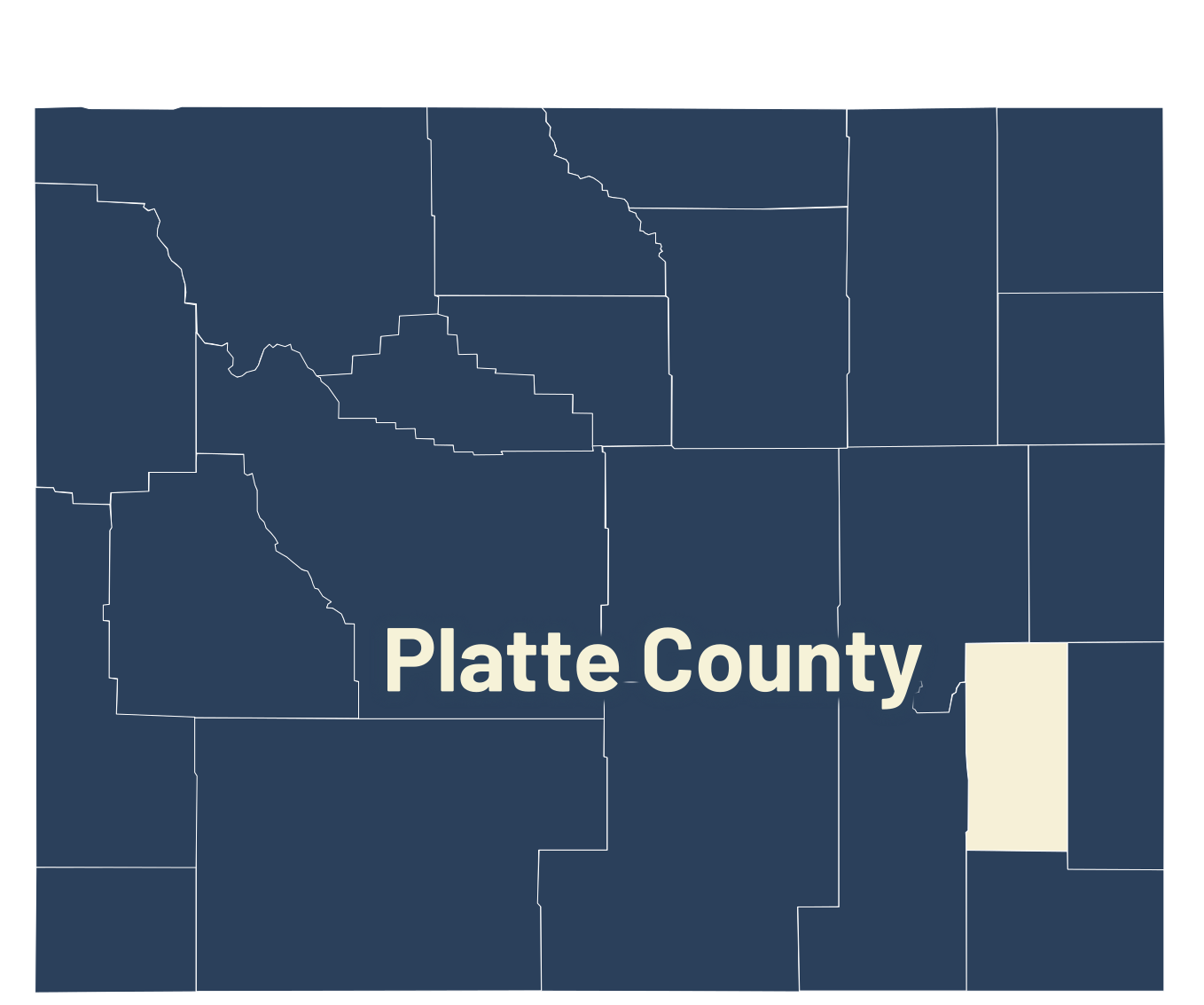
The property, owned by Gregor and Cindy Goertz, is located northeast of Wheatland near the Platte-Goshen county line in an area known as Goshen Hole.
The proposed industrial designation would allow the property to be used for utility-scale energy generation, energy storage and a data center campus.
Developer Attorney Responds
Another point of contention during the discussion was Wyoming's industrial siting process and what oversight would remain if the property were rezoned for industrial use.
Jolovich questioned whether the designation could give a future developer significant latitude to develop the property without returning to the county for additional approval.
He also warned that if a project did not go through the state's industrial siting process, the county could have to absorb some of the costs associated with its impacts.
“The purpose of industrial siting is to make sure the community can absorb the impact,” he said.
Jeff Pope, an attorney representing the developer, addressed some of those concerns. He explained that the industrial siting process contains exemptions and that data centers in Cheyenne, as a practical matter, have been located on property already zoned for industrial use.
One misconception about the exemption, Pope said, is that it means a project receives no oversight.
Projects that qualify for an exemption still must report to the Wyoming Department of Environmental Quality's Industrial Siting Division, he said.
“To be sure, the amount of information under the exemption is different, but reporting is still required,” Pope said.
Pope is also chairman of the board of directors for Cheyenne LEADS.
Commissioners spent considerable time working through the wording of the rezone conditions, including whether the word “building” should be changed to “construction.”
Residents Speak Out
The commissioners' decision followed extensive public comment, with dozens of residents weighing in.
Some urged commissioners to approve the project, citing the potential economic benefits and the ability of a large industrial development to provide another source of income for ranch families.
Juan Reyes, a landowner who frequently speaks publicly about private-property rights, told commissioners he supported giving the property owners the opportunity to pursue the project.
“I can't think of a $26 billion project with so small of a footprint and so much revenue to our community,” Reyes said. “Projects like data centers can keep families ranching. If I was the church family, and you oppose this project, you are denying them the opportunity of profitability.”
Other residents asked commissioners to slow the process.
Several speakers requested a moratorium on consideration of the rezone, saying more time was needed to evaluate potential impacts to the Ogallala Aquifer, wildlife, noise and other issues.
The debate was not simply about data centers or industrial development, however. Several residents spoke about the importance of maintaining relationships among neighbors regardless of the outcome.
Barb Fletcher urged residents to remember they would continue living alongside one another after the debate was over.
“When this is all over, one way or the other, we’re still going to be neighbors,” Fletcher said. “It would be really nice if we could still wave at our neighbors and say hi, shake hands, and be civil. These knees were only bent for praying and not bowing down.”
Laticia Lane told commissioners, “We’re not dead.”
Elizabeth Fuentes said Wyoming's young people are leaving the state.
“Young people are Wyoming’s biggest exports right now,” Fuentes said.
Not A Done Deal
The proposed project remains in its earliest stage.
Developers have described the effort as being in Phase 1, site evaluation, which includes preliminary siting along with financial, technical and land-use feasibility work.
A second phase would involve securing land approvals, utility contracts and permits. Construction would come in the third phase.
The developer has said the purpose of the rezoning is to help expedite the permitting process for a possible energy storage and data center campus intended to support growing computing needs.
The project also would generate its own power, they said. It would not connect to municipal water or the Wheatland Irrigation District.
The Platte County Planning and Zoning Commission voted unanimously last week to recommend the rezoning.
The property is currently zoned Ranch, Agricultural and Mining, or RAM.
Kate Meadows can be reached at kate@cowboystatedaily.com.


