
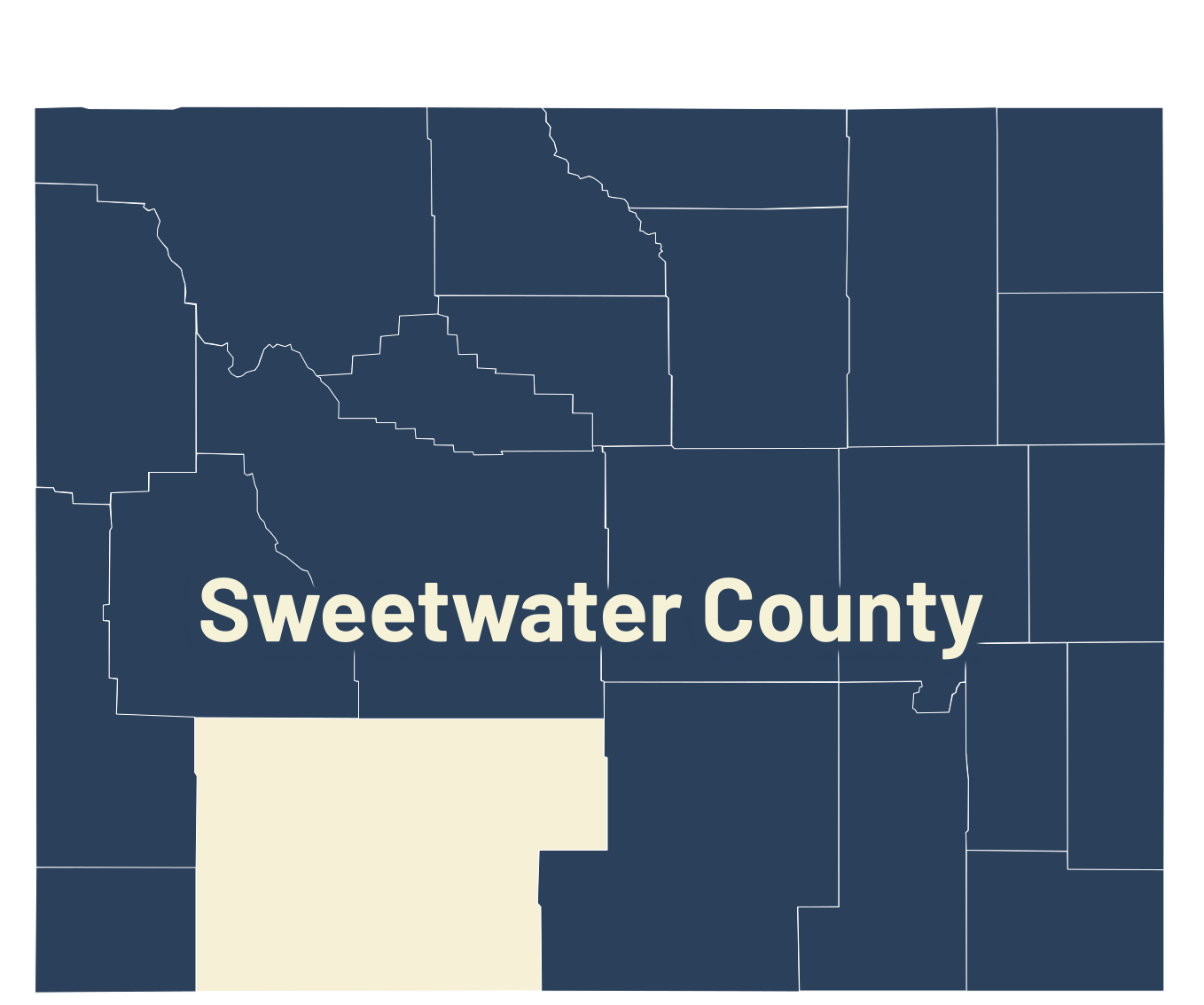
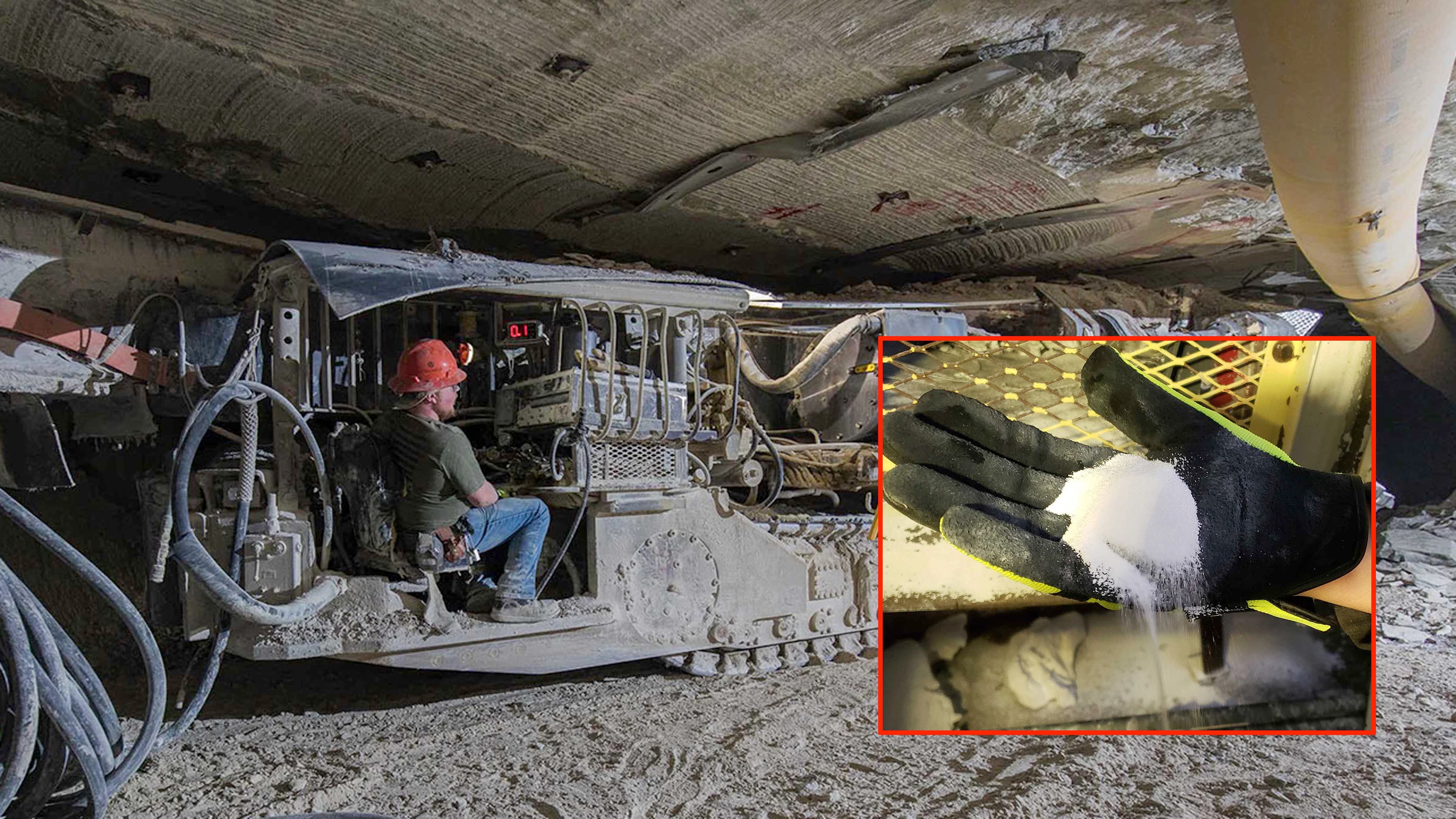
Wyoming’s trona industry is being charged three times the price for shipping a ton of trona from the state’s southwest quadrant than northeast Wyoming is being charged to ship a ton of coal.
That’s an unfair advantage the industry is seeking to change, We Soda’s Marshall Cummings, union president for USW 13214, told Cowboy State Daily on Wednesday. The stakes are high, with China flooding world markets with soda ash, depressing prices and putting at least one large southwest Wyoming project — with about 400 jobs — temporarily on hold.
“One of the levers we could manipulate that would actually make it a little bit closer playing field is the logistics to actually get soda ash from southwest Wyoming to a port,” Cummings said. “The only way we can do that is by rail, and with only one railroad that services this area, they, in my opinion, have a monopoly and an unfair advantage on how they could price us out of the market.”
Trona jobs are a lifeblood for the entire southwest Wyoming region, Cummings said, adding that support for the industry is critical to protecting Wyoming’s economic futured.
To that end, Cummings and a couple co-workers traveled to Washington, D.C., to meet with Sen. Cynthia Lummis, Sen. John Barrasso, and Rep. Harriet Hageman.
“What I would like to see is some help from the state, and some help from the national government on that front, trying to say, ‘Hey, let’s readjust this price,’” he said.
Cowboy State Daily has reached out to the congressional delegation for comment, as well as Union Pacific. No response was received by publication.
Long Road To Railroad Reform
What Cummings learned from his visit with Wyoming's congressional delegation is there’s no quick cavalry coming over the hill to save the industry.
“One of the paths you could do is make a complaint to the Surface Transportation Board,” he said. “The Surface Transportation board could make a hypothetical competitor to Union Pacific and say, ‘This is what your prices should be.’ That’s a years-long process, and I think it’s not really fair it takes that long to do.”
Cummings isn’t seeing much movement on that front, but some of the industry’s players have taken action to improve their competitiveness.
We Soda bought Genesis Alkali last in February 2025, bringing the world’s No. 2 and No. 3 trona players together.
The $1.425 billion acquisition gave the company a combined capacity of 9.5 million metric tons per year, making it the largest natural soda ash producer in the world. The move was billed at the time as crucial to taking on China and other international competitors.
Scaling up is also a way the company could leverage better prices for rail shipments — a strategy that’s long worked for coal.
Another logistical advantage of the acquisition was an export terminal in Oregon, which had been exclusive to Genesis Alkali since 2023.
Why Trona Matters
Trona is the common name for the chemical sodium carbonate, which is used to make soda ash.
Soda ash, in turn, is used for a host of products, from the baking soda found in just about every American home, to glass, soaps, detergents, water purifiers, insulation, flue gas desulfurization equipment, paper and more.
The mineral is Wyoming’s largest international export, generating between $1.3 billion to $1.5 billion in annual revenue, according to figures from the Wyoming Mining Association. Trona from the Cowboy State also supplies 90% of the domestic need.
The industry employs more than 2,500 miners and technicians, and its payroll averages more than $100,000 per employee, giving the industry a cumulative annual payroll of more than $450 million.
What Wyoming Is Doing To Help
The trona industry is vital to the state’s economy, Travis Deti, Wyoming Mining Association executive director, told Cowboy State Daily. Because of that, the state is also exploring what it can do to help.
“Largely, the three issues that we’re working at the state level right now, and I think the most concerning one is, we’re watching what’s happening with the Colorado River,” he said. “Water is critical for the soda ash and trona industry, so we want to ensure that we continue to have enough water to do the work that we need to do to develop the mineral.”
A second effort involves improving timely access to power.
“We’re having issues with the power provider in that area not being able to provide power to new projects in a timely fashion,” Deti said. “And, frankly, some of the service disruptions to existing operations. Reliable power is a big issue right now for the trona operators.”
Not only is that affecting existing operations, Deti added, but it’s holding back expansion as well.
“I mean, we can’t move forward on expansion projects if we don’t have timely and reliable power,” he said. “And then the other thing we’re facing right now is the BLM office in the state has a staffing shortage. We’re seeing some delays in permit work. That’s something that’s got to be addressed before things can really get ramped up and running again.”
Solving those issues will help put Wyoming’s trona industry on a more competitive footing internationally, Deti said.
“The industry’s got a lot of support,” he added. “We just have to keep working diligently to correct some of these problems that we’ve got here.”
Two Millennia Of Advantage
Wyoming has long been home to the world’s largest trona reserve. It accumulated 50 million years ago in an alkaline lakebed called Lake Gosiute, which once covered between 4,000 and 15,000 square miles of southwestern Wyoming.
It was a shallow lake. Dramatic climate shifts between humid and highly arid phases led to rapid evaporation, and the accumulation of highly concentrated alkaline brines.
The huge scale of this prehistoric lakebed deposit is what’s made Wyoming the trona powerhouse it is today. More than 116 billion tons of naturally occurring trona ore is in these deposits. Roughly 40 billion tons are recoverable with current technology.
That means the state has enough trona to supply the world for the next two millennia. Better technology could one day unlock even more.
Pushing For Trade Alliance
Cummings praised statewide efforts to help but believes the industry also needs to band together and create a broad trade alliance when it comes to unfair market practices.
“The only reason China can compete with us is because the government gives them subsidies on all kinds of things,” Cummings said. “It gives them subsidies on the gas they use to burn and make this … They’re getting cheap loans from the government that are below market value. They’re getting land for below market value.”
China also subsidizes transportation, Cummings added.
“It’s one thing if we were competing against a soda ash and trona mining company,” he said. “If it was miner for miner, I’m 100% confident we can compete. Miners in southwest Wyoming are some of the best miners in the world.”
But the competition is not just mining company vs. mining company.
“We’re competing with our company versus government,” he said. “And that government controls many different levers, where we just control one. We control how safe, how efficient, and how many tons we get out of the ground.”
Renée Jean can be reached at renee@cowboystatedaily.com.


