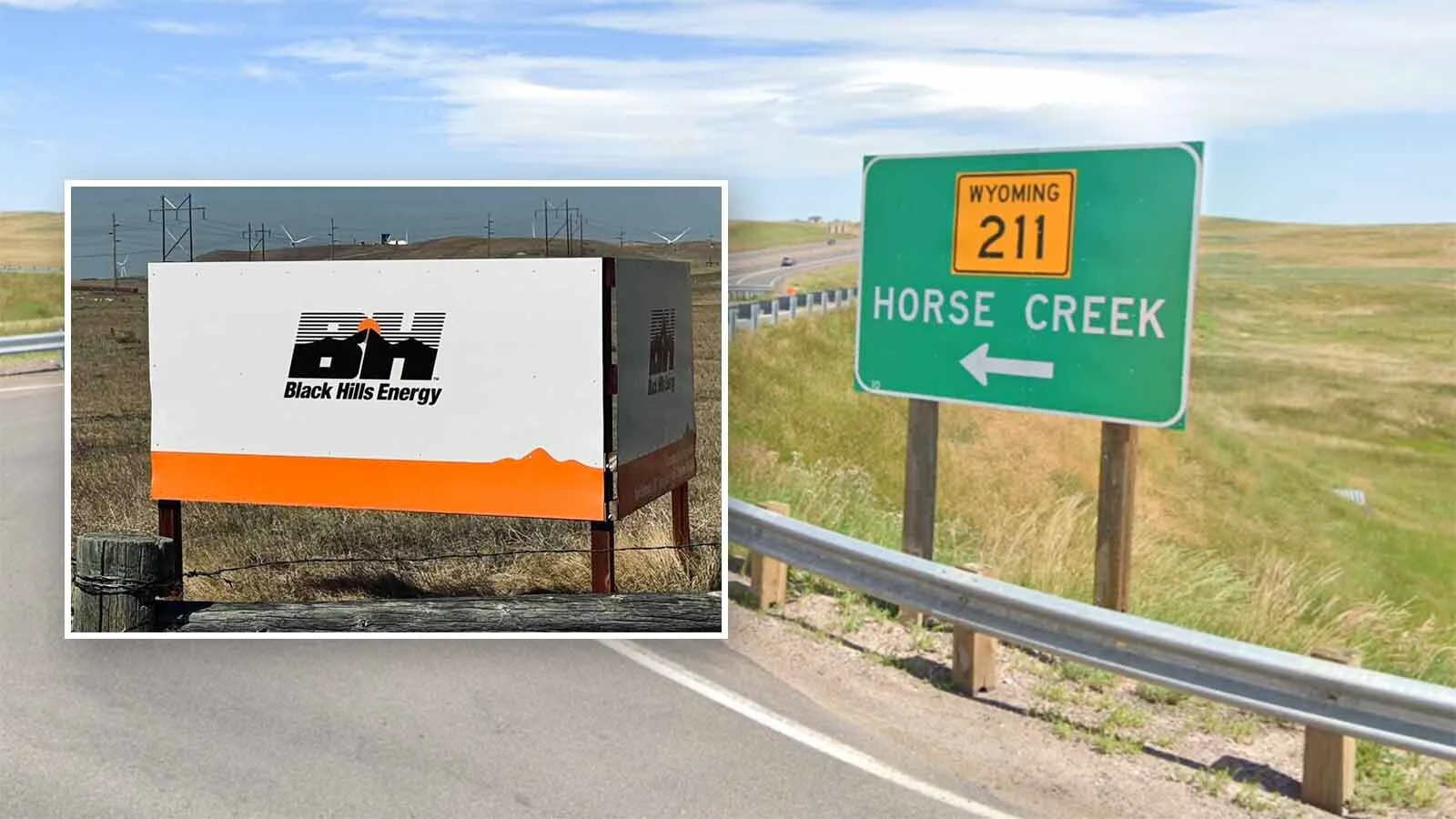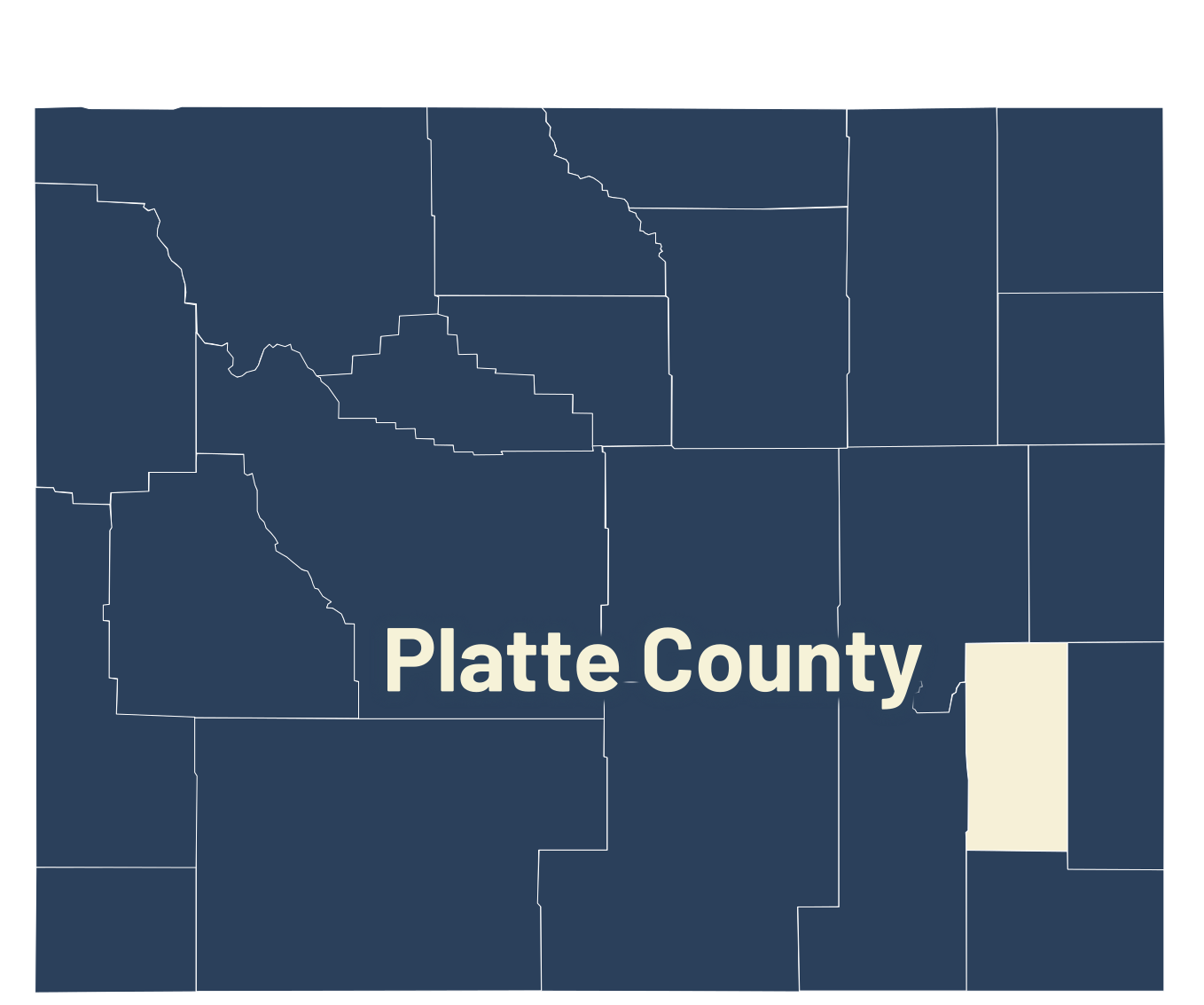
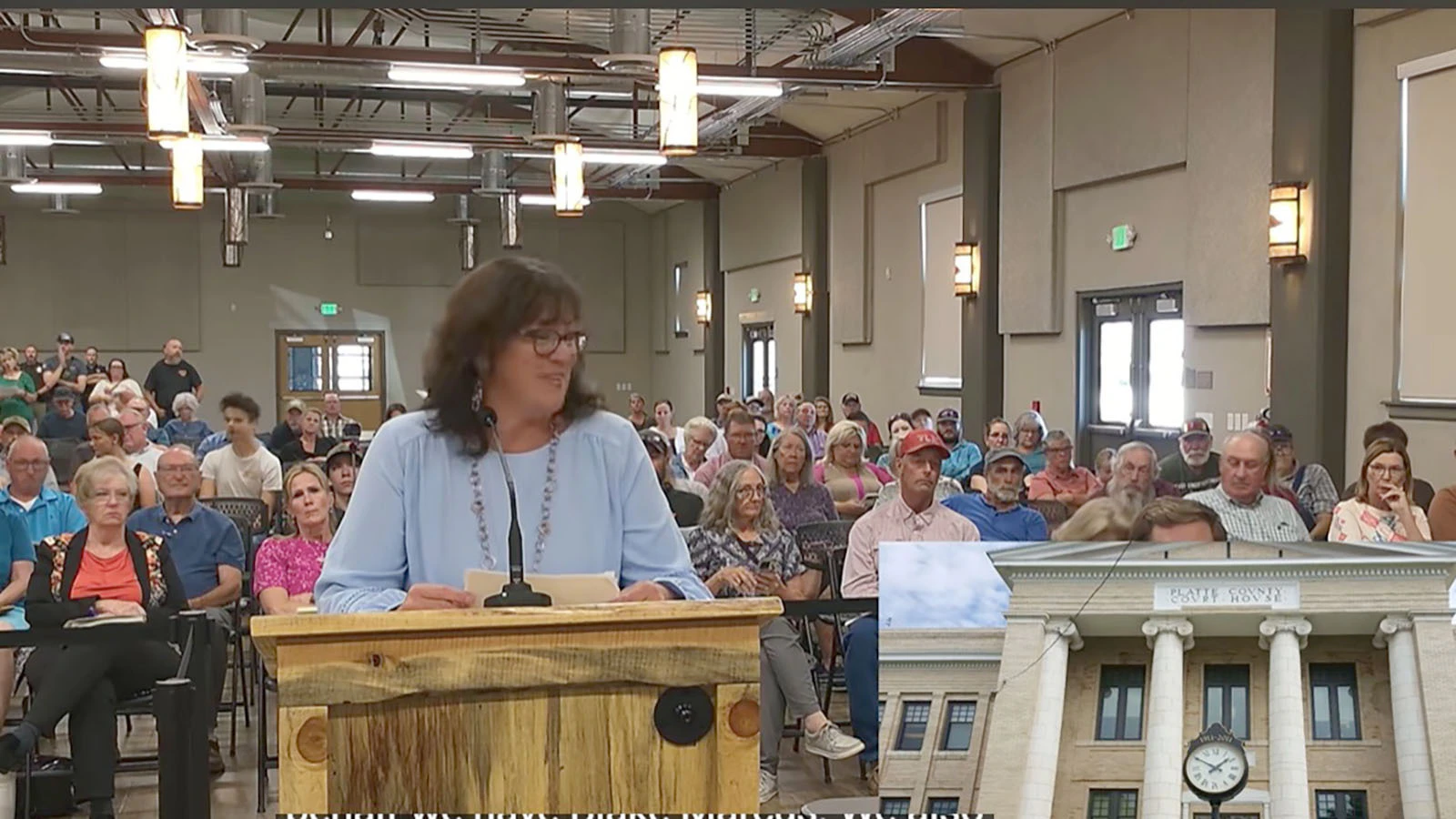
A proposal that could eventually bring a utility-scale data center to more than 5,300 acres of private ranchland near the Platte and Goshen county line cleared another hurdle Wednesday, as the Platte County Planning and Zoning Commission unanimously voted to recommend rezoning the property for industrial use.
The request involves 5,344 acres northeast of Wheatland in the area known as Goshen Hole. The land, owned by Gregor and Cindy Goertz, is currently zoned Ranch, Agricultural and Mining (RAM).
The zoning change would allow the property to be used for utility-scale energy generation, energy storage and a data center campus.
The vote was not an approval of the data center itself.
Instead, the recommendation would place the property under the county’s industrial zoning framework and require any future development on the land to obtain a special-use permit, giving Platte County additional opportunities to review and regulate the project.
After hearing about two hours of public comment from residents of both Platte and Goshen counties, the Planning and Zoning Commission voted unanimously to send the rezone request to the Platte County commissioners.
The request is scheduled to go before the county commissioners at 1 p.m. Sept. 2.
Three Conditions
Because of the size and unusual nature of the request, the Planning and Zoning Commission attached three conditions to its recommendation.
Under the first condition, the property would revert to its previous Ranch, Agricultural and Mining zoning if construction of the project has not begun within five years of the rezoning approval date or upon permanent decommissioning.
The second condition requires any industrial park subdivision of the land to be presented to the Platte County Board of Commissioners before it is recorded.
The third requires any development on the rezoned land to obtain a special-use permit.
Planning and Zoning Commission Chairman Marty Shepard stressed during the meeting that the board was considering only the zoning change.
“Just because these people are here does not mean a project is going to happen,” Shepard said during the public comment period.
Shepard also has said the county wants to ensure it retains oversight of any data center development rather than giving developers broad authority once the land is rezoned.
“If we rezone to commercial industrial and we give these companies free rein, we’re not in favor of that,” Shepard said during an Aug. 11 meeting. “We’re looking at a special-use permit instead of giving them carte blanche.”
Still In The First Phase
The proposed project remains in its earliest stage.
Developers described the effort as being in Phase 1, site evaluation, which includes preliminary siting along with financial, technical and land-use feasibility work.
A second phase would involve securing land approvals, utility contracts and permits. Construction would come in the third phase.
The developer has said the purpose of the rezoning is to help expedite the permitting process for a possible energy storage and data center campus intended to support America’s growing computing needs.
The project also would generate its own power, according to information presented to the planning commission.
Developer Blake Marcus said the project would not connect to municipal water or the Wheatland Irrigation District. He said the proposed facility would use a closed-loop cooling system and is expected to use less than 15 acre-feet of water annually.
That, he said, is less water than one of Cheyenne’s golf courses uses during a season.
The developer also told commissioners that the eventual size of the project will depend in part on how much energy generation can be developed at the site and on future commercial negotiations.
More detailed workforce projections are expected to become public as the project moves through the development process.
That uncertainty was one of the concerns raised by Planning and Zoning Commissioner Bill Klein.
“What I’m getting from the public [is], in three years, is the town of Wheatland going to double if it goes through?” Klein said. “That scares a lot of people.”
Klein referenced the late 1970s construction of the Laramie River Station power plant, which brought temporary housing and other changes to the surrounding community.
“Help us reassure what’s going to happen to the county if this goes forward,” he told the developers.
‘We Need A Shot In The Arm’
The public hearing drew dozens of speakers, with residents from Platte and Goshen counties offering a relatively even mix of support and opposition for the rezone.
The tone was notably calmer than a hearing several weeks earlier, when public discussion at times became contentious. Wednesday, speakers were required to sign in before approaching the microphone and were limited to three minutes each.
Supporters argued that Platte County needs new industry and a larger tax base if it hopes to retain young people and continue growing.
Retired attorney Steve Sherard recalled opposition to the construction of Laramie River Station, when he said residents feared everything from increased trash to earthquakes.
“As it turned out, we had some fine people come in,” Sherard said, adding that he was grateful for the people who now work there.
“We need a shot in the arm,” he added.
He said the school district is already seeing the effects of a shrinking population.
“If we lose two more students, we’re moving from 3A to 2A,” Sherard said.
Longtime rancher Juan Reyes echoed those sentiments, saying the community faced similar divisions when the power plant was proposed and when water was sold for its use.
“I think this project is worth approving,” he said.
Don Hale, who moved to Platte County 38 years ago and brought a business with him, said he has spent years trying to create opportunities that would allow his children and others to remain in the county.
“We need new things in this county,” Hale said. “If we don’t keep growing, we’re gonna die.”
Cindy Witt, a fourth-generation Platte County resident and Realtor who has lived in the area for more than 60 years, said data centers have become an essential part of modern life.
“I can’t imagine how society would function without data centers,” she said, adding that Platte County is “in desperate need of new industry and businesses.”
A Warning From A Business Owner
Fred Meyer, who owns White Tail Ranch and operates manufacturing facilities in Wheatland, offered another warning about the county’s ability to attract and retain industry.
Meyer said he hoped Wheatland would become a place where young people would want to work and where the company could build a manufacturing operation involving CNC equipment and robotic arms.
Instead, he said, the company has struggled to attract enough interest in manufacturing.
“The fact is, we made a mistake,” Meyer said.
Some manufacturing operations will be moved to Texas, he said, although the company plans to keep its Wheatland facilities for another purpose.
“If Platte County and Wheatland don’t wake up and do something, Wheatland’s going to dry down to a small (town),” he said.
Meyer said he supports the rezoning request in part because he believes strongly in private property rights.
“If ranchers and farmers can’t do with their property what they’ve slaved with blood on for years and can’t enjoy the benefits of it, we’re not in a free country,” he said.
Concerns About Water, Land And Trust
Opponents and neighboring landowners said they were less concerned about growth itself than about the possibility of placing a massive industrial development in an area they describe as one of the county’s most scenic and environmentally sensitive landscapes.
Amy Miller, who owns property adjacent to the proposed site, said she sent a certified letter to Gregor Goertz and project developer Ian Marcus seeking a meeting to discuss concerns.
She said Goertz met with her and other neighboring landowners, but Marcus returned her letter unopened.
Miller said Goertz told her Marcus did not have time to meet with an individual landowner.
“I feel that’s very concerning,” Miller told the planning commission. “They said they are here to listen.”
She also alleged that a surveyor trespassed onto her property to gain access to part of the proposed project site.
Shepard later addressed Miller’s concerns, saying county officials do not want to see Platte County harmed by development.
“None of us want to see the county be harmed,” he said. “We want to try and do the right thing.”
Others called for the county to slow down.
A woman who identified herself as Kim suggested a moratorium on data center development until the county has a better understanding of the long-term effects.
Teresa Baker of Chugwater questioned whether the county was moving too quickly without enough information.
She compared the process to “putting the cart before the horse” and questioned how a massive industrial development would affect people living in and around Goshen Hole.
“Love your neighbors as yourself,” Baker said. “How does that apply here?”
‘Our Own Local Grand Canyon’
Several speakers focused on the landscape itself.
Susan Cowan called Goshen Hole one of the prettiest places in Platte County.
“It’s gorgeous out there,” she said.
Cowan said residents were not going to “stand idly by” while more than 5,000 acres of what she described as prime Wyoming land is considered for industrial development.
Kathryn Stevens, who owns a homestead on agriculturally zoned land about five miles from the proposed site, compared Goshen Hole to “our own local Grand Canyon.”
She said residents value the area’s beauty, quiet and clean well water and worry the rezoning could amount to giving developers too much authority before the public knows exactly what will eventually be built.
Rick Teeters, whose family has lived in Goshen Hole for 85 years, said he supports the Goertz family's right to make decisions about their land.
“I’m not against Gregor doing what he wants to do with his land,” Teeters said. “I believe in landowner rights.”
But, he added, there are sensitive issues surrounding development in Goshen Hole.
“There is no water in Goshen Hole,” he said.
Several speakers said they were neither firmly for nor against the proposal but wanted more information before such a large development moves forward.
A Century Of Family Ownership
Gregor Goertz told the commission his family’s connection to the area goes back generations.
Goertz, who has owned the property for about 24 years, said his grandfather began acquiring land in Goshen Hole roughly a century ago.
For supporters of the rezoning, the proposal represents an opportunity for the landowners to make a decision about their property while bringing new industry and economic activity to Platte County.
For opponents, the same proposal raises questions about whether the county is prepared for a development of its potential scale and what the long-term consequences could be for water, wildlife, nearby property owners and the rural character of the area.
Those competing concerns followed the Planning and Zoning Commission into its deliberations.
After taking a brief recess following roughly two hours of public comment, Commissioner Jay Collins made a motion to recommend approval of the rezoning request to the Platte County Board of Commissioners.
The commission voted unanimously in favor, drawing light applause from some in the audience.
The commission's recommendation now moves to the Platte County commissioners, who will have the final say on whether the 5,344 acres should be rezoned from Ranch, Agricultural and Mining to industrial.
If the commissioners approve the zoning change, any actual development would still face additional county review and require a special-use permit before construction could move forward.
Kate Meadows can be reached at kate@cowboystatedaily.com.