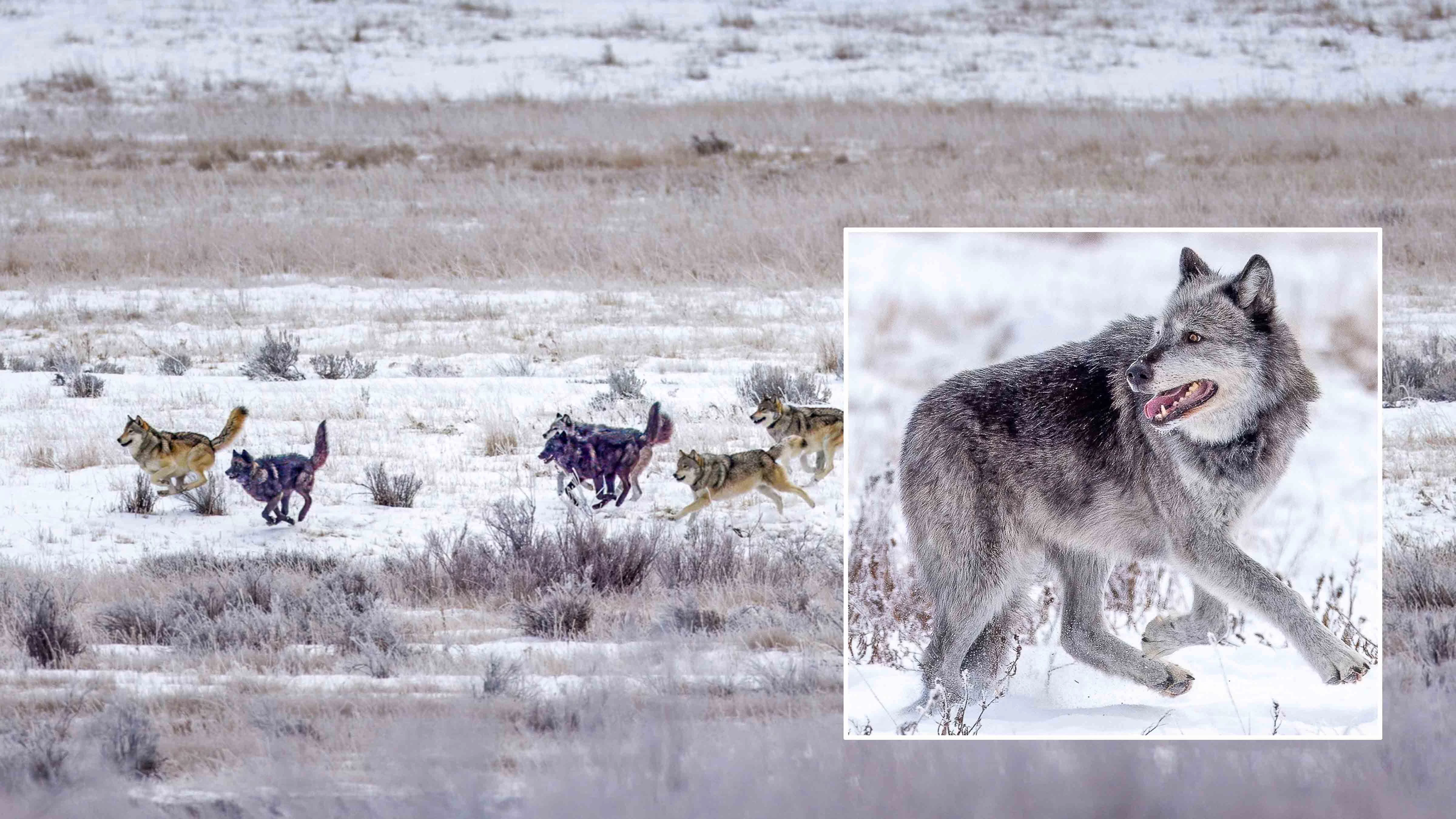
Activists are ratcheting up their efforts to halt wolf hunts in an area where the famed Mollie’s Pack is denned, including its matriarch, the 12-year-old Wolf 1090F.
Wyoming Game and Fish Commissioner Carlisle "Fonzy" Haskell told Cowboy State Daily on Monday that he’s received messages from New Zealand, Australia, and “from all over the U.S.” to shut down the season in wolf hunt areas 1 and 2.
Haskell said he has no plans to reverse his vote on the 2026 wolf hunting season, which the Commission approved in July.
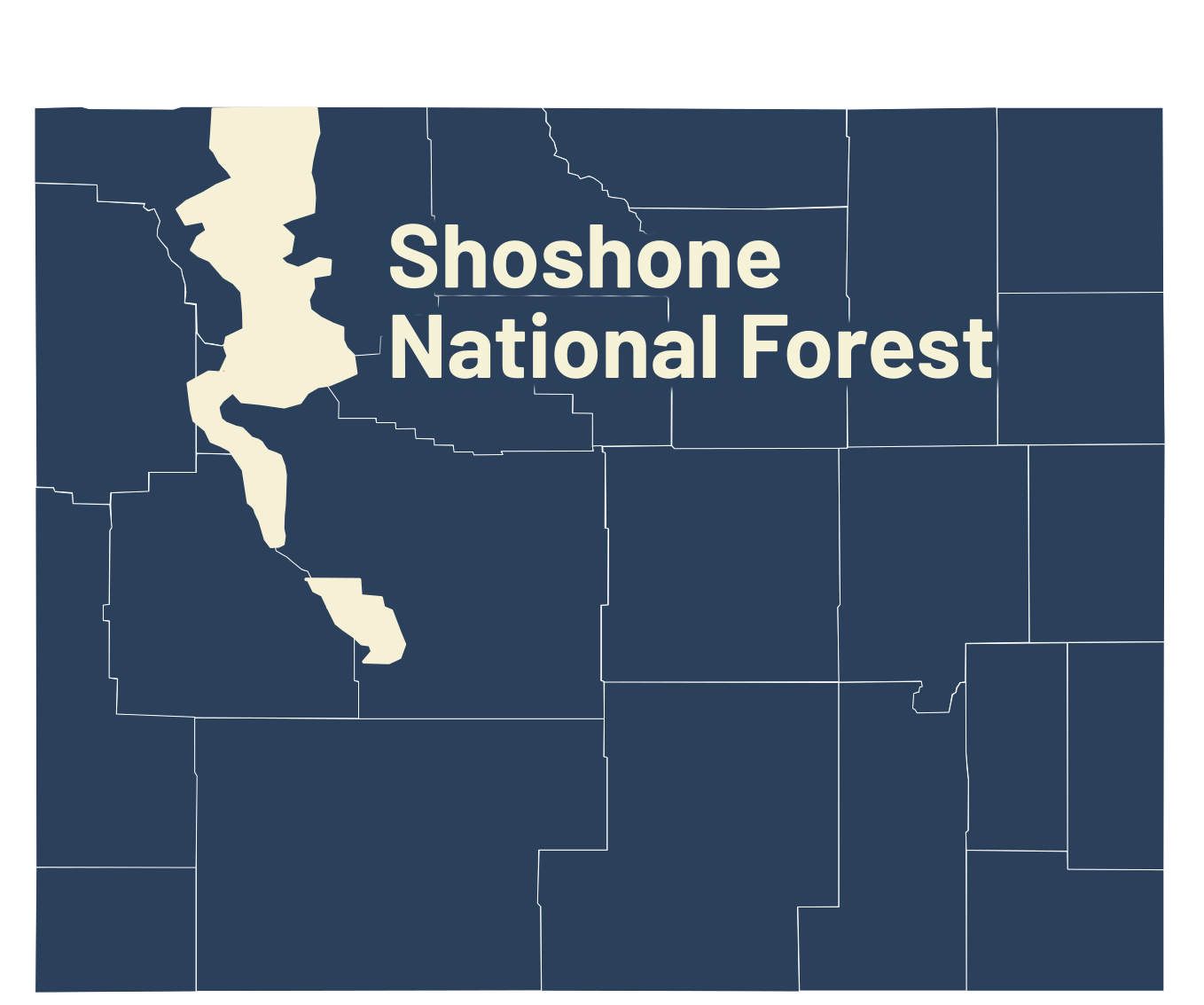
Starting Sept. 15, the two areas have a combined hunting kill quota of four wolves. The Mollie's left the safety of Yellowstone National Park and denned on the Shoshone National Forest, within the boundaries of Wolf Hunt Area 1.
Big Piney-area outdoorsman Mitch Gilliam told Cowboy State Daily that “I plan to be there on Sept. 15,” in hopes of filing his wolf tag.
As for Wolf 1090F, “if I see her, I’ll harvest her,” he said.
Public Pressure Campaign
The Center for Biological Diversity is an environmental group stepping in to get hunting shut down in the Mollie’s Pack area.
“Our campaign is a public pressure campaign,” Kristine Akland, the group’s Northern Rockies director, told Cowboy State Daily. “We are trying to create enough public pressure on the (Game and Fish) commission to take action.”
That’s included distributing coloring books about the Mollie’s to school children, she said.
Samantha Miller, the senior carnivore campaigner with the Center for Biological Diversity, said she plans to attend in person the commission’s scheduled meeting Sept. 21-22 in Evanston.
A crowd of wolf advocates might be there, she added.
One suggestion the Center for Biological Diversity has made is to allocate the Area 1 and 2 wolf tags to Native American tribes, which would not hunt the animals, she said.
Online Chatter
On social media forums, there have been calls for creative ways to protect the Mollie’s.
Those have included that activists should hike into the hunt area and play loud music over portable speakers. Some commenters have noted that could amount to hunter harassment, which is a criminal offense in Wyoming.
On the other end of the spectrum, there have been calls to deliberately try to find and kill the Mollie's, particularly 1090F.
Haskell said posters suggesting that they’d deliberately subject 1090F to a slow, painful death are probably “trolling” social media to illicit strong reactions.
“If so, then I’d say, mission accomplished,” he said.
Commission Followed Science
Regarding the wolf advocates, Haskell said that nearly all the correspondence he’s gotten from them has been positive.
“People are going about it the right way. They’re being very respectful and they’re asking us (the commission) to use the tools at our disposal,” he said.
However, the commission’s decision on the wolf hunts was based upon science and research from the Game and Fish Department’s biologists, and it isn’t likely to change, Haskell said.
“I trust their (department personnel) judgement. I think they did their research and came up with the right policy,” he said.
If Wolf 1090F is killed by a hunter, that would be a “legal harvest” according to the regulations, Haskell said.
He added that it might be difficult for hunters to target her specifically because “I don’t know if that wolf has any identifying markers.”
‘It’s Not A Cartoon Character’
Gilliam said he might be able to recognize 1090F from the numerous photographs of her that have been published or shared online.
He added that wolf advocates might have created their own problem by giving attention and publicity to the Mollie’s.
“I didn’t know anything about it until Jonas Black made a big deal out of it,” Gilliam said, in reference to outspoken Austin, Texas-based wolf advocate.
Given that most wolves live about four or five years in the wild, 1090F is “obviously a smart wolf” to have lived as long as she has, he said.
“A wolf that age, she’s going downhill. Would it be better to just put her out of her misery or let her starve? Which is what is going to happen, unless she gets killed by another wolf pack,” he said.
Perceptions of the Mollie’s Pack are driven by sentimentality, Gilliam said.
“The problem with society is when they take and put a name on something. It’s not a cartoon character; it’s a wild wolf,” he said.
Why Hunt Wolves At All?
Wolf biologist Robert Crabtree told Cowboy State Daily he understands the “strong feelings” on both sides of wolf management and hunting.
He’s concluded that wolf hunting is unnecessary, at least from the standpoint of biology and wildlife management.
“It’s sport killing and political chicanery,” said Crabtree, the founder, chief scientist, and president of the Yellowstone Ecological Research Center.
“I understand the anger people have against wolves, but it’s misplaced,” he said.
He’s become an advocate for non-lethal deterrents to keep wolves from killing cattle.
The Mollie’s are the oldest established pack in Yellowstone National Park, and so it has special scientific value, he said.
The pack was established when wolves were restored into Yellowstone in 1995 and was originally called the Crystal Creek Pack.
In 2000, the pack was renamed the Mollie’s Pack. That was in honor of the late Mollie Beattie, the first woman director of the U.S. Fish and Wildlife Service (FWS), and who Crabtree knew personally.
Beattie helped carry the aluminum crate holding one of the pack’s original dominant females, just before the wolves were released.
Crabtree said when that pack made its first documented elk kill in Yellowstone, that female was there.
Beattie, terminally ill at the time, was so moved by that she cried, he said.
Mark Heinz can be reached at mark@cowboystatedaily.com.