For roughly five years, the owners of the Beck Family Ranch in rural Lone Tree blocked off one day every month for a three-hour drive to Grantsville, Utah.
That’s where the closest USDA-inspected meat processor was located.
There were always two drivers – one carrying a trailer with 10 cows to be slaughtered and another pulling a refrigerated trailer in which to bring home the processed beef.
The trip, roughly six hours round-trip plus time for slaughtering and processing, took an entire day.
The Becks recognized they faced a logistical challenge in Wyoming, where cows outnumber people. As they considered how to more efficiently raise cattle and sell their beef directly to consumers across state lines, they knew a drastic measure was in order.
“We decided to build our own plant,” Annalisa Beck told Cowboy State Daily.
After four years of research, permitting, construction and what Beck describes as an enormous amount of manual labor, the Beck family’s Western Meat Processing facility is preparing for its final USDA inspection Friday.
If it passes, the family will be able to process its own cattle and sell the beef across state lines.
The facility also will provide USDA-inspected processing services for neighboring ranchers.
For the Becks, it’s the culmination of a project they literally built from the ground up.
And it’s an effort they hope will demonstrate what is possible for other Wyoming ranch families.
“American ranchers raise the best meat,” Beck said. “So let’s get it to where it needs to go.”
A Capacity Problem
Wyoming has added USDA-inspected meat-processing facilities in recent years, but the state’s processors remain relatively small, according to Jim Magagna, executive vice president of the Wyoming Stock Growers Association.
The problem isn’t necessarily that Wyoming has no processing facilities, Magagna said.
It’s that those facilities don’t have enough capacity to meet the needs of all the ranchers who want to use them.
Producers sometimes have to schedule processing a month or two in advance.
For a rancher trying to sell beef directly to consumers, that creates a difficult logistical puzzle.
The Beck family knows that puzzle well.
Annalisa said she knows other ranching families that sell beef directly to consumers. She also knows several USDA-inspected processors in Wyoming.
But she said she doesn’t know of another Wyoming ranching family operating a model that combines the two — raising the cattle, processing the beef and selling it directly to consumers from the same operation.
The Beck family’s goal is to create what Annalisa calls a more complete, closed-loop system.
They chose USDA inspection because federally inspected meat can be sold across state lines.
Other Wyoming ranches sell directly to consumers, Beck said. But, she said, “they haul their beef all over the place” to get it processed.
The Becks wanted to eliminate that step — and eventually offer another option to their neighbors.
One Wyoming ranch already operating a similar model is Jackson’s Lockhart Cattle Ranch, which includes a USDA-inspected slaughter plant and describes its operation as a “closed system” for raising and selling beef.
The Becks are hoping to create another example.
From The Ground Up
Building a meat-processing facility from scratch on a Wyoming ranch is not a simple undertaking.
The Becks had to work through permitting requirements, environmental regulations and the realities of building a specialized facility in a rural community.
They worked with the Wyoming Department of Environmental Quality to obtain a permit for a septic system.
The ranch also received only the second composting permit issued by the state of Wyoming, Beck said, allowing the family to compost waste from the operation, including bones and hides, on their own property.
Beck’s husband, Dana, was required to attend a composting class and obtain multiple certifications.
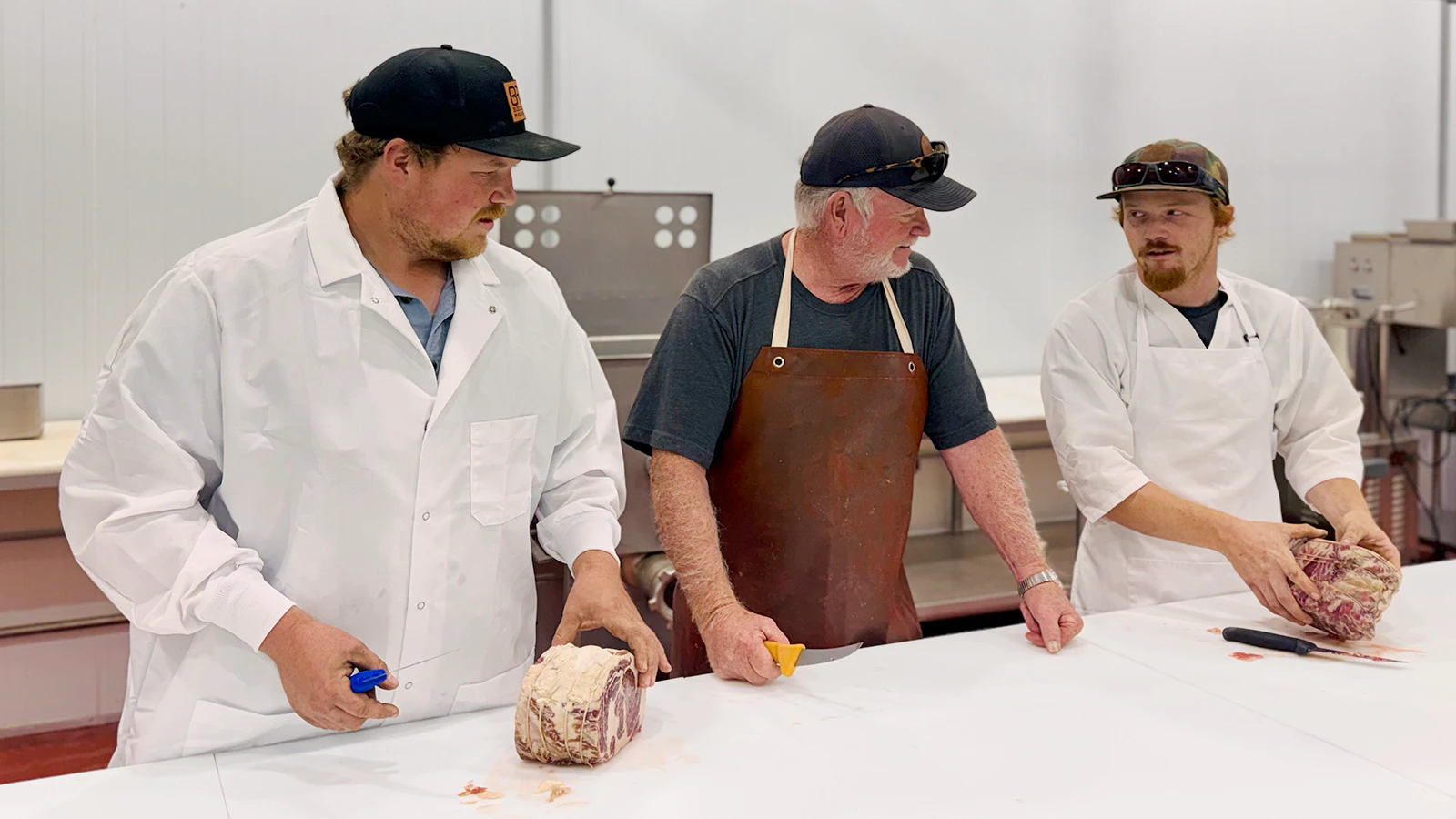
Dana and the Becks’ son, Broderick, also traveled to processing facilities in Torrington and Ogden, Utah, to learn how other operations worked.
They studied the details. They asked questions. Then they came home and built their own.
The family constructed the plant themselves, with Dana and Broderick doing much of the physical work.
“All of these permits take time,” Beck said.
So did the construction.
The Becks also attended public comment meetings as they worked through the civil process of establishing the facility.
Lone Tree has always been a deeply rural community, Beck said, and the family wanted to preserve that character.
“We’ve tried to be conscious of our neighbors,” she said.
But the Becks also believed their property provided enough room to accommodate the facility without changing the nature of the surrounding area.
The result is a processing plant built on the family’s own ranch.
And they did it without relying on government funding.
No Government Funds
The timing is notable.
The federal government is pushing to expand small and independent meat-processing capacity across the country.
The USDA’s fourth round of its Meat and Poultry Processing Expansion Program made $60 million available in 2026 to help eligible processors expand capacity and create more local market opportunities. Awards for processing-expansion projects can reach $2 million.
The agency has also launched additional programs aimed at strengthening independent and regional beef slaughter facilities.
But Beck said applying for grants wasn’t the right fit for her family.
Running a ranch leaves little spare time, and the grant-writing process can be daunting.
“You have to be a rocket scientist to write these grants,” she said. “We don’t have that much time.”
Instead, the Becks paid for the entire facility themselves.
All told, the buildout cost about $1 million, Beck said. That figure does not include the value of the family’s labor.
Because Dana and Broderick did so much of the construction themselves, Beck estimated the project cost roughly half of what it would have cost had they hired outside labor for the entire build.
The family might still pursue grants in the future, particularly for equipment, Beck said.
A New Chapter
Passing the USDA inspection will not mean the work is over.
It will mean the work is changing on the Beck Ranch.
Operating a meat-processing facility requires a different set of responsibilities than running a cattle ranch.
Beck said the family is working to keep the operation as family-centered as possible.
Their daughter-in-law will manage the plant, and they plan to hire local workers to fill other positions.
For Beck, the facility is about more than creating another business on the ranch.
She hopes it will encourage other ranching families to think beyond the traditional model of simply raising cattle and selling them into the conventional beef supply chain.
Maybe, she said, another ranch family will see what they have done and realize there are other possibilities.
“Maybe they can do something different,” Beck said.
That’s the larger idea behind Western Meat Processing and the family’s four years of figuring out how to turn a problem into an opportunity.
Now, with the final USDA inspection approaching, Annalisa said she is excited – and nervous.
The project has taken years of work, but she believes the payoff could extend well beyond her own family.
“It’s not a red issue. It’s not a blue issue,” Beck said. “Food is a people issue.”
Kate Meadows can be reached at kate@cowboystatedaily.com.