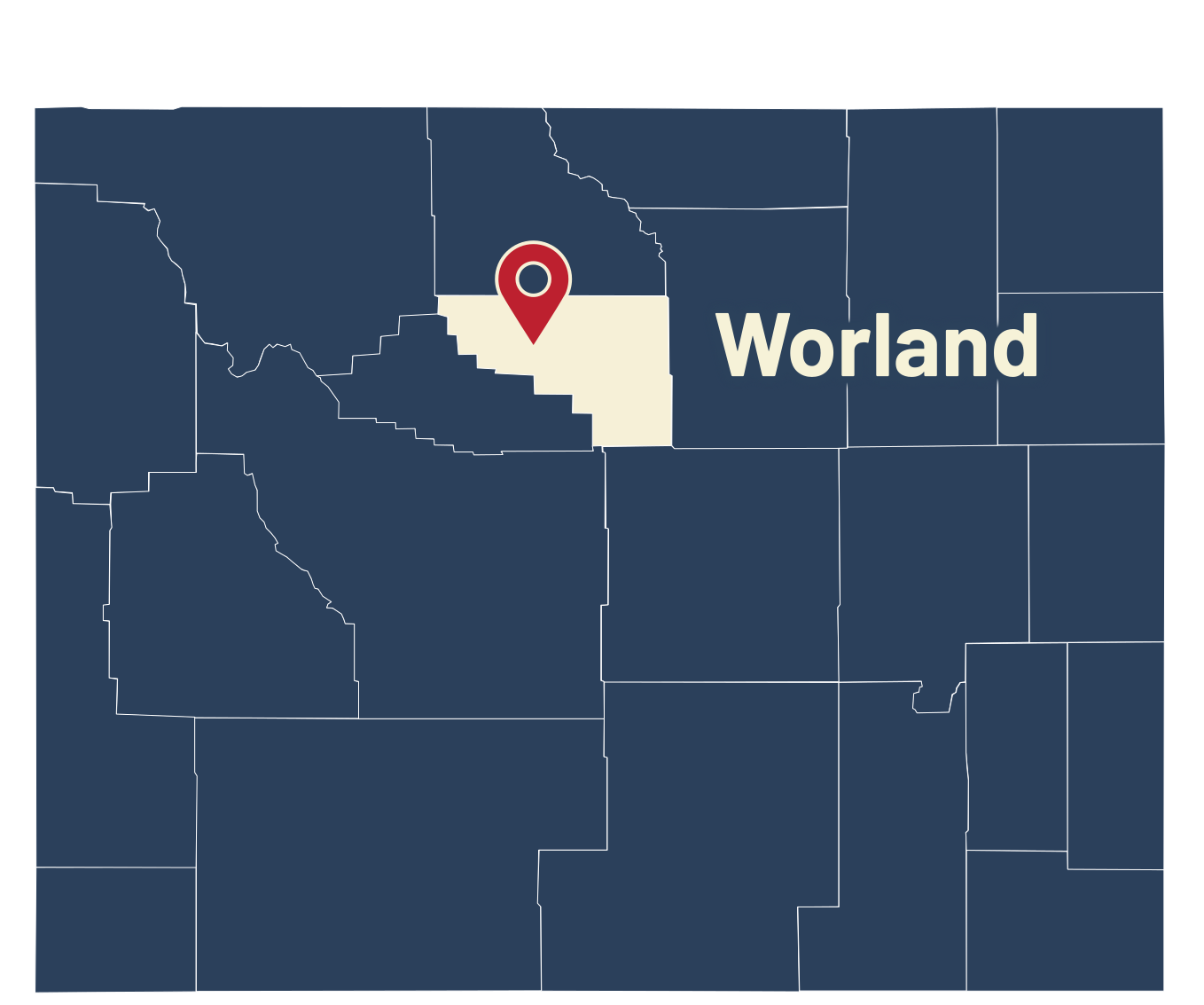
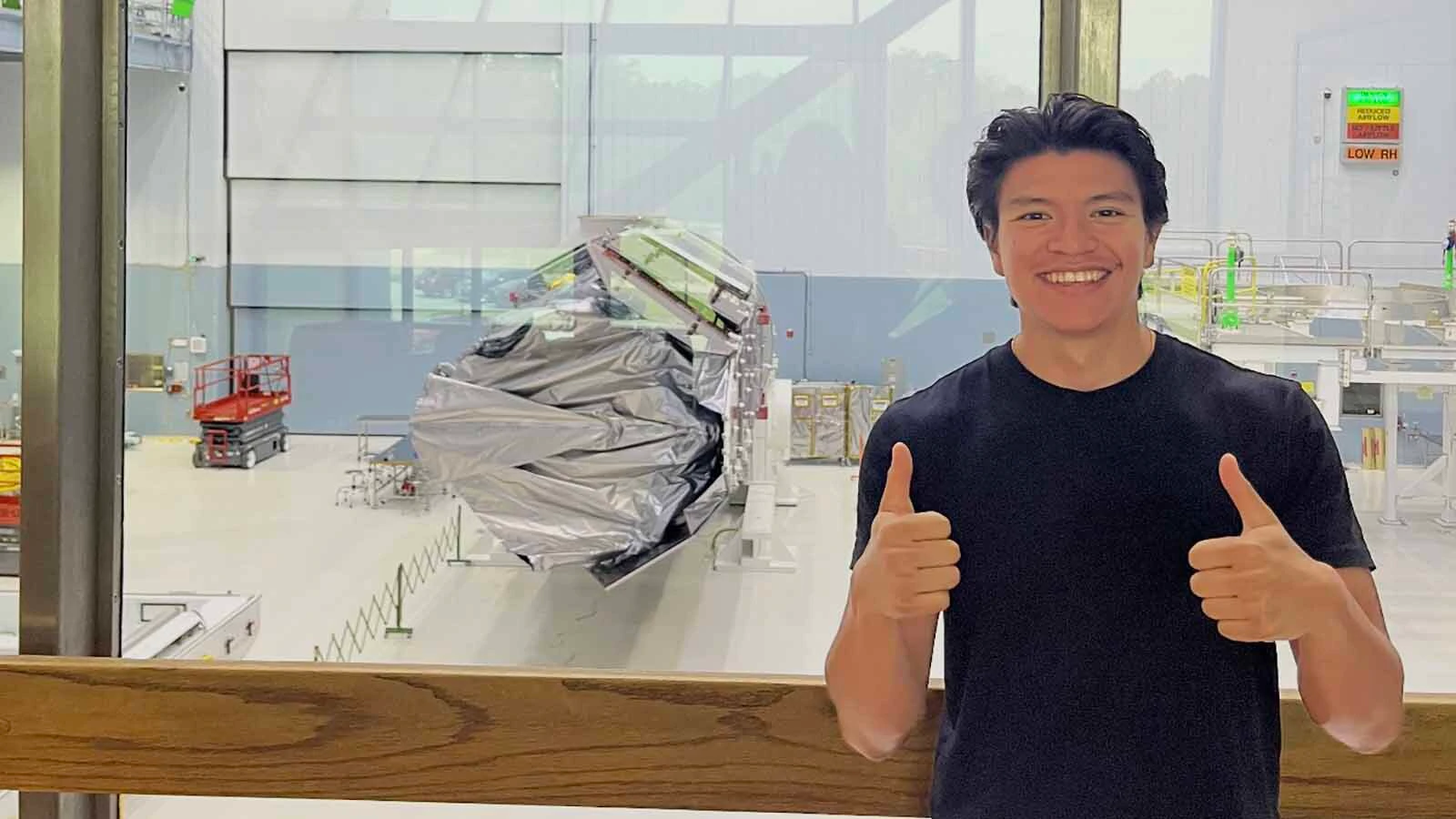
When NASA’s Roman Space Telescope was successfully launched Sunday at the Kennedy Space Station on a million-mile journey to Lagrange Point 2, Aaron Vigil of Worland, who was watching from bleachers 3 1/2 miles away, said the moment was more emotional than he’d imagined.
Vigil, a recent University of Wyoming graduate, has spent the past four years working on the Solar Array Sunshield for the telescope, which is 1,000 times more powerful than the Hubble launched in 1990.
“Once it starts rumbling up, you can feel it in your chest, everything's shaking,” Vigil said. “I can't quite put the moment into full words, but it was something I'll never forget.”
Vigil was joined by his parents and approximately 3,000 other employees and family members near the launch site, which is closest allowable spot to the launch pad.
Vigil has spent the summer at the space station and said he had seen at least a dozen launches, but nothing matched this experience. He said it was incredible to know that he was one of just a few thousand people who had put his special touch on the telescope before it was sent into orbit.
According to NASA scientists, the telescope will scan huge portions of the cosmos for clues about dark matter, dark energy, and distant worlds. The hope is because the new telescope has survey speeds roughly 1,000 times faster than Hubble and will be collecting 1.4 terabytes of data per day, the Roman could uncover cosmic surprises astronomers have never seen.
“I’m in awe that I've been able to be a part of this incredible mission,” Vigil said. “It’s all been incredible - from the really unique and fun tests that we've done all the way to our deployment testing to our acoustics testing and our environmental testing.”
The Roman Telescope
Named after NASA’s first chief astronomer, the "mother of the Hubble Space Telescope," the Nancy Grace Roman Space Telescope will have a field of view at least 100 times larger than Hubble's, potentially measuring light from a billion galaxies, according to NASA.
This observatory, according to NASA scientists, will also be able to block starlight to directly see exoplanets and planet-forming disks and complete a statistical census of planetary systems in our galaxy.
“What the Roman can do in one month would take Hubble a century to do,” Vigil said. “It's going to be able to do the surveying much faster and point the James Webb telescope to certain areas that we find in our surveys.”
In addition, the Roman is going to look at dark energy and dark matter that the scientific community currently doesn't fully understand. NASA scientists said they are hoping this new observatory will help settle essential questions in the areas of dark energy, exoplanets, and infrared astrophysics.
“What they're planning to do is essentially use this telescope and it’s images to make a 3D map of our universe,” Vigil said. “This will hopefully help us to understand what dark energy and what dark matter are.”
Vigil said what we know about dark energy is that it is the force that pushes the universe apart. It is causing the expansion and the acceleration, but we don't know why or how.
“With this observatory, we'll have the chance to be able to look at the universe in a different way,” Vigil said. “In a lot of ways, it could rewrite the laws of physics that we have and change how we see things in astronomy.”
From Wyoming to NASA
Vigil said the scientific study is exciting, but his part of the telescope project was all about engineering and the Solar Array. Although Vigil said he has always been interested in space, as a student from rural Wyoming he never expected to get the chance to go to NASA.
Vigil was working on his degree for mechanical engineering when he applied to an internship at NASA almost on a whim. He ended up with a graphic design job that few had applied for and was his sixth choice.
Although Vigil would have preferred the job mitigating moon dust on AVA suits, Vigil said this was an opportunity to get his foot in the door. He ended up loving the job.
Vigil worked remotely for the Goddard Space Flight Center doing 3D modeling and got to know the folks working there.
The graphic design internship led him to his current position at Goddard working on the Solar Array, first as a summer intern and then, beginning in 2024, as a full-time engineer.
The Solar Array that Vigil helped build and install has two main purposes.
The first is to collect power and keep all the batteries charged on the Roman observatory.
The second is to act as a sun shield. Essentially, Vigil explained, the solar arrays act to block the light from the sun so that the light will not impact all the instruments or the optics on board the observatory.
“We want it to be as dark as can be when using the telescope,” Vigil said. “It's the same reason why you can see the stars so much better in Wyoming than you can in Washington, D.C.”
Vigil’s team was responsible for building the system, testing it and was there for the final installation.
“I always tell people you can think of the whole Roman observatory as two big pieces, one is on the inside and one is on the outside,” Vigil said. “The solar arrays are part of the outside.”
Escorting Solar Shield
Vigil said it was a great experience helping on the solar array system from start to finish. He said it was especially meaningful transporting the system down to Kennedy.
“Being in there for encapsulation, which is when we essentially close up the spacecraft, was an incredible moment,” Vigil said. “It was the last chance any human eyes get to look at it.”
Vigil said he did not relax until an hour after the launch, when he got the text that the solar array deployed as designed. He explained that the solar arrays during launch are in a stowed configuration.
“The solar array wraps around the observatory, which is about the size of a tour bus and weighs about as much as a T-Rex," he said. "The solar array panels are outside of the observatory and cover one-half of it.”
Once the telescope launched and after separation from the SpaceX second-stage rocket, the solar array system was successful deployed.
Vigil said he got to work with brilliant engineers and is a great way to start his career.
“It's something I'm going to take to my next projects,” he said. He has also taken the opportunity to inspire the students in his elementary school in Worland.
“I've been calling into some fifth-grade classes there and I met with them last week,” Vigil said. “This is my way of showing that you can be from small town Wyoming and do some incredible things.
“It was not the path that I thought I was going to take. No matter where I go from here, I will always remember my Wyoming roots.”
Jackie Dorothy can be reached at jackie@cowboystatedaily.com.