Rick Bonander was riding a bus toward Glacier National Park when he saw the eagle.
"Not an eagle," he said.
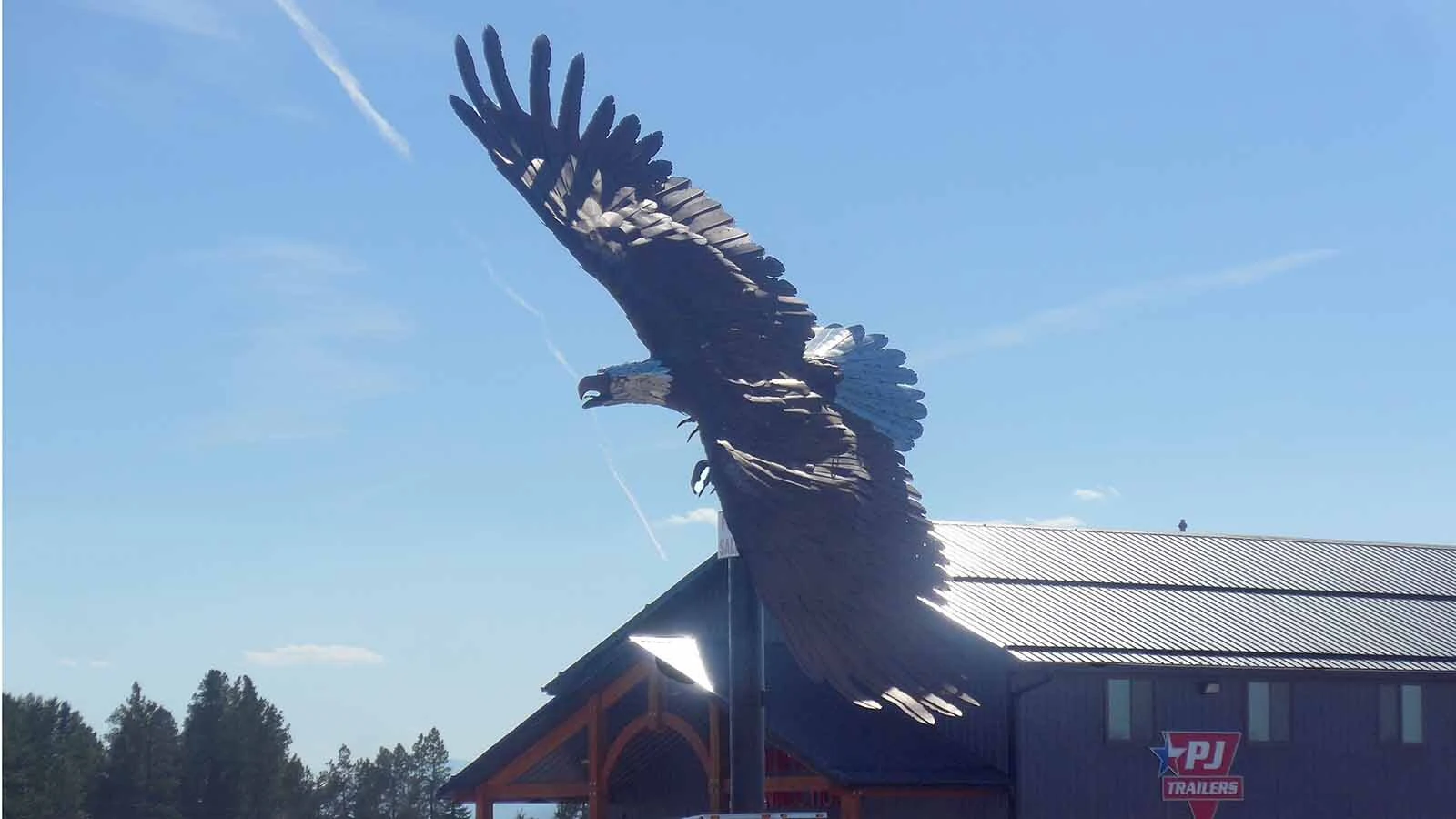
It was sitting outside a business in Kalispell, Montana, with its beak open, talons extended and great steel wings frozen in mid-strike, and hanging nearby was a for-sale sign.
“I actually had the bus pull over,” Bonander said.
The Casper businessman climbed out, found the owner, asked what he wanted for it and pocketed his business card. At the time, Bonander remembers the asking price being somewhere around $150,000.
“Well, you never know,” he told the man.
A couple of years later, Mills had an 8,100-pound eagle.
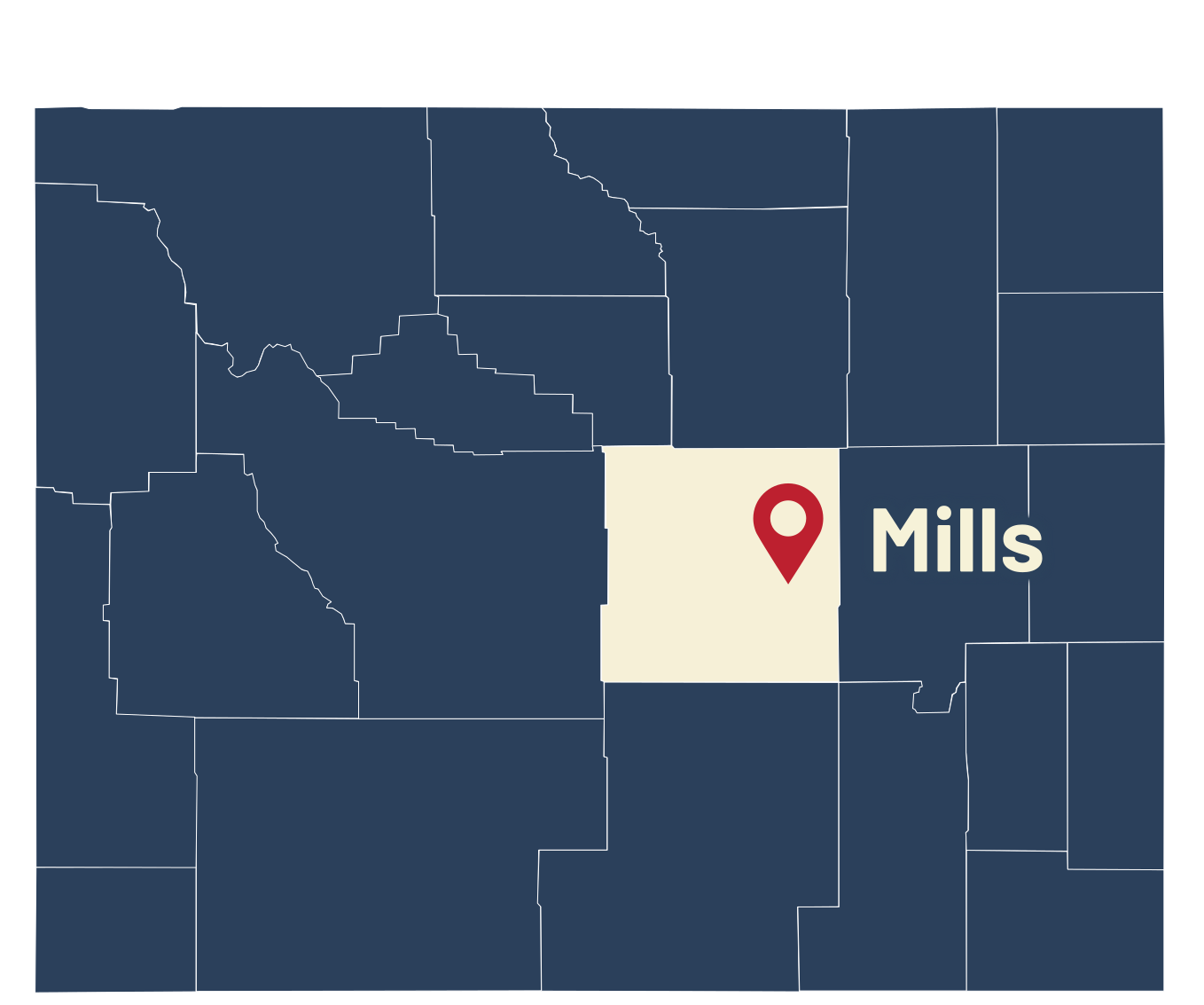
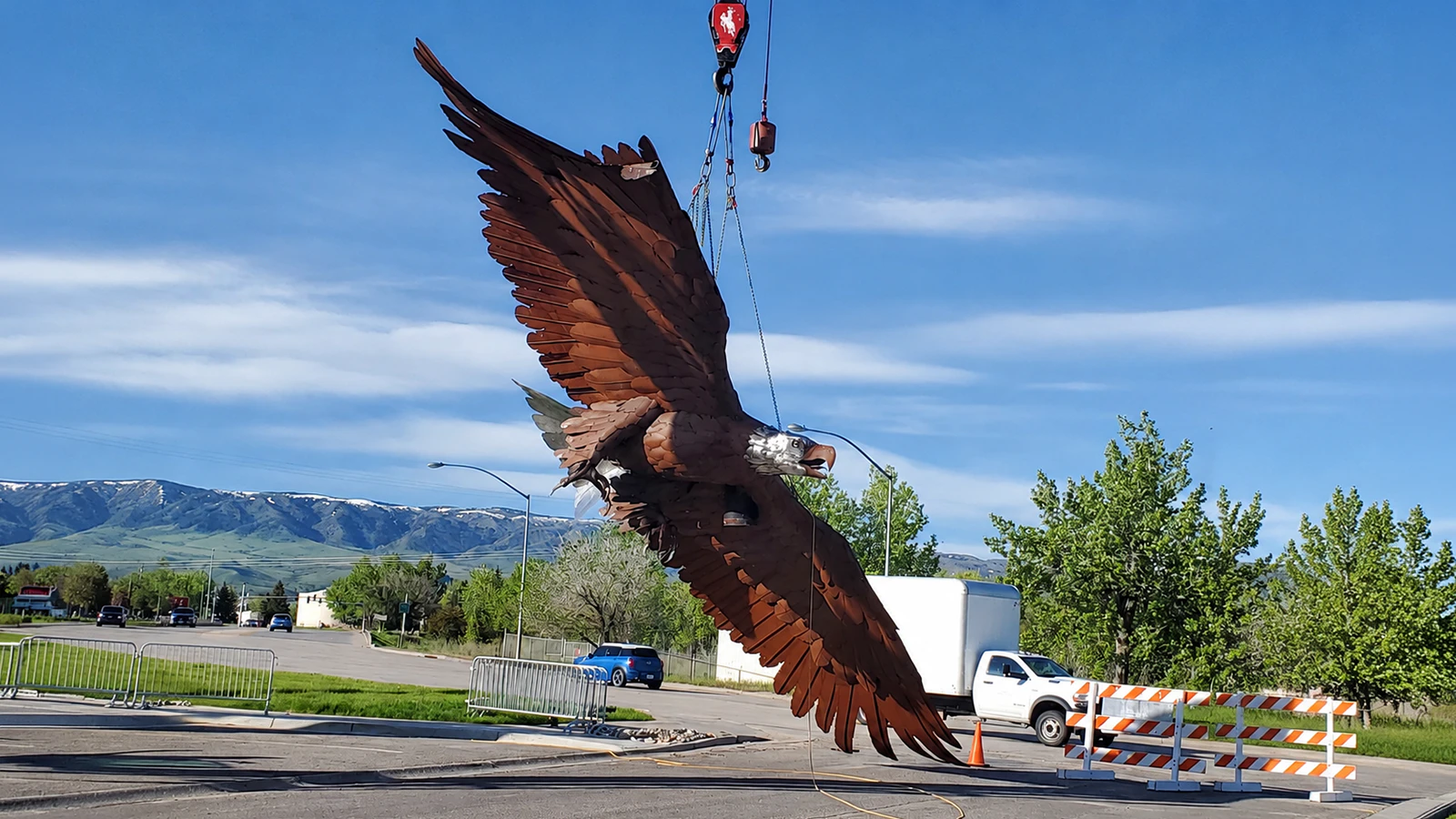
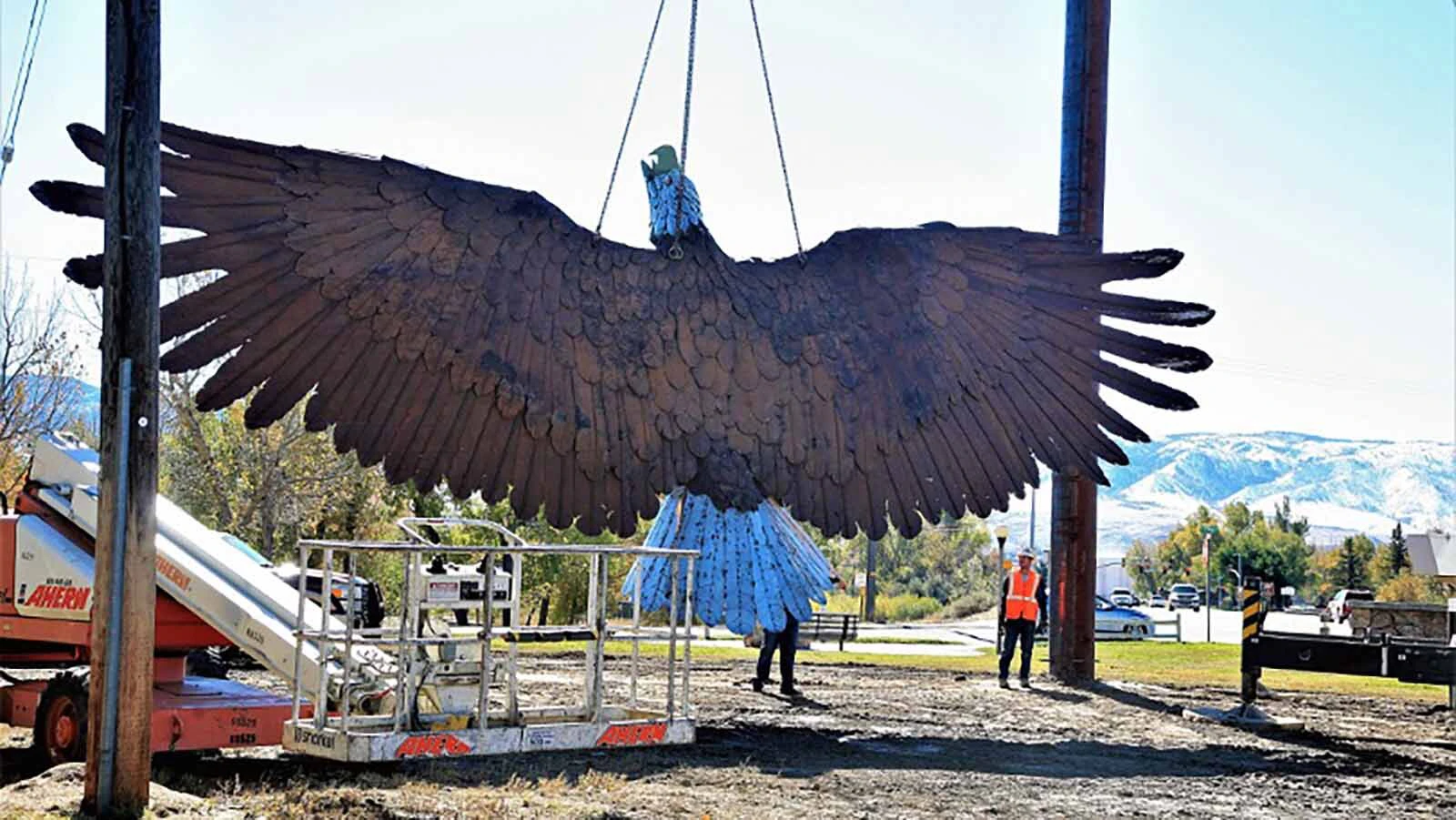
Today the bird is fixed over the little town immediately west of Casper, 48 feet from wingtip to wingtip, glowering down at Wyoming Boulevard as if ready to snatch a sedan at any moment.
It is part artwork, part landmark and part feat of industrial stubbornness.
Mills Needed Something
The city wasn't born of delicate things.
Mills sprang up in 1919 alongside the North Platte River after the Mills Construction Co. bought land to mine sand and gravel for roads and tank revetments connected to the booming Midwest Refining Co. Workers bought lots near their jobs and put up houses. Many were tarpaper shacks. There was a hotel. There was an amusement park.
Within two years, about 1,000 people lived there.
Then the work dried up, the Depression arrived and Mills nearly became a ghost town. Its once-fashionable hotel went through a spectacular decline, becoming a speakeasy, dance hall and gambling den before it was finally demolished in 1931.
Still, Mills endured oil booms and oil busts, the eventual closure of the refinery that helped create it, and the strange fortunes of being a small industrial city pressed against the side of a much larger Casper.
By 2018, Mills was trying to decide what it wanted to look like in its next century — not merely a place people drove through on their way somewhere else, but a city with a little swagger of its own.
An engineer and owner of Intermountain Pipe, Bonander had already helped shepherd several large public art projects around Casper, including the three running antelope on CY Avenue and the monumental sculptures near Fort Caspar.
Then-Mayor Seth Coleman asked whether Bonander might help Mills do something similar.
Bonander went back to his office, dug out the business card he'd saved from that roadside stop in Montana and called.
Bonander negotiated the price down to $75,000 and committed to buy it — before Mills actually agreed to take it.
That mattered to Bonander, because by then he had learned a couple of things about trying to make public art with government involved.
First, make sure the money is committed before you start.
Second, keep control of the project.
“If I can't get that, I won't do it,” Bonander said. “Because politics gets involved.”
So he called Coleman again. The mayor told him to bring the idea before the Mills City Council the next day.
The council voted unanimously to move forward.
Scrap Metal
Mills was getting an eagle, and not just any eagle.
The sculpture is the work of Montana artist and welder Todd Berget of Libby, who began building steel eagles in 1997 and ultimately made 95 of them.
They appeared outside businesses, along highways and eventually above a great steel arch welcoming motorists into downtown Libby. There were so many the community became known as the “City of Eagles.”
This one was the monster of the flock.
The finished sculpture weighed 8,100 pounds. Berget believed it was the largest metal eagle in North America, perhaps even larger than anything similar in Central or South America.
And despite its rather majestic appearance, the bird's pedigree was delightfully blue collar.
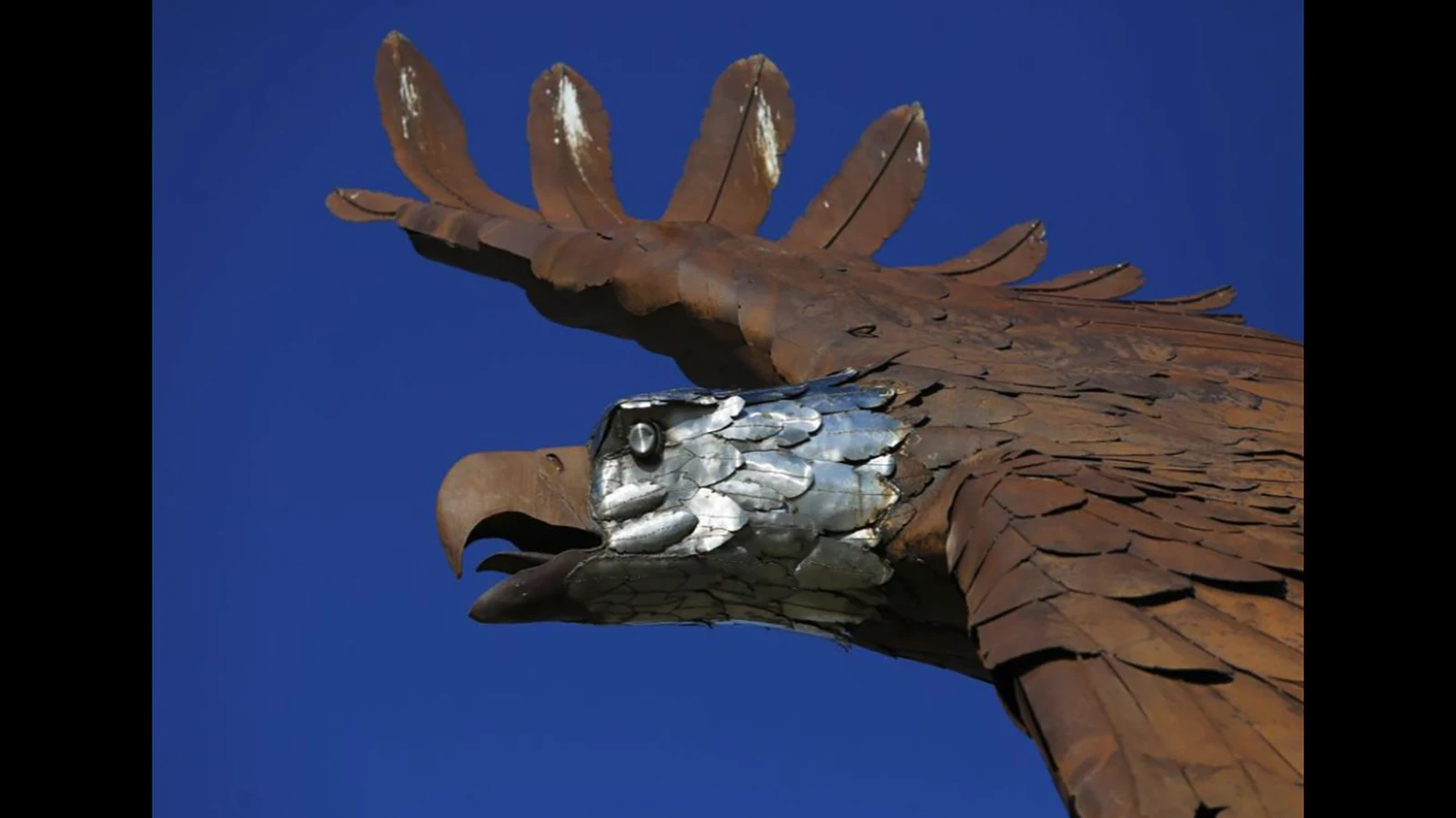
Contemporary reporting from the Casper Star-Tribune described Berget as an artist who liked incorporating scrap into his work. The eagle's talons had been fashioned from exhaust pipe an auto body shop couldn't use. Some of the internal structure came from sprinkler-system pipe salvaged from a wood mill damaged by heavy snow.
For a city born from gravel pits and refinery work, it was difficult to imagine a more appropriate piece of fine art.
Bonander, who has spent most of his career selling and engineering steel pipe, supplied a 22-inch steel pole through Intermountain Pipe.
He remembers Wyoming Machinery, Peterbilt, First Interstate, Pepper Tank and Watco contributing money. Brendan Bonner engineered the base. Mills workers helped with the project. Coleman Construction sent a truck to Kalispell to retrieve the eagle, and Mobile Concrete donated concrete.
Others piled in.
Heavy Molting
Today Mills is no longer the scrappy refinery settlement of tarpaper houses that nearly vanished during the Depression.
The eagle was installed at what is now Eagle Park, at Wyoming Boulevard and First Street. The location makes the bird nearly impossible to avoid. The road bends in such a way that the eagle seems to wait directly ahead of motorists approaching from either direction.
“The city picked that spot,” Bonander said. “What's neat, where you're talking about the curve of that road, you see it centered coming either direction.”
And people liked it.
The Star-Tribune put the new landmark on its front page Nov. 26, 2018, beneath the headline “Eagle soars over Mills," which later became quite literal.
For several years, the eagle did what a steel eagle is generally expected to do.
It weathered summers and winters. Snow and frost made the wings glisten in the sunshine.
Then came the wind.
In December 2021, sustained winds hammered the Casper area, with gusts reaching 76 mph and a structure collapsing at the Central Wyoming Fairgrounds. Mills Public Works Supervisor Casey Coates remembers it as the same general wind that started plucking the eagle.
One of the steel feathers came down hard enough to stick in the ground. Bonander estimates it weighed 300 to 400 pounds.
“If somebody'd have been there or a car, could have killed them,” Bonander said.
Suddenly Mills faced a problem: What do you do with a molting 4-ton bald eagle?
'Point Of Pride'
Coates wasn't involved with the original installation. His chapter came later, when the damaged bird had to be grounded.
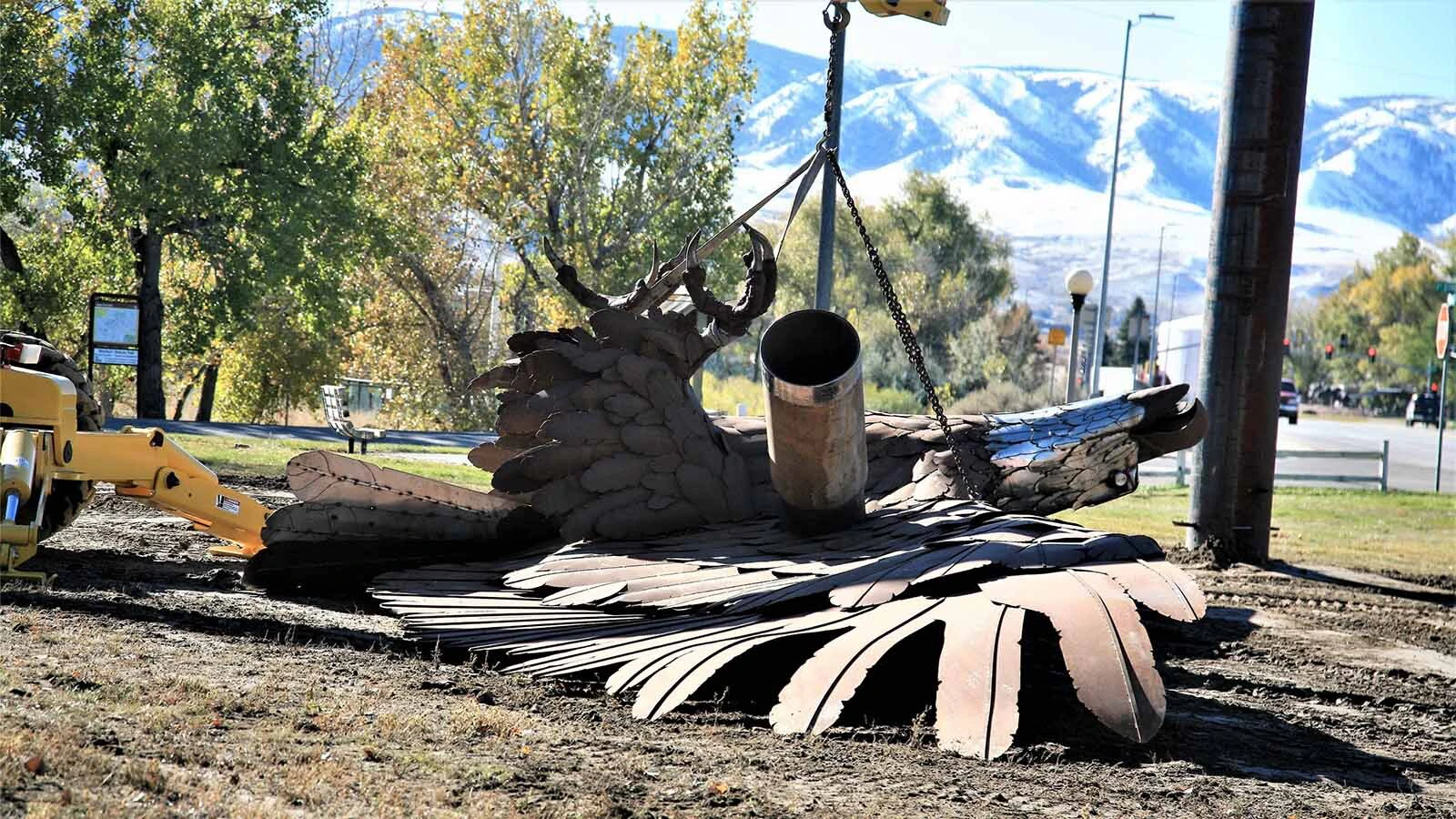
The eagle was lowered from its perch and crews went to work strengthening it.
Much of the structure was rewelded and reinforced. When it was time for the bird to return to the sky, the city also shortened its perch by roughly 10 to 12 feet, Bonander said, leaving it around 28 to 30 feet high.
The idea was simple.
There is slightly less wind 10 feet down.
The lower height also made lighting the sculpture easier.
For residents who worried the wounded eagle might someday break free, there was a wonderfully absurd moment during the repair process: After years of seeing it frozen above town, they got to watch the eagle dangling through the air as crews moved it.
For a moment, "the Eagle of Mills actually flew," said Coates.
Then workers put it back.
Coates describes the eagle as a point of pride and something of a centerpiece for town. Travelers stop. People photograph it.
“It’s kind of become a point of pride,” Coates said. “You’ll see that on our visitor signs now, we have an eagle on those as well."
Bonander is happy, too. “I think it’s awesome, I mean it’s just beautiful.”
Kolby Fedore can be reached at kolby@cowboystatedaily.com.