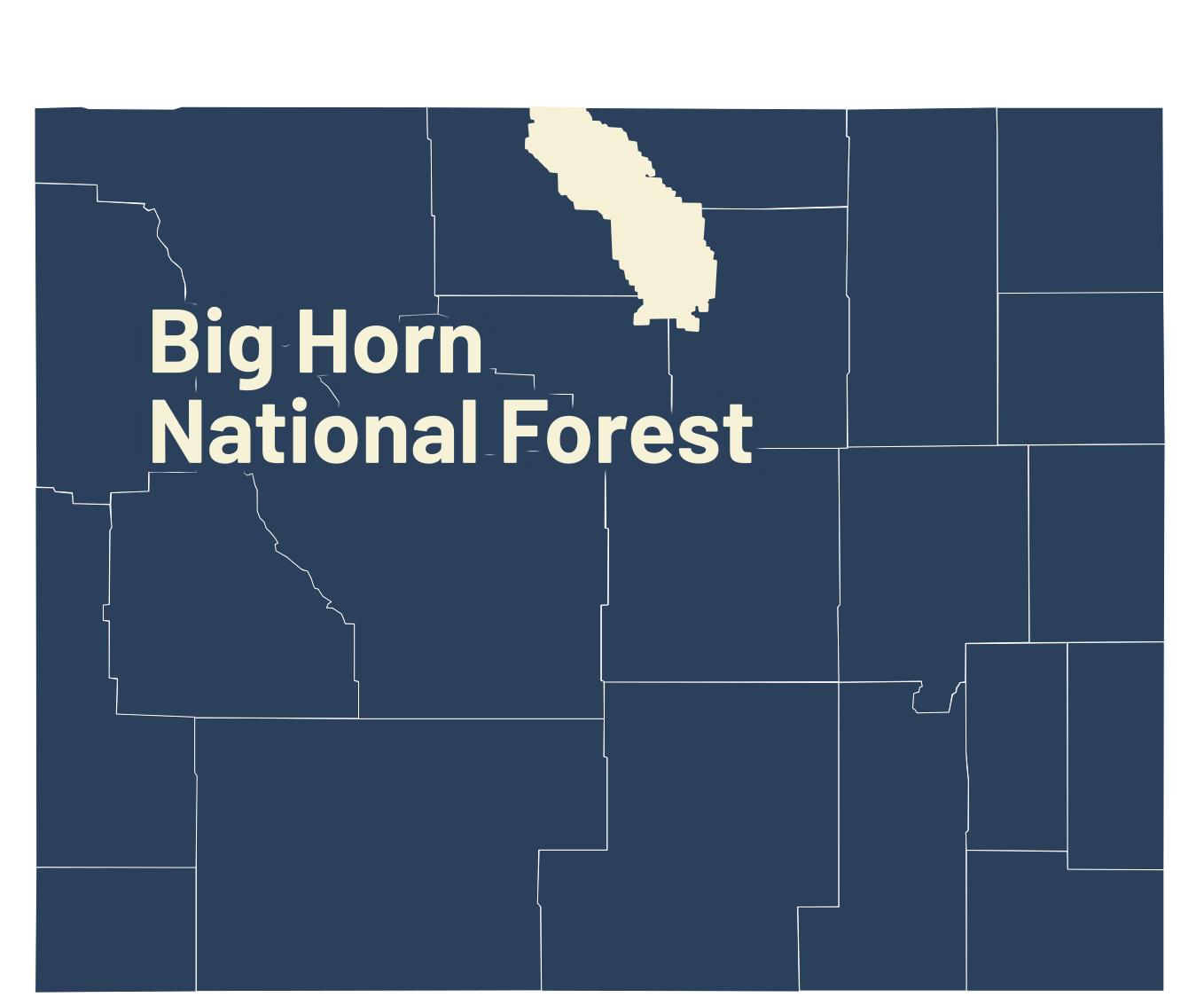
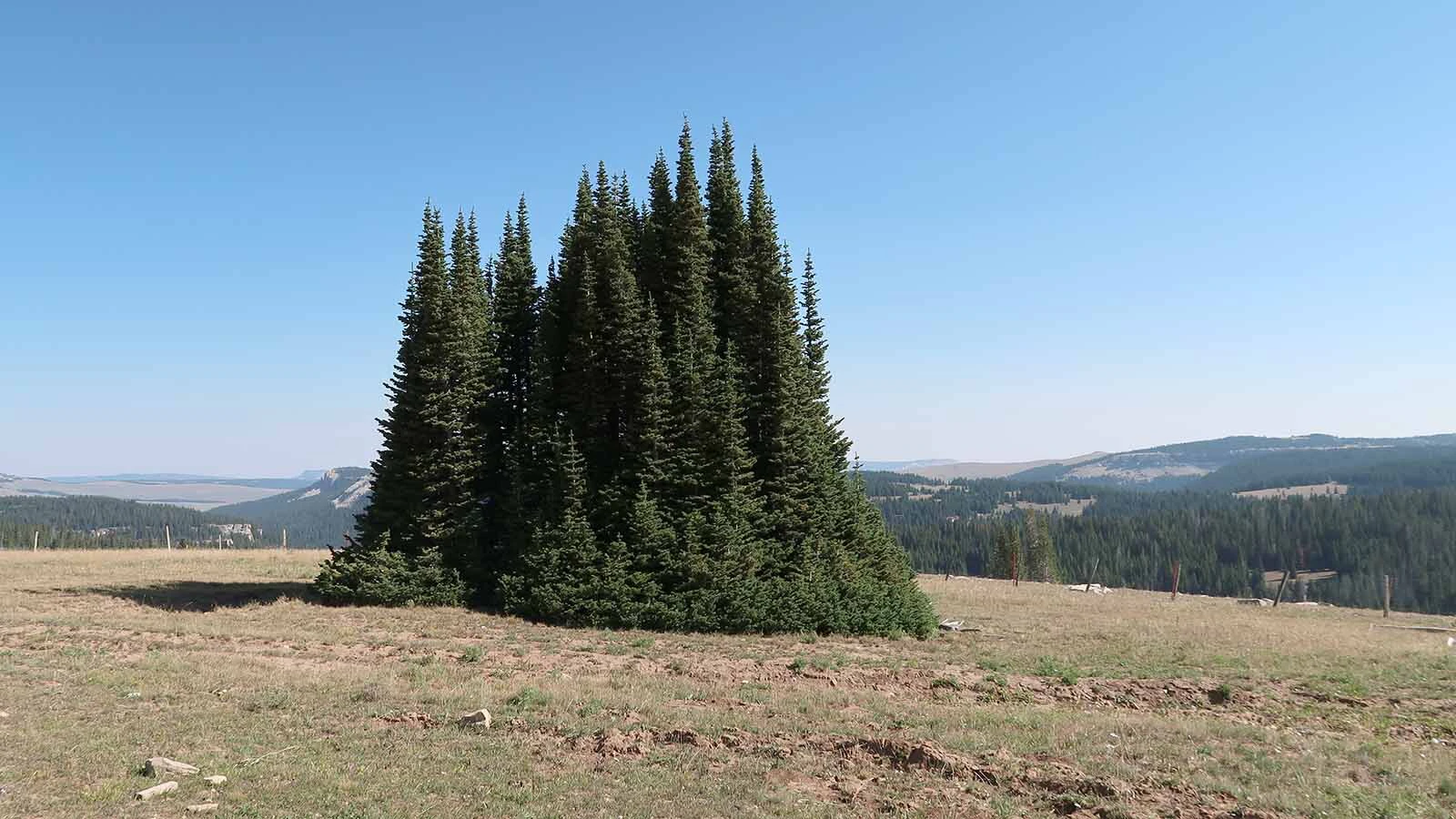
Wendy Johnson was driving through Granite Pass in the Bighorn Mountains when she noticed something beautiful and inexplicable.
“They were clusters of conifers, like an island in a sea of grass,” the Billings, Montana, woman told Cowboy State Daily. “I've been up there plenty of times, and I'd never noticed them before.”
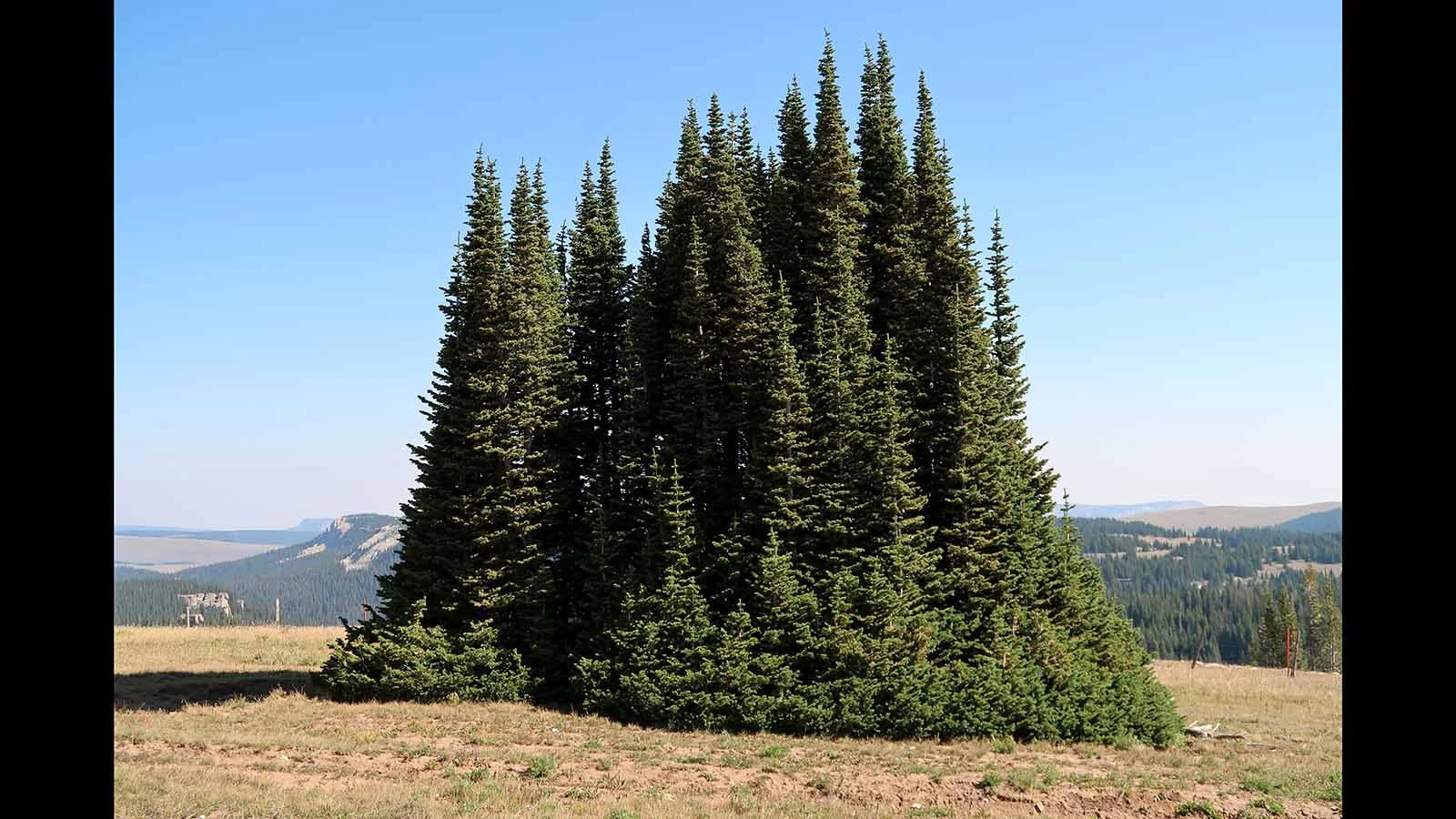
The “clusters” were sitting in the middle of fields and meadows, far from the expansive forests beyond. They consisted of several tall, mature trees in the middle, standing close together and densely packed, encircled by much smaller saplings.
“They looked like little fortresses,” Johnson said. “I didn't pay attention to how many I saw, but there were definitely other ones. I found them fascinating.”
With all the high-elevation forests in the Bighorns, why do these trees stand out in a crowd, and how did they get there?
F Is For Fir
Shane Smith, former director of the Cheyenne Botanic Gardens, saw Johnson’s photos of the conifer clusters and knew exactly what trees were growing there.
“It’s subalpine fir,” he said. “They look a lot like spruces, but they're different, and this is normal behavior for them.”
Abies lasiocarpa, the subalpine or Rocky Mountain fir, is an evergreen conifer that grows throughout the western United States and Canada. They’re most commonly found at high altitudes, which explains why they’re growing in the Bighorn Mountains.
According to Smith, it’s easy to determine the difference between firs and spruces. Just remember that fir starts with an “F.”
“If you think fir, you think flat, because fir needles are flat if you touch them,” he said. “The other F-word is flexible, because if you were to reach out and grab a fir branch, you could easily bend it 90 degrees, and it would happily bend with you.”
The flexibility of subalpine firs is an adaptation for windy environments. That’s why the firs have winged seeds, using the wind to propagate themselves in their high-altitude ecosystems.
Spruce, on the other hand, starts with “S.” Smith said that, in this context, “S” stands for sharp, square needles and stiff branches.
Now you know.
All In The Family
Johnson called the clusters of subalpine firs “islands” in the Bighorns. The scientific term for these clusters of trees is “atolls,” so she wasn’t far off.
Fir atolls are formed by a process known as layering. It’s a well-known botanical phenomenon in which stems or branches can promote root development while remaining attached to the main plant.
“It's a way the old trees can help the seedlings get established,” Smith said. “Some brave tree, that could be long gone or still in the middle of the cluster, germinated there and grew very slowly to a ripe old age, then started dropping pinecones and seedlings that took off in the sweet spot.”
Smith said subalpine firs struggle to grow in the granitic, rocky soil covering most of the Bighorns. When they find an optimal spot to grow, they make the most of it.
A telltale sign of a thriving atoll is where the seedlings are growing.
“You would think the seedlings would be like inside the (atoll) in total protection, but they're actually outside because they need more moisture and light,” Smith said. “They do get beat up by wind, but this is one species of evergreen that is really good with the wind.”
Over time, the atoll will slowly expand outward as more trees mature and saplings sprout. The firs will keep expanding until they’ve covered the entire patch of optimal soil.
“With the soils in Granite Pass, I don't think they're going to expand into full-fledged forests, but they're going to get bigger,” Smith said.
Fir Fungus
When Johnson first saw the subalpine fir atolls, she called them “colonies.” She stopped when she realized the atolls were probably different from the truly colonial aspens.
“I know aspen groves are produced because the parent tree sends up suckers that turn into other aspens that are all identical,” she said. “I don't believe all the conifers are growing from the parent's roots.”
The subalpine fir atolls aren’t colonies or clones of the same tree, but there actually is some communal sharing that helps them stay healthy. It’s all related to a fungus growing among all the roots in the atoll, called mycelium.
“If you've ever dug into some rich organic soils and saw some white material that almost looks like white ash, that's mycelium,” Smith said. “Through that fungal mycelium thread connection, trees can actually share nutrients. Even crazier, they can share information. They can communicate.”
When a subalpine fir is under threat from a browsing herbivore, usually a moose, they can exude substances that can deter the animals. Through a mycelial thread connection, that same defense mechanism can be triggered in every connected tree.
Smith called these subterranean fungal networks “the World Wide Web for trees,” which botanists are still trying to understand.
“We know how important these fungal networks are to our forests and trees,” he said. “Why would the fungal network want to become the fiber network? They might be taking some of the sugar and nutrients passing between the trees, which would be a fair trade.”
So, referring to these atolls as colonies isn’t that far off.
“I'd bet the house that the mother trees are connected to the baby trees and connected to each other,” he said. "It’s an amazing symbiotic relationship.”
Networking For Success
With the inherent adaptability of subalpine firs and the important mycelial thread, the atolls in the Bighorns can be extremely resilient. According to Smith, each atoll provides an ideal environment for all current and future trees to thrive.
“They create their own microclimates,” he said. “With these dense little islands, they can slow down the wind and catch the snow. That’s how they survive in areas where hardly any other conifers grow.”
The main threat to these subalpine fir atolls is the same one that could devastate flora and fauna throughout the Rocky Mountains: climate change. For Smith, it’s a serious concern.
“I'm seeing many forests right now that are changing in my lifetime, and that's just in the last 10 years, 15 years at most,” he said. “Lower-altitude spruces are more susceptible to disease and bugs. Pines are more susceptible to drought. Some lower-altitude aspen forests I'm seeing are 50% dead.”
Right now, the high-altitude forests are the least susceptible to these climate-related changes, but they won’t be immune forever. Their habitable range could shrink over time as the climate gets warmer and water becomes scarcer.
That’s why Smith is happy to see these subalpine fir atolls enduring.
“Let's hope these subalpine firs keep expanding and making new islands,” he said. “It's really fun when you come across them.”
Andrew Rossi can be reached at arossi@cowboystatedaily.com.