
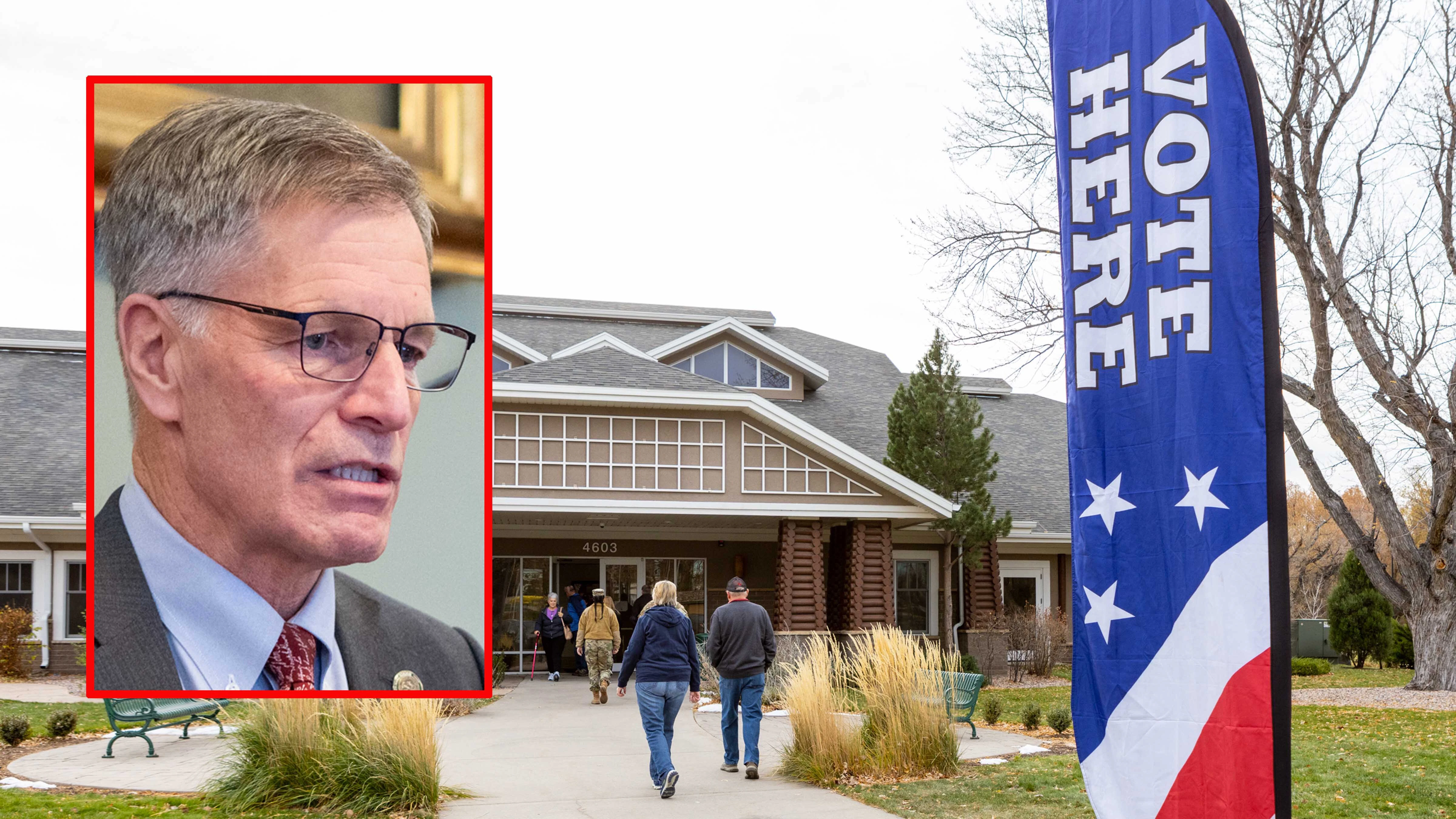
It’s too early for Gov. Mark Gordon to consider litigating over what he’s described as “aggressive” behavior by federal poll monitors in last Tuesday’s primary election, the governor told Cowboy State Daily on Thursday.
Gordon has referred his concerns about the federal poll monitors’ behavior to the Wyoming Attorney General’s Office for further review, he said.
“You know, it’s a little bit early to think about (litigation),” said Gordon in a Thursday phone interview. “I want to, kind of get to the bottom of what I understood some of the disruptions might have been, and get a better sense of what happened.”
Gordon said he found it irregular that Wyoming Office of Homeland Security Director Lynn Budd said, during a briefing on the election’s security and rollout, that she hadn’t heard about the federal operation before it happened.
“Which was a surprise,” said Gordon. “Because normally whenever we conduct an election, it’s pretty much all hands on deck.”
As for the federal agents visiting, by Gordon’s count, at least six of Laramie County’s seven polling stations, “We were delighted to let them participate as observers,” said the governor.
“But as ‘monitors,’ as per Wyoming state law, they weren’t allowed to go interview voters; they weren’t allowed to check the tabulators,” Gordon said.
A description of the visits by Laramie County Clerk Debra Lee describes the federal monitors trying to do both those things.
“Those are the sorts of things that could potentially put an election at risk,” said Gordon.
The governor questioned why, if the federal government had concerns about Wyoming election officials’ training and operations, its agents didn’t ask those before the busy election operation.
“It could have been done in advance, in a far less disruptive way,” he said.
Gordon said it surprised him that the Trump administration would be concerned enough about Wyoming’s elections to send monitors.
“I’m really shocked,” said Gordon. “I mean this is the state that went overwhelmingly (for Trump) more than any other state.”
‘Poorly Managed Exercise’
Lee called the federal officials’ visit “a poorly managed exercise and one that showed complete disregard for our state laws and administration of our elections.”
In a statement, Laramie County Clerk Debra Lee described a visit by two federal officials who didn’t show their credentials at first, then tried to launch a short-notice monitoring operation during “extremely busy times” at the poll station.
In response, the U.S. Department of Justice referred Cowboy State Daily back to a statement it distributed July 27, warning non-citizens not to vote, and another one dispatched the afternoon of primary election day announcing the monitoring operation.
The DOJ’s Thursday email to Cowboy State Daily includes a quote by Darin Smith, U.S. Attorney for Wyoming.
“Voters deserve absolute confidence that their ballots are secure and their voices are heard without interference,” said Smith in the email. “The DOJ worked alongside local officials to ensure every lawful vote was protected. We do not comment on internal operational timelines, but the deployment was fully aligned with our stated mission to protect the vote.”
From The Top
The U.S. Attorney’s Office announced in an election-day statement that it was coordinating with the DOJ’s Civil Rights Division to monitor polling sites in Wyoming “to ensure transparency, ballot security, and strict compliance with federal voting rights statutes.”
The statement goes on to reference a number of federal laws designed to protect voters’ access.
Cowboy State Daily received that statement via email at 2 p.m. on election day – five hours before the polls were to close for the day and seven hours after their opening.
Lee’s account of that operation paints an intrusive picture.
She said that on primary election day, two people who said they were U.S. Department of Justice election monitors told a county poll worker they were monitoring the election.
“They did not offer their credentials until I requested they do so,” said Lee. “Shortly after learning of their presence, I spoke with a DOJ official in Washington who informed me that the decision to deploy monitors to Wyoming was made on short notice, and an email had been sent to me, but it may have gone to the wrong address.”
According to Lee, the federal official said the Wyoming Secretary of State’s Office had also been notified.
“I was informed the monitors were sent to assess compliance with federal civil rights and voting rights laws,” said Lee. “To do this, they intended to interview voters. We do not allow interviews to be conducted in polling places, so this was denied.”
Lee said the monitors arrived “at extremely busy times when our poll workers were attempting to register, check in, and assist our voters in exercising their right to vote.”
Lee said the DOJ’s questions seemed, to her, to be outside the scope of federal voting-rights laws. They probed about the nature, length, and timing of poll worker training.
They asked for training guides, asked how the new election equipment was acquired, and wanted to examine the clerk’s tabulators, Lee added.
“Wyoming law does not specifically allow election observation, except by certified poll watchers, who are authorized to observe registration and turnout,” she added. “Wyoming law has no provision for election monitoring. This was a poorly managed exercise and one that showed complete disregard for our state laws and administration of our elections.”
The Governor Takes The Next Step
The State Canvassing Board comprising all top statewide elected officials except the superintendent of public instruction met Wednesday to certify the results of state races.
Gordon told the secretary of state’s election director, Paul Raines, that he’d learned election morning that the DOJ had sent observers to polling places in Laramie County.
“Were you aware of that prior to Thursday morning?” asked the governor.
“Our office had received an email,” answered Raines. “But that’s the extent of the communications I’m aware of.”
Gordon said he’d heard from Wyoming Office of Homeland Security Director Lynne Budd that she was unaware of the operation, and so were Attorney General Keith Kautz and at least some of Wyoming’s clerks.
“Sounds like the behavior of the observers was a bit aggressive,” continued Gordon. “It was just irregular, and I have asked the attorney general to start looking into the nature of all this.”
Kautz told Cowboy State Daily on Thursday he could not comment at this juncture.
In the Wednesday meeting Secretary of State Chuck Gray countered Gordon, noting there had been a news story announcing Smith was working with the election observers.
Gray said state law provides for observing the election process, and “transparency is so important,” as is accountability.
State law only carves out provisions for observation by designated poll watchers, who are selected by the chair of each county party; who must belong to their respective parties and must be registered electors living in that county.
Gordon said he didn’t think anyone was objecting to observers.
“I think it was when they were asserting that they were monitors, and the particular statutes they spoke to were Americans with Disabilities and Civil Rights actions.”
Gordon said he feels strongly about the notion of the federal government “coming in and taking our guns.
“I don’t like that; I don’t like the federal government coming in and taking our votes either.”
Neither the governor nor Gray, both Republicans, mentioned this in their brief back-and-forth, but the Wyoming Republican Party platform bears on the topic.
The 23rd plank of the state party’s platform says:
“The Wyoming Republican Party opposes any federal takeover or interference of federal, state, or local elections.”
In his interview Thursday, Gordon answered a question about any preparations he might make to curb potential disruptions or intrusions at the Nov. 3 general election, by noting that the secretary of state is, rather, tasked with overseeing the statewide elections.
Gray reiterated in a Thursday email that the law allows for public observation.
He said observers “have been sent to most if not all states.”
“The law also tasks the clerk with ensuring that there are no disruptions at polling places,” continued Gray, adding that it is clear Lee’s office followed that law in keeping the polling place orderly, “while also allowing observation.”
States V Biden
Missouri and Texas challenged President Joe Biden’s administration on this kind of monitoring ahead of the 2024 presidential election, which pitted then-Vice President Kamala Harris against President Donald Trump.
Missouri’s complaint read, “For the second election cycle in a row, the Department of Justice, at the 11th hour, has announced an intent to displace state election authorities.”
The state emphasized that the states retain the power to run their own elections, “absent clear federal authority.”
Texas’ then-Attorney General Ken Paxton had accused Biden's administration of engaging in a "lawless intimidation campaign" by sending federal agents to state polling and counting locations without authority to do so.
Both states sued to block the federal agents from monitoring their polling sites, but a judge cleared the DOJ to send the monitors.
A Little Law
Wyoming law allows for poll watchers: one from each political party or extras if the clerk deems it won’t be disruptive.
State law also bans “disturbing a polling place” and “interfering with the orderly conduct of an election.”
Breaking that law is punishable by up to six months in jail and up to $1,000 in fines.
The DOJ's election-day statement had invoked federal laws rather than state.
Those were the Voting Rights Act, National Voter Registration Act, Help America Vote Act, Uniformed and Overseas Citizens Absentee Voting Act, the Americans With Disabilities Act, and the Civil Rights Acts.
Clair McFarland can be reached at clair@cowboystatedaily.com.


