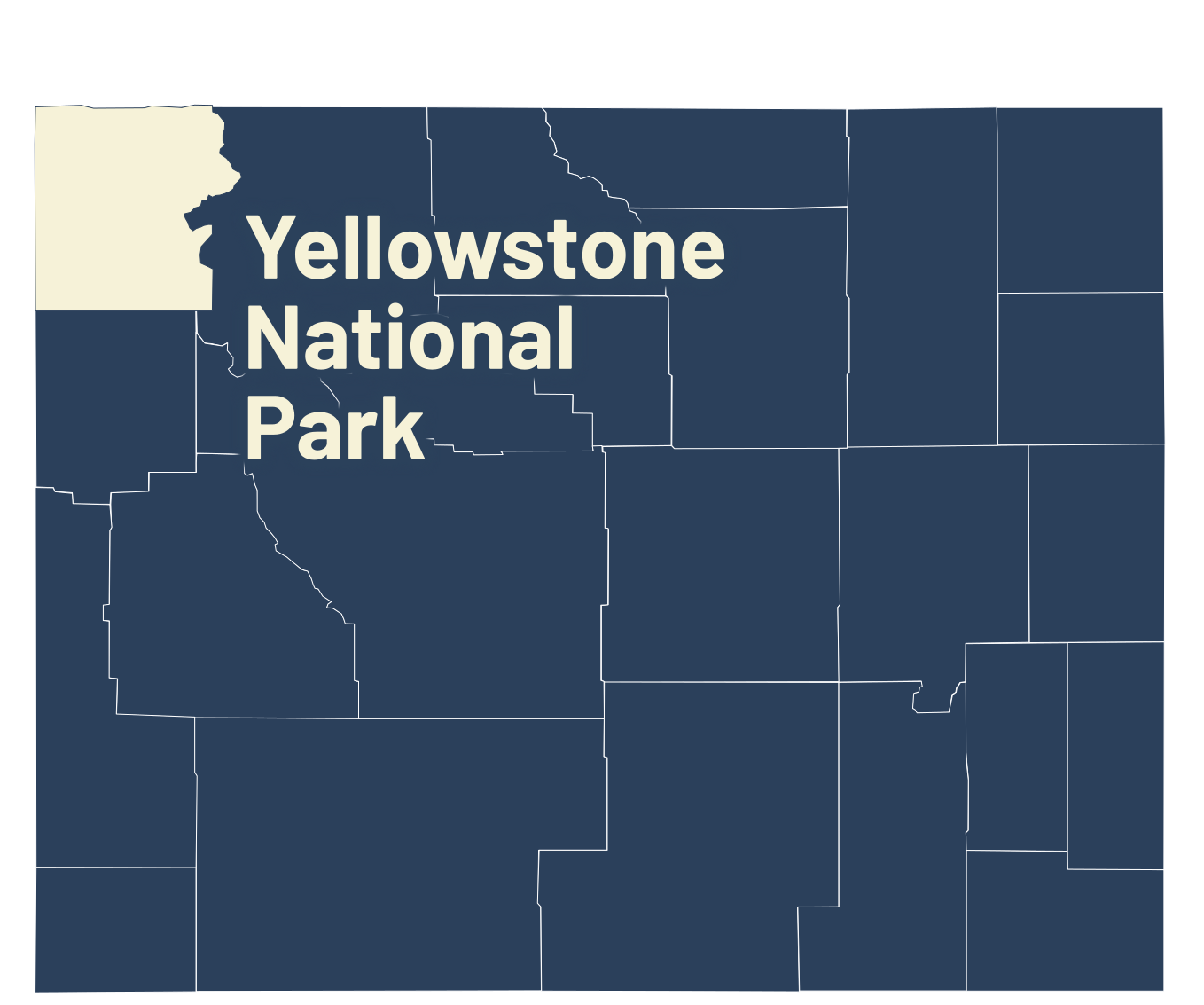
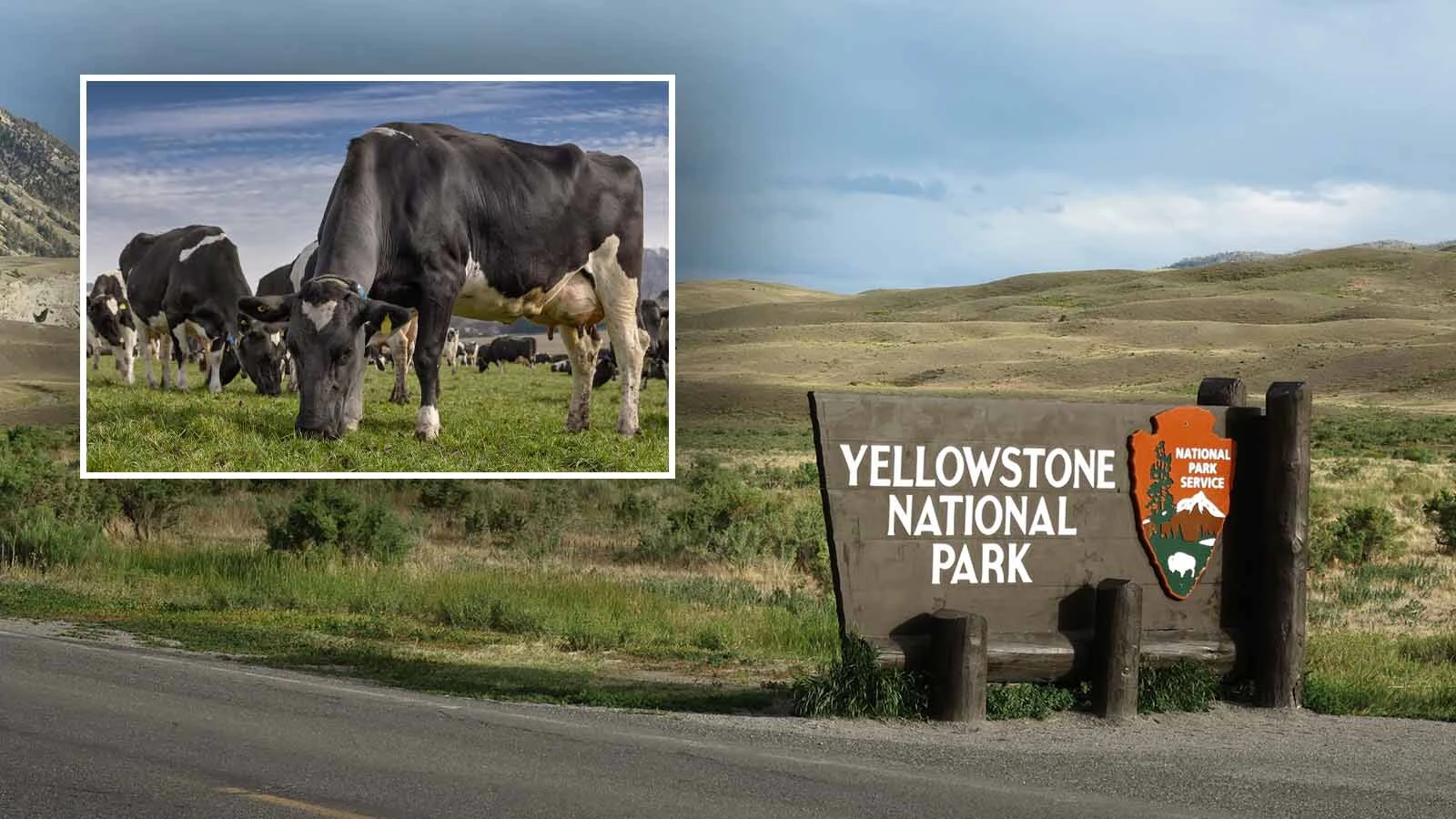
A herd of cattle inadvertently broke into Yellowstone National Park earlier this week, grazing where no cattle have grazed for more than 120 years.
Adam Bronstein, the Oregon director of the Western Watersheds Project, was visiting southeast Idaho on Monday when he was “woken up” by 25 cattle that were outside their federal grazing allotment on the Caribou-Targhee National Forest. They had wandered past signs and into the park itself.
“There are all sorts of signs of cows in Yellowstone,” Bronstein said in a video. “They’re trespassing. This is one of the only cow-free places in the lower 48 on public lands.”
It was soon discovered that this was an inadvertent act of trespass. The Western Watersheds Project posted an update Tuesday saying the situation was being addressed.
“The U.S Forest Service has contacted the permittee and is actively retrieving the cattle and repairing the fence,” they said. “No need to keep calling (but) thank you to everyone who did.”
Cowboy State Daily could not reach Bronstein by the time of publication, and the Western Watersheds Project had no additional information on the incident.
Where’s The Beef?
The debate on federal grazing permits on public lands has been ongoing for decades, but commercial livestock grazing in Yellowstone has been prohibited since the early 1900s. That’s what made the response to Bronstein’s discovery so immediate and intense.
According to the Western Watersheds Project, the cattle found in Yellowstone were privately owned livestock being grazed under a federal permit. The cattle wandered out of the national forest and into Yellowstone due to a fencing failure.
Federal grazing is permitted throughout the Greater Yellowstone Ecosystem but is strictly prohibited within Yellowstone.
“There is a historical antecedent for cattle inside the park,” said Jeff Henry, an author, historian, and former Yellowstone ranger. “Early-day concessionaires had pretty large herds of both beef and dairy cows inside the park.”
Livestock grazing was forbidden in Yellowstone because it was understood, even in the early 20th century, that it would be detrimental to native wildlife. Cattle would compete with near-extinct bison, and that was deemed too great a risk.
That doesn't mean the decision to ban grazing permits was popular or accepted.
When Jackson Hole National Monument, now Grand Teton National Park, was established in 1943, a group of armed ranchers deliberately escorted 500 cattle into the area to protest the loss of federal grazing rights in the Teton Valley.
The posse included future Wyoming governor and U.S. Sen. Cliff Hansen and Wallace Beery, a popular actor who appeared in several Western films.
Lester Hunt, the Wyoming governor at the time, threatened to remove "any federal official who attempts to assume authority in the monument area.” The National Park Service didn’t do anything to stop them.
Tempers have cooled since then. Even Hansen later acknowledged he was “glad I lost that fight” after recognizing the value of Grand Teton National Park.
Adjacent Attitudes
Nobody is fighting for federal grazing permits in Yellowstone, but the surrounding landscape has been fraught with controversy for decades.
During his time as a Yellowstone ranger, Henry didn’t have any encounters with cattle ranchers. He did remember a few close calls with sheep herders.
“I do have vague memories of sheep coming into the Bechler area a long time ago,” he said. “At one time there was a lot of sheep grazing in the area outside the southwestern corner of Yellowstone.”
Henry said that was one theory why bears were scarce in southwest Yellowstone for many years.
“Sheep herders were more than ready to shoot any bears they saw anywhere near their flocks,” he said.
Cattle First
In September 2025, a federal court ruled that the expansion of six grazing allotments in Montana’s Paradise Valley, just north of Yellowstone, violated the law by failing to fully explore how these expansions would impact the grizzly habitat they’d have been moving into.
The successful plaintiff in that lawsuit was the Western Watershed Project.
Most recently, the Bureau of Land Management rescinded seven grazing allotments held by the American Prairie nature reserve in central Montana. The allotments were intended for bison grazing and were rescinded in May in favor of cattle-only permits.
All bison on these public allotments must be removed by Sept. 30. American Prairie has appealed that decision.
“The BLM has decided to revoke our permits because they claim that the Taylor Grazing Act does not give them the authority to issue grazing permits unless the herd is managed for ‘production-oriented purposes.’ The BLM has said our herd does not meet that ‘production-oriented’ standard,” American Prairie said in a May 8 statement.
One of the biggest motivators to keep federal grazing allotments restricted to cattle is the potential spread of brucellosis. A 2013 study by the Centers for Disease Control and Prevention found brucellosis in 13 beef cattle herds and four bison ranches in the Greater Yellowstone Area between 2002 and 2012.
Henry found that the concern was “ironic,” given Yellowstone’s history.
“One theory as to how brucellosis was introduced in the park is that cattle originally brought the disease to bison and other species,” he said. “Nowadays, the bison are captured or killed when they venture out of the park, ostensibly to protect cattle from that very same disease. That’s quite the irony.”
Yellowstone has and will likely remain free of cattle and other livestock, but the conflicts over grazing permits in the Greater Yellowstone Ecosystem are older than the park itself.
As long as cattle, sheep, and other livestock graze in the lands adjacent to Yellowstone, there’s always the chance they’ll find a downed fence or an open gate and end up where they shouldn’t be.
Yellowstone's Burger King
Henry, who’s worked in Yellowstone for more than 50 years, has never encountered a cow within the park's boundaries, but he could recall one incident in which a bovine was found trespassing and was summarily dealt with.
“In 1985, a lone steer somehow appeared along the Firehole River, downstream from Old Faithful, all by himself,” he said. “How he got so far inside the park before he was discovered, nobody knew.”
The steer’s welcoming party was a group of rangers from Old Faithful. It was shot on sight.
“They shot him and left his carcass in the woods,” Henry said. “I guess it doesn't matter that I'm spilling the beans on that one 41 years later.”
Andrew Rossi can be reached at arossi@cowboystatedaily.com.