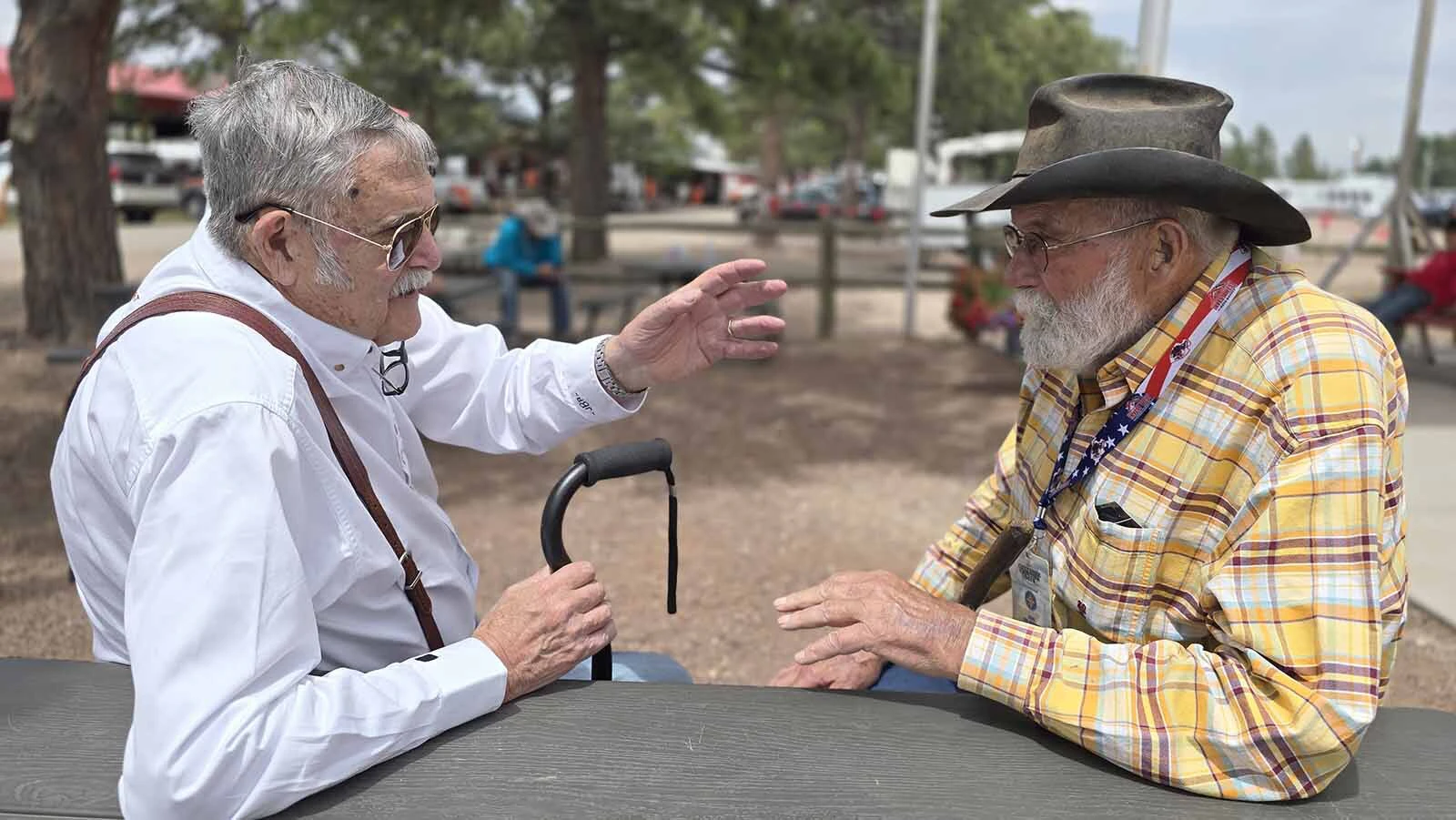
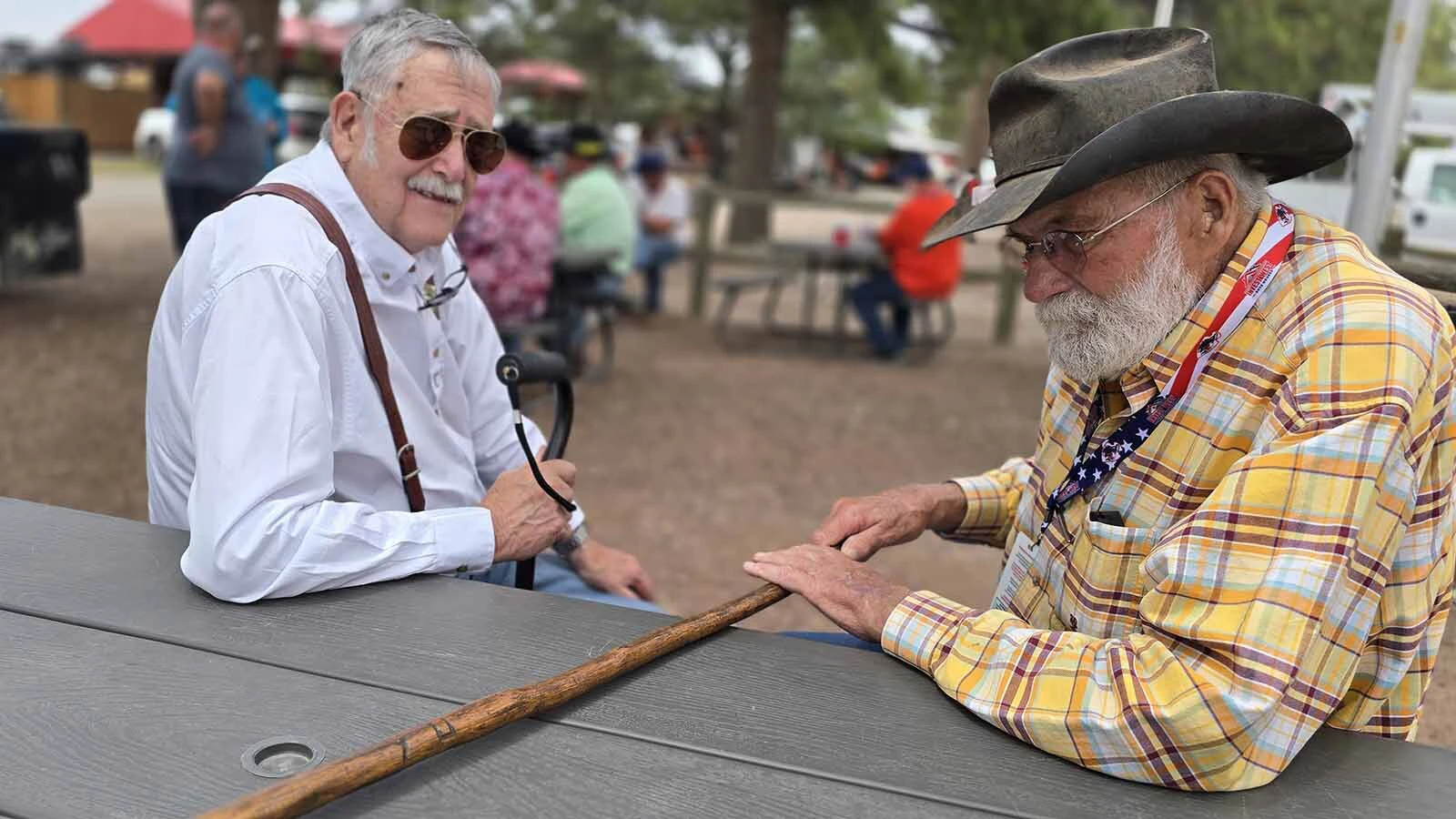
On a hot July afternoon at Frontier Park, two brothers sit side by side sharing a drink and decades of memories.
The Brewster brothers, John and Bill, are among Cheyenne Frontier Days longest-serving volunteers, starting in 1962 and 1959 — if you don’t count the years when they helped their dad, who was Indian Chairman at the time, shuttle Princess Blue Water around.
“You remember dad on those Indian trips?” Bill asks with a chuckle.
“That doesn’t count,” John says, shaking his head.
“When was that? ’51 to?” Bill says.
“It was ’50 to ’52,” John replies.
Or maybe it was until 1953, Bill suggests.
They decide John has volunteered 64 years, while Bill has 70 years in all. That’s 134 years between them — longer than Cheyenne Frontier Days has been around.
They laugh, as if at an inside joke.
The math all done, time has a way of blurring together, the Brewster brothers told Cowboy State Daily with a laugh and a shrug.
It’s been a time that’s full of story and family.
“Do you remember when those cowboys from the ranch used to come by?” Bill asked John. “They were all World War I veterans. They’d come by and drink a little whiskey and smoke cigarettes in the living room, and some of them still rolled their own. You know just being around cow people is … I’ve been a cowboy all my life.“
“Me, not so much,” John interjected.
“That’s OK,” Bill said with a chuckle. “I’ve got a picture of you on a horse. Saw it the other day.”
It’s proof, if nothing else, that John belongs the same way Bill belongs, in Cheyenne Frontier Days' unofficial pop-up city of volunteers, doing all the unsung jobs that keep this historic event rolling smoothly along.
For all the flashy cowboys, arena lights and concerts, it’s volunteers like the Brewster brothers who have become the real soul of Cheyenne Frontier Days, and not just for the work they do. It’s the stories they carry inside their heads.
They are a living archive of ranch hands, rodeo legends, and family moments that range from World War I cowboys to Indian trips with the likes of Princess Blue Water.
Fighting Custer
“I’ve got to tell the story about Dad bringing the Indians down,” John said with a chuckle.
Bill nodded his head to say, “Yes, please do,” and his eyes had a twinkle.
“Dad was Indian Sheriff, and they used to bring the Indians down in open trucks from Pine Ridge,” John said.
“They were just bobtail cattle trucks,” Bill added with a laugh.
“There were two who would ride with my father in a car,” John said. “They were Princess Blue Water, Rose Ecoffey and Joseph High Eagle. He was the last surviving combatant in the Custer massacre. He was 15 when he fought Custer.”
High Eagle would often try, in a mixture of sign language and Oglala Sioux, to tell the Brewster brothers’ dad about the fight.
“Rosie’s in the middle,” John said. “And Dad’s driving.”
“No, no,” Bill said. “I’m sitting right behind High Eagle, and she’s sitting right next to me in the back seat. And he starts in with sign language, and maybe Oglala too, talking about the Custer massacre, trying to tell my dad about it.”
Except, he claims that the Indians just had arrows, which the Brewster brothers believe to be false.
“They had rifles better than we had,” Bill said. “They had all Winchesters and we had our Henrys. We had single shots.”
The conversation at the time was making their dad uncomfortable, John recalled.
“Dad kind of gave this look, like, ‘Really?’ ” John said with a chuckle. “And Rose said, ‘You’re safe. He likes you.’”
Princess Blue Water And The Prince
Ecoffey was an amazing woman, Bill added. “She was blind in one eye,” he said.
John and Bill have both personally heard her tell the story of how she came to slap the Prince of Wales.
Blue Water was 7 years old, according to family legends, and told Queen Victoria her people would bow to no one.
“She told us they had been introduced at the court of Queen Victoria, and she said, 'I only bow to the president,’” John said. “And Edward the Eighth was standing there and he laughed.”
Ecoffey had thought he was laughing at her in that moment.
“So she slapped him, and he laughed all the harder,” John said. “And she said, ‘When we got back to the hotel, let me tell you what my father did to me!' She got into trouble for that.”
Ecoffey frequently visited the Brewster family whenever she was in town.
“She and my mother were great friends,” Bill said, wrapping one finger around another. “They were close. They’d come to the house and they’d bring a couple cartons of cigarettes and sit around the garden to smoke. They’d all be in costume.”
Bill still has a photo of Princess Blue Water sitting in the garden with other members of the tribe such as Charlie Red Cloud, Frank Afraid of Horse and Levi Sitting Hawk.
It’s A Family Tradition
Stories like that might not show up in a rodeo program, but they’re part of the living memory Cheyenne Frontier Days’ longtime volunteers have built around the event in the process of volunteering year-in, year-out.
For people like the Brewster brothers, Cheyenne Frontier Days isn’t just another event on the calendar. It’s the main event.
Pulling on a pair of cowboy boots and slapping on a cowboy hat to help run the rodeo in Cheyenne was simply what you did in the summer when you lived in Cheyenne — for generations running.
“It’s just part of life,” John said. “It’s part of summer. As far back as I remember, our mother was a member of a ranch family and our grandfather was on the Frontier Days parade in the '20s, so it’s family here, it really is.”
“Our dad rode a caisson in the arena here with the Black Horse Battery,” Bill said. “That was a wagon behind the horses and attached to that was a cannon.”
Over the years, the Brewster brothers have quietly done just about every job a volunteer can do. Bill started out driving parade wagons and later shifted to the carriage ranks, then worked around the chutes, and even recited the Cowboys’ Prayer on the last Saturday of Frontier Days.
“That’s on the final Saturday,” John said. “The rodeo stops. They read all the names of the volunteers, cowboys, anybody involved with ranching that has passed away, and then they recite the Cowboys’ Prayer, and Bill would do that.”
“I’m only the fifth guy who ever did it,” Bill added. “Well, there’ve been a couple in between. I’m not going to be doing it this year, I’ll do it again next year.”
John spent time doing the “car count” in the early 1960s, tallying up license plates by state so the announcer could tell the crowd how many people had come from which state. Then he moved into parades and contract acts, helping juggle wagons, floats, queens, VIPs and the Grand Entry.
These days, he hammers out the entire parade lineup, and he’s the guy behind the 10-gauge blank cannon that booms to officially start the parade.
Between them, they’ve stitched together a lifetime of jobs that rarely make headlines, but are still essential to keeping the Daddy of ‘em All on track. To them, it’s just another summer in Cheyenne, but it means the world to an event that’s celebrating 130 years of rodeo.
Renée Jean can be reached at renee@cowboystatedaily.com.