
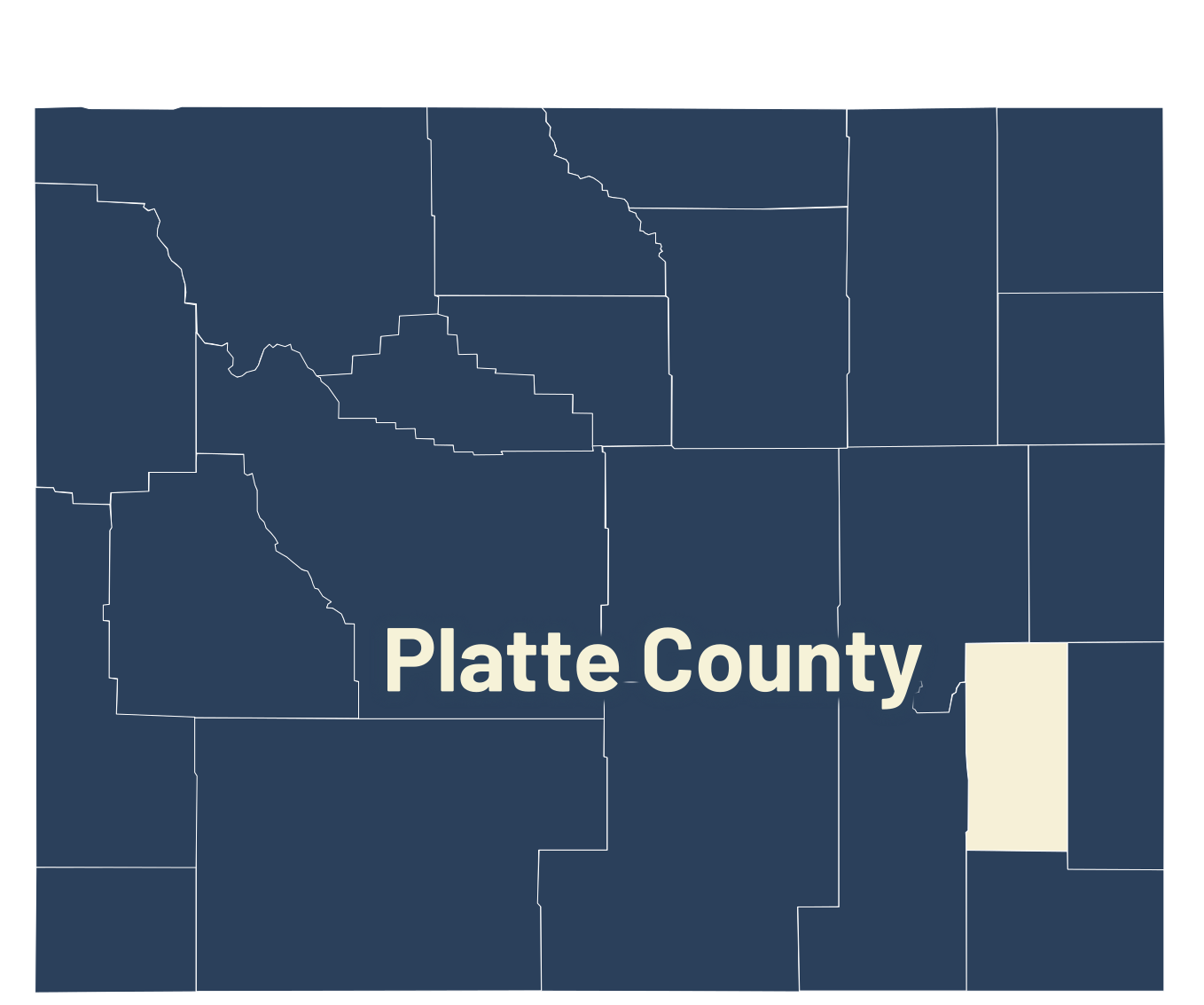
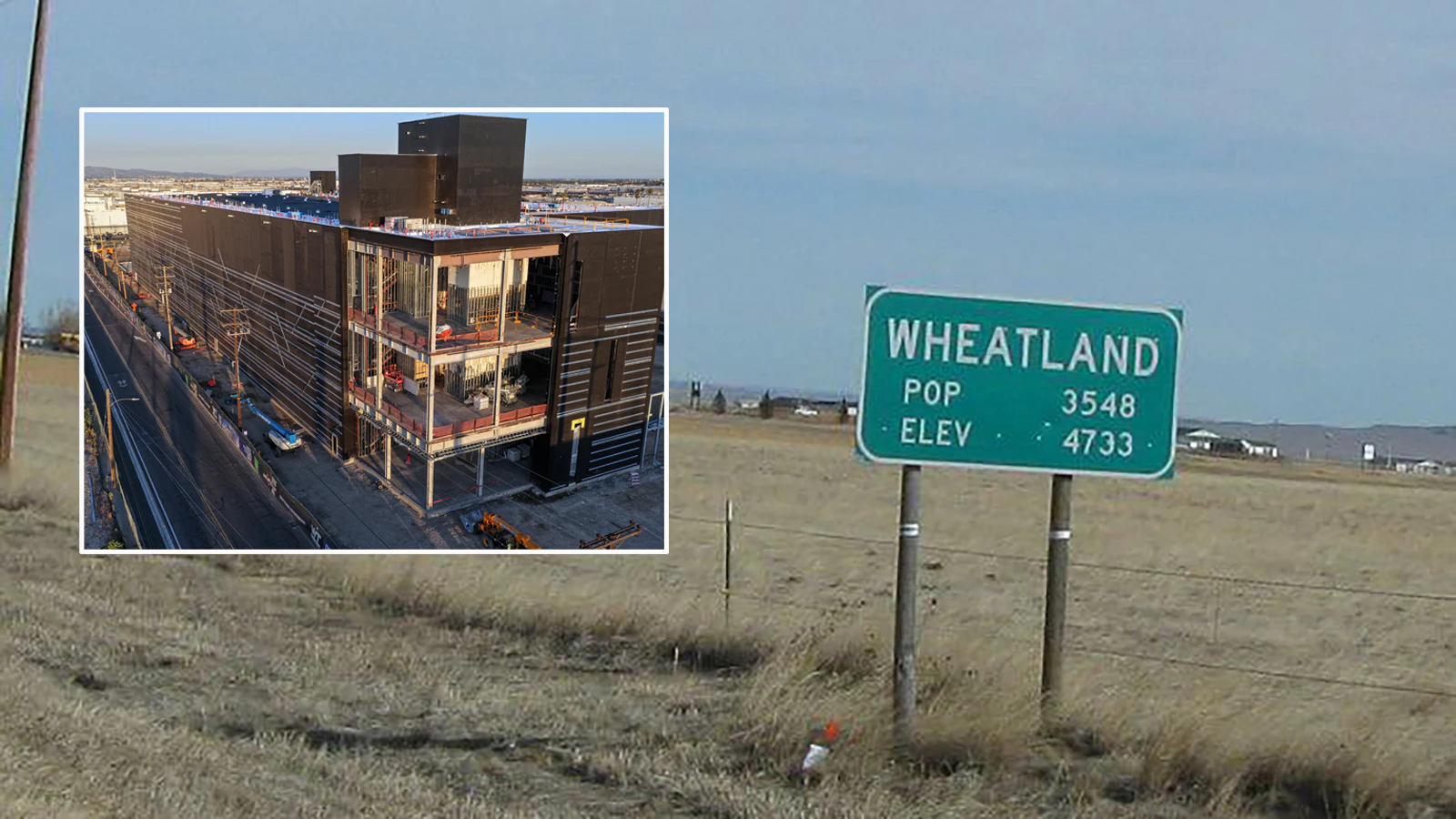
A massive data center and power generation complex is being proposed for 5,344 acres of ranchland northeast of Wheatland in Platte County near the Goshen County line, on property owned by the Lazy V Six Ranch.
The developer, a company called Site Layer 4, has filed an application to rezone the land from agricultural to industrial for what it describes as a $26 billion data center campus with co-located, utility-scale energy generation. The property is roughly 13 miles east of Interstate 25, in an area now used for grazing and agriculture.
Public hearings for the rezoning have been set for 7 p.m. Aug. 11 before the Platte County Planning and Zoning Commission and 10 a.m. Aug. 20 before the Platte County Commission.
Site Layer 4 says in its application that the project would be built over multiple years and is designed to concentrate infrastructure in one unified location.
Residents who live around the Goshen Hole Rim say that location also happens to include springs, mule deer habitat and big-sky views their families have cherished for generations.
Limiting Data Center Sprawl
In its application, Site Layer 4 describes the Wheatland project as a long-term phased industrial campus that could scale with market demand.
“Rezoning the proposed project area would allow well-planned large-scale industrial development in an appropriate location, and protect private landowner rights to use property for business and economic purposes in a manner reasonably balanced with regulatory oversight,” Site Layer 4 wrote in its application.
Site Layer 4 also emphasizes that the project area represents less than half of 1% of the acres devoted to ranching and agriculture in Platte County.
“The project area has been selected specifically because it enables development of a unified, co-located facility, limiting potential sprawl of infrastructure and associated regional impacts,” the company added. “The project area has access to critical grid interconnection and other necessary existing infrastructure, is separated from residential uses and public spaces, and is visually buffered via topography from the community of Wheatland.”
Site Layer 4 further promises that the campus would include stormwater drainage and other environmental controls consistent with local, state and federal requirements, and would “prioritize environmental protection and effective mitigation of potential environmental impacts.”
Goshen Hole Rim’s Micro-Climate
That might sound good on paper, one of the project’s neighbors, George Gamblin conceded. But, he said, the project’s footprint falls within a dramatic and scenic portion of Goshen Hole where Platte County’s plateau drops hundreds of feet into canyons and draws before flattening out again across Goshen County.
“You can see clear into Nebraska from here,” Gamblin said. “You can look all the way across Goshen County.”
The area is a unique land feature for the area, a place where there are plants and animals that probably should not be there, and would not be there, but for a micro-climate that’s supporting what would typically need more water.
“I probably have a couple hundred acres of pine trees on my little property that are not even really supposed to be there,” He said. “I think it’s about a 12-plus precip zone, and they’re not even really supposed to be growing there. But some of these trees are probably 100-plus years old. And they contain a lot of birds and things like that, which typically don’t exist in this area out here in the plains.”
Gamblin’s family has been in the location for close to 90 years.
“I live on Goshen Hole Rim, which dissects Platte and Goshen counties,” he said. “And in places, from the rim to the bottom is anywhere from I don’t know, 400 to 600 feet that drop and what you have in those canyons, there’s a lot of varied habitat.”
Ponderosa pine, mountain mahogany and little riparian areas near the natural springs that come up in the bottom of the canyons lie within a half to three-quarters of a mile from the proposed rezoning.
“Some of the wildlife we have out there — it’s pretty amazing,” Gamblin said. “I had some professional birders come out and they got I believe over 40 species of birds in like seven or eight hours walking along the rim.”
There’s also a diversity of wildlife, including elk and mule deer, as well as occasional mountain lions — which Gamblin noted wasn’t mentioned in the wildlife portion of the application.
“There’s just any number of things that are very unique to Platte County, and especially this part of Platte County,” he said. “So I would like to see, at the very least, some kind of buffer for that kind of habitat.”
From his place, much of the proposed industrial zone would sit less than a mile and a half away, with the rezoning boundary coming to within about a half-mile of his property.
“That’s a huge tract of land that’s going to affect quite a few people,” he said. “I understand private property rights and I respect them, but that needs to work both ways in my mind. You need to respect the neighbors. There’s no reason where they can’t protect Goshen Hole Rim and still probably have everything they need down there on the lessee’s land.”
Gamblin hopes if the project happens despite such objections, he hopes appropriate steps will at least be taken to protect water, wildlife and the view.
“I would rather not see it go in at all,” he said. “But I do understand the private property issue and I understand people wanting to make more money to benefit from it.”
Protecting Scarce Water Resources
Water and the view are the two biggest issues for Kathryn Stevens, who lives across the rim on the Chugwater Flats about 5 miles from the proposed industrial zone.
“We moved out here specifically for the wide-open space, for the landscape, for the beauty, because we wanted to be homesteaders,” she said. “We moved out here to appreciate the heritage of the land.”
The project has taken her and her family by surprise.
“I came from western Washington, where that land, which is really beautiful land, has been exploited,” she said. “And it’s so sad to see that. I just shudder to think of that happening here in an area that’s in many ways kind of untouched. I can look out my window and see for 40 miles, and I don’t know what would compel somebody to destroy that or put a huge building there. I just don’t understand that.”
The family, like their neighbors, all depend on domestic wells for water, so how much water the data center might use is her biggest concern.
“Everybody knows we’re in a drought,” she said. “Farmers are plowing under their wheat because it’s too low to even harvest and a lot of farmers didn’t even plant this spring. We are an ag community. Water is life. If you don’t protect your water supply, you’re going to be real sorry.”
The flats have no access to municipal water, Stevens added.
“The people who live here rely on their wells solely,” she said. “If our wells were to go dry or become intermittent, then we wouldn’t be able to live up here. Like, there’s no alternative, and you also wouldn’t be able to sell our land for anything.”
Modest Water Use, Jobs Transformational
The developer’s documents say the data center will use a closed-loop system to minimize water use. Its annual water use would be comparable to that of 25 to 30 residential homes, which Platte County Economic Development Executive Director Josephine Young characterized as watering about 5 acres of hay a year.
Young said she’s fielded phone calls, emails and social media posts about the project, some of which are mixing concerns for Wheatland with stories from Georgia and Cheyenne.
She hopes residents will zero in on the specifics of Site Layer 4’s project and judge the project on its merits.
“I’m sure you’ve been to Wheatland plenty of times,” she told Cowboy State Daily. “There’s a lot of vacant buildings. I think something everyone can relate to is wanting a place where their kids can come back to. I have an 8-year-old little girl, and I know we don’t want to lose our small-town culture, but we also want to thrive.”
Contrary to what some social media posts have suggested, the data center would offer between 250 to 300 permanent positions, which she said is “massive” for Wheatland.
“I mean, that would be one of our largest employers,” she said. “So I guess, if I could plug one encouraging statement, it would be to judge each project on its own merit and application, versus what Google says or what a standalone data center might offer versus one with power generation, because that does change a lot.”
The project, Young added, is in its infancy right now, and its application to rezone is just the first step of many to come. The application also doesn’t mean the project is necessarily a “done deal” either.
If it does come about though, the community benefits have potential to be “transformational.”
“I think the sales tax revenue would, gosh, triple our county budget,” she said. “It would be an influx. And I keep trying to tell myself, like when Laramie River Station — Basin Electric — came in, there was a lot of contention around it and now it’s the lifeline of our county.”
Commissioner ‘Agnostic’ — For Now
Platte County Commissioner Ian Jolovich told Cowboy State Daily he’s keeping himself at arm's length from the project, at least until the rezoning formally lands before the commission.
“I make a point to let the planner do — to not insert ourselves into the deal and to let them make an unmolested decision at the planning and zoning commission level,” he said. “I do know what’s coming down the pipeline but, typically, that’s how I feel like you get to muddy, if you start digging around too early.”
Commissioners will get a “full staff briefing” in time for the meetings, and until then Jolovich plans to stay “agnostic” about the project, though he did add that he is typically “for private business.”
“There’s some good and bad in everything,” he said. “So just find the good and regulate or treat the bad.”
Water will be a big issue to Jolovich as well, he confirmed.
“I’m in agriculture so I have a different perspective on water and its uses and whatever else,” he said. “Basically, what we do is we turn water and sunlight into beef, and so, when there’s no water, you can’t make beef.”
The nearby Laramie River Station power plant already uses 18,000 gallons of water per minute, which dwarfs the data center’s projected use.
“The water issue is almost a solved problem to me,” he said. “The biggest issue with water is what happens to the stuff that is wastewater … So I’m interested to see what wastewater treatment practices and force majeure practices are, if say, something goes wrong, act of God, and something gets out and gets into the aquifer or whatever.
"That’s more of a detriment to the existing water supply. It’s not the use of it. I think they’ve got the use dialed down.”
Like Young, Jolovich, too, worries about young people leaving Platte County in the search for better job opportunities.
“I want more productive people in Platte County,” he said. “Our people are very productive, but we’re getting older and there’s not as much opportunity for kids to stay around.”
Renée Jean can be reached at renee@cowboystatedaily.com.


