
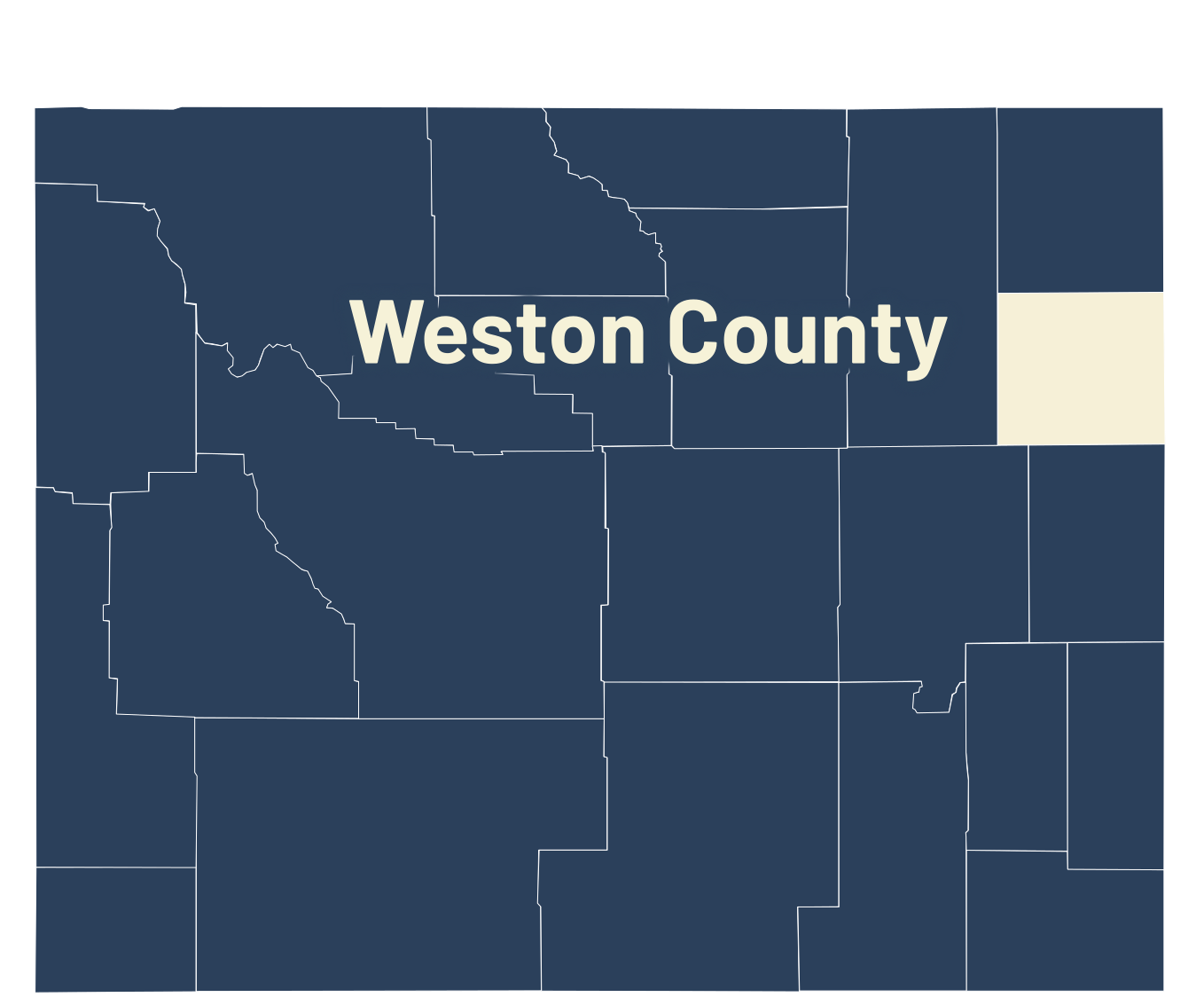
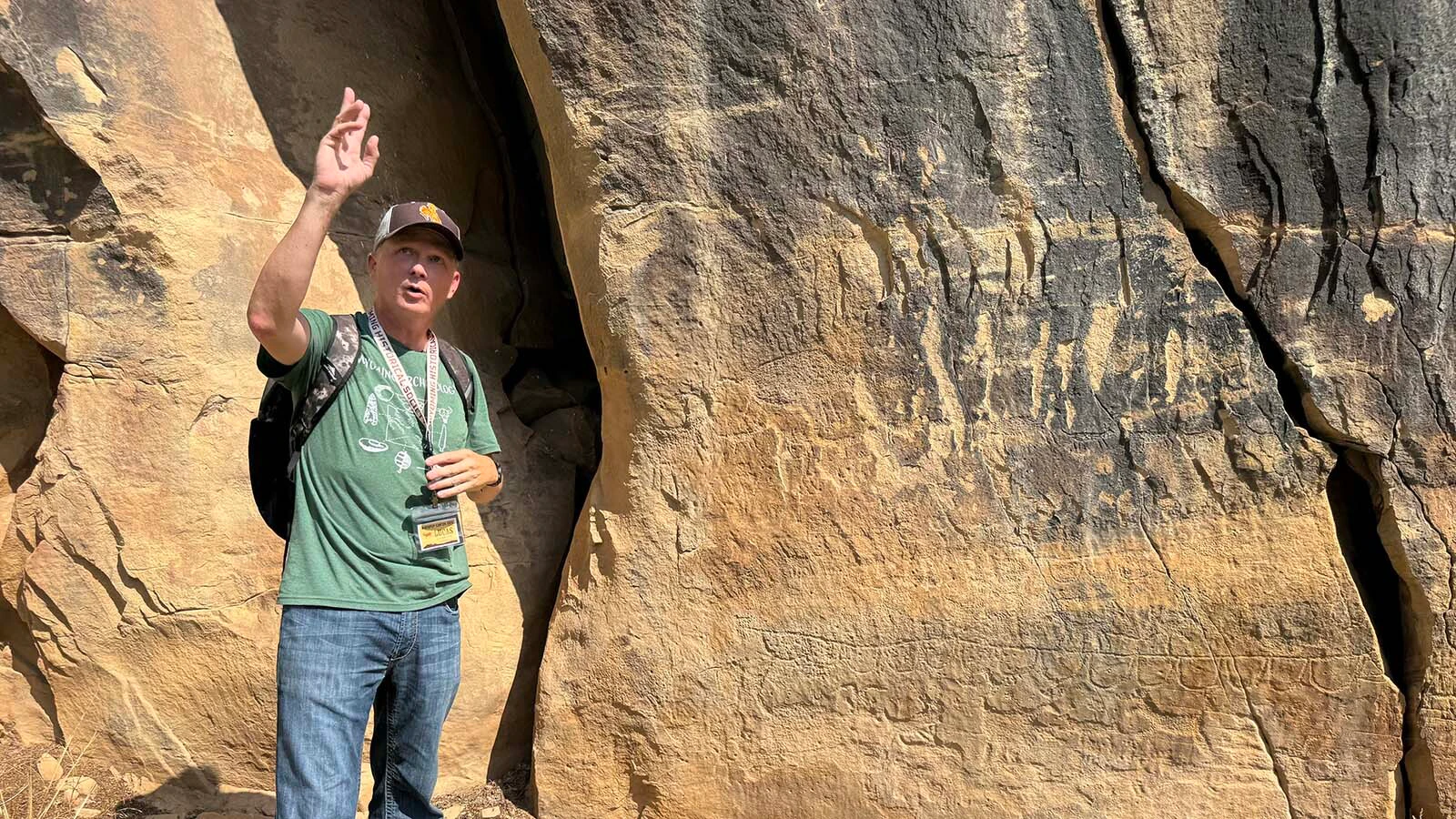
One of the most extraordinary petroglyph sites in North America is hidden away in a secret spot near Newcastle, Wyoming. The petroglyphs of Whoopup Canyon are among the oldest and most "realistic" known to exist.
Hundreds of images are carved into the sandstone walls across 150 known panels. They depict people, animals and even the technology used by some of the earliest Indigenous people in North America.
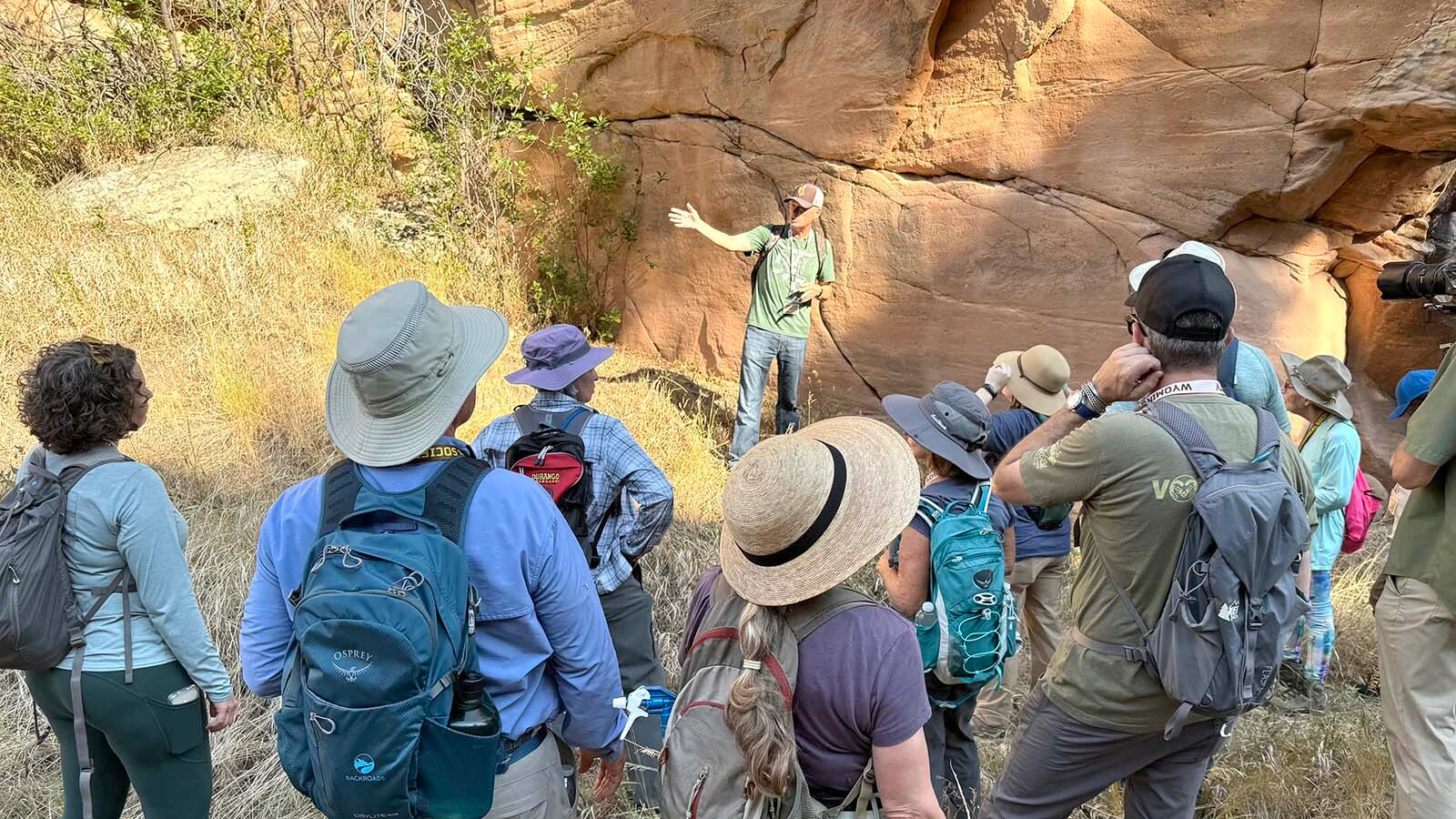
A lucky group of people got to visit this protected site July 25 as part of a tour coordinated by the Wyoming Historical Society and the Bureau of Land Management (BLM) Newcastle office.
The tour was led by Lucas Keeler, a BLM petroleum engineering technician who’s also one of the foremost authorities on Whoopup Canyon.
“It’s one of the largest and oldest petroglyph sites in North America, and it’s a love and passion of mine,” he told Cowboy State Daily.
It’s Not Art
At many petroglyph sites, it’s hard for most people to recognize what’s being depicted. Images are deliberately abstract or artistic, which some believe is attached to the spiritual significance of the people who made them.
At Whoopup Canyon, little is left to the imagination. The images, free of artistic embellishments, are easy to identify and interpret as what they are.
Ralph I. Olinger, a businessman, amateur archaeologist, and Wyoming House representative from Lusk, noted as much during the first scholarly assessment of the petroglyphs with University of Denver anthropology professor Etienne B. Renaud in the 1930s.
“The deer and elk are mostly pictured, but there are mountain goats, antelope, bison, and a few other animals,” he wrote. “There seems to be none of horses.”
Keeler noted that the realism of the petroglyphs is one of many unique attributes of Whoopup Canyon. That’s also why he emphasized that the images “are not art.”
“It wasn’t art to the people that created them,” he said. “It is a historical record with cultural and spiritual significance. A sacred link to the land. There’s nothing wrong with referring to petroglyphs as ‘rock art,’ but it’s deeper than that.”
That was the background Keeler provided to the tour group before they departed from Newcastle to reach the sandstone canyon. They hiked a mile through chest-high grass, under the shade of ancient cottonwoods, before stopping at the end of the canyon to get a closer look at the panels.
Life And Times
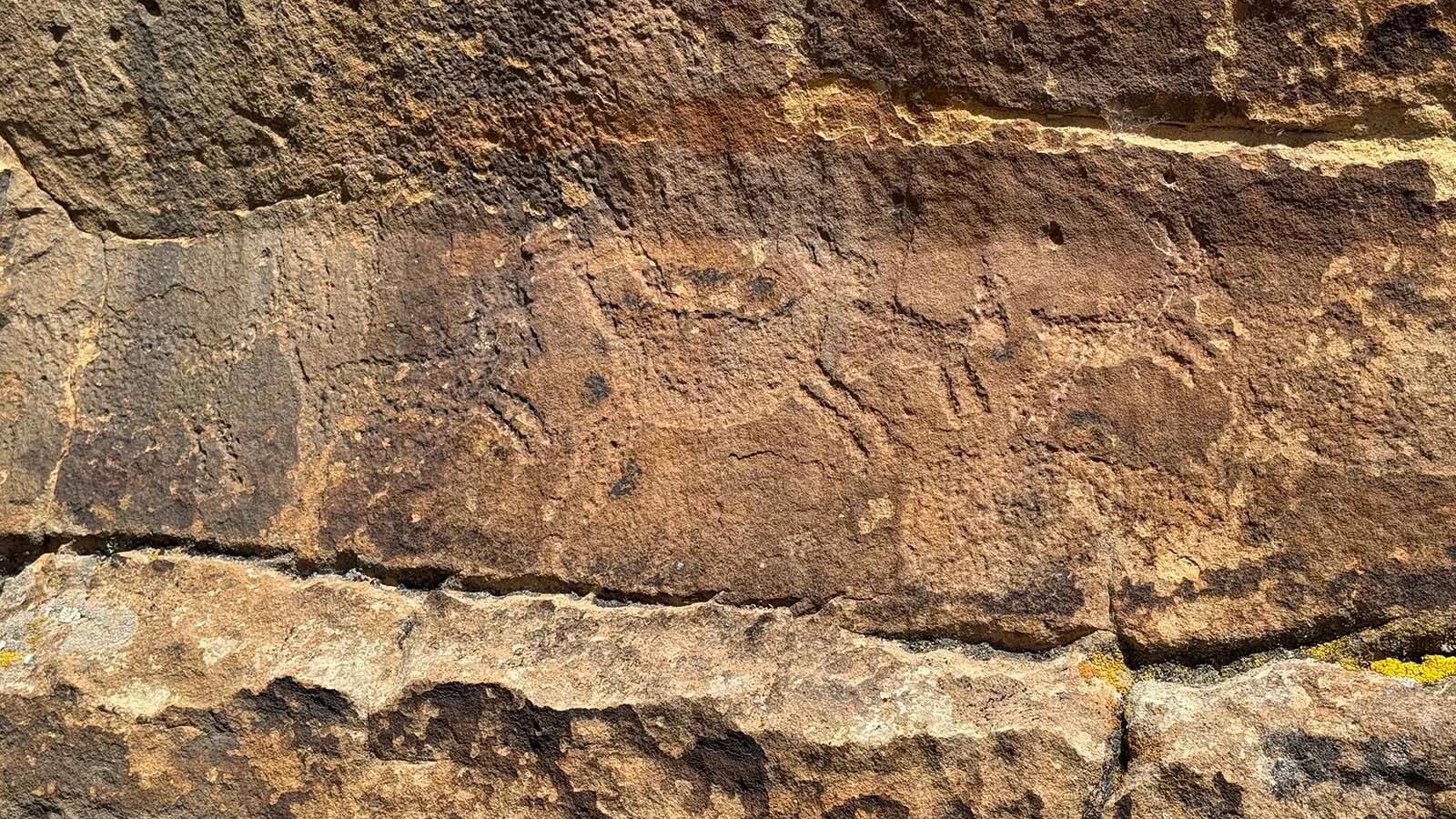
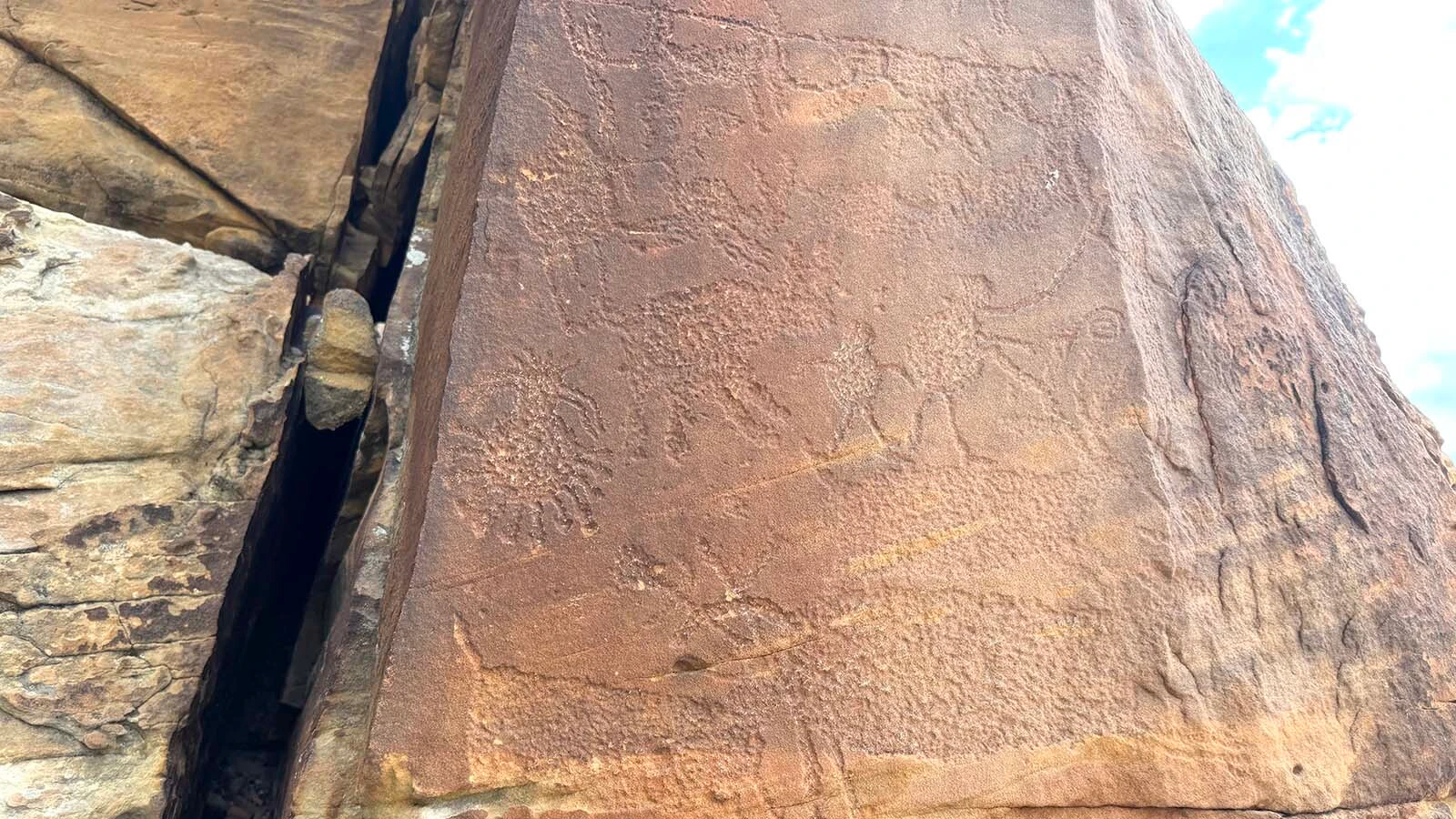
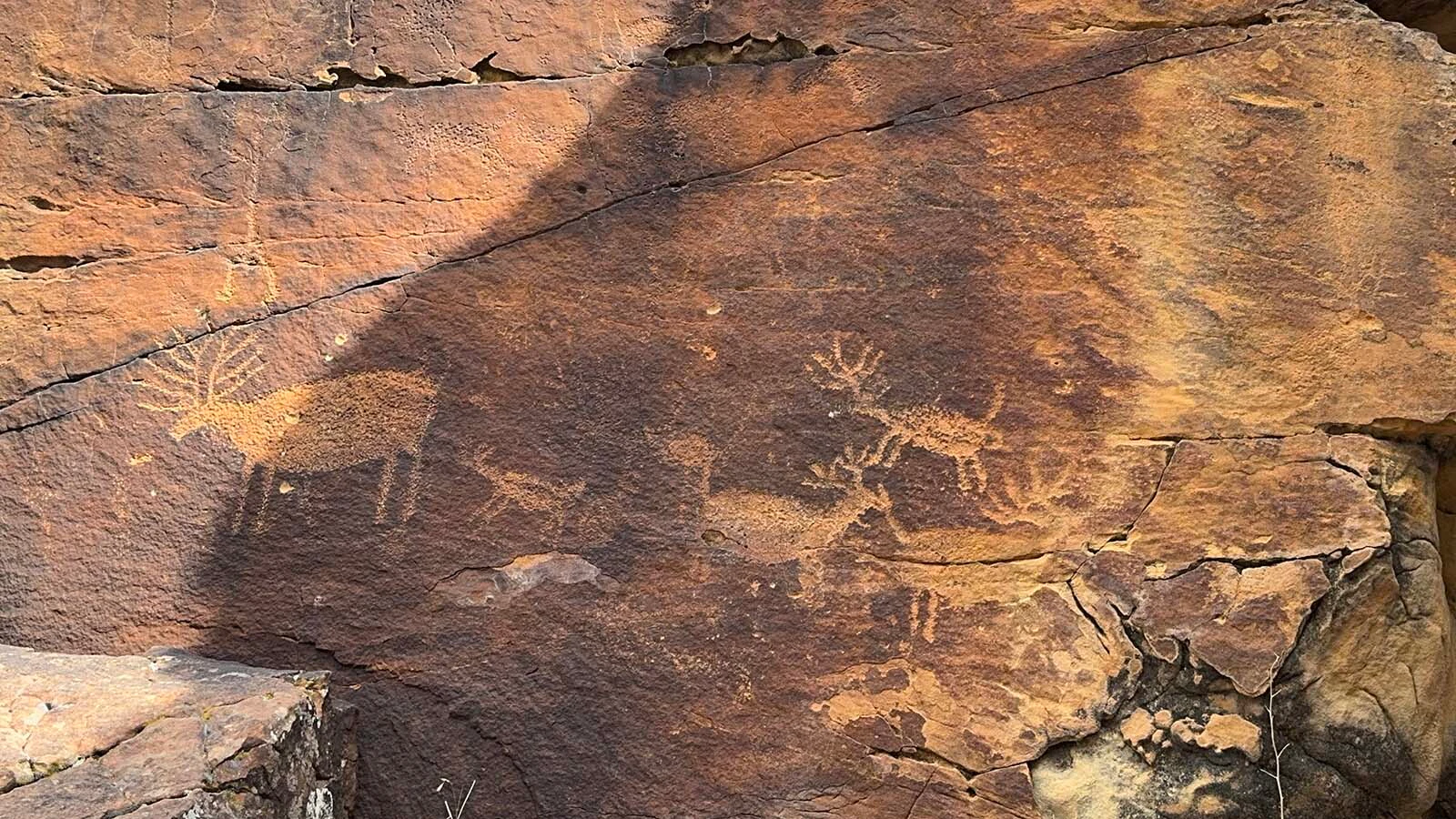
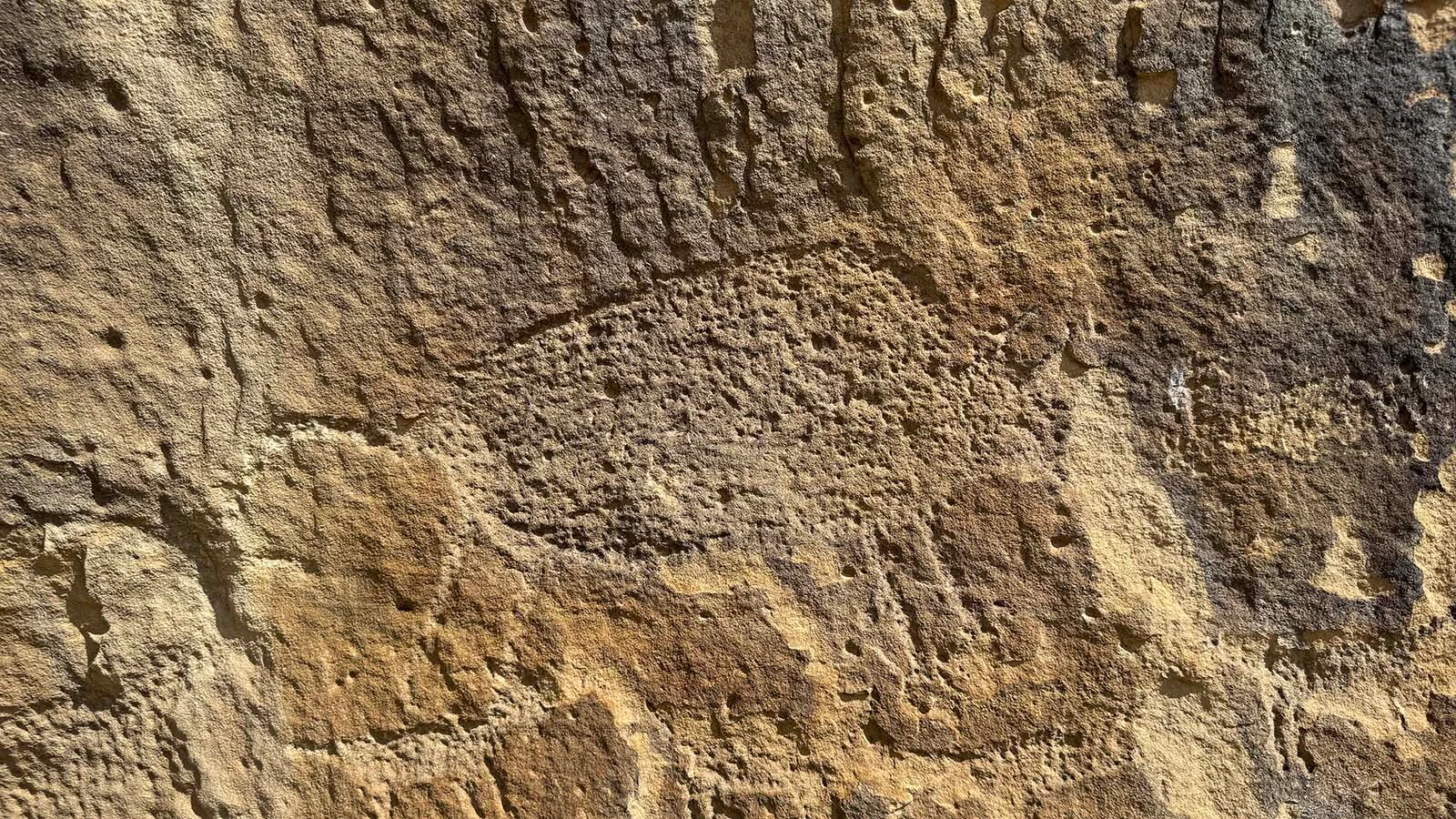
As the group approached the canyon wall, careful not to touch anything, many images were easy to understand. The walls were covered with elk, deer, pronghorn, bighorn sheep, birds, and “Mister Bison,” the only bison depicted along the entire four-mile expanse.
Keeler noted that all the animals are extant, meaning they still exist in Wyoming. No mammoths, lions, or other extinct animals are depicted in Whoopup Canyon.
There are also images recognizable as humans. They aren’t passive figures but are depicted as actively engaged with other figures in the same panel.
According to Keeler, most of the panels depict hunting scenes. It reveals how these nomadic tribes hunted and the tools they used to do it.
“We have a lot of hunting scenes,” he said. “It was a big deal to these people, because it took a lot of time and pride to make these panels. You can see different creators with different techniques.”
Many panels depict human figures wielding atlatls, one of the oldest weapons in human history, as they pursue pronghorn and deer.
Many of those same panels also have a repeating pattern of half-circles along a long horizontal line. Instead of an artistic flourish, this is believed to be another accurately depicted tool.
“We think these are large game nets,” Keeler said. “It was some sort of netting used to capture animals. We'll see a lot of that netting (pattern) with a bunch of animals running up to it.”
Keeler explained that many indigenous tribes set up nets and drove herds of animals toward them. An individual isolated at the point where several nets met would be much easier to kill.
“They would bring this antelope into a three-sided catch, and somebody at the end, the game caller, would whack it on the head,” he said. “It’s well-documented. Lewis and Clark witnessed the Cheyenne using these antelope traps, and they continued to use them up to the 1870s.”
“The game caller” is also a common figure in these rock panels. It’s a humanoid figure wielding a large object, like a club, over their head.
Keeler also noted another intriguing animal depicted alongside the human figures. The best explanation for these four-legged, pointed-ear creatures is that they’re images of domesticated dogs.
“You can see where the dogs were being used, running after the other animals,” he said. “Dogs were domesticated over 10,000 years ago, so that tracks.”
That’s where the age of Whoopup Canyon’s petroglyphs gets interesting.
Oldest Or 'Oldest?'
Whoopup Canyon is believed to be one of the oldest petroglyph sites in North America. However, age can be a tricky thing to determine.
Keeler referenced “Mister Bison” as a textbook example of accurate dating based on the patina of iron oxide and manganese covering the image, contrasted with a nearby elk.
“The elk is pretty cream-colored without much black on it, while the bison is completely black,” he said. “That means the image has to be older than the stuff covering it.”
The iron oxide-manganese patina can be dated using Carbon-14 and cation-ratio dating, and many of the panels have been.
Based on previous dating of the patina, “Mister Bison” is believed to be over 8,000 years old.
That might not even be the oldest image in the canyon. Samples from other panels have been dated from 2,500 years to 10,500 years old.
Today, dating is more difficult due to the mistakes of well-intentioned amateurs.
In 1942, historian and farmer Charles Haas of Rapid City, South Dakota, did an extensive photographic documentation of Whoopup Canyon. To make the images more visible in his black-and-white photos, he traced the images with white chalk.
“The chalking left residue which interferes with dating methods,” Keeler said. “It is estimated that nearly 97% of the glyphs at Whoopup have been chalked.”
Nevertheless, the panels in Whoopup Canyon are still considered among the oldest in North America, and certainly in Wyoming. They’re so old that even today’s tribes have trouble interpreting them.
“We have tribal consultations with various Plains Native American tribes that we periodically bring out to get opinions on the images,” Keeler said. “It can be very eye-opening because (images) go so much further back than the tribes that we know of today.”
Keeler has guided members of the Lakota, Sioux, Northern Cheyenne, Shoshone, and Arapaho tribes to Whoopup Canyon. While spiritually and culturally significant to all of the tribes, the petroglyphs are not ascribed to any of them, because they’re so much older.
“There were no Lakota, Cheyenne, or Arapahoe when these were made,” he said. “These were nomadic tribes, wandering and following game. It was a whole different world back then.”
Standouts
Amid the plentiful images of elk, pronghorn, and people, there are a few images that Keeler found particularly noteworthy.
One, at the far end of the canyon, depicted several people standing close together. Instead of being simple stick figures, each figure has depth and dimension.
“It looks like a family,” Keeler said. “They’re not holding hands, but they’re close together. That whole cliff face had so much going on that’s unlike anything else in the canyon.”
Keeler mentioned that he’s asked about that panel during the tribal consultations.
“They all say something different,” he said.
A nearby figure, wielding an atlatl, is almost three-dimensional. He has clear proportions that were intentionally carved into the rock.
“He’s about the only person out here that's got any meat on him,” Keeler said.
There are several images and panels that Keeler can’t explain. They include a line of pronghorn, end to end, and something he referred to as “the Unicorn.”
But there’s one panel, on the opposite end of the canyon from the family, that defies explanation.
Skin-Changer?
One of the more unique panels is four humanoid figures close together. They’re unlike anything else in Whoopup Canyon and, to Keeler’s knowledge, any other petroglyph site.
He introduced it as “the one the tribes don’t like.”
“There’s nothing else like it here, that’s for sure,” he said. “It's hard to know what was going through their head when they did that.”
The images appear to be part of the same sequence. One of the figures appears to be stretching their head and upper body, while the final figure is holding an object that resembles a torch.
Keeler has no definitive explanation, but he’s wary of one that’s been proposed: the panel depicts the transformation of the Deer Woman.
Many Indigenous American tribes have stories of spirits or “witches” that can turn into animals to disguise themselves and deceive others. The Navajo have “yee naaldlooshii,” “the skin-walker,” and many tribes, including the Sioux, have “the Deer Woman.”
Historically, these spirits have been malicious and duplicitous entities in tribal mythology. That would make a depiction of one on a petroglyph panel unique and unusual.
“A lot of cultures across the world have that story of a bad shapeshifter,” Keeler said. “I don’t know if that’s what’s depicted on the panel, or what it’s trying to symbolize, but there’s a lot going on.”
Exclusive Access
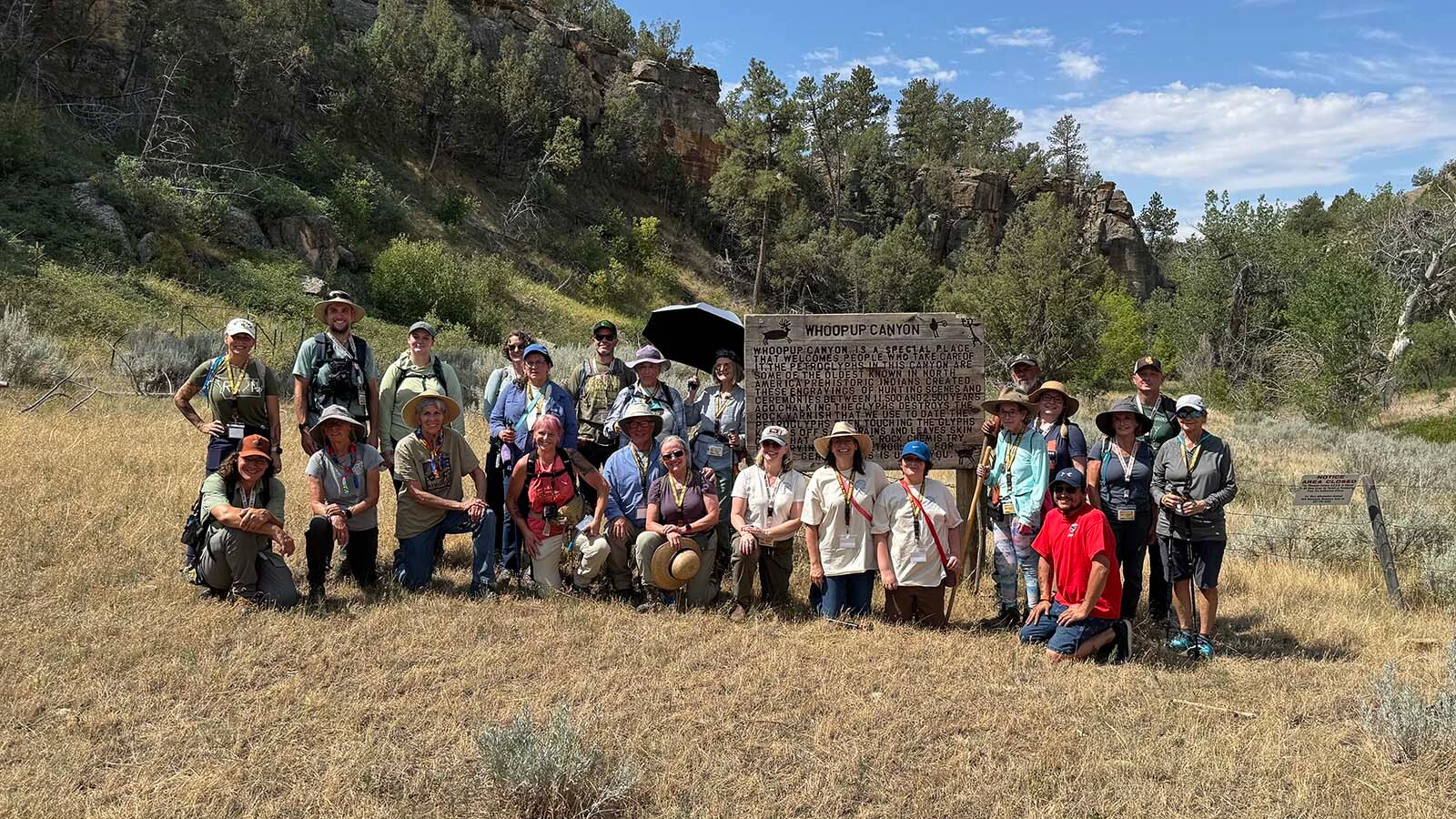
Many of Wyoming’s petroglyph sites are open to the public. Whoopup Canyon is not one of them.
While the canyon itself is on BLM land, the only way to access it is by roads going through private ranches. That has given the site some added protection, as it has been vandalized in many ways over the last century.
In 1997, the U.S. Department of the Interior called for an emergency closure of Whoopup Canyon. That closure remains in effect, keeping the canyon off-limits to all activity except scientific, educational, and sociocultural projects.
The easiest way to see Whoopup Canyon is to be an elementary school-aged student in Newcastle or Upton.
“The Upton Science Kids come out for one day in June, and I take the Newcastle Elementary School fourth graders doing Wyoming history out in October,” Keeler said. “Those are the only two groups I do every year.”
The June 25 excursion with the Wyoming Historical Society was the first tour of its kind in several years. The group worked with the BLM to get permission from the private landowners to access the site.
“It’s illegal to access without their permission, and it’s still an area of critical environmental concern for the Interior Department, so it’s closed to the public,” Keeler said.
That said, Keeler hopes there might be an opportunity to offer future tours of Whoopup Canyon, perhaps one a year, so more people can experience the canyon and its history.
While the petroglyphs are most closely associated with today’s Native American tribes, Keeler believes anyone can find a connection to the images in the sandstone. The history depicted in the petroglyph panels of Whoopup Canyon is universal.
“For me, the petroglyphs are telling the same story of everyone’s history,” he said. “Wherever we came from, we all go back to these nomadic-type peoples. So many different cultures can relate to these things, because this is our origin story. It’s the roots of so many different people.”
Andrew Rossi can be reached at arossi@cowboystatedaily.com.


