
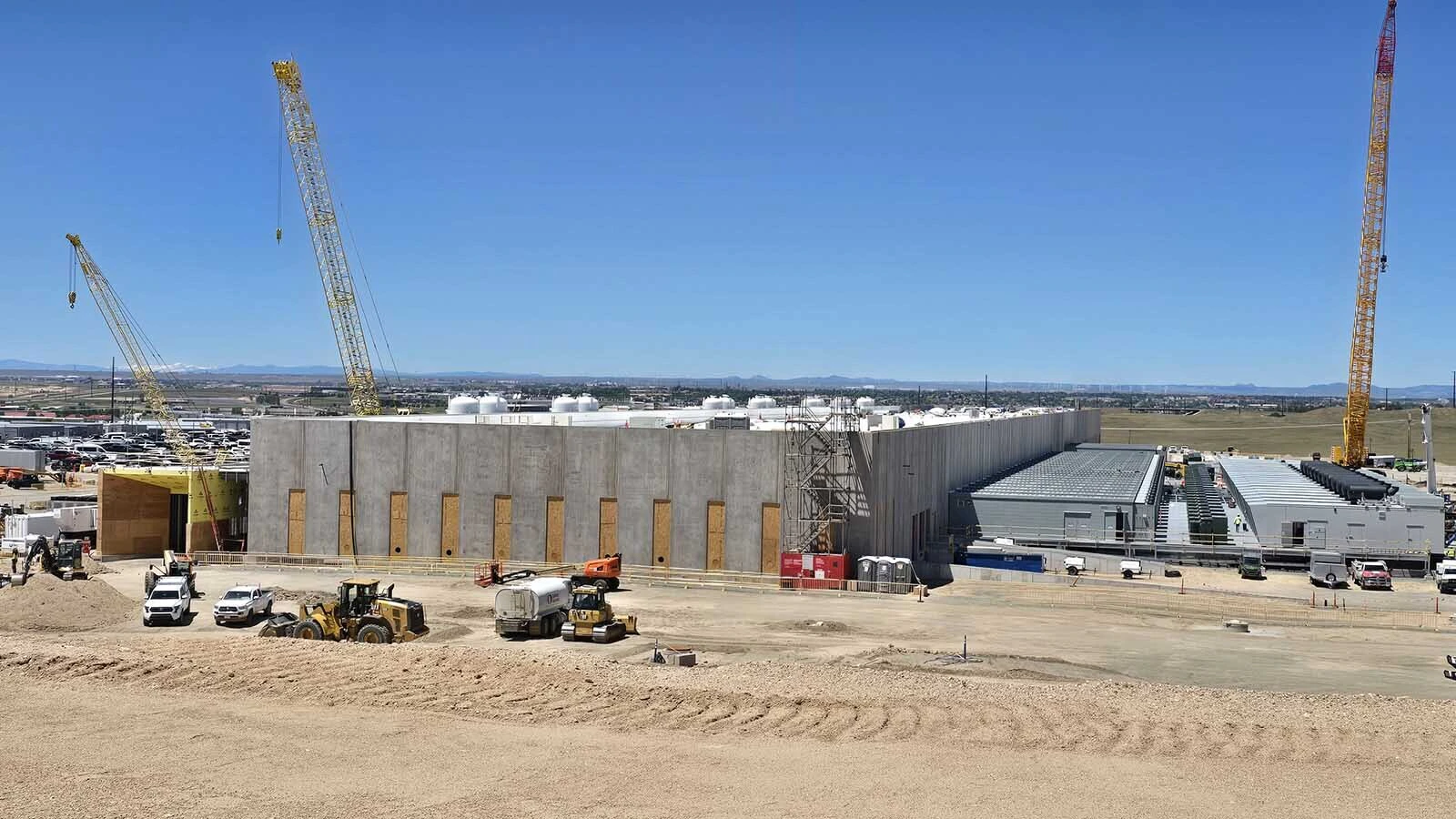
Local government heads in data-center heavy areas who spoke to Cowboy State Daily on Thursday say they’ve never signed non-disclosure agreements with data center companies.
Those include the mayor and county commission chair of the state’s most booming data center region – Cheyenne and Laramie County – as well as commission chairs of Uinta and Lincoln counties and the mayors of Casper and Afton.
The nonprofit economic development group Cheyenne LEADS reports 10 active data centers, five under construction and nine in planning in the Laramie County and Cheyenne area – more than any other Wyoming community.
Cheyenne Mayor Patrick Collins said he’s never signed a non-disclosure agreement with any company, though various companies – but not data centers – have asked him to.
“I have signed one NDA in my life, with (Cheyenne) LEADS, because I’m a board member, and that covers things I learned, information I learned as a member of the board, like board meetings,” said Collins, who sent Cowboy State Daily a copy of his Cheyenne LEADS NDA.
Cheyenne LEADS, though private, secures public contracts with Cheyenne and Laramie County to perform economic-development projects. It also has advocated for data centers.
Its contracts with public entities are public, but its internal work as a private entity doesn’t have to be, said Collins.
“In my job as mayor, that is a public job, and anything I do in my job, it’s got to be transparent,” said Collins, who spoke of delineating his work with LEADS from his mayoral work.
Laramie County Commission Chair Gunnar Malm, who oversees meetings involving data center controversies frequently, gave a flat no.
“I have never signed an NDA nor have I ever been asked to,” wrote Malm in a Thursday text message. “I also am unaware of any commissioner or staff ever signing or being asked to sign one.”
He noted that the massive “Project Jade” data center project whose backer — Google — Cowboy State Daily unveiled Wednesday, is slated to be smaller than originally proposed. He also said that the county’s project approval passed “after all required public meetings and comment.”

Nope, Nope, And Nope
Cowboy State Daily contacted local government leaders of communities listed as data center hosts on datacentermap.com. Though the map lists Afton as a hub for a Silverstar Communications data center, Mayor Jeff Jensen said that is not accurate. He also said he’s never signed such an NDA.
“We’ve had no interactions with anybody trying to locate a data center here,” said Jensen.
Cowboy State Daily called the leader of Afton’s encompassing county, Lincoln County Commission Chair Kent Connelly, for good measure.
“We haven’t signed an NDA with any of them,” said Connelly. “Nor do we have data centers.”
He added, however, “data centers make it possible for you to call me on my cellphone like this, so somebody’s going to have them.”
Uinta County Commission Chair Mark Anderson said the county hasn’t signed any NDAs with data center companies.
Government entities get involved in data center permitting, land use and environmental approvals. But the government is less involved – and less able to announce project milestones – when the build is on private land, Anderson noted.
“A little bit of uniqueness about the data center in Uinta County, it’s on private land. We didn’t have as much say as to that,” said Anderson, adding that the county’s role was “strictly a zoning question: does it fit in our land use plan? Have they met the letter of the law?”
If they do, said Anderson, by way of explaining his recent aye vote on a data center land-use approval, “my personal opinion on private property rights is, if it doesn’t put a strain on infrastructure and things of that nature, I’m a big supporter of private property rights.”
The map shows data centers in the Casper area.
Mayor Ray Pacheco said as mayor and in his 12 years on City Council he’s never signed an NDA with a data center company nor heard of that. After checking with staff he called back and reiterated that.
“We don’t know of any nondisclosure agreements related to any data center projects in the City of Casper,” said Pacheco in a Thursday phone call. He also doesn’t know of any large data center projects within the city, though “that doesn’t mean there aren’t some smaller, private server rooms or computer facilities owed by local businesses.”
Natrona County Commission Chair Jim Milne did not respond by publication to a voicemail and text message request for comment.
The Public Courtship
The Converse County Commission made headlines in May for its attempt to fast-track data centers. That would have required a special zoning maneuver that the Wyoming attorney general reportedly discouraged, since the county doesn’t have general zoning.
Commission Chair Jim Willox told Cowboy State Daily in a Thursday voicemail he’s “never been asked to sign one and never would sign (an NDA).”
“The companies we work with understand the open meetings and the public records (laws), and we work with them accordingly,” said Willox.
Just A Little Law
Tom Lubnau, a Gillette-based attorney who’s worked at length with Wyoming’s public-records law, said state law allows for local governments to sign NDAs with data center companies, but it’s complicated.
“The answer is, yes, you can do it. But it’s not unlimited,” said Lubnau.
That’s because Wyoming’s public-records act is also not unlimited.
Government documents are public. But the law, found at Wyoming statute 16-4-203, expounds many instances in which the record-keeper “may” deny disclosure, and other instances in which he or she “shall” deny disclosure.
If an NDA sticks to the information for which governments can deny disclosure anyway, they may be legal, said Lubnau. “Trade secrets” are on that list.
The government “may” deny public disclosure of documents in investigations, test questions and metrics, real estate appraisals, interagency memoranda that wouldn’t be available by law to a private person suing the agency, documents that may jeopardize government building security, the job applications of prospective college or university presidents, and sensitive wildlife location data.
The government “shall” deny disclosure of:
- Medical data on individuals,
- Adoption or welfare records on individuals,
- Personnel files, with some exceptions,
- Letters of reference,
- Trade secrets,
- A person’s library checkout history,
- School district records generally,
- Internal personnel investigations,
- Sensitive information about state technology and physical security systems,
- State veterinary records on infectious diseases,
- Agriculture operation information given to participate in a government program,
- Income tax returns, generally,
- Workers’ compensation claims, unless they enter a contested hearing or are redacted,
- The internal records of the state’s revenue estimating group,
- Body cameras and dash cameras – but that provision has multiple exceptions, including, “in the interest of public safety,”
- Any records of the state’s investment funds committee,
- And information regarding the legal taking of wildlife.
Clair McFarland can be reached at clair@cowboystatedaily.com.


