A northern Colorado rancher who lives near one of the state’s reintroduced wolf packs said she and her neighbors are becoming increasingly frustrated because when wolves aren’t threatening livestock, coyotes are.
Amanda Cerveny said she spotted and took video of a lone canine crossing her property near cattle.
She thought at first it could have been a small or young wolf, but also thought it might be a coyote.
Her latter suspicions were confirmed by biologist Doug Smith, who texted “100% coyote” to Cowboy State Daily after viewing Cerveny’s video.
Cerveny told Cowboy State Daily after seeing the first coyote she returned to her house to retrieve her rifle.
As in Wyoming, it’s legal to shoot coyotes on sight to protect livestock.
By the time she returned, the animal was gone.
‘Two Knuckleheads’
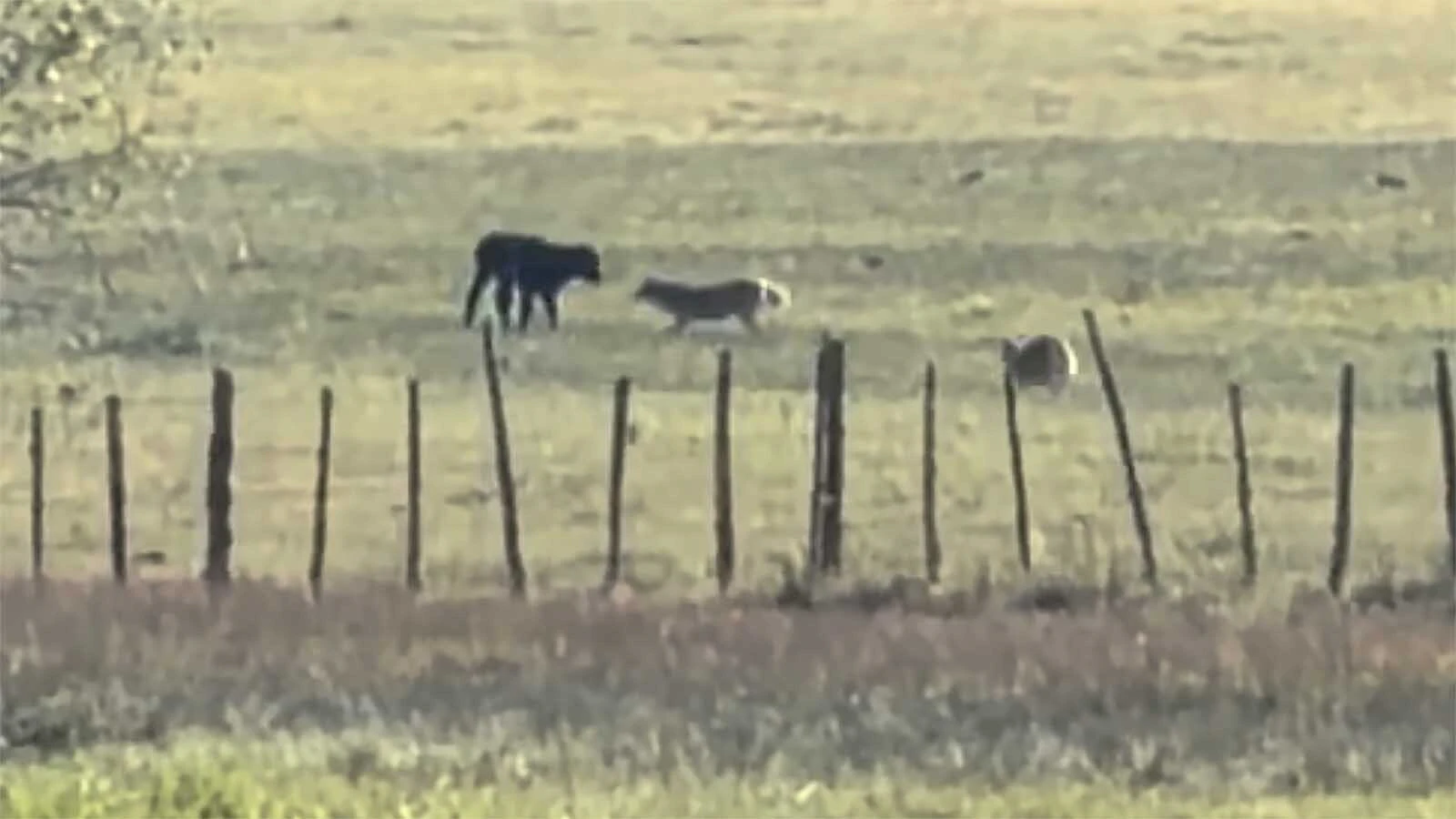
A short while later while walking down a lane on her property, “that’s when I saw these two knuckleheads attacking a calf," she said.
About 250 yards away, Cerveny saw two canines chasing and harassing one of her neighbor’s calves. She took video of that scene as well.
At the time, she was reasonably confident those two canines were coyotes.
But, as she noted, in Colorado, anything less than 100% certainty over whether the critter is a coyote or a wolf can be good reason to hold your fire.
"At 250 yards, how can I be absolutely certain whether it’s a coyote, or an uncollared wolf pup, or yearling?” she said.
Smith, who led the wolf program in Yellowstone National Park for nearly three decades, told Cowboy State Daily this year’s wolf pups wouldn’t leave the immediate area of the den this early in the year.
Pups don’t usually start venturing out until September or October, he said.
However, “come winter or fall,” it might be difficult to discern a coyote from a wolf pup at a great distance, he added.
Cerveny said her hesitancy to open fire on the canines she saw harassing the neighbor’s calves, even at a time when she could be reasonably sure they were coyotes, is indicative of the quandary she said she and her neighbors face.
Wolves remain protected in Colorado, and killing one, even by accident, could result in thousands of dollars in fines, Cerveny said.
It is legal for Colorado ranchers to shoot wolves if they catch them “directly in the act” of attacking cattle, she said.
But in most cases, the burden of proof is so high, ranchers might hesitate. And in her case, she said, it caused her to not even shoot at coyotes.
‘More Aggressive’
Cerveny said that as far as she knows, her neighbor’s calf wasn’t seriously. Even so, she worries coyotes getting away with attacking a calf might embolden them to keep doing so.
Cerveny said that she, her husband and others in the area think that coyotes might be getting "more aggressive."
She said she showed the video of the coyotes attacking the calf to her husband.
“He said, ‘in 30 years of doing this (ranching) I’ve never seen anything like that',” she said.
There have always been instances of coyotes darting in to attack a sick or wounded calf, or “going after the afterbirth” during calving season, she said.
But nobody in the area seems to recall many instances of coyotes, which are usually opportunistic hunters, going directly after healthy livestock.
Smith said coyotes generally favor small prey, such as rodents. They do tend to “hunt in pairs” and will on rare occasions go after something bigger, such as sheep or a calf, he said.
Are Wolves To Blame?
Cerveny said she and her neighbors wonder if coyotes are more aggressively going after cattle “because of competition from wolves” for other prey.
Smith said that almost certainly isn’t the case.
“Coyotes do what coyotes do, and wolves do what wolves do," he said. "They’ve lived alongside each other for hundreds of thousands of years. One doesn’t force the other to do anything.”
Smith added that wolves returning to an area where they’ve been absent for a while, such as Colorado, doesn’t change that dynamic.
“Pull them (wolves) away for a few decades, and that’s not really going to change coyote psyche and behavior,” Smith said. “It’s the ghost of evolution past."
Wolves are thought to have wandered into Colorado from Wyoming and formed a pack in about 2020.
The state also began reintroducing wolves in December 2023.
Smith said elk might leave an area this time of year to move to higher elevations, and leave both coyotes and wolves in the low country.
But as he sees it, both canine species can get by without elk.
Outside of rarely taking an calf, coyotes don’t rely on elk as a prey source, he said. And wolves’ dependence upon elk might also be greatly overestimated.
Wolves are actually lousy elk hunters, Smith said, succeeding only about 5% to 15% of the time they set out to kill elk.
When elk leave an area, it’s probably not because wolves scared them, Smith said.
“Elk stay where they want to stay because of food,” he said. “They aren’t hype-afraid of wolves, because if they encounter a wolf they’re likely to live.”
Mark Heinz can be reached at mark@cowboystatedaily.com.