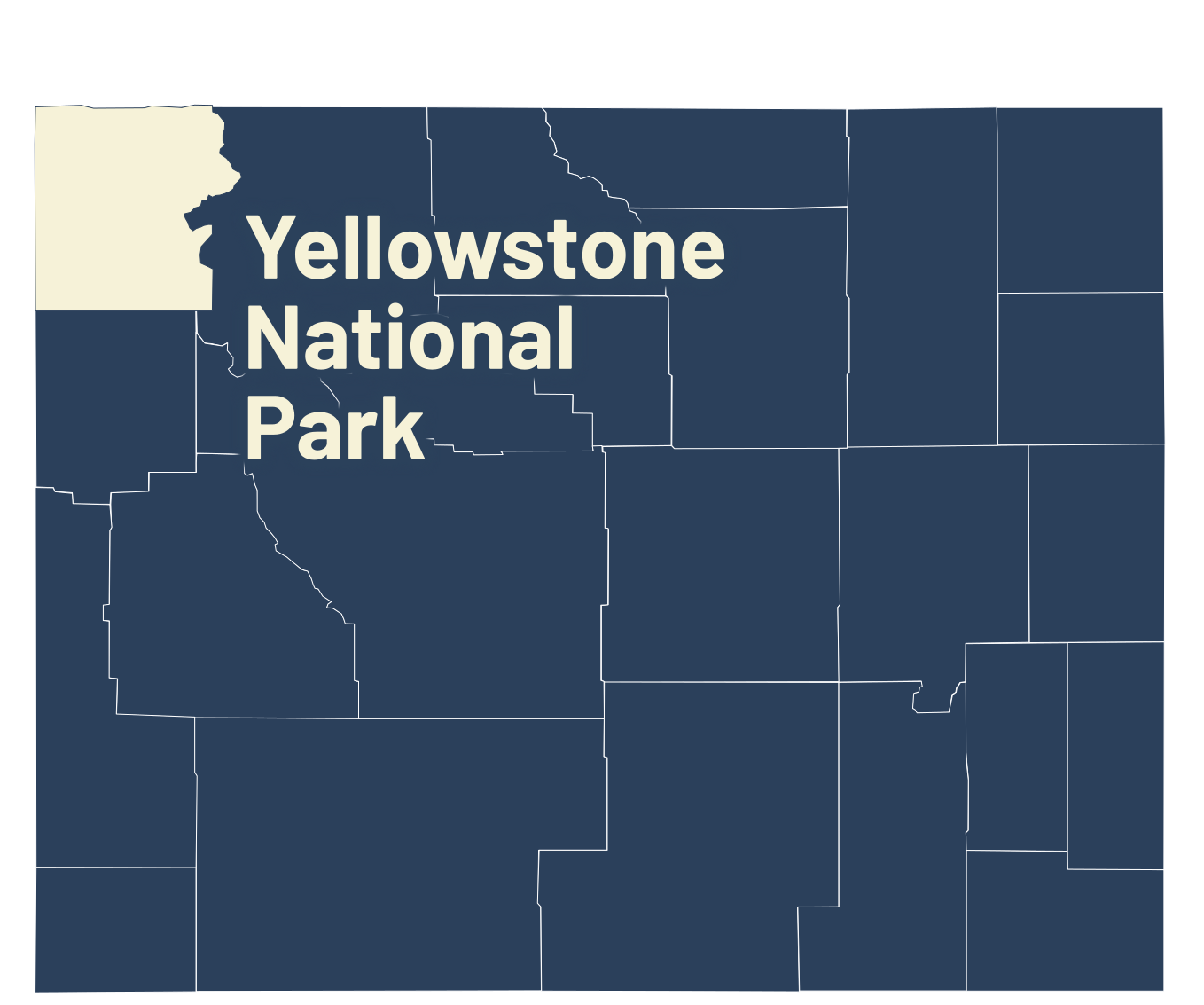
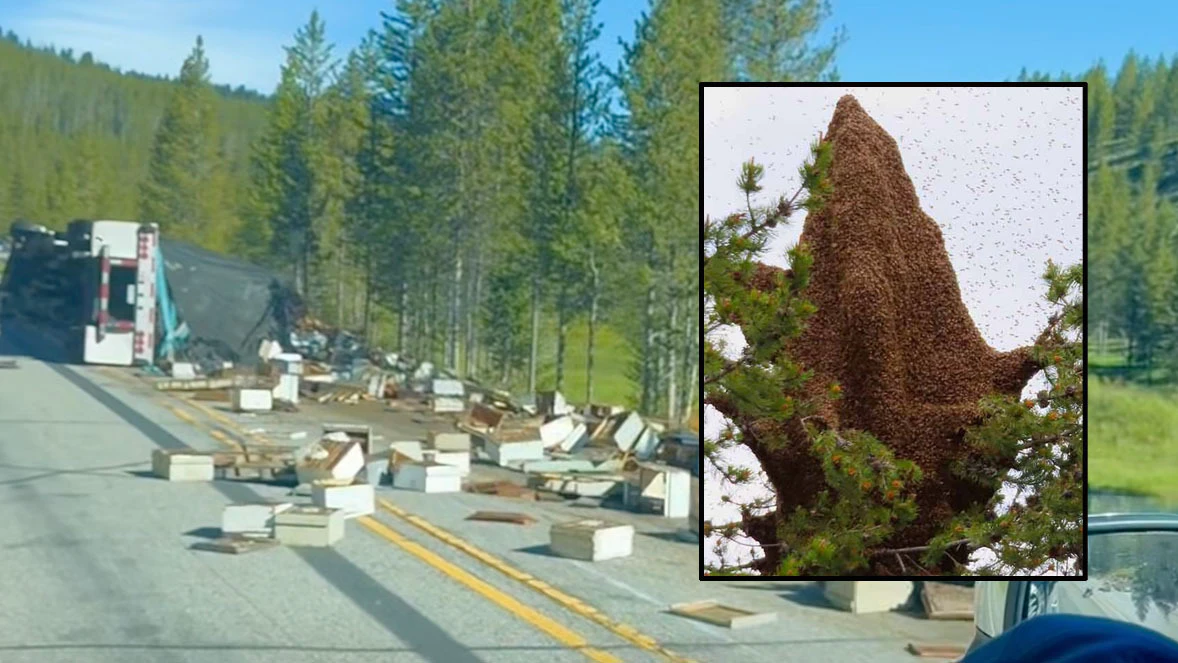
It’s been a week since a semitruck carrying millions of bees crashed along U.S. Highway 191 in Yellowstone National Park’s northwest corner. Hundreds of destroyed hives have been cleared from the highway, but the homeless bees are still swarming the area, trying to find a new home.
While many are concerned about the fate of the still-homeless honeybees, others worry about
Honeybees aren’t native to Yellowstone or North America. Their presence in Yellowstone could have repercussions.
“If these honeybees get established as feral colonies, the primary concerns would be food and disease,” said Laura Burkle, a professor of ecology at Montana State University in Bozeman. “It all depends on whether or not they're going to persist in the area.”
Native Vs Foreign Bees
Burkle is a community ecologist. She studies bee communities and the flowers and other plants they pollinate in natural and managed systems.
While Burkle was aware of the bee catastrophe in Yellowstone, she didn’t have any specific insight into the circumstances or how many bee colonies had yet to be collected. However, she is aware of the diversity of bees in the park.
“There are hundreds of native species of bees present in Yellowstone,” she said. “Some of them are social, like bumblebees, and some of them are solitary, meaning they don’t live in a colony.”
An article published in the November 2014 issue of Park Science, published by the National Park Service, said least 3,604 described species of bees inhabit North America. Several National Park Service sites, including Yellowstone and Grand Teton, were included in a cursory nationwide survey.
However, none of these bees are honeybees. All honeybees in the United States were imported from Europe and Africa, with the first colonies arriving in the 18th century.
“That’s why honeybees are considered livestock,” Burkle said. “Bringing a colony of honeybees into a national park wouldn’t typically be allowed.”
Semitrucks aren’t permitted in Yellowstone. The stretch of U.S. 191 between West Yellowstone and Big Sky, Montana, is the exception.
Burkle said honeybees are usually transported en masse to pollinate crops or to move between fields where they can collect nectar for better honey production. The hives, or honey boxes, are critical to their survival.
“Almost all the honeybees in North America go back to a hive,” she said.
Of the 20,000 known species of bees worldwide, only eight are honeybees. Nevertheless, they have been one of the most beneficial insects to humanity since they were first domesticated nearly 5,000 years ago.
That’s where the homeless honeybees could pose a threat to Yellowstone’s natives.
A Dish (Or Disease) To Pass
Because honeybees have been so thoroughly domesticated, they tend to rely on their honey boxes to build colonies, raise larvae, and produce honey. A honeybee colony that thrives without hives is what Burkle called a feral colony.
“There aren't very many feral honeybee colonies, although they do exist,” she said. “If there were any honeybees in Yellowstone, they would have to be feral colonies.”
There have been concerns about the impact of non-native honeybees on native ecosystems in North America for decades. Honeybees can be defensive and are known to compete with native bumblebees for food and territory in North America and Europe.
That would be one of Burkle’s primary concerns about the homeless honeys in northwest Yellowstone. If one or multiple colonies establish themselves as feral colonies, they could start competing with the park’s native bumblebees for food.
“Honeybees collected a lot of nectar and pollen to produce honey,” she said. “They could use up floral resources that would be needed to sustain Yellowstone’s native populations, taking food away from native bees.”
The foraging area for a single honeybee hive can extend over two miles. Foraging bees have been observed as far as four miles away from their hives.
Furthermore, bees can only forage when the temperature is right, usually between 55 and 66 degrees. With a limited window and limited resources within their foraging range, non-native honeybees could quickly start competing with native bees.
Then there’s the risk of spreading bee disease. That’s the other concern that immediately presented itself to Burkle.
“It's known that honeybees can give diseases to native bees, and vice versa,” she said. “It’s more likely that these honeybees are carrying various pathogens and parasites that Yellowstone’s native bees haven’t been exposed to before.”
Bees don’t need to come into direct contact to transmit diseases. According to Burkle, they can be shared from flower to flower.
“If a honeybee visits the flower, and then a native bee comes to that flower next, it could pick up a pathogen that was left by a honeybee,” she said.
Between competition for food and the spread of disease, the homeless honeybees could pose a serious problem for Yellowstone’s native bees.
But will they?
Watchful Wait
When colonies of honeybees are destroyed, it’s in the best interest of their owners to collect as many queens and colonies as they can. Efforts to collect the surviving bees were immediately underway after the semitruck incident.
Without seeing the scene, Burkle couldn’t say how serious the situation might be for Yellowstone’s native bees. That’s partly because not a lot is known about Yellowstone’s bees.
“To my knowledge, Yellowstone's bee populations are poorly characterized and understood,” she said. “There have been studies, not all of which are published, that are just starting to scratch the surface of which species are even present inside the park.”
That means it’s hard to say if Yellowstone’s bees are thriving or struggling.
Entomologists and biologists like Burkle are collecting data to understand the health of these native populations and to determine whether they’re affected by climate change or other environmental factors.
That said, Burkle said there are reasons to think the homeless honeybees won’t make any noticeable impact on native bees. They’re actively being collected, and even an established feral colony might struggle to survive.
“They might not be able to set up colonies, depending on the weather and how far they have to fly to find a suitable place to set up a feral colony,” she said. “They might not be able to persist where they’ve ended up.”
Also, honeybees tend to live the easy life. Their hives are placed in optimal environments, where they don’t have to expend energy foraging to find enough food to sustain themselves and produce honey.
“Big bees, like bumblebees, fly farther than smaller bees,” Burkle said. “Smaller bees might only forage 200 meters away from the hive, so they can have a pretty limited range.”
Burkle was aware that many people are concerned about how these honeybees could impact the Greater Yellowstone Ecosystem. While there are many potential concerns and factors to consider, there isn’t enough known to inform conclusive answers.
“I’m not an expert on all things bees, but I don’t know how concerned the National Park Service or anyone else is or should be right now,” she said. “These honeybees could be disruptive if they set up feral colonies, but I don’t have a good sense of what’s happening down there. I don’t know if I have a good answer at this time.”
Andrew Rossi can be reached at arossi@cowboystatedaily.com.