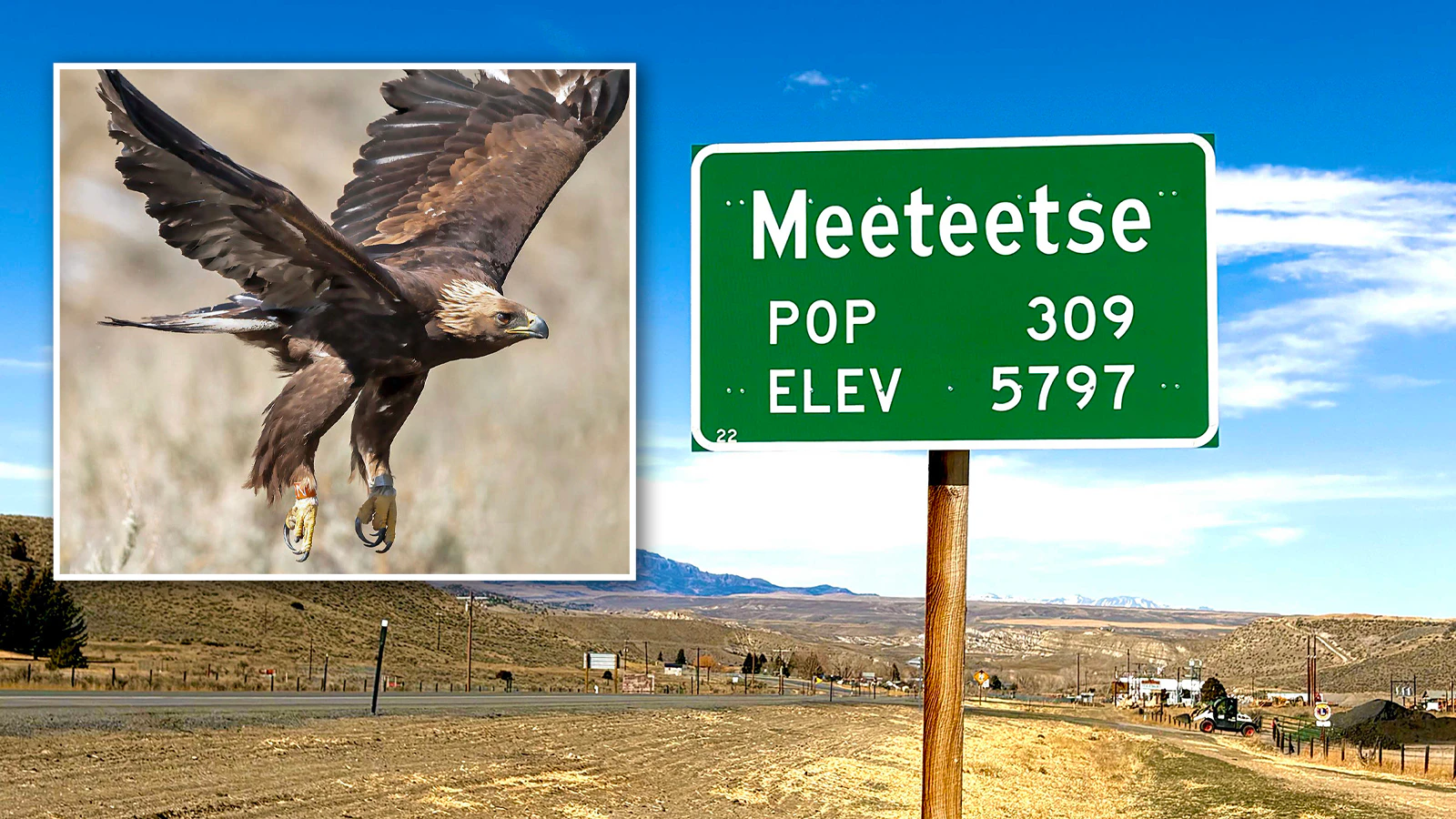
Eagle 2N is raising young with her mate in the Bighorn Basin, but by all rights she shouldn’t even be here.
When the golden eagle was about a year old, she was found by the highway near Meeteetse, apparently having been struck by a car.
If that wasn’t bad enough, rescuers discovered she was also suffering from lead poisoning, a frequent killer of golden eagles and other Wyoming raptors.
But she pulled through, and Susan Ahalt, who runs Ironside Bird Rescue in Cody, dubbed her Aurum, which is Latin for gold.
“She is just absolutely the most beautiful girl,” said Ahalt, who has run Ironside for 34 years and nursed 2N/Aurum back to health in 2021.
2N/Aurum is familiar to raptor researchers, who hope her life will help shed light on how to conserve Wyoming’s dwindling population of golden eagles.
First Captured As A Fledgling
Raptor researcher Chuck Preston first captured and banded 2N in July 2020, when she was just a fledgling. A fledgling is a young eagle that can leave the nest and fly, but isn’t quite ready to be completely on its own.
At the time, he had no idea whether he’d see or hear about the young eagle again.
Preston knew odds are that he wouldn’t.
About half of golden eagles don’t survive their first two years.
And of those that survive, only 25% make it to age 5 and hatch and fledge young of their own.
When 2N was found by the roadside in 2021, it seemed that she’d already lost to the grim odds.
Vehicle strikes are a leading cause of golden eagle deaths in Wyoming, Preston said. And lead poisoning is also near the top of the list.
Golden eagles and other raptors contract lead poisoning mainly by eating gut piles or carcass parts from big-game animals shot with lead bullets.
That’s why raptor conservationists admonish hunters to switch to bullets made from copper or other lead alternatives.
A Healthy Diet Of Rats
But Ahalt wasn’t ready to give up on her.
Despite the eagle’s miserable condition when she was brought into the rescue center, she had a couple advantages, Ahalt told Cowboy State Daily.
“The vehicle strike didn’t break her,” said Ahalt, meaning the eagle hadn’t suffered any broken bones.
Instead, she was severely bruised from the impact, she said.
Moreover, 2N’s lead poisoning, while serious, wasn’t so grave that it would require injecting her with a counteracting agent.
Instead, 2N could be treated with pills.
“She was a good eater,” Ahalt said.
“I fed her rats. I would cut open a dead rat’s belly, put the pill inside the rat, and she would swallow it right down,” she said.
It didn’t take long for the eagle to regain enough strength to be released back into the wild, Ahalt said.
While it was encouraging to hear that Eagle 2N had pulled through, things didn’t bode well for her future as a mother, Preston said.
Frequently, eagles that survive lead poisoning can’t successfully breed afterward, he said.
Back Again, With A Family
Wyoming is prime golden eagle habitat, both for resident eagles and those that migrate in from the north during the fall to spend winters here.
Bald eagles eat mostly fish, so they like hanging out near lakes and rivers.
Golden eagles prefer small game such as prairie dogs and rabbits, so they’re drawn to open prairies or vast sagebrush steppes.
Unfortunately, Wyoming’s golden eagle population is struggling, said Preston, who was the founding curator of the Draper Natural History Museum at the Buffalo Bill Center of the West in Cody.
They’ve suffered from human encroachment on their core habitat, and many have also been killed by wind turbine blades, he said.
And many are illegally shot, Preston added.
On top of all of that, the Bighorn Basin, where Eagle 2N was born and fledged, had a massive outbreak of rabbit hemorrhagic disease in 2020, diminishing the eagles’ main prey base there.
Amid all of that, it was thrilling to hear that researchers from the Teton Raptor Center this summer captured and examined Eagle 2N, “about 15 to 20 miles, as the eagle flies, from where she was fledged,” Preston said.
He’d been monitoring the territory since 2009 and considered it “abandoned” by golden eagles because there had been no evidence of breeding there for a few years.
However, 2N and her mate have hatched two offspring, which have grown into fledglings. They were also captured and banded, Preston said.
It’s estimated that the fledglings were “at least two weeks apart” in age, he added.
That’s rare, because young golden eagles typically hatch only days apart, Preston said.
“These birds have definitely beaten the odds,” he said.
If all goes well, the fledglings should take off completely on their own by early autumn, he added.
Ahalt said she was thrilled to hear that 2N/Aurum was thriving, with a family of their own.
“When I rehabilitate eagles, I very rarely get to hear about them ever again,” she said.
Mark Heinz can be reached at mark@cowboystatedaily.com.