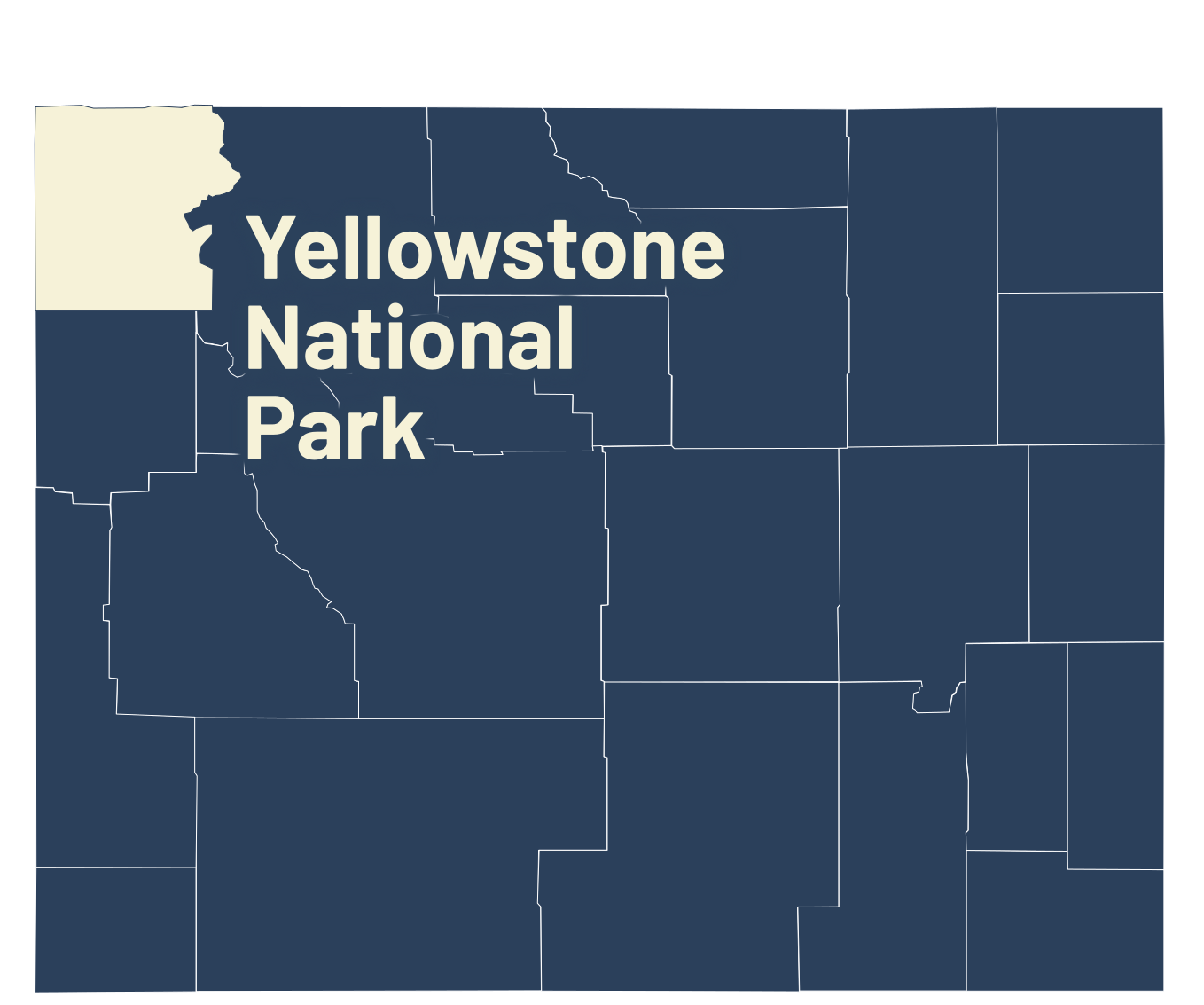
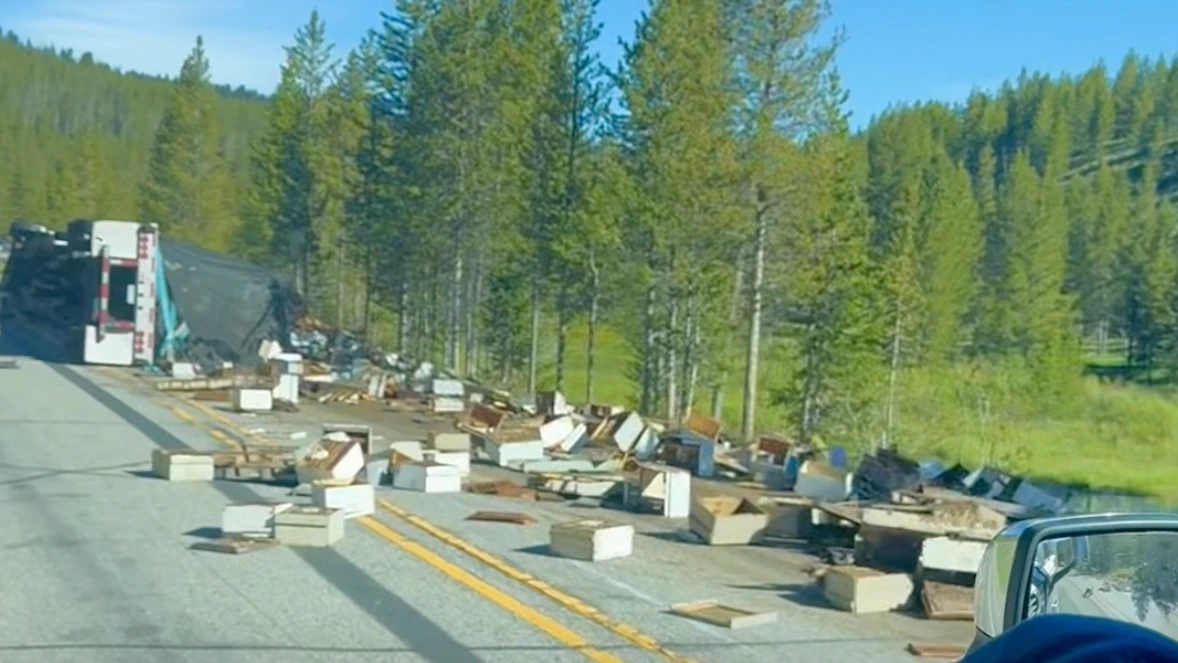
Almost a week after a semitruck carrying millions of bees flipped over in Yellowstone National Park and destroyed hundreds of hives, bees are still swarming around the area.
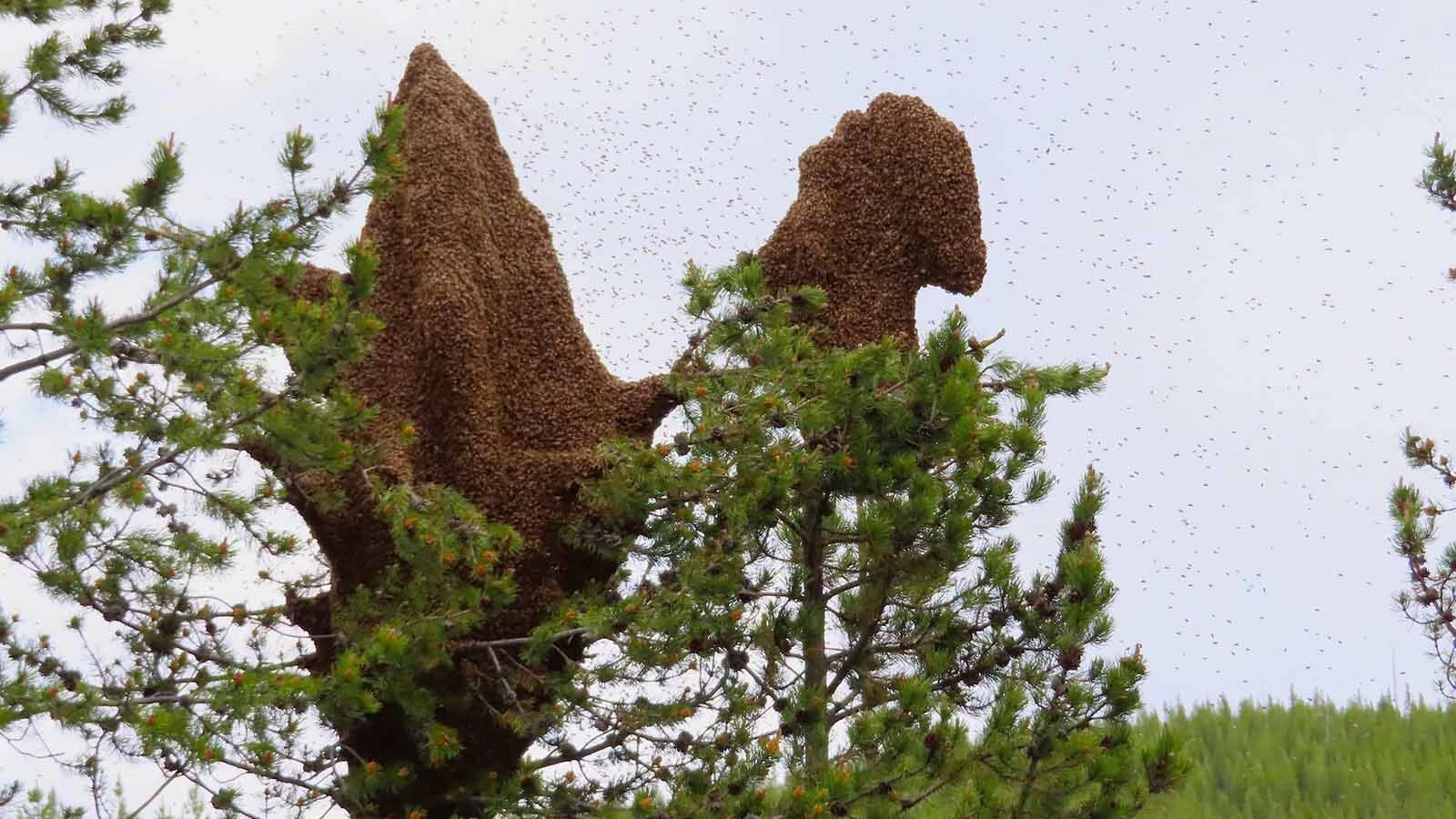
Thousands of bees are still homeless and visibly trying to survive in large groups on “bee trees” along U.S. Highway 191.
Jim Holstein with Yellowstone Tour Guides has been passing through the area where the accident occurred. He took a photograph of one of the bee trees, where thousands of bees had completely covered a small lodgepole in a vast, buzzing swarm.
“They were still there on Monday,” Holstein told Cowboy State Daily. “It’s in the park between Big Sky and West Yellowstone. All the hives have been cleaned up, but there are quite a few bees left.”
Bee Trees
Cheyenne beekeeper Michael Jordan is familiar with bee trees. They’re an indication that a colony of bees is actively house-hunting.
“It’s what's called a swarming mechanism,” he said. “The queen leaves and takes about half or more of the colony and moves to a new safe location.”
Jordan said this is common behavior for honeybees when a hive gets overpopulated. The existing queen will take nurse bees and guard bees to sustain herself in a temporary location while scouts search for a permanent place to establish a hive.
“The scouts will search until they find a permanent location,” he said. “In the meantime, you'll have groups and colonies hanging in the trees as they regroup.”
A new permanent home could be a hole in a tree, a cave, or “anywhere that’s out of the water and elements,” said Jordan.
Bee trees are meant to be staging locations so the scouts can lead the hive to their new home.
Sugar High
When the scout bees find a suitable location for a permanent hive, their next priority is finding food. That means a rich source of sugar.
“Right now, they’re looking for a sugar source,” Jordan said. “Bees need sugar to produce wax from their glands. Once they produce the wax and form it, they'll actively engineer foam in what we call a pendulum manner to make honeycombs.”
Bees instinctively know how to build hives, and their goal is to start propagating as soon as possible after a hive-destroying incident.
Once they find a suitable spot with plenty of sugar in the vicinity, maybe a rock formation or building near a flower-filled meadow, the queen will follow the scouts to the new hive. Instinctively, all the bees on the bee tree will follow her.
Jordan didn't think there would be any bee trees for tourists to see by Wednesday.
“Those clusters will be gone within 24 to 48 hours if they find a good location,” he said. “After that, there’s nothing you can do to recover them, because tracking them is very hard.
The fact that bee trees can still be seen along U.S. Highway 191 six days after the June 16 crash might indicate the bees are having trouble finding an ideal place for a new home. But it definitely means the colonies can be safely recovered.
Get Those Bees, Please
Within 24 hours of the semitruck incident, people were at the scene removing the damaged honey boxes and trying to recover whatever remained of the bee colonies that had been residing in them.
Jordan said the first 48 hours are crucial in a bee recovery situation like that.
“If you can’t get new hives set up in 48 hours, the queens will migrate and leave a pheromone trail that the bees accommodating her in that hive will follow,” he said. “That’s what the bee trees are: thousands of bees accumulating around the queen.”
That means there’s a small window to safely save these bees before they become permanent Yellowstone residents.
Jordan’s strategy would be to place a mobile swarm trap. It’s basically a column of PVC pipes with buckets attached to either end. The height can be adjusted to get as close as possible to the colony clusters.
“If the bees accumulate in the buckets as a temporary hive, you can relocate them to an apiary and manage them there,” he said. “You can even hold a bucket up to the colony and shake them inside. That’s how you can naturally collect and remove a colony.
No Bears — Yet
Commercial vehicles like semitrucks are banned in Yellowstone, but U.S. Highway 191 is an exception. It hugs the western boundary of the park and is an important 55-mile thoroughfare between West Yellowstone and Big Sky, Montana.
"They've enacted a temporary 35 mph speed limit on the section where the bees are," Holstein said. "People have to keep their windows up, and there's no stopping until crews can get the remaining bees rounded up."
When the bee trees disappear, it means the bees have found a suitable spot to rebuild their hive. Finding and removing the colony would be difficult, if not impossible, especially in the dangerous wilderness of Yellowstone.
After all, who loves honey more than bears?
“I haven’t seen any bears,” Holstein said. “Yet.”
Jordan was more concerned about the people who lost their honey boxes and bee colonies. He knew how much money they had lost and must have spent trying to salvage whatever they could from the accident.
“From the way it looks. I’d think about 40-50% of what’s there is salvageable, maybe,” he said. “Each honey box can cost around $500 and generate around $2,000 in honey.
"There could be two or three owners who lost their livelihood in that accident. That’s at least one whole company that has to rebuild.”
Andrew Rossi can be reached at arossi@cowboystatedaily.com.