
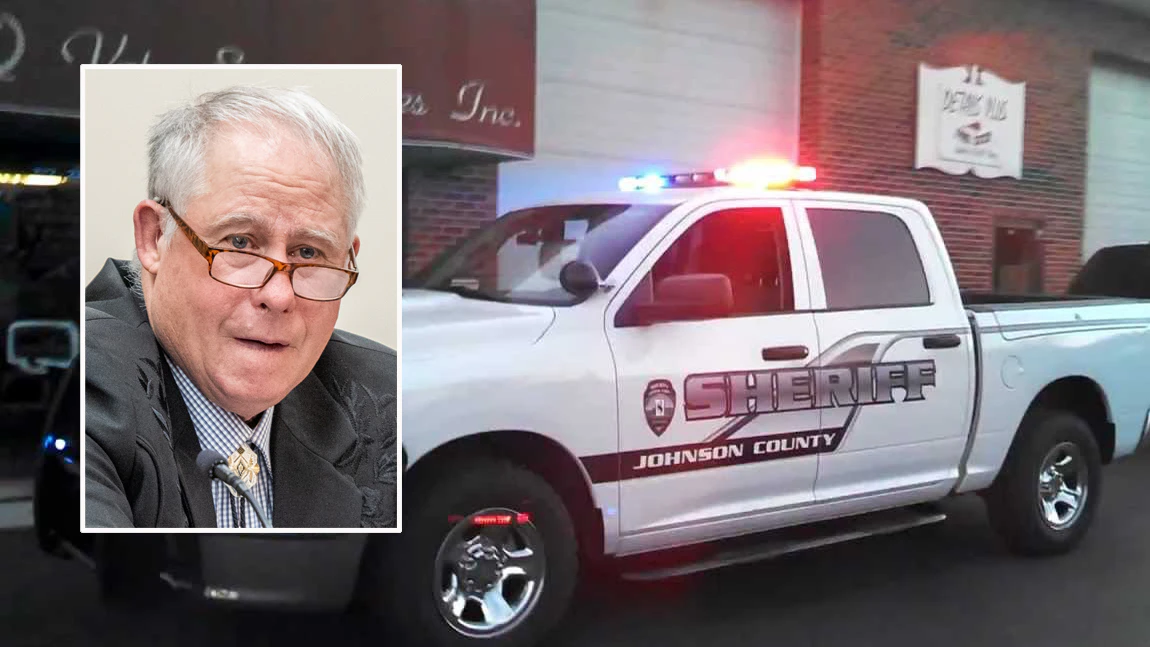
The things Wyoming state Rep. Bill Allemand said while handcuffed for 12 minutes during a DUI traffic stop can’t be used as direct evidence against him in a trial slated for September, because his arresting deputy failed to give him his Miranda rights, a Johnson County court magistrate has ruled.
Allemand, a Republican state representative of the Mills area, was charged Dec. 29, 2025, on suspicion of driving under the influence of alcohol in Johnson County – one day after a Buffalo traffic stop just off Interstate 25.
When Johnson County Deputy Caleb Campbell stopped Allemand at around midday Dec. 28, Campbell handcuffed Allemand without first giving the lawmaker his Miranda warnings against incriminating himself.
That was a fair move, because Allemand had a gun on his front truck seat and Campbell had concerns about officer safety, Buffalo Circuit Court Magistrate Jeremy Kisling ruled in a Friday order.
But Allemand remained handcuffed for 12 minutes – including a length of time after Campbell had secured the gun and after Campbell’s secondary “cover” deputy arrived. And Campbell kept asking Allemand questions, and also urged Allemand to be honest with him, according to court documents and body-camera video shown in court.
This led to a number of potentially incriminating statements while Allemand was confined, but not warned the order says.
Because Allemand was being interrogated while in custody without receiving his Miranda warnings, what he said during that 12-minute span can’t be part of the Johnson County Attorney’s Office’s main case against him at his Sept. 16 trial in Buffalo Circuit Court, Kisling ruled.
“Even in consideration of the totality of the circumstances, the court can think of no scenario where a reasonable person would not consider themselves in police custody after being placed in handcuffs,” Kisling wrote. “Deputy Campbell violated the defendant’s constitutional rights by questioning him while he was handcuffed without reading Miranda advisements.”
But Allemand wasn’t coerced, threatened, or tricked into saying the many things he said or indicated while handcuffed. In the body camera footage, for example, Allemand said he’d had two beers, and he knew drinking and driving is “highly illegal” but drinking while driving down the interstate helps with his “anxieties."
So since Allemand's statements were voluntary, the case prosecutor can still bring those statements up for “impeachment,” or to fact-check testimony at trial, Kisling ruled.
The prosecutor can also bring direct evidence of what Allemand said after Campbell removed his handcuffs and tried getting him to perform field-sobriety tests. For example, Allemand voiced confusion about whether his gun was on his body, said “nonsensical” things and repeatedly asked questions that had already been answered, notes Kisling’s order.
Kisling also said the evidence shows Allemand’s speech was slurred, and he swayed and stumbled during the traffic stop.
Allemand reportedly failed his field-sobriety tests and was arrested and taken to jail.
The Arrest
The evidentiary affidavit, body and dash camera video, and court testimony together indicate that a blue truck was the subject of a Report Every Drunk Driving Incident (REDDI) call. A male in his 60s with white hair was driving the truck, the REDDI caller told dispatch at the time, according to court documents. The caller initially described the truck as a blue Dodge with a bed topper, but later voiced uncertainty as to whether it was a Dodge, the order recounts.
Campbell arrived on that section of interstate to find the REDDI caller’s vehicle driving near a blue Toyota Tacoma with a bed topper. The Tacoma left the interstate in the Buffalo area, stopped at a stop sign, rolled toward the intersection and braked abruptly to avoid colliding with a red truck, Campbell testified in court in March.
Dash camera footage, though grainy, corroborates this partially by showing a red truck pass in front of Allemand’s truck.
Allemand parked the blue truck at the Miller’s Travel Center gas station.
Campbell activated his lights, knocked at Allemand’s window, and soon put him in handcuffs because Allemand had a gun on his front truck seat, according to the case evidence. That’s reportedly why Campbell handcuffed him.
‘Justified Under All Circumstances’
Allemand’s attorney Mike Vang had brought an argument with regard to this evidence that Campbell didn’t have reasonable suspicion to justify the initial traffic stop or its extension.
The Wyoming Constitution’s Article 1, Section 4, requires that searches and seizures be reasonable under all the circumstances. For traffic stops, Wyoming courts are to review that reasonability question under “all facts and circumstances,” Kisling’s order says.
Vang argued at a March 25 hearing that Campbell failed that test.
Kisling disagrees.
“The initial stop was justified under all circumstances,” the magistrate wrote. The REDDI report and matching circumstances in which Campbell found the REDDI caller and Allemand lent reasonable suspicion, but Campbell also had probable cause of a traffic violation with Allemand’s alleged failure to yield the right of way to the red truck at the intersection.
Campbell was also justified in extending the stop because he had evidence that a DUI had happened, Kisling added.
“The video speaks for itself in establishing there was probable cause to believe the defendant was under the influence of alcohol while operating a motor vehicle,” the magistrate wrote
Clair McFarland can be reached at clair@cowboystatedaily.com.


