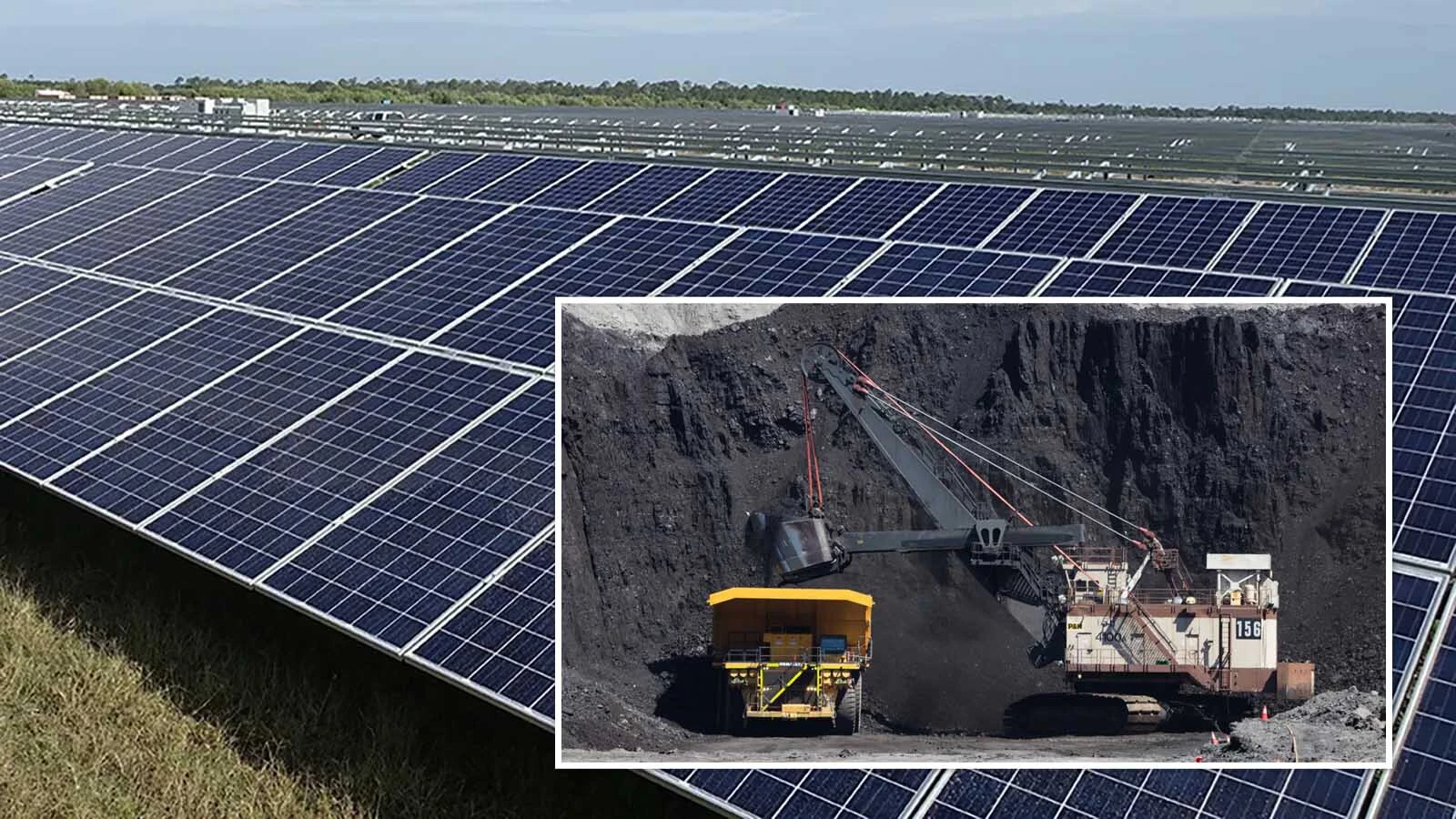
Solar-generated electricity surpassed coal power in the United States for the first time in May, marking a symbolic milestone in the nation's changing energy landscape.
But Wyoming energy experts say the crossover suggests more about shifting demand, aging coal plants and seasonal trends than it does about coal disappearing anytime soon.
According to a report released this week by Ember, an independent energy think tank, solar supplied 12.8% of U.S. electricity generation in May, while coal fell to a record low of 12.2%.
Natural gas remains the nation’s leading source of electricity, accounting for about 37% of generation in May, the U.S. Energy Information Association reports. Combined with coal, fossil fuels were behind nearly 50% of U.S. power generated last month.
"You take those snapshots with a grain of salt," said Travis Deti, executive director of the Wyoming Mining Association, in response to solar passing coal.
Dr. Rob Godby, an economist at the University of Wyoming who studies energy and environmental economics, said May is exactly when such a crossover would be expected.
Coal plants often reduce output or temporarily shut down for maintenance during what the industry calls "shoulder season" — the period between winter heating demand and summer air-conditioning demand.
At the same time, longer days and sunnier weather boost solar production.
"May would make perfect sense as the month to see it," Godby told Cowboy State Daily. "I've never seen coal as low as 12%, but if there was going to be a month where it happened, this would be the time."
Growing Demand, Different Sources
The milestone also reflects a larger shift happening with the nation's electric grid, Godby said.
Electricity demand, which remained relatively flat for years, has begun climbing sharply as data centers, advanced manufacturing facilities and other energy-intensive industries expand across the country.
"Very often developers prefer having a renewable source of energy, both for climate and cost reasons," Godby said.
Solar has become the least expensive source of new electricity generation, he said, often competing directly with wind power on price.
“Solar energy is neck-and-neck, and often lower than wind,” Godby said. “Renewable energy is just cheaper, and that’s why so much has been produced.”
At the same time, little new coal generation has been built in the United States in more than a decade.
"The (energy) market is growing," Godby said. "Coal has stayed constant. As we add new generation to the fleet, it has primarily been wind, solar or gas."
The dynamics are easy to visualize in a fraction, Godby said.
If the top number of the fraction is coal-generated power and the bottom number is total energy demand, the top number is not growing while the bottom number is.
As the bottom number grows, coal takes on a smaller and smaller share of the market.
Solar demand is growing, while coal is not, Godby said.
“The market is growing. We haven’t built any new coal (plants). Therefore, coal share goes down,” he said.
Deti agrees electricity demand is surging, but argues that growing demand ultimately benefits coal producers.
He said data centers are the next wave of modern technology that will require all types of power, from coal to renewables, to function.
Coal Plants Getting A Second Life
The picture becomes more complicated because many coal-fired power plants once slated for retirement are now being granted additional years of operation under coal-friendly Trump administration policies.
Utilities and grid operators increasingly worry that electricity demand is rising faster than replacement generation and transmission infrastructure can be built.
"We have to maintain coal-fired power plants to keep the grid stable," Godby said.
Still, he cautions that extending the lives of aging coal plants is not a permanent solution.
"It's like an old car," he said. “Eventually, they'll wear out."
Many coal plants scheduled for retirement received minimal investment in recent years because operators expected them to shut down.
As a result, some older facilities cannot consistently run at maximum capacity, Godby said.
The Trump administration has pushed aggressively to preserve coal generation, issuing orders intended to delay retirements and rolling back renewable energy incentives.
Wyoming has seen some of those changes firsthand.
The Dave Johnston Power Plant near Glenrock will not retire in coming years as anticipated, while Rocky Mountain Power has extended retirement dates for several coal-fired generating units serving Wyoming customers.
Deti believes those decisions reflect a growing recognition that coal remains essential.
"Because of that power demand, we're going to be seeing a renewed interest in coal," he said.
Wyoming Coal Still Looking Overseas
Coal production in Wyoming has fallen roughly 50% from its historic peak, Godby said, but demand has stabilized in recent years as electricity consumption rises.
Wyoming's coal industry also remains heavily dependent on markets outside the state, with about 90% of Wyoming coal being exported.
Deti said interest in Wyoming coal remains strong internationally, particularly among countries along the Pacific Rim seeking reliable fuel supplies amid geopolitical uncertainty.
A recent trade delegation that included representatives from Malaysia's largest electric utility explored opportunities involving Wyoming coal, he said.
"We're definitely seeing a renewed interest in coal," Deti said. "Coal's not going away anytime soon."
Godby agrees coal is unlikely to disappear quickly, but said that Wyoming still faces long-term challenges because the state's fortunes depend largely on energy decisions made elsewhere.
"Long term, the reality is you won't be able to keep these coal plants running forever," he said.
Wyoming Still Lags In Solar
Even as solar gains market share nationally, Wyoming remains one of the least-developed solar states in the country.
According to the Solar Energy Industries Association, Wyoming ranks last in the nation for installed solar capacity and has no utility-scale battery storage projects operating within the state.
Godby said expanding transmission lines and battery storage will be critical if Wyoming hopes to participate more fully in the nation's growing renewable energy market.
For now, however, he sees the latest numbers less as a death sentence for coal and more as evidence that the country will likely need every available source of electricity to satisfy rapidly growing demand.
Kate Meadows can be reached at kate@cowboystatedaily.com.