It was yet another data-center dominated night for the Cheyenne City Council at its regular session Monday night, with intense, sometimes emotional public testimony on a proposed, roughly 3,460-acre annexation south of the Sweetgrass subdivision and east of South Greeley Highway.
City staff and Microsoft representatives who were present confirmed the annexation is being advanced to support future expansion of data centers.
No annexation vote was taken. The routine item, which was initially part of a consent agenda, was a referral to the Public Service Committee.
Out-Of-Date Plan
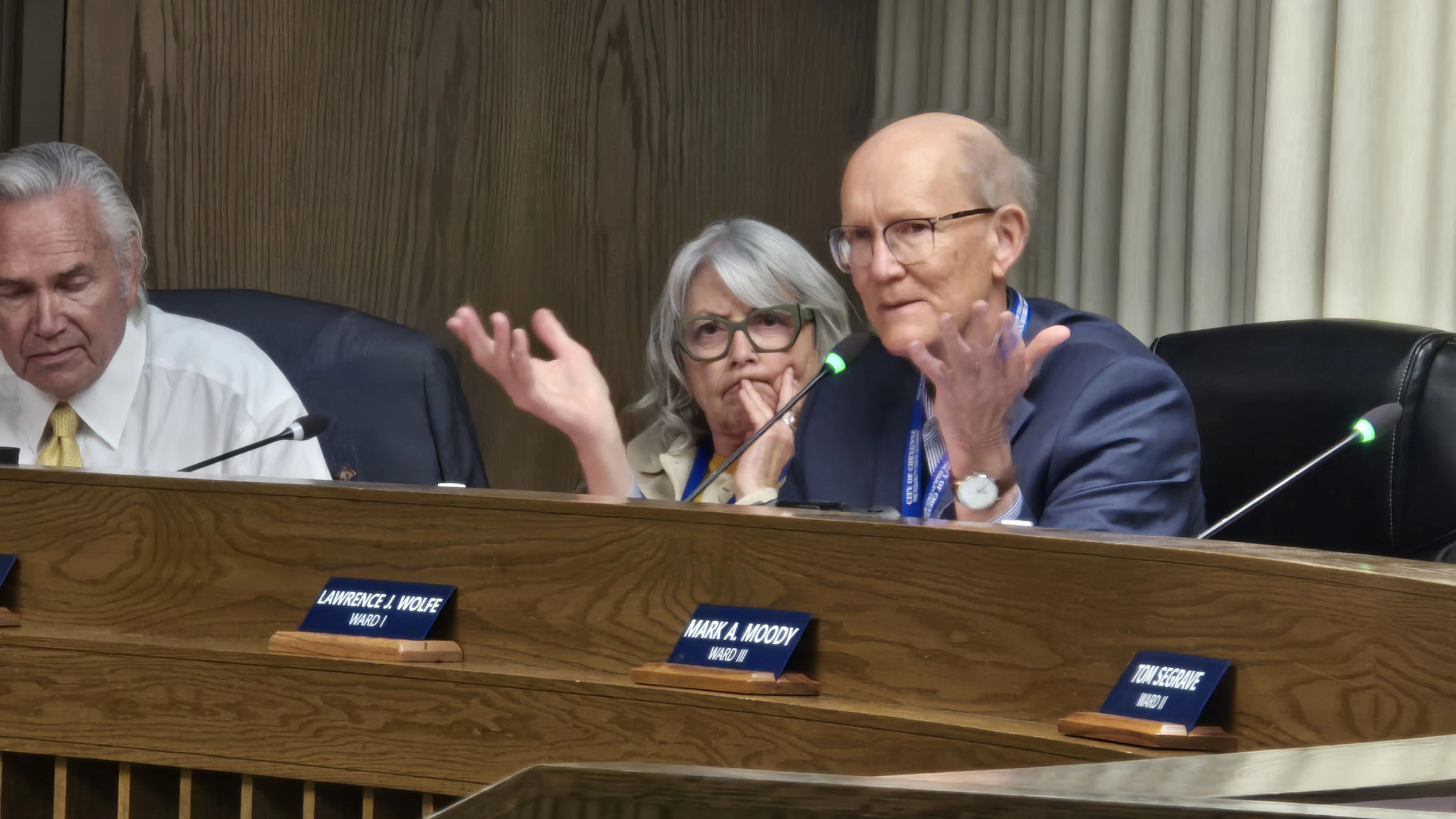
Ward 1 Councilman Larry Wolfe requested the council take the proposed annexation off the consent agenda so it could be discussed separately.
The area, Wolfe contended, should not be treated the same as a 2-acre parcel of land. He questioned annexing so much territory into the city at once when there are no specific plans yet attached to it, even as the city is getting ready to update its long-range planning, which Wolfe suggested is 12 years out of date.
“As you look at this giant annexation, and as you look at all of the hullabaloo about it that we have faced as a city council, and your office has faced, did it occur to you all to think maybe this annexation could proceed in a couple of steps?” Wolfe asked Cheyenne Planning and Development Department Director Charles Bloom. “Maybe it might even be better off to just be considered in the future, two, three years from now, when you, in fact, have updated Plan Cheyenne?”
Not Staff’s Job
Mayor Patrick Collins interceded, saying it’s not appropriate for staff to dictate the timing of an annexation.
“The state law says that if they bring a petition to us, we must look at that petition,” Collins said. “And if it meets the criteria, shall by ordinance annex that property. And so I don’t know that it’s staff’s position to censor applications. That’s our job.”
On that point, Wolfe agreed.
“It’s your job to take a look at something of this magnitude and make a judgment about whether or not it ought to proceed through our regular processes,” Wolfe said. “Or, in fact, we might think hard about an annexation of this size for a topic of this controversy, and treat it in some different kind of manner. That’s my point.”
Collins, on that point, demurred.
“I think if you were to poll your colleagues here and say that I have the authority to decide what comes before this governing body, I think you’d lose probably eight to one in that vote,” he said. “I think the job is we’re separate but equal, and when those applications come, we’re part of — all of us together, are the legislative body, the governing body. It should be done as a joint decision.”
Just Map Color Is Changing
Collins also said he felt the discussion itself is conflating annexation with the development action, which are two separate items.
“Annexation doesn’t do anything but change the color of the map,” Collins said. “What you’re concerned about is what happens once it’s annexed, and that is another process the governing body goes through. That is when we do the zoning for it, when we do the final plat for it, when we do those types of actions. If we were to just annex this property and it sits there for a decade or so, it doesn’t really change anything does it?”
“In 10 years, a couple of things may change,” Wolfe replied. “And I take some guidance from what our good governor just said to us last week in his executive order on data centers. You know, he says local authority and community investment, we’re keeping power close to —”
“Point of order,” another council member interjected. “Are we on annexation? Or are we on data centers?”
“Madam Councilwoman,” Wolfe replied. “You cannot possibly separate them today.”
And so the conversation would roll throughout the public debate, with citizens and officials wrestling over points and points of order all along the way.
Sounds Like “Extortion”
Wolfe said he wants to see developers like Microsoft invest in local housing, charity and infrastructure, and believes annexation is the beginning of the right time to start talking about that.
“We shouldn’t kid ourselves that we are in fact looking at just the annexation,” he said. “This is the time for this council, for this government, for Mr. Bloom to actually take ahold of these issues and make them reality.”
A community benefit requirement, Collins replied, is “too much like extortion.”
“I just don’t agree,” he added. “At this point in time, what we’re doing is annexing a piece of property. If, in fact, the companies want to do some things like we have later on in our agenda, I think that’s well-welcomed, but to condition annexation on that, I think is a slippery slope, sir.”
“Mr. Mayor, it’s not a slippery slope, it’s in fact the slope that we are on right now,” Wolfe replied. “It’s not extortion. I’m talking about something that I’m going to call a mutually beneficial partnership agreement with Microsoft.”
“You can be annexed if you give us what, a rec center or something like that?” Collins said.
“No, no, my proposal is going to be 3% of the total cost of the project,” Wolfe replied.
“So two rec centers,” Collins said.
Questions About Scale, Benefits
Members of the public also came to the podium, both for and against, to discuss their own points and their own frustrations with city processes.
Harmony Meadows resident Heather Madrid questioned the council’s use of an outdated land-use map.
“How is this protecting the health, safety, and welfare of people?” she asked. “If people don’t live there yet, it’s not really protecting anybody. In fact, I would argue that it’s harmful to that area.”
Such a large annexation, meanwhile, is going to affect the entire city, Madrid said, not just people who may live within 300 feet of the facility.
“If there’s no plan of what’s going to happen over the next 10 years, how is it even possible that the criteria in Wyoming statute … has been met?” she asked. “At the Planning Commission, Microsoft was asked how many buildings and they didn’t know.
“So how is it even possible to say that that statute has been met if there is no plan?”
The city should update everything before proceeding, Madrid added, and consider “not only what benefits global corporate billionaires who are trying to land grab in rural America.”
Speaking for the annexation was Brian Napier, a Cheyenne resident who has worked for Microsoft since 2016.
“I’ve been with Microsoft for 10 years and everything I’ve ever seen with the company has been positive, working with the community and trying to be a good neighbor,” he said. “If I didn’t believe that, I wouldn’t be standing in front of you here, on their behalf, today.”
Napier said the company has hired 100 people in the past three years, jobs that he characterized as “good” with “great benefits.”
Largest Annexation In City History
The annexation which drew so many comments is the largest Cheyenne has ever seen at 3,459 acres land, 46% of which is contiguous to city limits.
The only annexation to rival it in size, according to city officials during the meeting, was the Sweetgrass annexation. Records show that was a 2,269-acre project, brought into the city in 2018 near the intersection of East College Drive and Avenue C, south of Laramie County Community College.
It took another 1,000 acres to get to the project to annex it, Cheyenne planner Connor White said during the council meeting, making the two comparable in size.
The plan for that was a buildout over 50 years, White added.
“The main reason they did it all at once is because they wanted a unified development program for the Sweetgrass development,” he said. “The PUD (Planned Unit Development) has changed a few times. You’ve changed it probably within the last few months. So it changes, yes.”
At the time, it represented a major growth spurt for Cheyenne at one-sixth the city’s size, one that was going to require more staff members for various city departments to take care of the land.
“That was … a higher impact on city services, fully built out,” he said. “But we had a greater standard of review on that larger annexation than we did with say someone annexing single-family homes to connect to sewer. So I just wanted to shed light on what’s happened in the past.”
Microsoft’s Turn
Microsoft officials said it has identified the annexation area as a logical future expansion for the Bison Business Park, and decided it’s best to pursue that with Cheyenne.
For long-range planning, it’s important the company knows the zoning for the area.
After that, it can begin transportation, cultural, environmental, noise, and other studies.
An open house was held for the project with neighboring landowners, which was attended by three people.
A more general community forum was also held during that general timeframe, which drew around 150 people to learn more about Microsoft’s plans in Cheyenne.
Rachel Irwing, land development and permitting manager for Microsoft, said the size of the Highlands project represents a long-term commitment from the company to plan and grow responsibly in Cheyenne.
“Large contiguous parcels with the infrastructure characteristics needed for future development are increasingly rare,” she said. “Planning comprehensively now allows us to have growth occur thoughtfully and with the city’s input and with the public’s input over time, rather than incrementally and reactively, parcel by parcel.”
That doesn’t mean that all of the 3,050 acres Microsoft will own is being developed all at once.
“Complete and full build-out of the site would likely be a 10- to 20-year phased development,” she said. “The larger planning area provides flexibility to responsibly coordinate infrastructure, transportation, utilities, buffering, environmental concessions, and future community needs over many years, and in alignment with market demand and infrastructure readiness.”
Long-Term Commitment To Cheyenne
These efforts further reflect a long-term commitment by Microsoft to Cheyenne, Microsoft Community Affairs Senior Manager Lucas Downey said.
“Microsoft is not new to Cheyenne,” he said. “We’ve called Cheyenne home since 2012 and from the start we’ve tried to be good neighbors, not just a company with a footprint here, but a partner in the community’s future.”
Downey said more community forums are planned in the future, so collect feedback from the public about what matters to them, and to ensure that those concerns are appropriately addressed.
“We want to keep listening, keep showing up, and keep addressing your feedback directly,” he said. “We’ve also tried to back up our words with investment. Since 2018, Microsoft has supported 56 community projects across 28 local organizations, and we’ve donated $4.7 million to local nonprofits and organizations across Wyoming.”
Those groups range from Boys and Girls Club Cheyenne and Laramie County Community College to Habitat for Humanity, Climb Wyoming, Cheyenne Frontier Days and many more.
Microsoft is committed to paying the full cost of its electricity bill so that residential rates are not affected and to minimizing water use and being good stewards of the water shed.
The company’s commitment to Cheyenne also includes creating jobs, investing in local training and nonprofits, and contributing to local taxes that support public services.
“In 2025, Microsoft was the No. 1 taxpayer in the city of Cheyenne,” Downey said. “We know trust is earned, not announced.
"We’re committed to earning it this summer and for years to come,” he added. "We’re not just proud of the 14 years we’ve been a part of the community, we’re genuinely excited for the decades that are still to come. Cheyenne isn’t just where we operate, it’s where we intend to keep growing, contributing, and building in partnership with the community.”
Not Just Changing Map Colors
“We don’t make decisions like this, haven’t before, and certainly not in such a politically charged atmosphere, with so many nearby aspects,” Councilman Pete Laybourn said toward the end of the discussion. “And I don’t think we can look at this in that narrow view that’s been suggesting tonight that we’re changing the color on the map, Mr. Mayor.
We’re not changing the color on the map,” he continued. “We are adopting the rules and regulations of the city. That’s a really serious thing.”
The needs of South Cheyenne, which is immediately adjacent to the proposed land that’s being annexed, need to be fully considered in context with the annexation, Laybourn suggested.
“I believe there’s contributions that should be considered to help that neighborhood,” he said. As well as other issues here in the city.”
Given the public interest and concerns surrounding data centers right now — and Microsoft’s expansion plans in particular — Laybourn suggested it’s actually a huge problem that the most recent minutes from the Planning Commission, which dealt with recommendations related to the annexation, are unavailable to the council, even in draft form.
“When we don’t have the minutes, we don’t have a real chance to discuss the action they took,” he said. “And they took several votes. I personally don’t want to call on my recollection.
"I think we need to go to the record. I think that’s a very important part of this. And certainly
those minutes can be dispersed as draft minutes,” Laybourn added. "We (shouldn’t) have to wait a month for them to be approved by the next meeting of the commission. There’s got to be some middle ground on this.”
Renée Jean can be reached at renee@cowboystatedaily.com.