
Two neighboring homes in California’s infamous Palisades wildfire last year offer a stark contrast that Jackson Hole-based Frontline Wildfire Defense CEO Harry Statter loves to share.
In the video, one home is reduced to ash, with just a few charred beams jutting up from the ground, while the house beside it appears all but untouched.
It still has its roof and siding, and even the surrounding landscape is vividly green — a brilliant contrast to the blackened hillside next to it.
Both of the homes sat in the same burn zone, but had radically different outcomes.
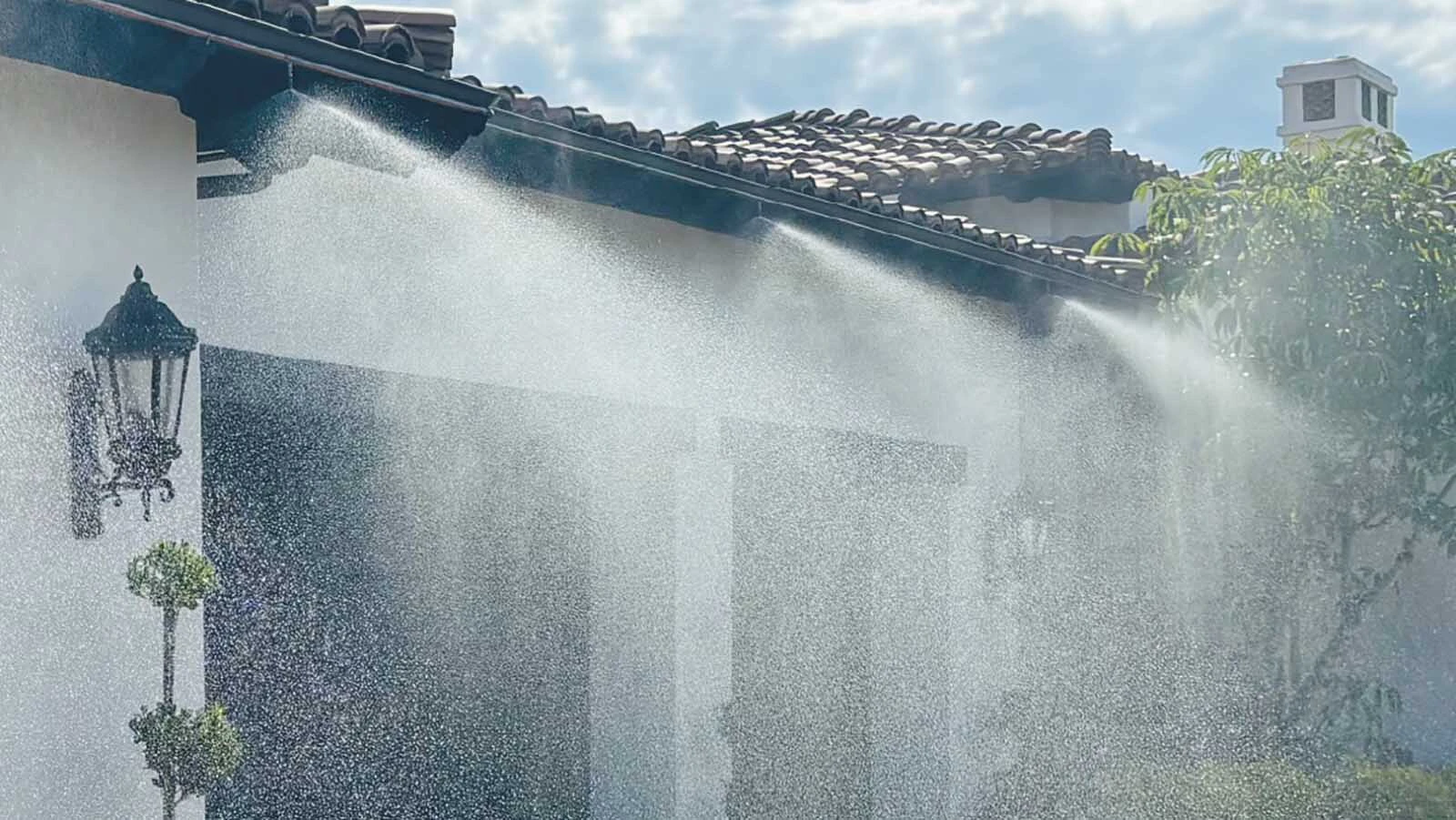
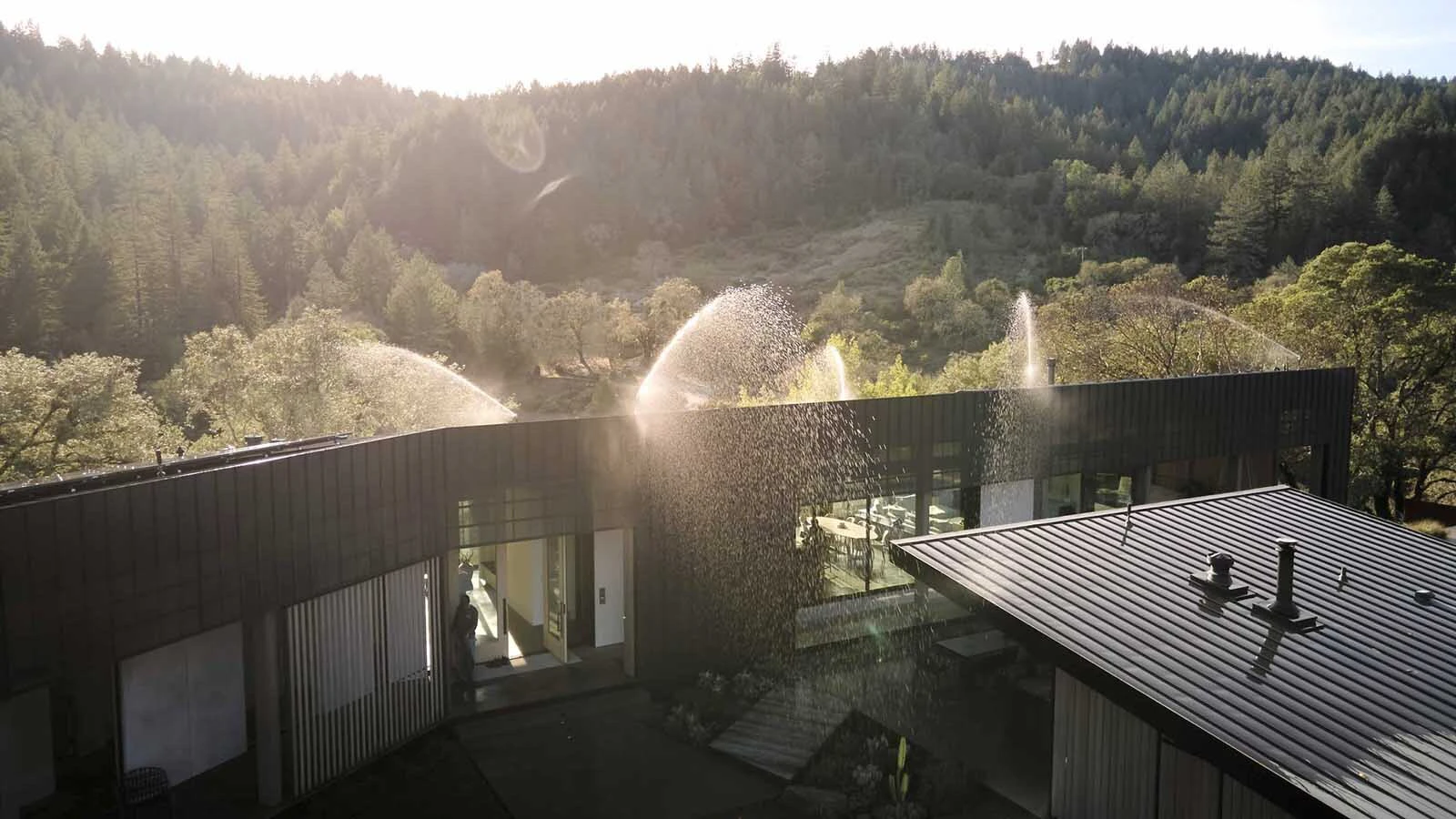
The difference, Stater said, was a system that uses artificial intelligence to monitor fire conditions and automatically activate a rooftop and perimeter sprinkler system, wetting structures down so embers cannot easily ignite them.
“We had 61 systems that were activated across properties,” he told Cowboy State Daily, referring to multiple fires in the Los Angeles area. “There were 41 in the Palisades fire, with others in the Sunset, Kenneth, Hughes, Eaton and Hurst fires.”
Of all those homes, just two were ultimately lost. In both cases, embers were pulled into the home by the ventilation system, starting a fire that burned from the inside out.
“You can see the entire hillside is burned,” Statter said. “But as you get into the Frontline protected property, everything is green.”

Wyoming Heads Into A Tinderbox Summer
This year, the stage has been set for another tinderbox summer in Wyoming.
Winter essentially never came, leaving 97% of the state in some level of drought, along with one of the worst snowpack deficits on record.
Fire experts have warned the 2026 fire season could look uncomfortably similar to the 1988 Yellowstone fires, when nearly 800,000 acres of the Greater Yellowstone Ecosystem burned, becoming a smoky hellscape that took upwards of 25,000 firefighters — as many as 9,000 at one time — to fight at a cost of around $120 million.
Meanwhile, the state experienced its second-worst wildfire season on record in 2024, when nearly 1 million acres burned in various fires across the state.
Wyoming has had about the same number of fires this year as in previous years, Wyoming State Forestry officials told Cowboy State Daily. But those fires have already burned 4,000 more acres over the same period.
Those kinds of fire seasons have already prompted some insurance carriers to pull back from parts of Wyoming’s market, while others have raised premiums so sharply it amounts to a slow-motion exit for homeowners who cannot afford the new rates.
That’s turning app-driven sprinkler systems like Statter’s into more than just a gee-whiz-cool idea.
It’s creating what could be the last line of defense for wildfires where firefighting resources become too overwhelmed to protect every home.
And insurers are already embracing ideas like these, offering discounts in some cases to homeowners who install them — including Statter’s company, which he said expects to announce just such a deal sometime later this year.

Wildfire Protection Gets Weird — And High Tech
Statter’s company is part of an emerging trend in wildfire protection that leans heavily into high-tech, automated approaches that seek to save homes even if firefighters can’t get to them.
Some of these high-tech systems are quite flashy, like the subterranean “disappearing” homes featured in April on "Shark Tank.”
The modular HiberTec Homes system can hydraulically lower a house into a subterranean vault in 15 minutes after safely disconnecting from utility lines.
Once there, a fire-resistant cover seals the vault, protecting the home from the presumably raging fires above.
There are also precision sprinklers and smart foam, as well as ember-resistant vents.
There’s even a company called Sonic Fire Tech that uses sound waves to fight fire.
It works by vibrating oxygen molecules faster than the fuel can use it, blocking the chemical reaction that causes fire to burn.
As sci-fi as this sounds, it’s not a new concept.
The U.S. Defense Advanced Research Project Agency started studying the method in 2008, and a George Mason University duo built a subwoofer extinguisher in 2015, which they demonstrated on YouTube.
Insurers Say Talk To Us Before You Tech Up
Many of these approaches are interesting, but unproven, Rocky Mountain Insurance Association Executive Director Carol Walker told Cowboy State Daily.
“There are lots of different private vendors that have set up around this space,” she said. “I can’t speak to any one particular service, but there’s a number of them out there, and I think the most important thing is collaboration.”
By talking to their insurer about potential wildfire protection systems, homeowners can learn whether there are any particular issues with a given company’s fire protection approach.
“With individual dwellings, there can be concern from insurance companies, especially in states like Wyoming, where we have purge freezes or leaks with these types of systems,” she said.
“So, as much as they can help with a wildfire situation and sprinkler systems being turned on, do ask your insurance company about any concerns they may have with water damage,” Walker said, "because unfortunately we see more water damage claims that are very expensive more often than we see wildfire.”
That said, Walker acknowledged many insurance companies are embracing approaches like Frontline Wildfire Defense’s and even offering discounts on premiums for those who install such systems.
Don’t Neglect The Obvious
They also offer discounts for the Wildfire Prepared Home designation from the Insurance Institute for Business and Home Safety (IBHS), she added, which offers a range of fire-hardening tips for homeowners.
IBHS is a nonprofit organization that serves as the research arm of the insurance industry. It “crash” tests homes against all kinds of disaster scenarios at a lab down in South Carolina to formulate recommendations for homeowners.
“They create hurricane conditions, they create hail storm conditions, and then they burn down homes … to test products from wood to glass to the space around your home,” Walker said.
“And they’ve come up with a designation standard called wildfire-prepared home, which is the steps that are scientifically backed to protect your home,” Walker added.
One of the key tips from the IBHS wildfire ready program is just removing flammable debris from the first 5 feet around a home.
It sounds obvious, but it’s a step research has shown many homeowners neglect, said IBHS research scientist Evan Sluder.
Mulch beds, garbage cans, firewood piles — these are among the most common materials that homeowners forget about when they’re trying to harden their homes ahead of a wildfire.
“The way we talk about sprinkler systems is they’re good icing on the cake,” he told Cowboy State Daily. “In the weather that we see with extreme fire conditions, where we have high wind scenarios and low humidities, sprinkler systems can miss certain key areas of our homes.
"So take advantage of all the other mitigation measures that do work 100% of the time first.”
The program has recently expanded to Wyoming, Walker said.
It can help homeowners, and entire neighborhoods, take a proactive approach to fire prevention.
With or without a high-tech system, many insurers offer discounts to homeowners who earn the program’s designation, but for maximum impact it’s key to work with neighbors.
“Doing these programs as communities is important,” she said. “Because you have to get it to scale to have it make a difference with risk reduction for that entire community.”
How An Ember Sparked A Startup
Statter’s idea for his wildfire protection company grew out of a particular realization while helping to manage forests across Wyoming, Montana, New Mexico and beyond.
His crew’s job was to thin trees and create defensible space around structures so firefighters could safely work. But he noticed that structures “surrounded by acres of parking lot with no trees growing” were still, somehow, catching fire.
The problem, he realized, was embers.
They land on a roof, on nearby mulch or on anything flammable — even a car — and start a fire that eventually spreads to the main structure, even if it is otherwise surrounded by a sea of concrete.
“It’s just like a campfire,” he said. “You have sparks coming out of a campfire when you have wind. And those embers can go a really long way — up to 24 miles outside of the wildfire perimeter.”
Depending on where a fire starts, that could literally mean more than a million structures at risk.
“LA has the highest density of firefighters anywhere on the planet,” he said. “And (Palisades fire) was the beginning of January. There were no other fires competing for resources.
"But there’s fire, and there’s wind, and firefighters were quickly overwhelmed.”
Fighting Fire Before It Starts
Statter started thinking about what technology could do about all the limitations he was seeing on the ground.
That’s created the system he has today, which tracks fire service data to decide when to soak a home and everything around it.
The sprinkler system cycles on and off instead of running nonstop, using a fraction of the water it would take to put out a house fire.
“We’re 300 times more efficient than traditional fire suppression activities,” Statter said, adding that backup water supplies can be set up using swimming pools, tanks, water wells and ponds.
Homeowners can also start or stop the system from a smartphone app, and a solar backup panel keeps the system running even if the power grid goes down.
“The system incorporates a biodegradable Class A firefighting foam, that’s non-toxic,” he added. “It’s the same stuff that firefighters carry on a truck.
"You just don’t need a firefighter there to apply it.”
Renée Jean can be reached at renee@cowboystatedaily.com.


