
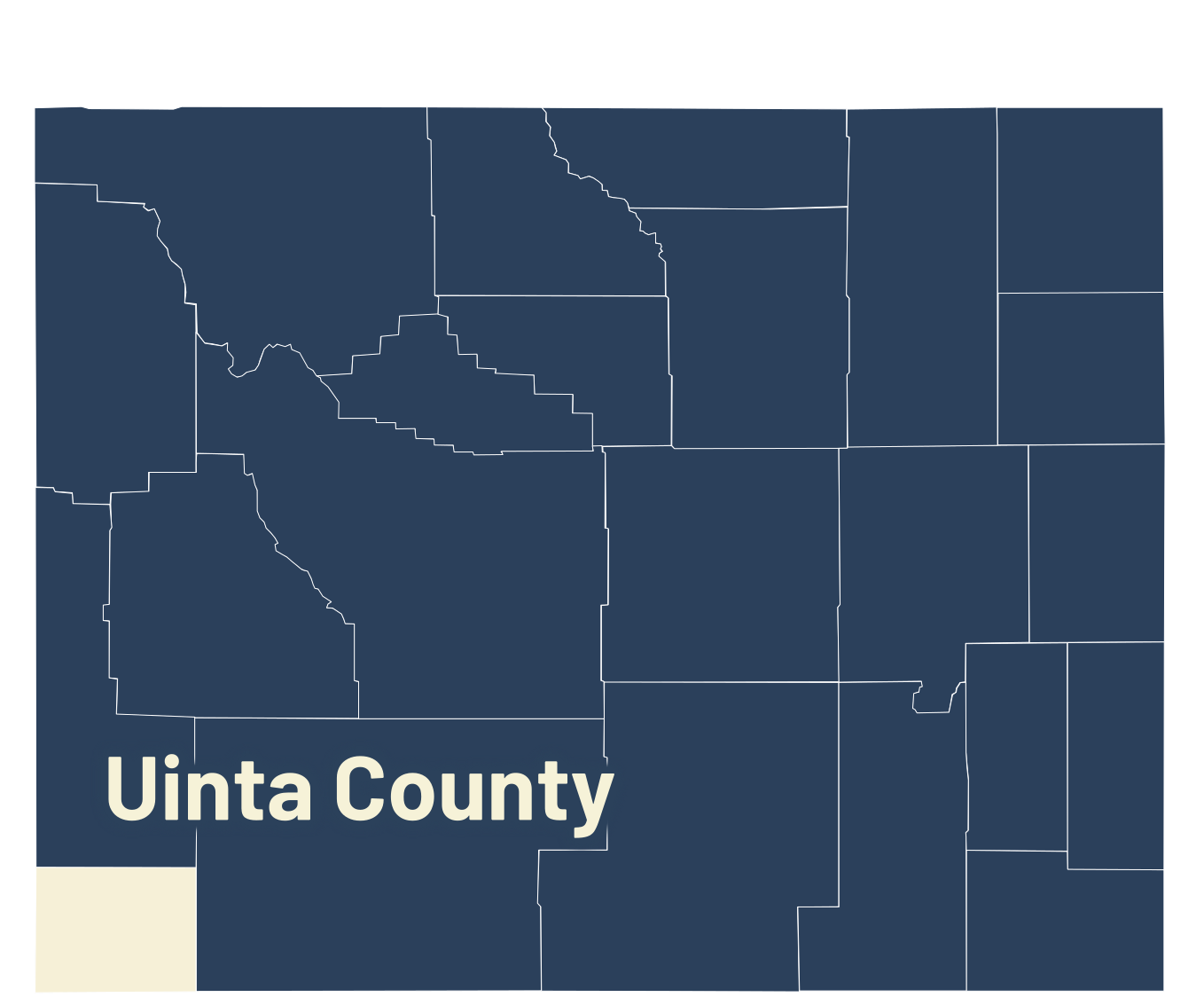

My family has ranched in Uinta County for six generations.
I spent summers moving cattle north of the interstate, learning to respect the land and water the way you do when it is your responsibility.
My grandfather Kay worked on the original Bear River Compact. My Uncle Gordon spent his life advocating for the basin. We get the value of water.
So, when people in Evanston and Casper raise concerns about what a proposed data center means for Wyoming's water, I'm not dismissing them. I'm here to talk about it.
Prometheus is proposing data centers in Wyoming that would generate their own power on-site and support the computing infrastructure driving emerging technologies we use in our state every day.
For generations, Wyoming has produced energy that left the state, meaning much of the economic value including jobs and tax revenue was shifted elsewhere. We believe Wyoming has an opportunity to capture more of that value here at home.
Many Wyoming residents are reading about data centers that consume millions of gallons of water a year, and that’s creating a worry.
Those concerns are mostly about early development models using water-intensive, evaporative cooling, very unlike our current design, which uses a closed-loop system that never draws from, or discharges to local water supplies.
Data center design has changed, and for the better.
The Closed-Loop Cooling System
Our data centers will use a much more efficient, closed-loop system that uses a cooling solution and works more like a sealed radiator than the traditional evaporative water system.
A cooling fluid (containing a food-grade propylene glycol, found in cosmetics and some medicines), is circulated through pipes to reduce the heat.
There is no continuous consumption, no discharge into the ground, and no connection to local aquifers.
This is an important shift in new data center technology and one of the reasons we believe Wyoming can participate in this industry responsibly.
Power is another question we’ve heard a lot about.
Our power plan supports the Wyoming natural gas industry and will generate its own power on-site. Residents will not pay for any part of our operation.
Power for our project is also Wyoming-friendly. Our projects will generate their own electricity on-site using Wyoming’s bountiful natural gas.
Local ratepayers will not see impacts to their utility bills from our projects. Like other energy projects across the state, our facilities are subject to permitting requirements and environmental standards.
There are also water questions on the power side, and we are mindful of this as well.
Our current plan is to use turbines that have a closed loop system which circulates coolant, not water, through reciprocating engines, similar to a semi or Dodge pickup.
Our energy water needs will be similar to other natural gas projects around Wyoming, which bolster our local natural gas economy.
Some are concerned about noise and light and what this means for neighbors. Those questions deserve answers, too.
Noise mitigation is part of the design from the beginning. Most of our equipment runs inside the building. Exterior-facing equipment is fitted with sound controls designed to keep noise at the property line comparable to a quiet neighborhood.
In fact, the sound of traffic on I-80 can generate a higher decibel level than our proposed operating systems. Lighting is planned to be dark-sky compatible and directed to reduce spillover into surrounding areas.
Beyond design and infrastructure, there’s a bigger question: what does Wyoming gain?
Our planned facilities will generate substantial tax revenue that supports local communities, without raising taxes on residents.
Property tax will flow directly to Uinta, Natrona, and Converse counties, funding emergency services and local infrastructure.
Construction activity also generates sales and use taxes, which will flow directly to the county. Wyoming's severance tax base grows as our natural gas demand supports in-state production.
That's durable revenue for local needs.
Wyoming has exported its energy as a raw commodity since statehood and as a result the value has been built somewhere else.
This is a chance to change that — to keep jobs, tax revenue, and opportunity here for Wyoming families.
There are talented young people in this state who want to stay here and build a future. We should be creating reasons for them to do that; building something worth staying for.
Peak construction on the project will offer approximately 3800 jobs.
After that, the facility runs on a permanent technical workforce; well-paying positions we intend to fill with Wyoming people. We're already working within the state to build that pipeline through our Build Wyoming program.
We’re still early in the permitting process, and there is more to decide, more to discuss and more questions to answer, which we welcome.
We’ve done the work to get this right, and we want to share it. We've already started to sit down with community members in small and larger groups in both Evanston and Casper to talk things through the Wyoming way, and we'll keep doing so.
I am building our project on land my family has worked for six generations. I intend to protect it.
Trenton Thornock is the founder of Prometheus Hyperscale and a sixth-generation Uinta County rancher.


