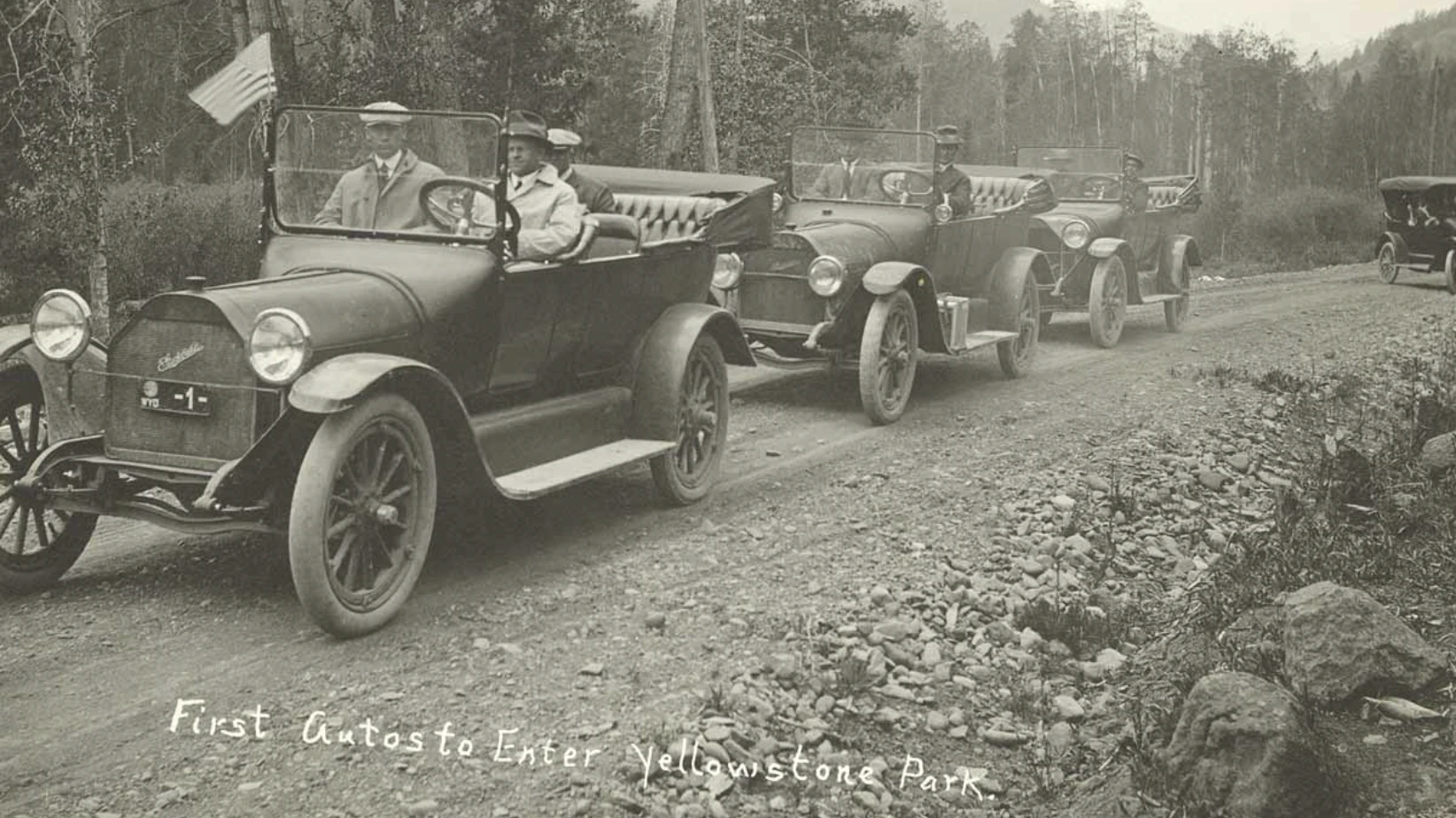
Although cars were not allowed in Yellowstone National Park until 1915, park historian Aubrey Haines said several vehicles entered the park by accident or trickery before the ban on cars was finally lifted.
The man responsible for the parkwide automobile ban was Henry G. Merry, who in 1902 charged through the gates of Yellowstone in his 1897 Winton on the way to a military ball with his wife.
They caused a ruckus as horses bucked at the noise caused by their automobile and soldiers shouted at the couple to stop.
That was the first documented time anyone drove a car into Yellowstone, and it was
Merry claimed at the time that he didn’t hear the soldiers over the noise of his engine.
However, Merry’s diary told another story.
He admitted in those private pages that he knew his car wouldn’t be welcome in Yellowstone, but hoped he could convince the commandant otherwise.
He almost succeeded.
The Winton
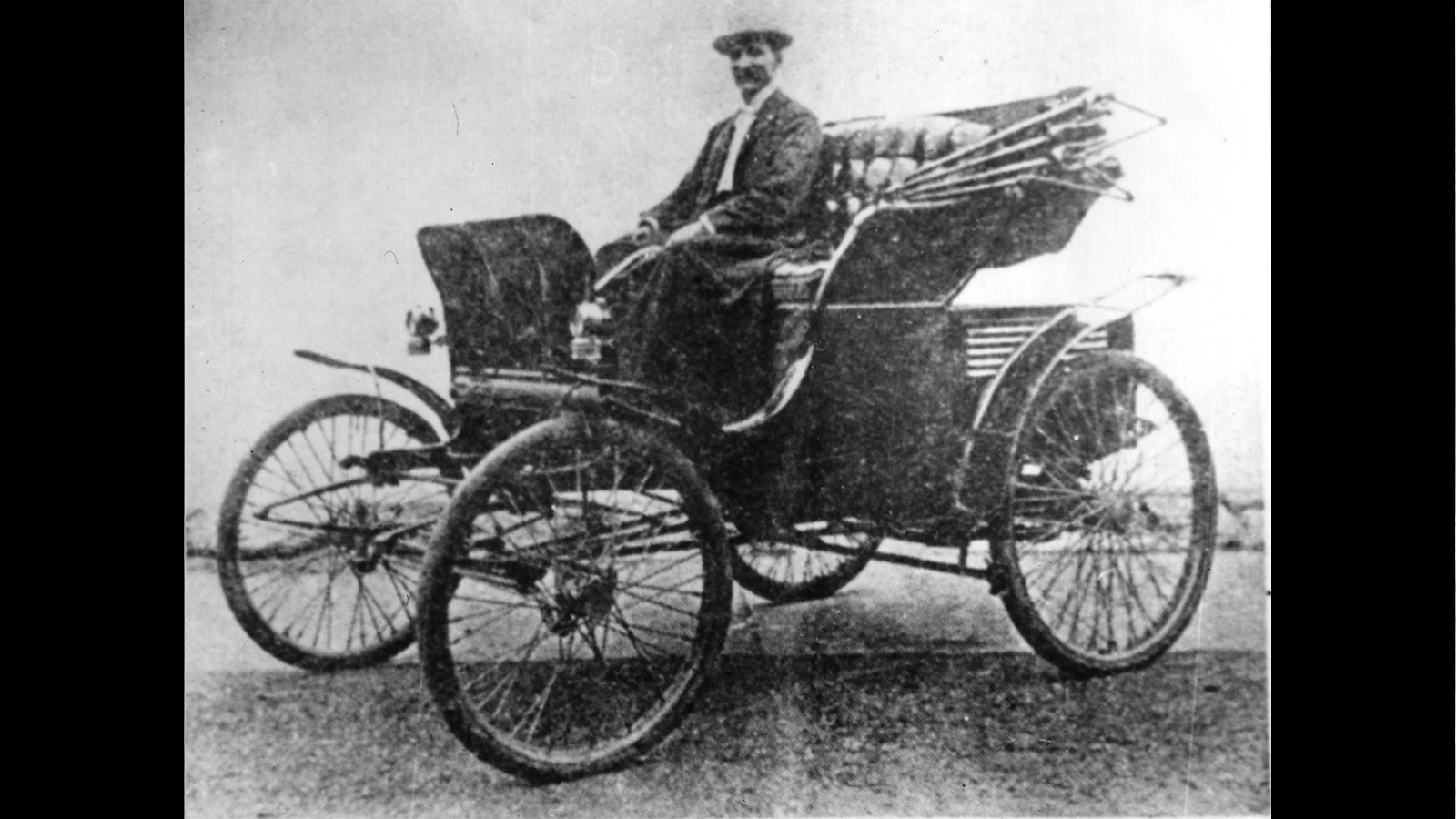
The 1897 model Winton horseless carriage that made history as the first car in Yellowstone National Park could make an average of 20 miles per hour on the flats, according to Yellowstone photographer and historian Jack Haynes.
Haynes described the scene that Merry caused in the March 26, 1953 edition of The Park County News of Montana.
Haynes himself was only 13 years old when the Winton barged into the park.
Haynes described the Winton as a buggy-like contraption with patent leather front seats and large bicycle wheels with wire spokes. A kerosene lamp, both fore and aft, was carried for night driving.
Haynes said that the two-cylinder opposed motor continuously spit a cloud of smoke from the rear and made a roaring noise that had every stage horse in nearby park barns in panic and trembling with fright.
Henry G. Merry was the general manager of the Montana Coal & Coke company from the nearby coal-mining town of Electric on the west bank of the Yellowstone.
Joined by his wife, they sat in their horseless carriage as it chugged along the sandy and dusty road to Mammoth.
They were oblivious of the fact that they were making history.
The couple were dressed in dusters, long linen-like coats to keep dirt from getting on their clothes Haynes said. They wore gauntlets that came above the elbows and each wore a pair of goggles to keep the dust from getting in their eyes.
Merry, the driver, wore a patented leather cap, easily cleanable after every motor trip. His wife was veiled within an inch of her life.
Mayhem Draws Near
It was June 14, 1902, and history was in the making at Yellowstone National Park.
The horse of a mounted sentry at the Gardiner entrance to the park was the first to notice. In reaction to the noise, the horse nearly threw his rider as the horse was described as trying to climb a telephone pole to get away from the approaching Winton.
“From across the Gardiner flat, veiled in a cloud of dust and blue smoke, and making a noise like a threshing machine, there approached the park gate, a 'horseless carriage,'” Haynes said.
The news of the approaching horseless contraption threw the military post into pandemonium.
Maj. John Pitcher, commander of the First Cavalry detail at the post, was incredulous when he first learned of the approaching “demon” from the officer of the day, according to Haynes.
Until that day, no automobile had ever been in Yellowstone.
“No one in the park, military or civilian, had ever ridden in one of those new motorized contraptions,” Haynes said. “In 1902, there weren’t six people in a million that had ever seen an automobile.”
Charging The Gate
The park’s sentry yelled at the Winton's driver to halt but the Merrys drove past the sentry oblivious to his command.
In his diary, Merry wrote that when he and his wife reached the north entrance, he opened up the speed to about 25 mph, and the troopers’ mounts acted up so that they could not block the passage.
“The machine was well on its way before they got their horses quieted down and started after the car—which was rapidly widening the distance between us,” Merry said.
By this time the military parade grounds was a scene of chaos, according to Haynes.
“Everyone was running to get their first glimpse of an automobile and to talk to this daring couple,” Haynes said.
Among those who came running was Pitcher, who, Haynes said, was trying to decide if he should arrest these 20th century invaders of the West’s scenic wonderland.
No official government or park laws had been written about these mechanical contraptions.
Meanwhile, Merry said that all went well as long as the road was level but that was not for long. As the grade became steeper, the speed was reduced and soon the car came to a stop. The troopers arrived at a hard gallop.
Each one had a lariat and between the two horses. The soldiers managed to pull the car to the commandant’s office and gave him a report of how things happened.
Pitcher was quite pleasant and explained to Merry, who admitted in his diary that he already knew, that the noise of his conveyance posed a threat to the lives of all tourists who were visiting the park in horse-drawn vehicles.
Merry and his wife said that they had not intended any infraction of laws. In fact, the laws had not yet been written according to Haynes.
However, Pitcher had issued an order prohibiting the Winton car from the park because he had heard that the noise it made was terrifying to horses.
Merry knew of this order but thought he would pilot the car to the fort and talk things over with the commandant. In the interim, two troopers had been stationed at the entrance to prevent any such violation of the commandant’s order.
The couple explained to Pitcher that they had been invited to the military ball at the post that evening and had decided to travel by their new horseless carriage, which they had shipped out to Electric from their former home in Alleghany County, Virginia.
The Punishment
Pitcher became quite stern according to Merry and reminded him that he was still under arrest and would have to pay a penalty to be released. When Merry asked what the penalty would be, Pitcher was very serious with his reply.
“You will have to take me for a ride in this contraption around the parade grounds,” Pitcher said.
Haynes said that Merry got out the “engine crank” and proceeded to show the major how to start the crank in the side of the car under the driver’s seat and giving the motor a spin.
“The little motor of that Winton had chugged and climbed the grades to Mammoth and now was hotter than Vesuvius on an August day,” Haynes said. “She started off with a bang.”
The noise of the motor rolling across the parade grounds to the Mammoth Hot Springs Hotel caused stage horses to buck and rear. Stage passengers became too frightened themselves to venture out on their tour of the park in stages that day.
Pitcher, chugging around the parade grounds in Yellowstone’s first auto entry, saw firsthand the commotion among the stage horses lined up at the hotel according to Haynes.
Later that day, in a telegram to the War Department at Washington, D.C., Pitcher advised that an order should be issued barring automobiles from the park to lessen the danger of runaway stage horses.
The War Department approved Pitcher’s suggestion, and on June 15, 1902, the order came through barring autos from the Yellowstone wonderland.
That order remained in effect until Aug. 1, 1915, when Secretary of the Interior Franklin K. Lane issued a memorandum opening Yellowstone National Park to traffic for the first time, just 13 years after the Merry couple first crashed the gate going 25 mph.
Jackie Dorothy can be reached at jackie@cowboystatedaily.com.