
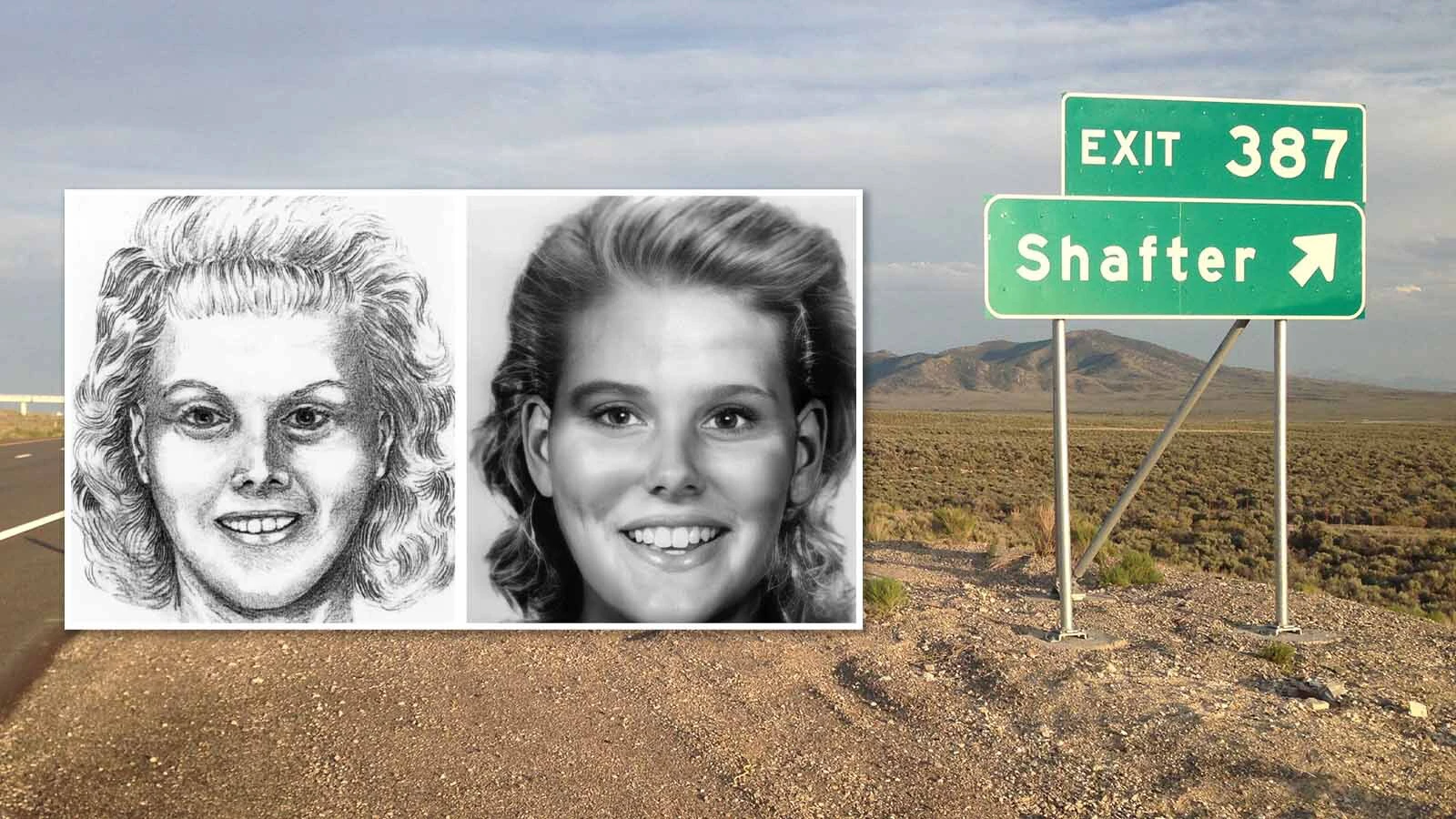
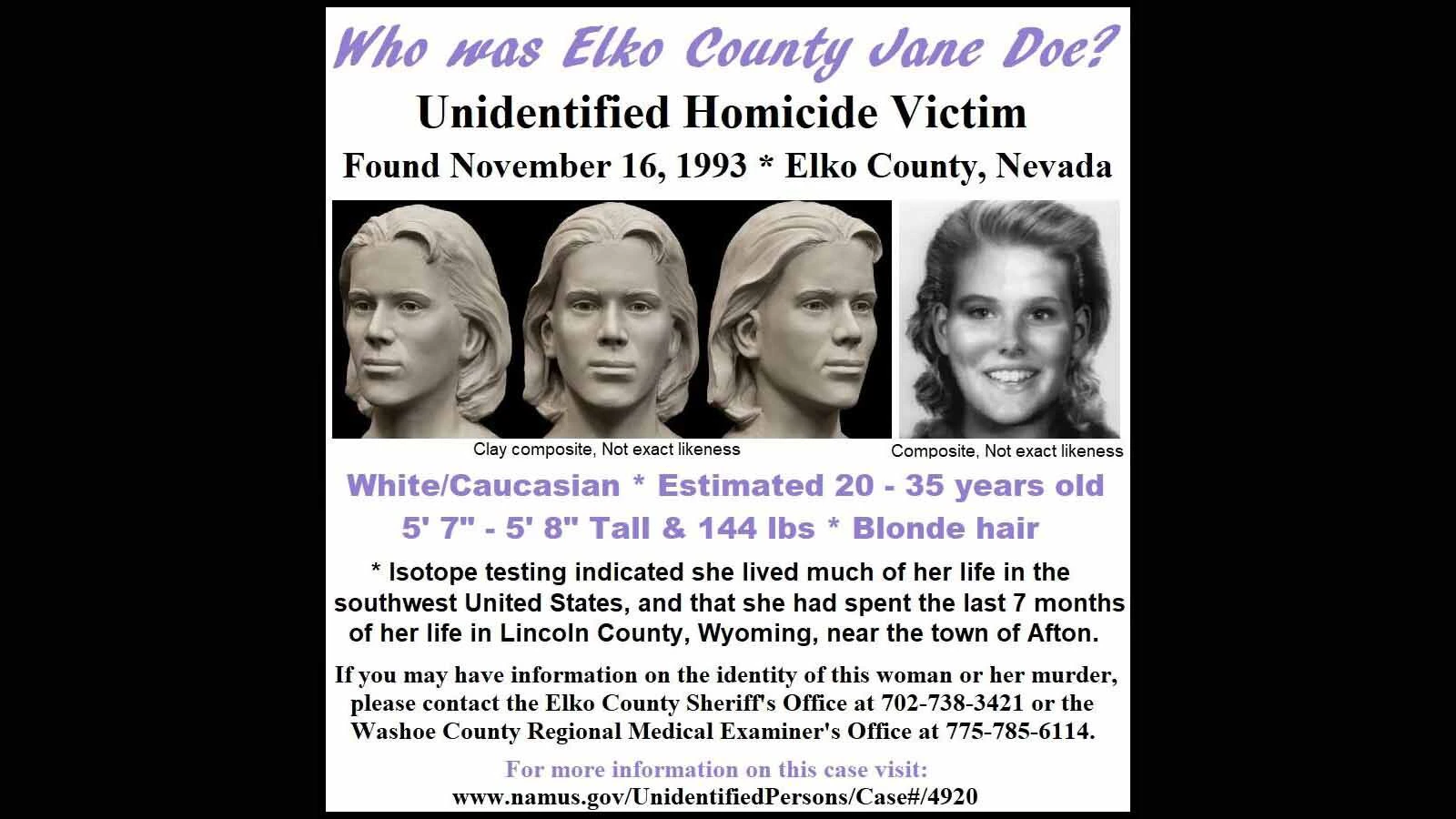
For more than 30 years, the body of an unidentified woman discovered in the remote desert along Interstate 80 in rural Nevada has kept her secrets hidden.
The woman, known colloquially as “Shafter Jane Doe,” had been beaten and shot in the chest and back.
Her nude body was posed on the ground, arms extended to either side in the shape of a cross with legs slightly parted.
Less than a week after her death on Nov. 16, 1993, a geologist who had pulled off at the remote Shafter exit off I-80 to stretch his legs discovered her body, according to news reports from the time.
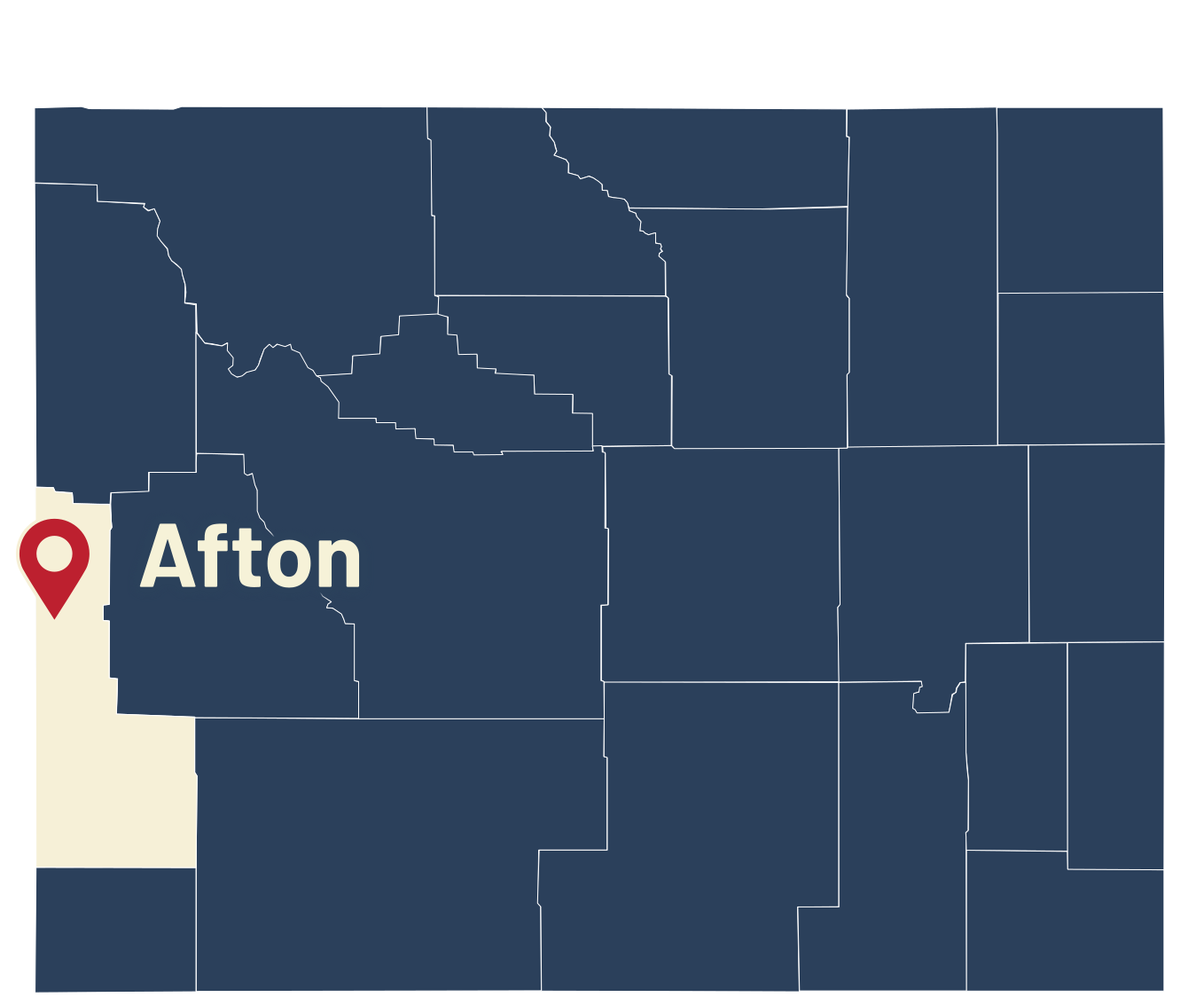
Later investigation in 2010 revealed that the woman had spent seven months in Afton, Wyoming, which was determined through the isotope testing.
For years, her donated headstone has read, “Who Am I?”
Now more than 32 years after the gruesome discovery, authorities finally have an answer.
Her name is Marion Hertha Alexander, who was a German immigrant who moved to California with her family in 1972.
After a decades-long investigation, members of the Elko County Sheriff’s Office and other law enforcement partners told the Elko County Commissioners on Thursday afternoon that they identified her through the use of advanced DNA testing and forensic genetic genealogy.
The decades-long investigation also revealed the woman was in Afton, Wyoming, for about seven months before she was murdered.
Alexander left home around age 18, and her family told investigators that Alexander was a free spirit who liked to drift around.
Her family questioned where she had gone, but given her lifestyle, they did not report her missing to law enforcement.
Her living family members were notified of the identification in January of this year, Elko County Sheriff’s Office Lt. Douglas Fisher stated, and continue to be in touch with law enforcement.
No Justice
Her suspected murderer, however, will not see justice.
Authorities were closing in on Roger Lee Durkee of Milwaukee, Wisconsin, who was identified through semen found on a vaginal swab that yielded a full DNA profile, authorities said.
The profile was run through the FBI’s Combined DNA Index System (CODIS) but did not result in a match, so the Elko County Sheriff’s Office contracted a private group to perform forensic genetic genealogy analysis in February 2022 that led to Durkee as a potential suspect.
Further investigation indicated that Durkee was likely the murderer, but as detectives began planning their trip to Wisconsin to make an arrest, they learned that Durkee had died on Nov. 13, 2025.
He died within 14 days of detectives learning Alexander’s identity.
Now, however, Alexander will be properly laid to rest.
The Elko Sheriff’s Office asked the commission — and were granted — money to buy a proper headstone to finally put her to rest.
Piecing Together Mystery
Authorities worked for decades to identify Alexander through the use of several forensic tools.
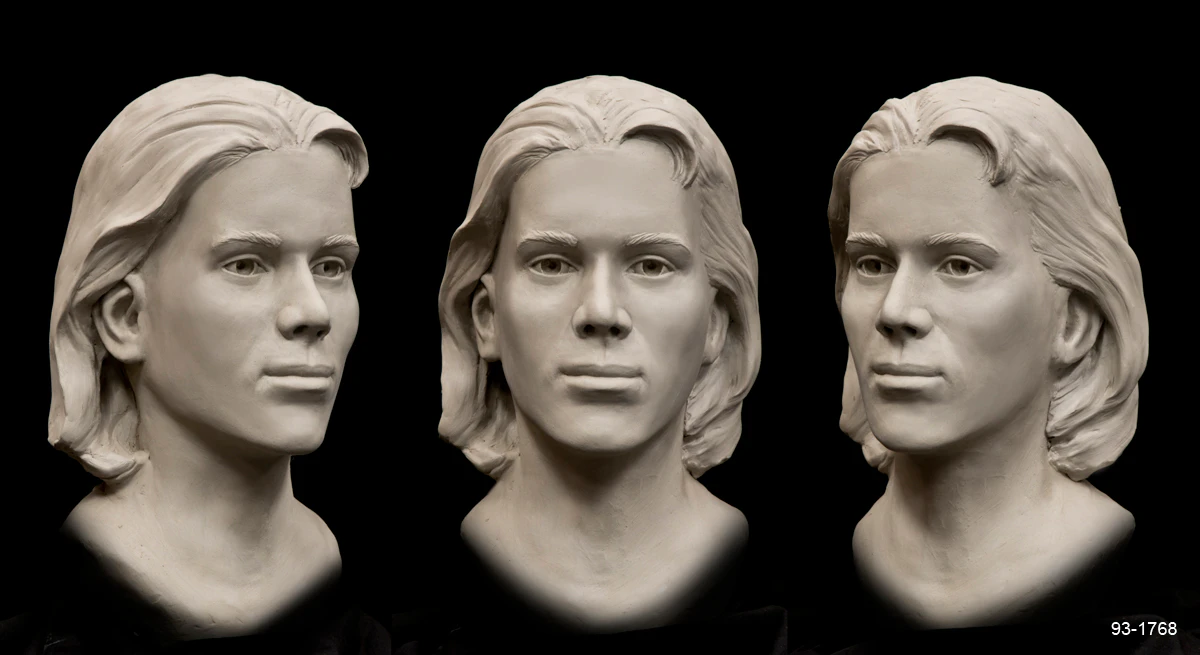
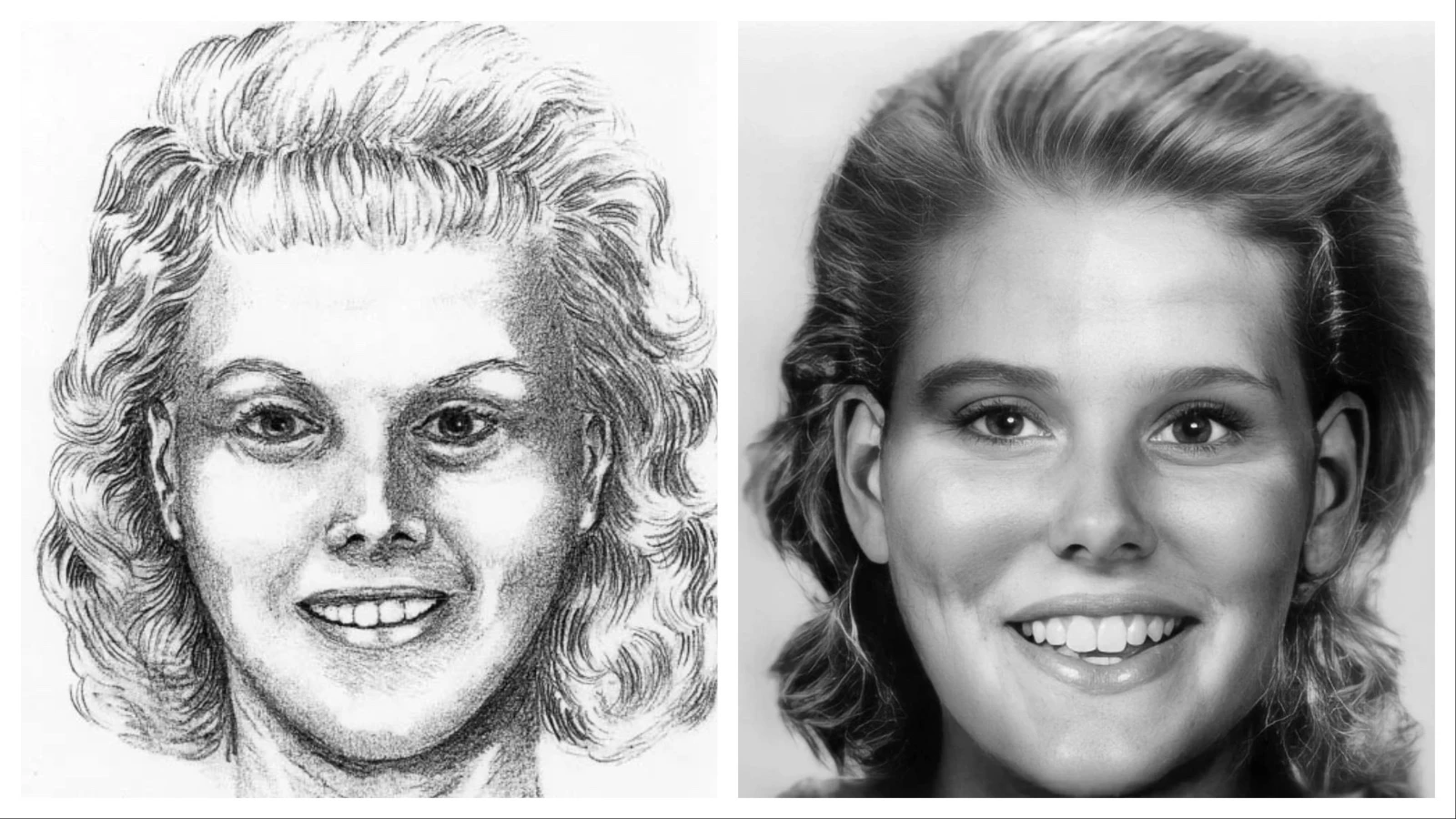
Initially when she was discovered, Alexander’s face was beaten beyond recognition, so the FBI created a computer-generated image of her likeness to help local authorities attempt to identify her, according to a 1993 article by the Elko Daily Free Press.
Along with her image, authorities had little else to go on.
They were able to extract a partial print from her right thumb, which did not find a match in any federal databases.
The only other identifying characteristics were what appeared to be a burn scar or birth mark on her right calf, pink fingernails that looked to be professionally done and a tooth that had undergone a partial root canal, according to the same article.
A portion of her skull was sent to the Minnesota State Crime Lab, according to reporting from the Casper-Star Tribune, where her DNA was extracted and run through databases with no match.
They turned to the media and a national crime show, but no viable leads to her identity were forthcoming.

From the March 20, 1994, Salt Lake Tribune. 
From the March 20, 1994, Salt Lake Tribune.
Human Time Capsule
A big break came nearly two decades later with the advancement of using stable isotopes that tracked Alexander to Afton, Wyoming.
This discovery came in 2010 when scientists at Utah State University were able to determine she had spent the past seven months in Afton by analyzing isotopes in her hair that traced her to the area.
Though not new science, this application of stable isotope analysis has transformed how law enforcement solves cold cases, said Christy Mancuso, an assistant research professor at the University of New Mexico and sales representative for Thermo Fisher Scientific.
Mancuso knows the science well.
She got her doctorate degree in biology from the University of Utah and was affiliated with the stable isotope lab, where her thesis advisor, Jim Ehleringer, started the now-shuttered IsoForensics lab.
She wasn’t familiar with Alexander’s case, but said that stable isotope analysis is an excellent tool for helping to identify remains.
Essentially, humans are like time capsules of chemical information that are stored within one’s bones, teeth and hair, Mancuso said, which helps trace that person to a generalized location.
Humans living in these various regions incorporate the stable isotope signal from their drinking water and food that correlate to particular regions.
Hair Excellent Time Recorder
When forensic scientists analyze human remains, they examine the various stable isotopes — carbon, nitrogen, oxygen, hydrogen — that act as chemical signatures reflecting what a person consumed and where they lived during their lifetime, both recent and past.
Every geographical location has a unique chemical composition evident in its local water and food sources, soil composition and climate, Mancuso explained.
Researchers can then track these predictable geographical patterns using isotope maps called “isoscapes” to identify likely regions where that person lived or traveled.
Hair in particular, which was used to trace Alexander to the Afton area, serves as an excellent linear time recorder of isotope information because it grows at a predictable rate of about one centimeter per month and provides a chronological record in its keratin protein structure, Mancuso said.
In this case, isotopes in Alexander’s hair matched those in drinking water that suggested she’d lived in the that particular area of Wyoming for the past seven months.
Great Basin Murders
Alexander is thought to be one of about nine victims killed between 1983 and 1997 across four states in the Great Basin geographical area that includes Wyoming, Utah, Nevada and Idaho, and dumped along interstates in the remote arid watershed.
Many had been sexually abused or assaulted and either strangled, shot or stabbed.
Some were posed like Alexander, including another Jane Doe found in rural Elko County in July 1972 who also had been shot twice with her body posed to resemble a cross.
Initially, it was thought that one serial killer might be responsible for all the deaths, but it was quickly determined that most the murders were committed by different people.
The first victim was thought to be 23-year-old Janelle Johnson, who was hitchhiking from Denver to Riverton in February 1983 and was last seen at a truck stop in Sinclair, Wyoming.
The aspiring model was found less than a month later in a shallow grave near Shoshoni, Wyoming, according to the national nonprofit Parents of Murdered Children.
Lisa Marie Kimmell, who was murdered by Dale Wayne Eaton in March 1988, was also among the young women killed.
Her body was found floating in the North Platte River near Casper and it took until 2004 to bring her killer to justice.
Eaton had also been suspected in Alexander’s murder because he had reportedly lived in the Elko area at the time and had been arrested for domestic violence, according to a 2010 report by the Elko Daily Free Press.
One of the other Wyoming victims, who remained unidentified for years and was known as “Bitter Creek Betty,” was identified in 2025 as Irene Vasquez.
Both Vasquez, and Cindi Arleen Estrada, who had formerly been known as “I-90 Jane Doe,” were determined to be victims of Clark Perry Baldwin.
Baldwin, a long-haul truck driver who was convicted of murdering a woman in 1991 in Tennessee, was also facing two counts of murder in Wyoming but died months later before he got to trial.
Other victims affiliated with this geographic region and time period are Vicky Lynn Perkins, 19, who vanished from Oregon and whose body was found two months later off 1-70 in Emery County, Utah, in May 1989.
Two more victims were found within one month of each other in 1991.
The badly beaten deceased body of Ermalinda Garza Sherman was found in St. George, Utah, in April while a Jane Doe, later identified as Barbara Kaye Williams, was found in Salt Lake City in March.
Jen Kocher can be reached at jen@cowboystatedaily.com.


