
The Wyoming Legislature’s Joint Judiciary Committee voted Tuesday to begin a rough draft of a bill to deter people properly expressing themselves from frivolous lawsuits meant to silence them.
This kind of policy is called anti-SLAPP legislation, where SLAPP stands for strategic lawsuits against public participation.
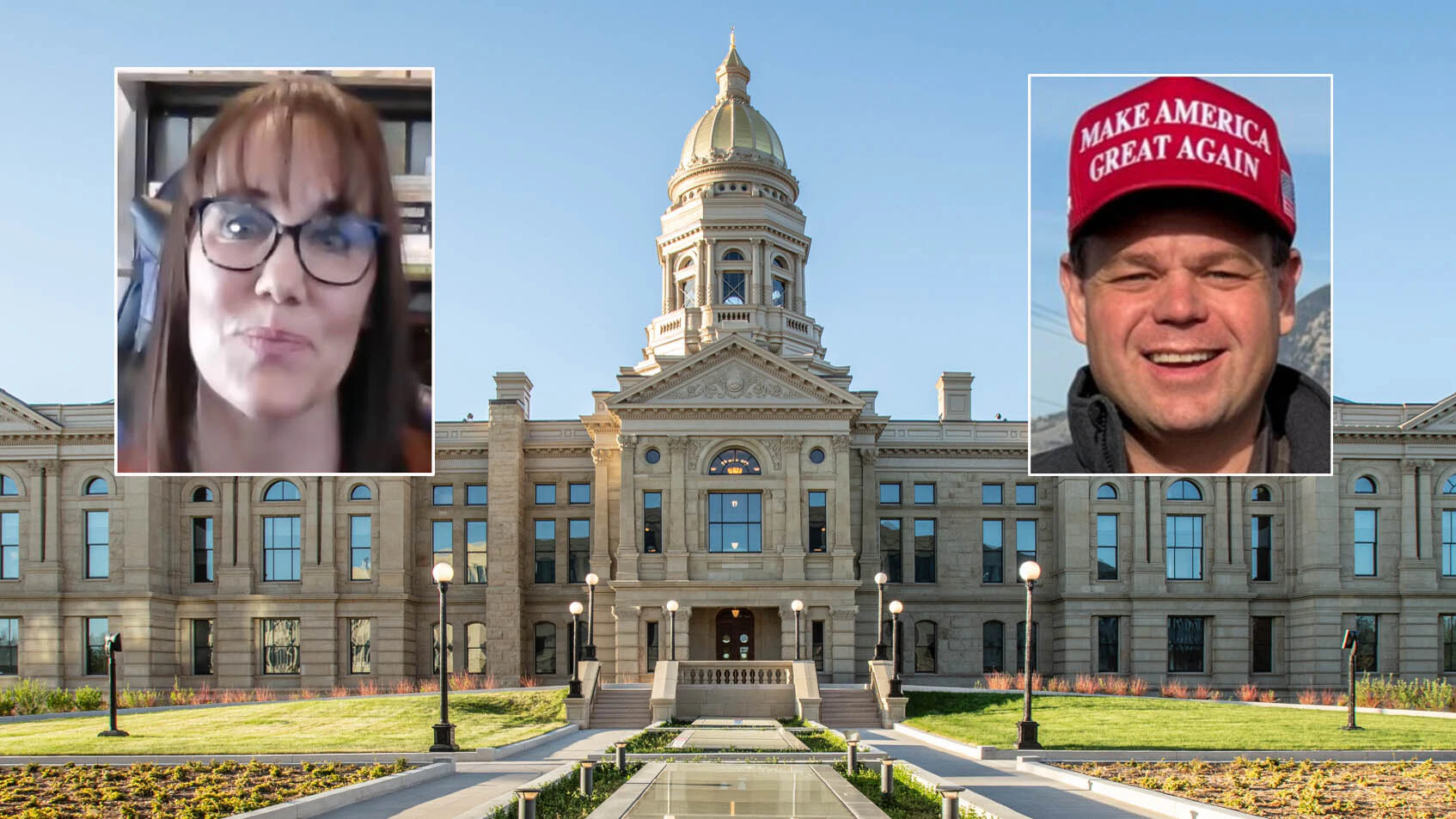
Michelle St. Louis, who is being sued for online comments she made about Casper-based congressional candidate Reid Rasner, delivered a speech to the committee saying cases like the one she faces are meant to silence people.
“This issue is larger than any, one individual case,” St. Lous told the committee, while urging it to draft anti-SLAPP legislation. “The question before this body is whether ordinary Wyoming citizens can realistically afford to participate in public discourse, when the threat of prolonged litigation is hanging over them.”
St. Louis had called Rasner “creepy” and said a person should keep his son away from him, court documents say.
St. Louis has told Cowboy State Daily and others that she believes this case is an attack on her religious faith. That’s because Rasner’s complaint both alleges and laments that St. Louis had said Rasner “has blasphemed the name of God” due to his sexual orientation.
St. Louis on Tuesday urged the committee to craft a bill that will protect legitimate First Amendment activity, while letting people be held accountable for “truly defamatory and knowingly false statements.”
She emphasized people's right to be involved in public processes, including elections.
Rasner's spokesman did not respond by publication to a text message request for comment.
Sen. Jared Olsen, R-Cheyenne, who chairs the Senate side of the committee, asked committee members if they wanted to ask any questions of St. Louis.
St. Louis had warned that she was limited in what she could say since the case against her was ongoing, but said she’d answer questions to the best of her ability.
After a momentary silence, Olsen said, “Well, no one wants to touch that pending litigation, so you’re fine.”
Rep. Ken Chestek, D-Laramie, who is also a retired University of Wyoming law professor, asked the nonpartisan Legislative Service Office’s staffers to build the draft. The committee majority, with no audible nays on the video stream of the meeting, agreed via voice vote.
That doesn’t codify the law. It begins the bill’s formation so that the committee can tweak it, then decide whether to advance it to the full legislative session that convenes January 2027.
Back It Up A Little
State Rep. Pepper Ottman, R-Riverton, has twice brought anti-SLAPP bills and twice seen them fail to clear the Senate side of the Judiciary Committee after they passed the House, in 2025 and earlier this year.
Rep. Joe Webb, R-Lyman, demanded an explanation for that Tuesday.
“I don’t know why that’s been held up. That’s never been heard,” said Webb. “I think if we’re going to address the problem, we need to know what the issue is.”
Sen. John Kolb, R-Rock Springs, said Webb is welcome to review the videos of bill deliberations, but urged Webb to look ahead to the current effort to craft a bill.
“That’s why we’re here. That’s why we’re here with both sides,” said Kolb. “There’s a lot of other issues and I would suggest you go back and look at the video – but we’re here to fix that.”
The Bills That Failed
Ottman’s 2025 bill and 2026 bill both would have given people immunity for acting within certain First Amendment rights. Her 2026 bill was more expansive and included the religious freedom right plus the rights to petition, assemble, and speak.
It said that if a person engaging in one or more of those privileged activities was sued, he or she would be “entitled to immunity from suit” on that account. And the person sued could raise that immunity argument as a potential avenue to have the suit discarded.
If the court denied the person immunity, he or she could appeal midcase to a higher court for review.
The bill had carveouts for knowingly false or defamatory statements, true threats, incitements to imminent lawless action, obscenity, child pornography “or any other established category of expression that falls entirely outside constitutional protection,” plus for defamation against a private figure.
A person wanting to dispute that immunity claim could overcome it by bringing evidence that the conduct wasn’t protected.
The bill would have deprived governmental entities and public employees of using the immunity provision for government acts they undertook.
A person who won the immunity dismissal would, under this bill, have won his or her court costs and attorney’s fees. That person could also receive compensatory damages and compensation of between $5,000 and $100,000.
Conversely, a person who fell prey to an immunity claim later found to be frivolous or made in bad faith could win his or her costs and attorney’s fees.
‘Innovative’
Colin Crossman of Cheyenne, who addressed the committee on his own behalf as an individual, said Wyoming should try to build a “substantive” anti-SLAPP law so that federal courts would recognize and use it in “diversity” cases, which means cases where the litigants are from different states. He said trying out the immunity provision could be a way to do that.
Black’s Law Dictionary calls substantive law the kind of law that creates, defines, and regulates rights, duties and powers.
Some federal courts, multiple people told the committee Tuesday, have declined to apply states’ anti-SLAPP laws in federal court cases because they’ve found them “procedural” rather than substantive.
Procedural law is of the kind that dictates court rules and processes.
The federal government already has its own court procedures.
“We might not get everything we want,” said Crossman. “But (by using the immunity provision) we’ll probably get more than nothing.”
But it’s a tradeoff, other speakers indicated.
Betsy Anderson, general counsel for Gov. Mark Gordon, told the committee that the governor supports the idea of an anti-SLAPP law, especially if it’s based upon the Uniform Public Expression Act (UPEPA). That’s a law that the Uniform Law Commission spent years developing after reviewing the most effective anti-SLAPP laws, First Amendment attorney Laura Prather told the committee.
The UPEPA doesn’t grant an immunity provision, but lays out an evidentiary process for having one’s case dismissed.
The idea of Wyoming setting out instead with its own immunity provision gives the governor’s office “pause,” said Anderson.
“This is very complex,” said Anderson, who urged lawmakers and legislative staffers to research this area of law. “If you apply immunity in this case, you’re giving people immunity for what they did – which is the subject of the lawsuit. And I think that’s very awkward.”
It could also have unintended consequences, Anderson added.
Crossman acknowledged the uniqueness of the provision.
“Yes, I fully admit that bringing in immunity here is an innovation,” said Crossman. “It would have to be tried.”
Still, he cast it as a way of distinguishing the law from more procedural mechanisms that federal courts may decline to use.
Speaking for the Wyoming Trial Lawyers Association, Beth Lance voiced favor toward crafting anti-SLAPP legislation that uses UPEPA as a starting point. She urged some clarifiers though, such as adding definitions to generalized language and explaining to courts where the defensive mechanism cannot be used.
We’ve Got That
One part of the uniform anti-SLAPP law left Chestek “just a little confused,” he said.
Chestek discussed Phase 3 of the uniform law, which says that the court can dismiss the case if the person asserting the anti-SLAPP provision shows that the lawsuit doesn’t state a viable cause of action, or if there remains no genuine dispute about the events giving rise to the lawsuit, and one person is entitled to win the case based on the law.
Those provisions are already used in court.
Generally when a person is sued, she can assert that the evidence pled against her doesn’t line up with a civil lawsuit mechanism well enough to carry the case. That’s called a motion to dismiss and happens very early in the case.
A judge can dismiss a case early if he or she agrees with that argument.
But if the judge finds the case viable, the judge will send it to the evidence-swapping phase, called “discovery.”
Once the evidence is exposed and both sides know what unfolded in the controversy, one or both sides can tell the judge that the law is on their side, and that there’s no more dispute about what happened that would need to go before a jury.
That’s called summary judgment.
A judge can end the case early in favor of whoever the law supports at that phase.
But if after all that, the judge believes there’s still a controversy in which a jury should find the truth, he’ll send the case to trial.
Then the jury decides the truth, and the winner of the case.
Chestek asked how a judge can consider the issue that is normally argued at the post-discovery summary judgment phase, before he has all the evidence.
“Some courts have struggled with that as well,” said Tamara Crolla, staff attorney for the LSO, adding that some states have allowed for the case parties to request additional discovery just related to the anti-SLAPP motion.
“I do think it’s something of concern that a lot of courts have struggled with,” she said.
Clair McFarland can be reached at clair@cowboystatedaily.com.


