
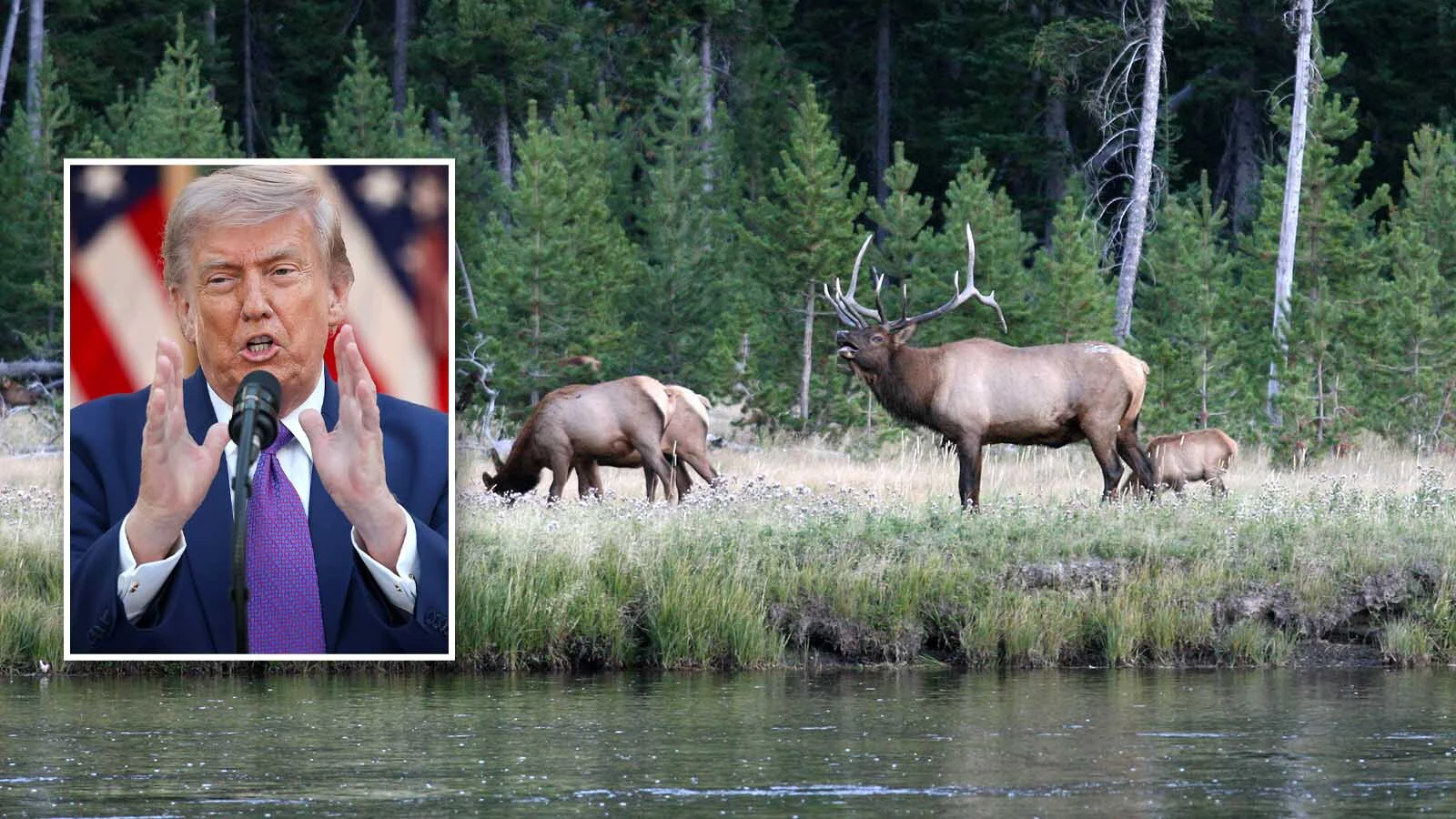
The Trump administration is moving to lift hunting restrictions in some national parks and other federal lands, generating backlash.
The move is in response to Interior Secretary Doug Burgum’s Order No. 3477, issued in January.
It calls upon the National Park Service (NPS), U.S. Fish and Wildlife Service (FWS) and other agencies under the Interior Department to “identify and remove unnecessary regulatory or administrative barriers to hunting and fishing on Department-managed lands and waters.”
That doesn’t mean fluorescent orange hunting vests and rifle shots will light up Yellowstone National Park this fall during elk hunting season, however.
There will likely be little, if any change in Wyoming’s crown jewel national parks, Yellowstone and Grand Teton, officials told Cowboy State Daily.
Rob Wallace, who served the assistant secretary for the Interior during the first Trump administration, said the backlash against the implementation of Burgum’s order amounts to a “tempest in a teapot.”
A similar measure was carried out with little fanfare during Trump’s first term, said Wallace, who oversaw the NPS and FWS at the time.
Already Some Hunting
There already is some limited big game hunting in Grand Teton and adjacent to Yellowstone.
For years, the NPS and the Wyoming Game and Fish Department have coordinated elk reduction hunts in segments of Grand Teton that were included in a 1950 expansion of the park’s boundaries.
There is also limited hunting in the vicinity of the John D. Rockefeller Jr. Memorial Parkway, which runs between Grand Teton and Yellowstone.
And hunting has always been allowed in the Bighorn Canyon National Recreation Area, near Lovell, which is also administered by the NPS.
Grand Teton spokeswoman Emily Davis said that as of Monday there was no word of any changes to existing regulations for the elk reduction hunts or hunting in the parkway region.
Nor was there any indication of expanded hunting in Grand Teton, she said.
An inquiry sent to the Yellowstone communications office was answered with an email from the NPS new media office.
The order “advances a commonsense approach to public land management by expanding access to hunting and fishing opportunities where it can be done safely and responsibly,” according the NPS.
Burgum’s order “ensures their access is not unnecessarily restricted by outdated or overly broad limitations that are not required by law,” the NPS added.
‘Terribly Confusing To The Public’
Many national parks are located amid other federal lands, as well as state lands, Park County resident and retired Forest Service and Park Service ranger Richard Jones said.
And while hunting is typically banned within national parks, it’s frequently allowed on adjacent public lands, he said.
That can be “terribly confusing to the public,” when jurisdictions overlap, Jones said.
Burgum’s order might help clear up the “mishmash” between different agencies and jurisdictions, when it comes to hunting and angling, he said.
Jones doesn’t think Burgum’s order will change any of that, nor will it have much effect on Grand Teton and Yellowstone.
He added that it probably won’t change anything in Bighorn Canyon either.
Jones doesn’t recall friction between hunters and sightseeing tourists being a problem there.
There was some illegal killing of wildlife there, outside of designated hunting seasons and areas, he noted.
“We had problems with a number of poachers there,” Jones said.
He added that in northwest Wyoming, most of the “prime hunting areas” are on the National Forest, administered by the Forest Service.
The Forest Service is under the Department of Agriculture and is unaffected by Burgum’s order, Jones said.
Retired park ranger Greg Jackson said the only NPS-administered area he worked in that allowed hunting and trapping was Lake Mead.
And at least during his career, hunting and trapping there were done in remote areas and didn’t cause conflict with tourists, he said.
Some Department of the Interior lands have kept the “practices and traditions” of hunting and angling that were established when they were still under state jurisdiction said Jackson, the former deputy chief of the National Park Service division of law enforcement, security and emergency services.
He now runs NPS Park Ranger News.
‘Top-Down’ Approach
There’s still some uncertainty about whether the order will result in any long-term changes to hunting in Bighorn Canyon and along the Rockefeller memorial parkway, said Stephanie Adams, wildlife fellow with the National Parks Conservation Association (NPCA).
Regarding the Grand Teton elk reduction hunt, “that one does not appear to be a focus of the secretary’s order,” she said.
NPCA isn’t opposed to hunting, but questions the wisdom of possibly changing longstanding policies established by national park superintendents and other officials with direct oversight, Adams said.
“These superintendents have very thoughtfully put things in place to make sure there isn’t a conflict between hunters and hikers,” she said.
So, there is concern about the “top-down” approach of Burgum’s order, Adams said.
An Act Of Congress
Wallace said that during his tenure, roughly 4 million additional acres of Department of the Interior lands were opened for fishing and hunting, mostly on FWS wildlife refuges.
The Park Service has jurisdiction over about 430 land units, of which 63 are national parks, he said.
Burgum’s order will probably affect mostly land units other than national parks, he said.
Grand Teton’s elk reduction hunt is a “very mature” and “very well run” program, so it will probably not be subject to change, he said.
Likewise, regarding hunting in the parkway area and in Bighorn Canyon, “I don’t see that there’s that much else to do,” he said.
Hunting in Yellowstone is forbidden by law. So, an executive order can’t change that, he said. Congress would have to change the law to allow hunting.
“There’s nothing in the works to do that,” Wallace said.
Mark Heinz can be reached at mark@cowboystatedaily.com.


