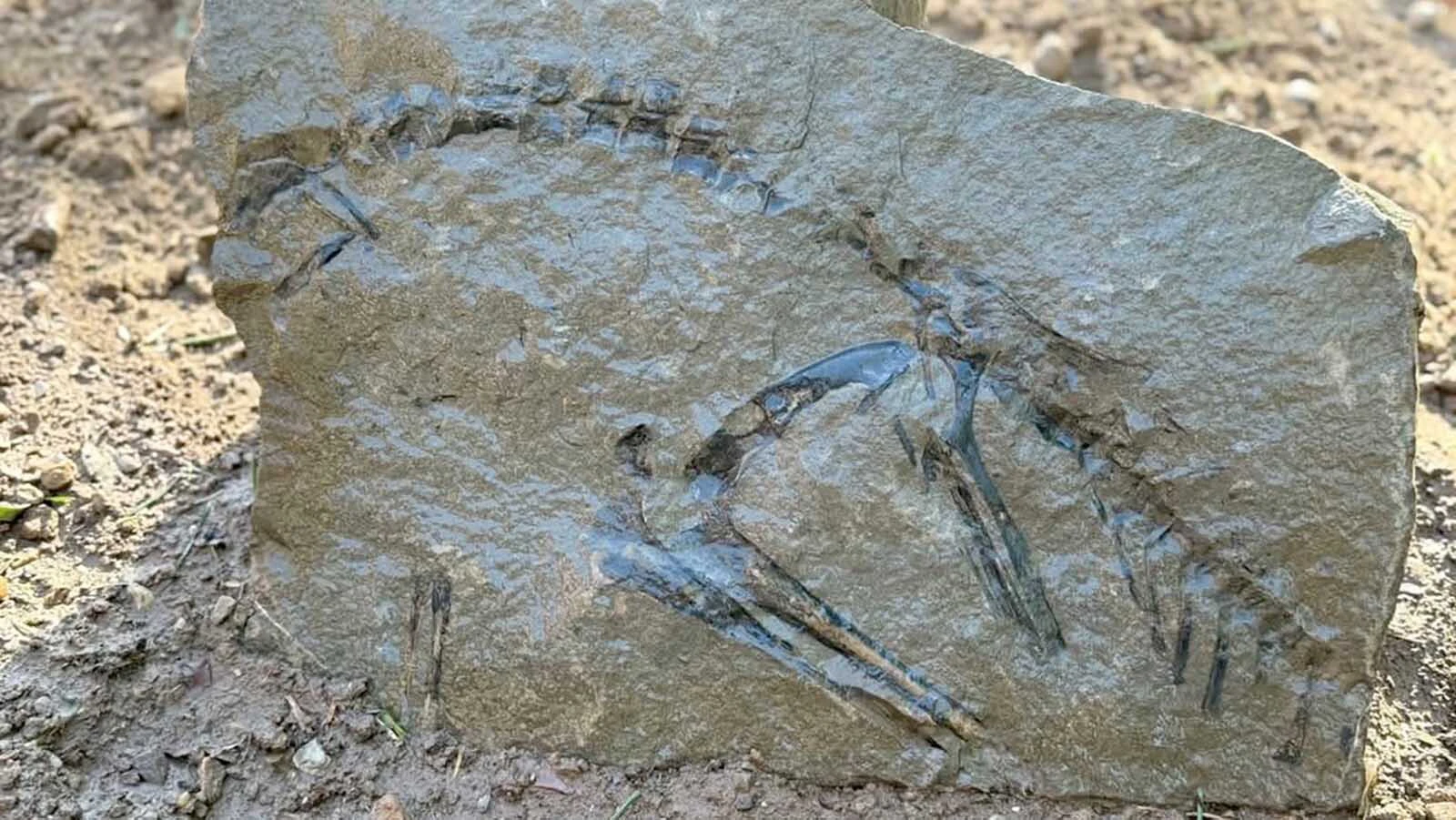
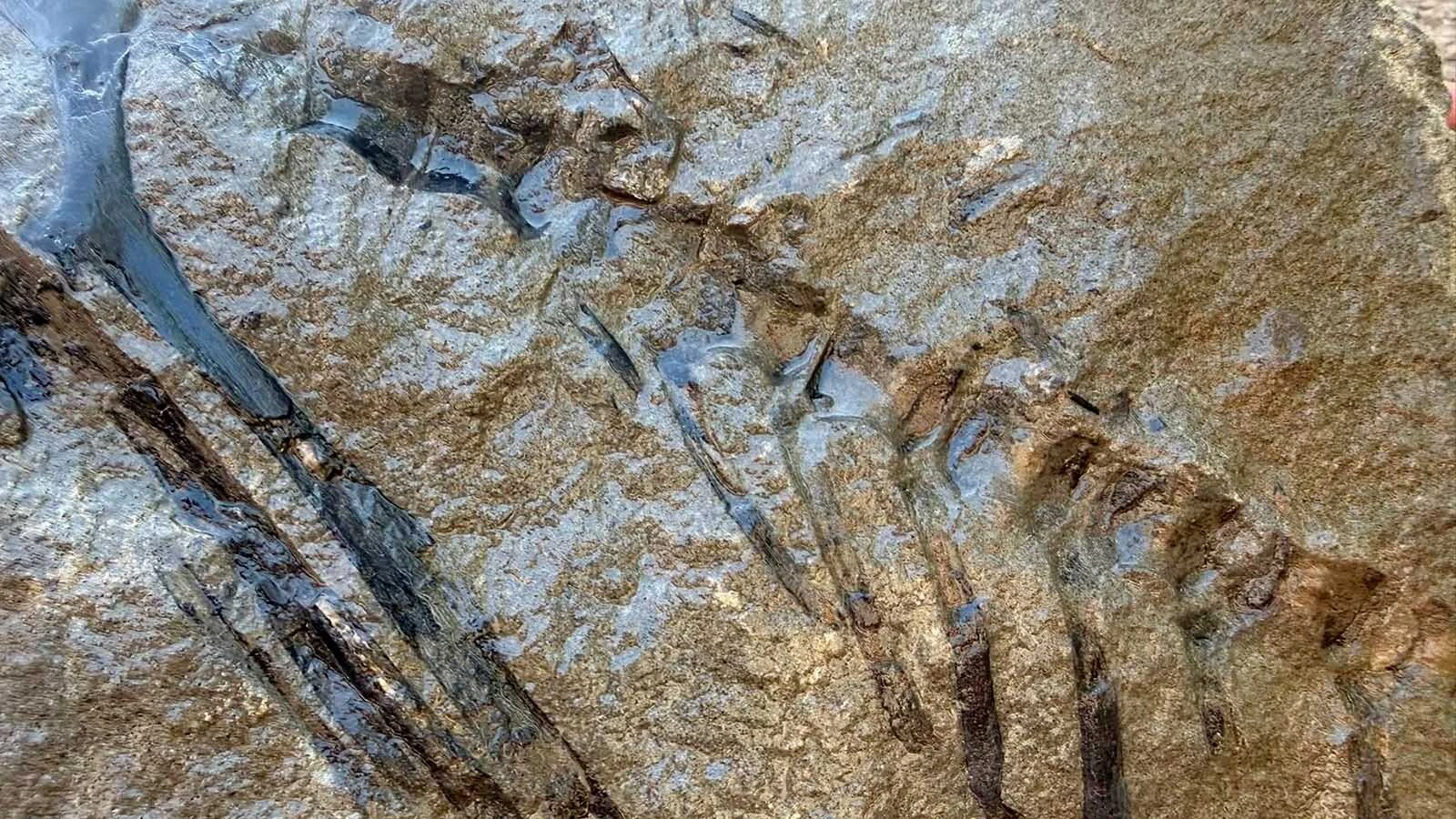
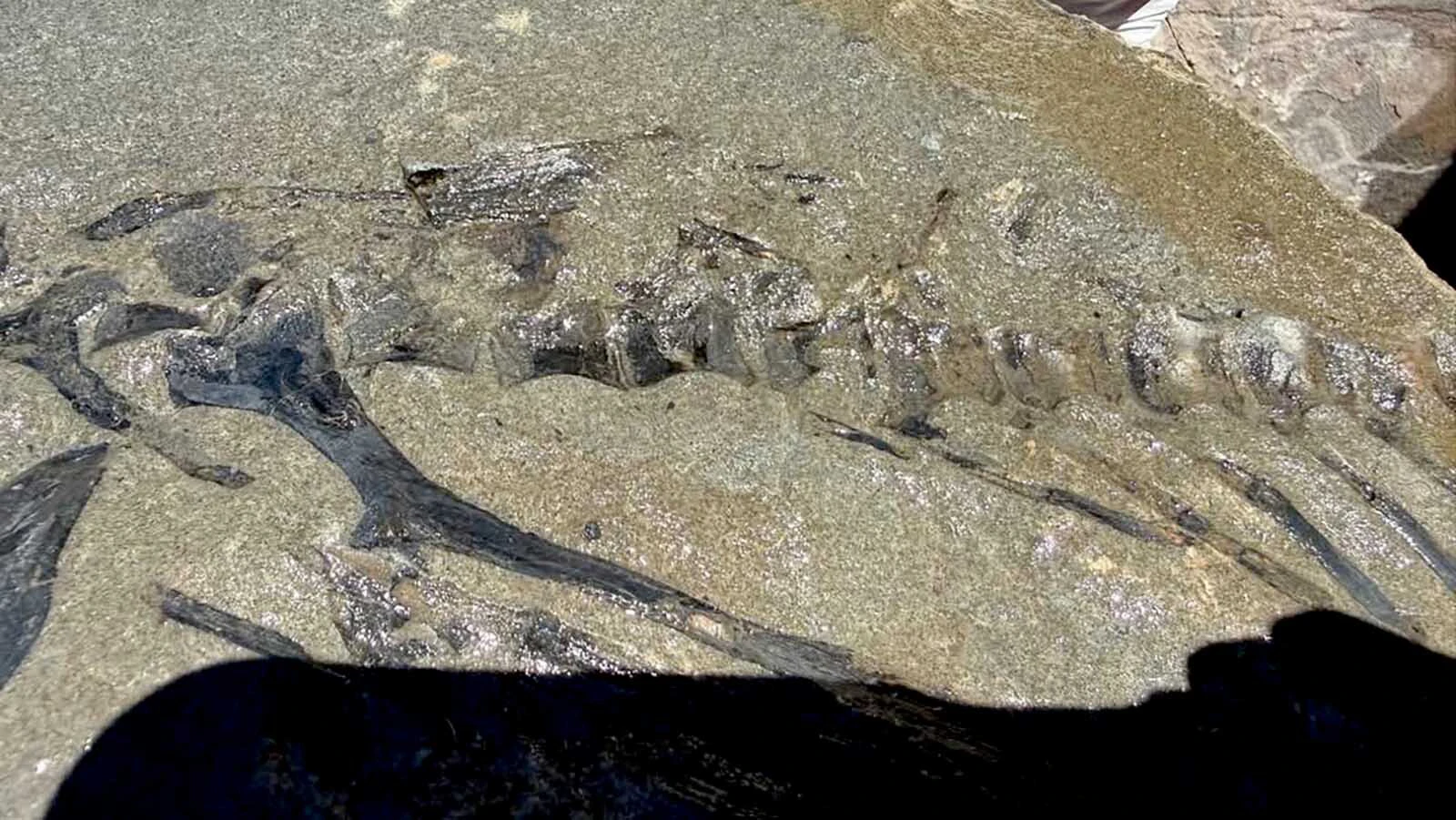
Jackson resident Heather Zamora spotted a rare and important animal while hiking near Alpine. What she found was a remarkably well-preserved skeleton of a small dinosaur exposed on the broken edge of a rock.
“It’s about 18 inches long,” Zamora said when she shared images of the fossil in the Facebook group Wyoming Rockhounder. “Hope you guys can help identify this amazing fossil.”
L.J. Krumenacker, a professor of geology and biology at the College of Eastern Idaho, thinks he knows what it is. That's why he wants to get out there and see it as soon as he can.
“I’d do it tomorrow, if Heather’s up for it,” he said. “This one got me extra excited, and it's going to be important.”
Zamora posted photos of the find Wednesday, but isn’t saying just where or when she found it.
A Nutmegger Dinosaur In Wyoming
The specimen Zamora found was the arms, legs, torso, and tail of a small two-legged dinosaur. What makes it so exciting is that every bone is articulated, just as they would be when the animal was alive.
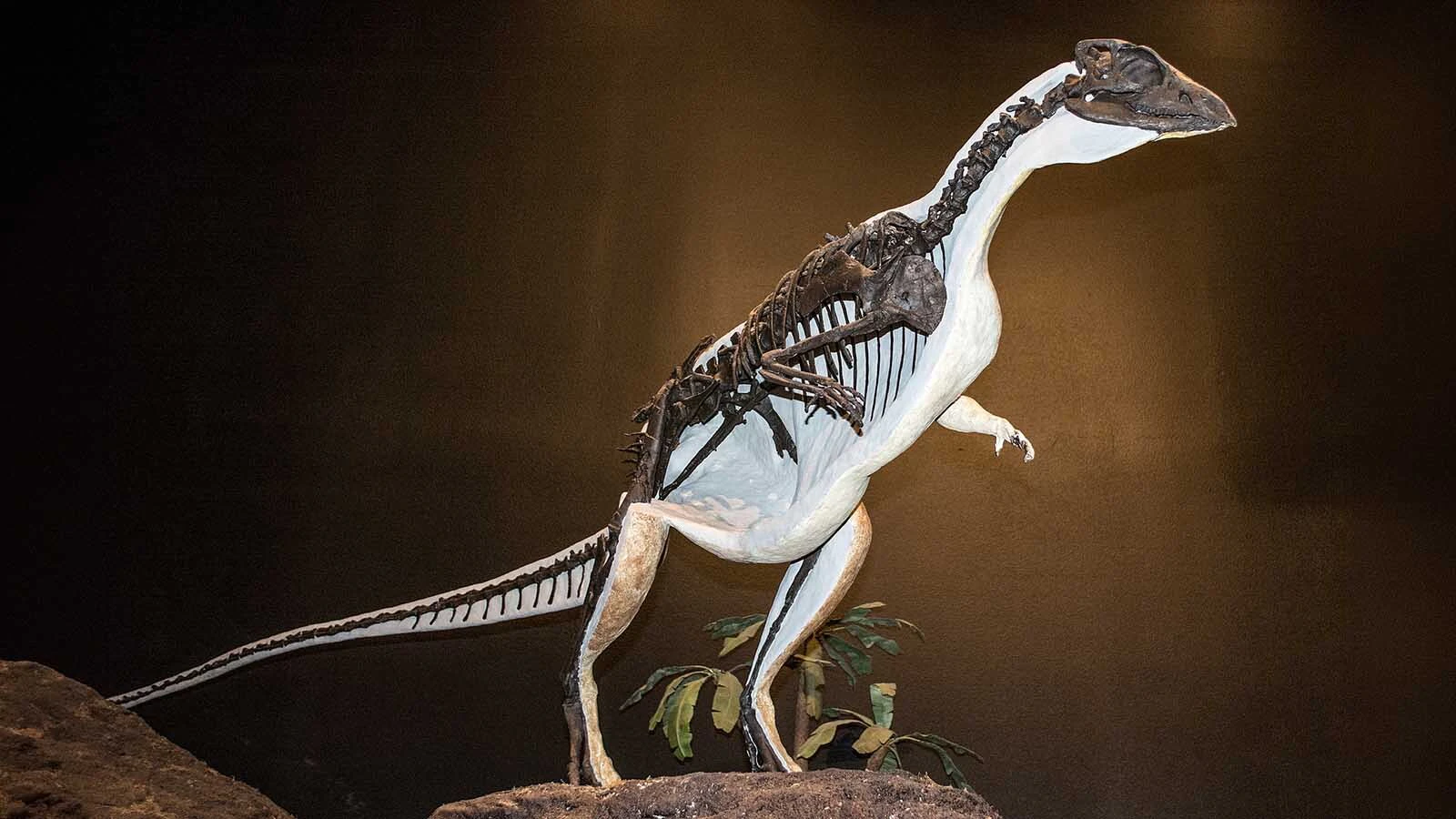
Based on the photos and the location where it was found, Krumenacker made a confident identification. It’s the skeleton of a unique burrowing herbivore called Oryctodromeus.
“This is actually the state dinosaur of Idaho, because it’s the most common dinosaur found in Idaho,” he said. “I've been out there finding those guys, close to the Idaho-Wyoming state line, for 20 years.”
Oryctodromeus lived during the Late Cretaceous Period, around 100 million years ago. Its name is Greek for “running digger,” because it’s one of the first dinosaurs that shows evidence of digging and living in burrows.
“They don't get a lot of attention because they're not fancy meat eaters, but they're really good parents,” Krumenacker said. “It lived and raised its kids in burrows, and we’ve found burrows with adults and kiddos together inside.”
Krumenacker said the shape of the hips, legs, and tail vertebrae are enough to identify Zamora's find as an Oryctodromeus.
Since a fully-grown Oryctodromeus was around 11 feet long, Krumenacker said this specimen is from a smaller, younger individual. And where there's one, there may be others.
“They tend to occur in pockets of multiple individuals, buried in their burrows,” he said. “I think they lived in colonies like groundhogs, which is crazy for dinosaurs.”
Picture Perfect
While Oryctodromeus fossils are plentiful in Idaho and Montana, their bones are usually jumbled together. They must be sized, separated, and studied before they’re reassembled.
The specimen Zamora spotted near Alpine is close to paleontological perfection. That makes Krumenacker all the more eager to get out there and see it firsthand.
“We usually don’t find them where all the bones are connected that way,” he said. “Based on the fact that the bone goes to the edges of the rocks, I'm hoping we could find the rest of it.”
If that much of the small skeleton is preserved intact, there’s a good chance the rest of it is still encased in the surrounding rock. Finding the missing pieces would be a windfall, especially if that includes an articulated skull.
“It is so flipping hard to find a skull, but it looks like that thing was buried totally complete,” Krumenacker said. “I'm really hoping to find out where exactly it came from and go out there, because I’d like to find the rest of it and think we can.”
Gender Studies
Many fossils can spend years, decades, or centuries on shelves or in museum exhibits until they’re thoroughly studied. Fortuitously, Krumenacker has the perfect in-progress study where this specimen could make a big difference.
“We think we've possibly found a way to tell the boys from the girls, which is really hard based on skeletons,” he said. “Our hypothesis is that different proportions in the arms and legs represent the boys, and another proportion represents the girls.”
Determining the sex of a dinosaur from its fossils is nearly impossible. Some paleontologists believe they've found enough evidence, like the same pattern of broken bones, that reveals a dinosaur's sex, but even those are under very specific circumstances.
Considering this specimen’s arms and legs are not only intact but articulated, Krumenacker believes it could help support or refute their skeletal-based gender hypothesis.
“This would be perfect for that study,” he said. “We only manage to find a decent skeleton every few years, so every single one's important, but this specimen could definitely be one of the best.”
State Of Residence
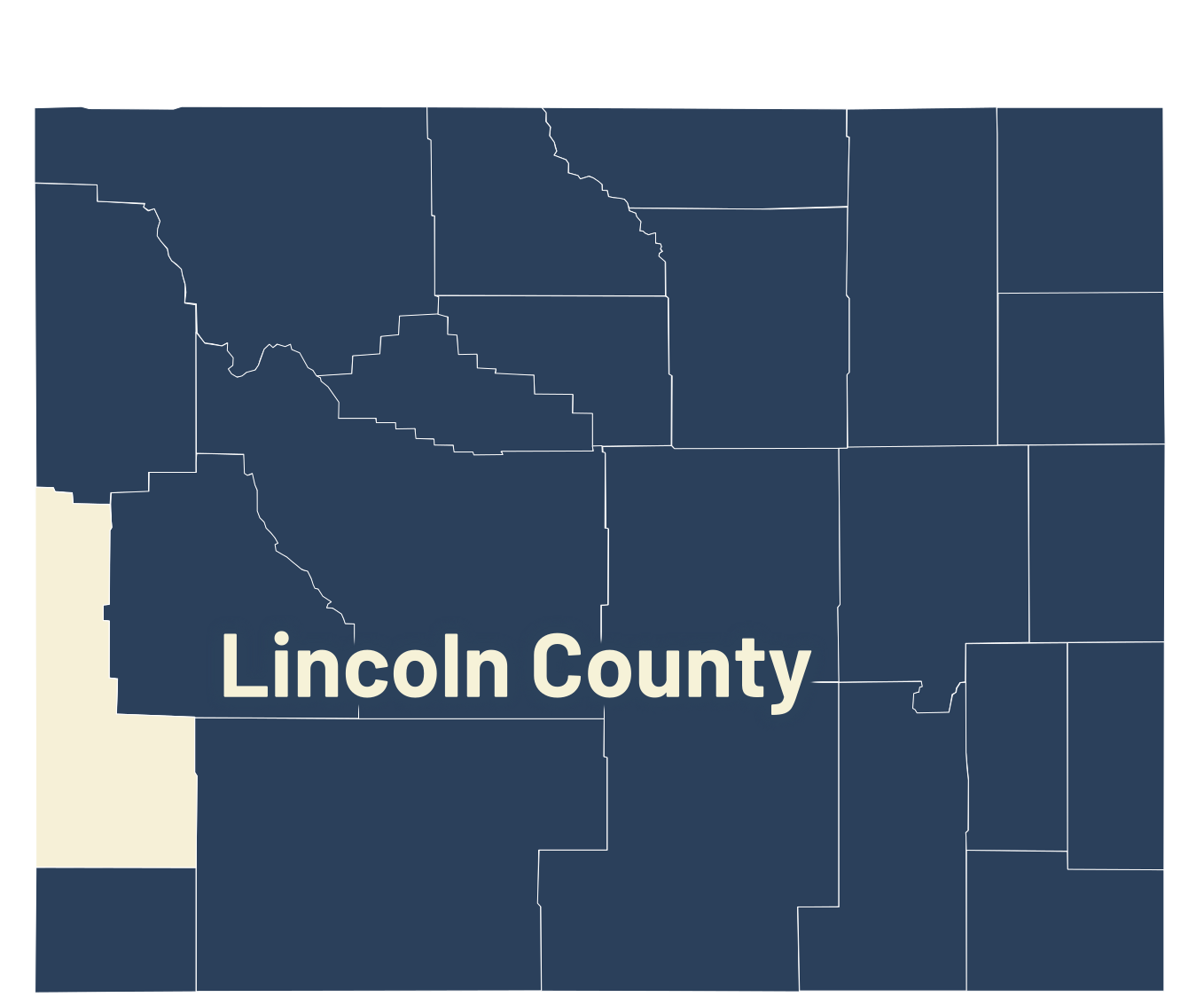
This might be the first Oryctodromeus fossil ever found in Wyoming – if it’s from Wyoming.
Since Alpine is so close to the state line, Krumenacker suspects that this fossil might be closer to his "best spot” in Idado where he’s been finding Oryctodromeus fossils for years. Lines on maps don’t matter for paleontological research, but it’s something he’d like to know definitively.
“I suspect that if it’s near Alpine, it's probably just over the Idaho side,” he said. “That rock is similar to the rock I’ve been working in, and that’s literally four miles from the border in some places.”
Krumenacker, who’s also a researcher and affiliate curator with the Idaho Museum of Natural History, would certainly like another spectacular Idaho specimen of Idaho’s state dinosaur.
Still, he’s hopeful it might be Wyoming’s first Oryctodromeus.
“I'm trying to find Oryctodromeus in Wyoming for my research,” he said. “If it is in Wyoming, Heather would have found the first one in the state. Either way, it’ll be an important find.”
Since the fossil was probably found within Bridger-Teton or Caribou-Targhee National Forests, Krumenacker would need a federal permit to collect the specimen.
Collecting vertebrate fossils on federal land is illegal without a permit. That’s why Zamora left the specimen where she found it, rather than pick it up and carry it off.
Fortunately, Krumenacker already has a permit to collect fossils on lands managed by the U.S. Forest Service. He’ll be heading out to see this specimen first-hand as soon as he can.
“I'd be out there today, but I'm submitting final grades for all my students,” he said. “I plan to be out there this weekend, regardless. It'll be great to see where this fossil is from and what else we can find there.”
Andrew Rossi can be reached at arossi@cowboystatedaily.com.