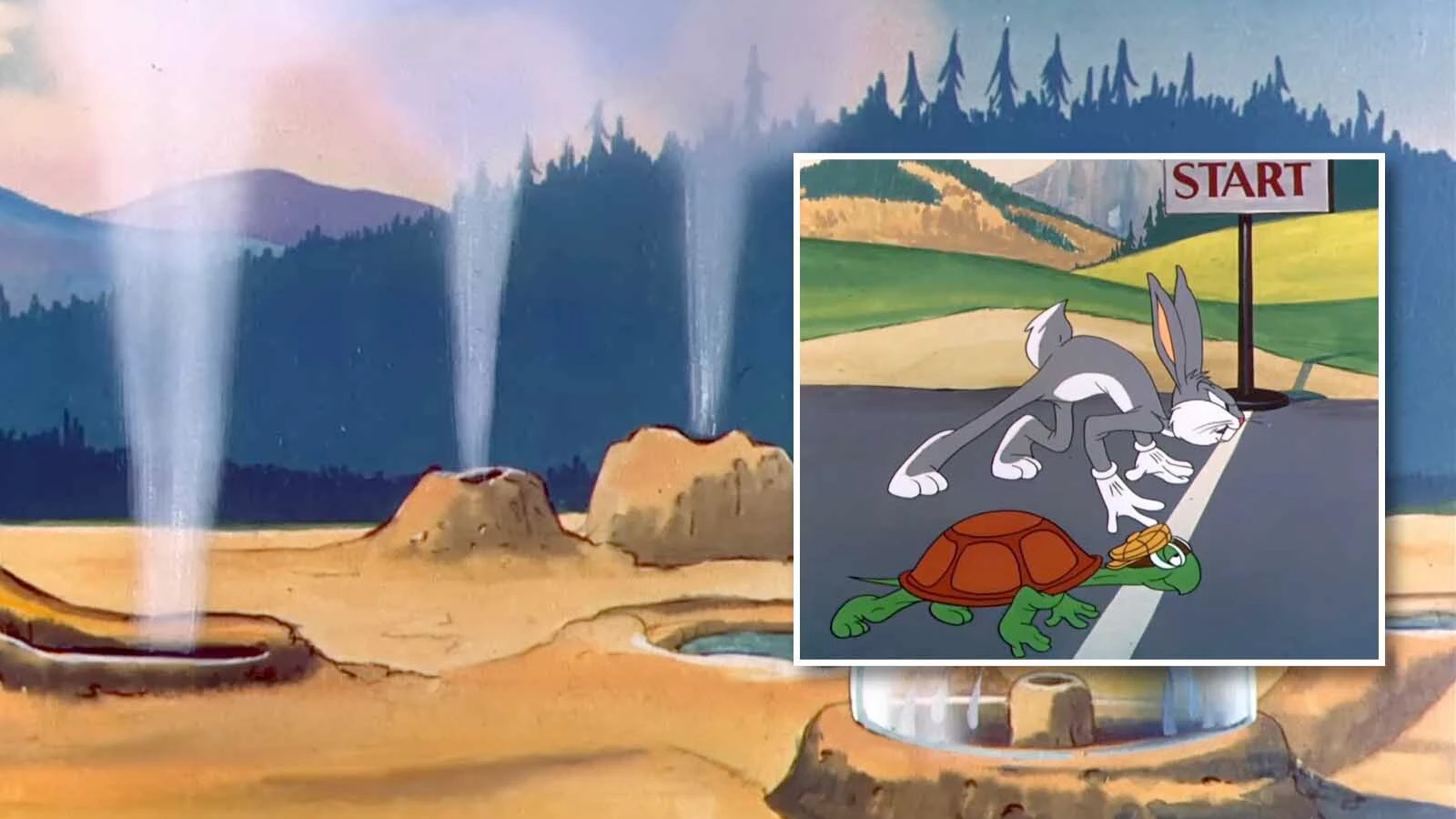
"The Tortoise and the Hare" is one of the most famous fables from ancient Greece, so it was inevitable that the 20th century’s most famous rabbit would be cast in that famous tale.
Bugs Bunny, the kingpin of Warner Brothers’ Looney Tunes, was the titular hare in multiple adaptations of the classic fable in the heyday of animated theatrical shorts.
He was angrily and spitefully motivated to break convention and leave the tortoise in a gloating cloud of dust.
The first time, Bugs raced because the concept of a tortoise beating a hare incensed him. The second race resulted from Bugs reviewing and refusing to accept the outcome of the first race and demanding a rematch with his opponent.
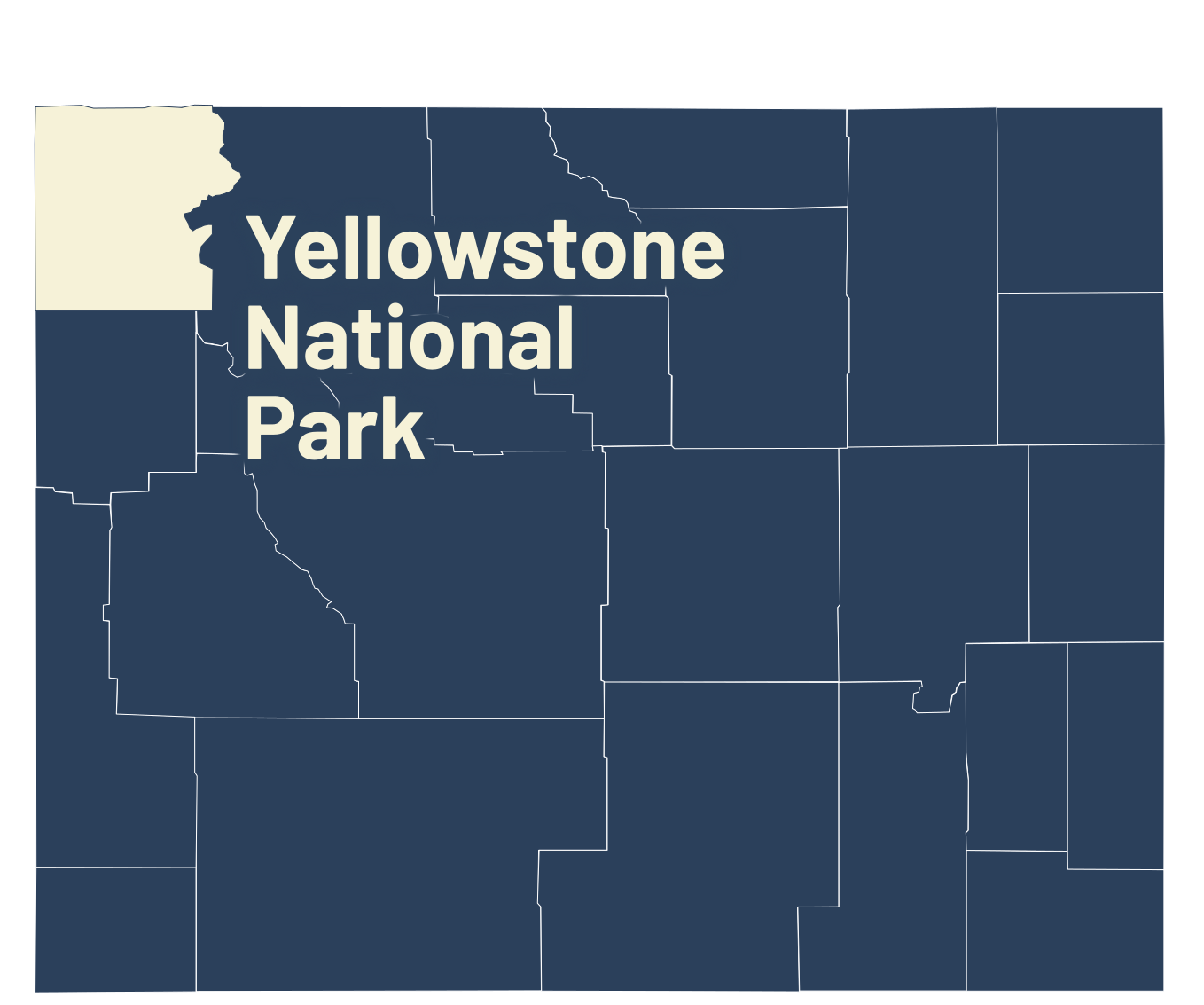
The third time, both Bugs and the same reptile duplicitously agreed to a race after getting steamed up during a spa date in Yellowstone National Park’s thermals.
The 1947 cartoon “Rabbit Transit” is another cartoon in the Looney Tunes franchise with an odd Wyoming connection. The confirmation comes in the form of a blink-and-you'll-miss-it sight gag.
Bugs had been found living in Yellowstone before, but this time he was running away from it as fast as he could, but not until after he got a relaxing steam bath in the inner workings of the park’s famous geysers.
He wanted to avoid another serving of humble pie in the face from the only foe he’s never outsmarted: Cecil Turtle.
All Steamed Up
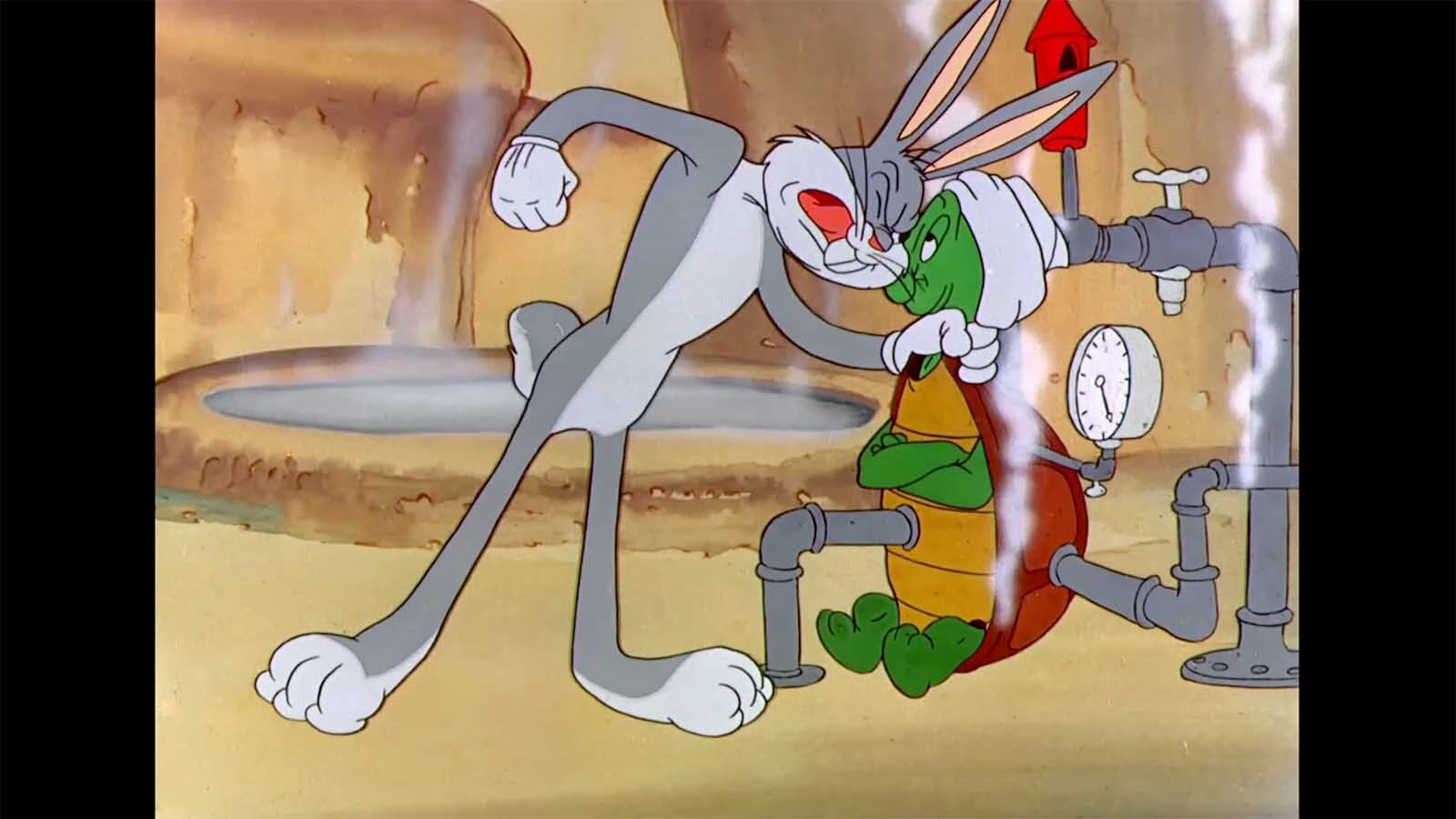
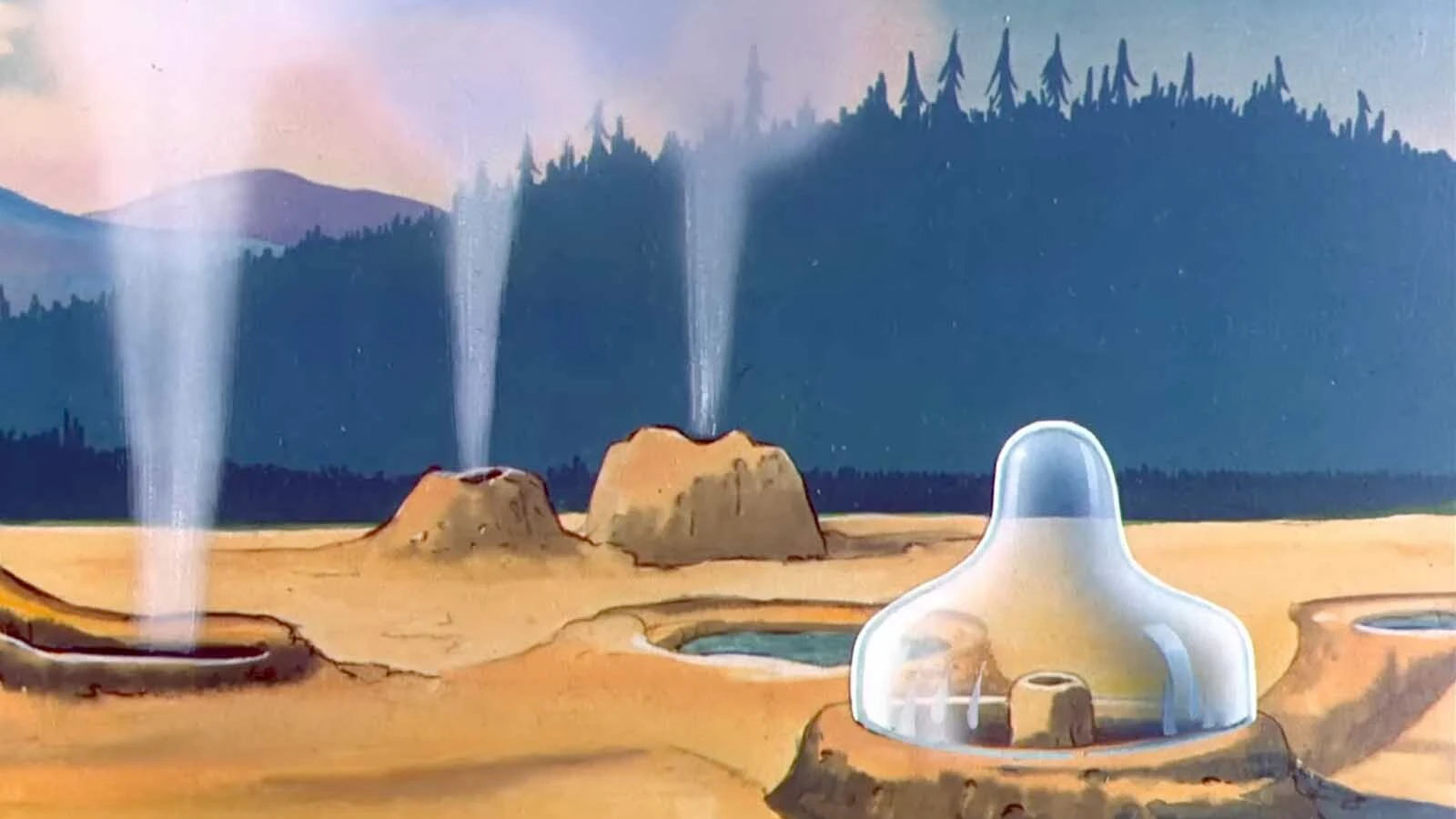
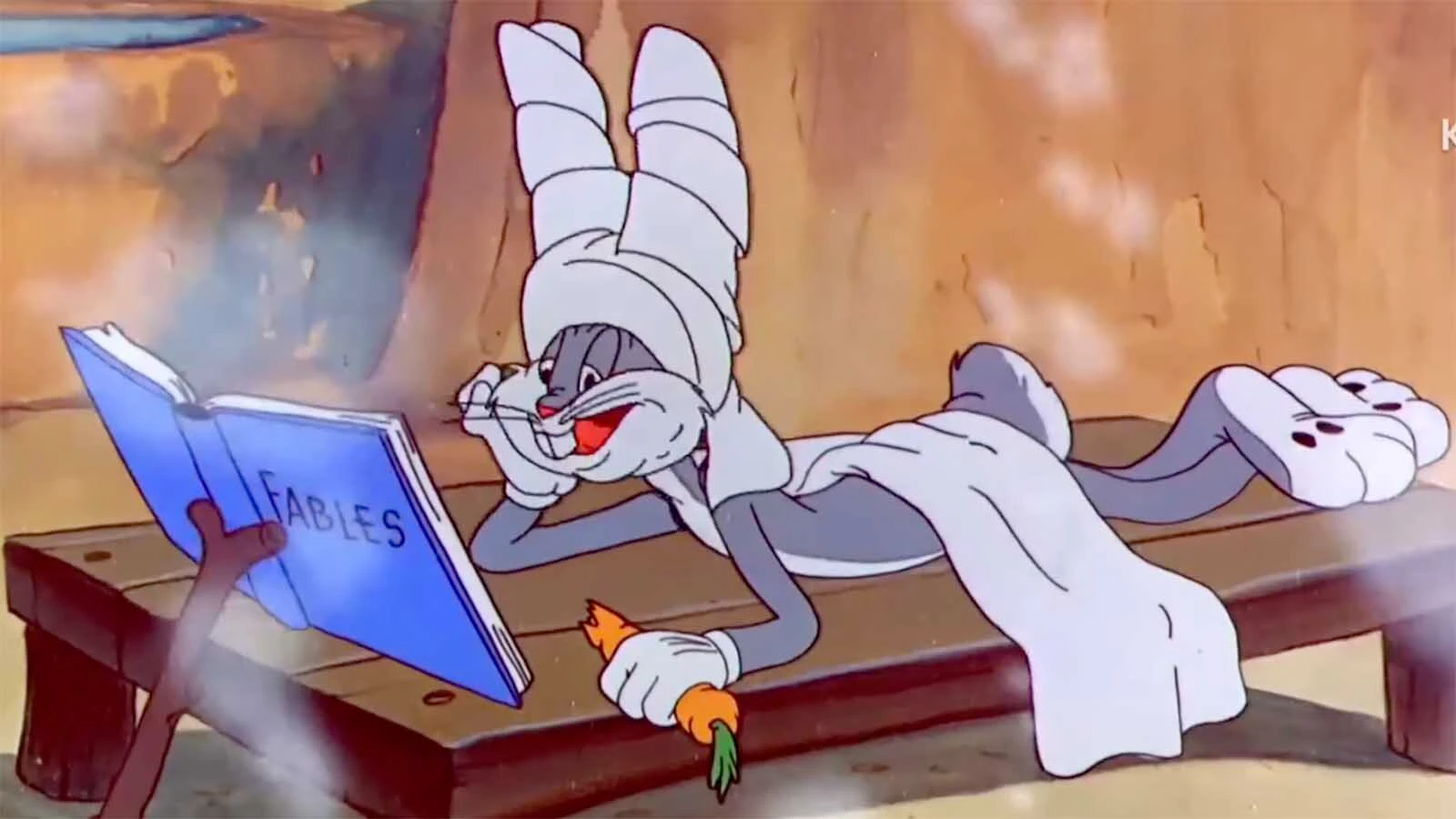
“Rabbin Transit” opens with a shot of steaming geysers and hot springs that slowly pans over to reveal Bugs Bunny, lying on a wooden bench, wrapped in towels, and clearly enjoying a sauna while reading aloud from a book of fables.
When Bugs reads that the tortoise beats the hare, he spits out his carrot in a fit of outrage so intense that he can’t finish his own sentences.
“Who’d ever believe such a silly story?” growls Bugs.
“I would,” says a drawling off-screen voice.
“Who said that?” says Bugs, looking everywhere except behind him for a nincompoop in need of a dressing down.
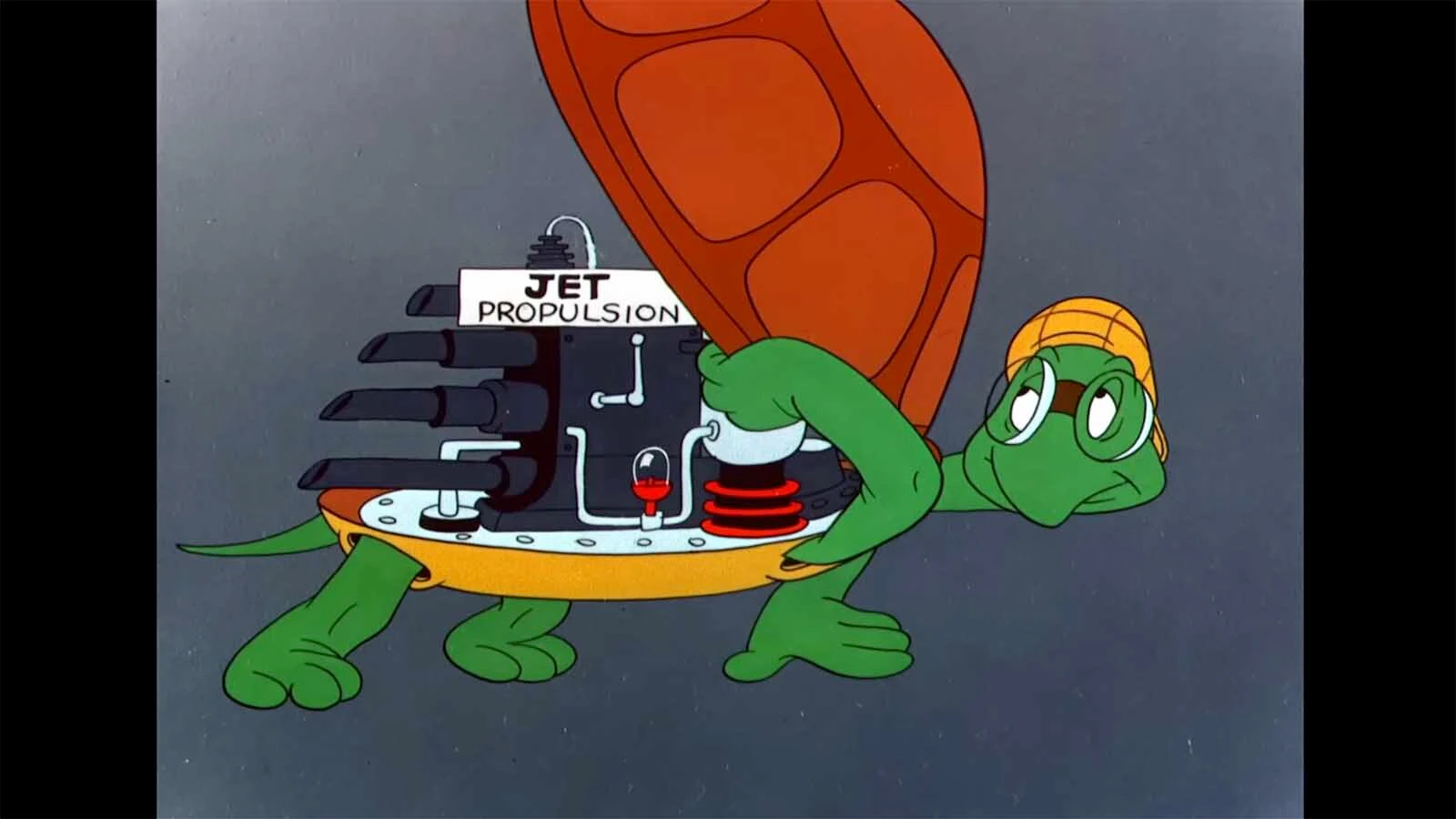
“Uh, I did, Mister Rabbit,” says Cecil Turtle, revealed to also be enjoying a steamy sauna via multiple pipes connected to his shell.
Bugs relaxes and tells “the knave little turtle” to “simmer down to a slow boil,” an obvious reference to the spot where they’ve both been illegally steaming.
“Uh, I’m a tortoise, and uh, I can beat you, Mister Rabbit,” Cecil Turtle (who’s not a tortoise) responds.
With that, Bugs boils over.
He launches into a tirade of angry analogies before calming down enough to challenge Cecil to a race.
Uh, yes,” accepts Cecil.
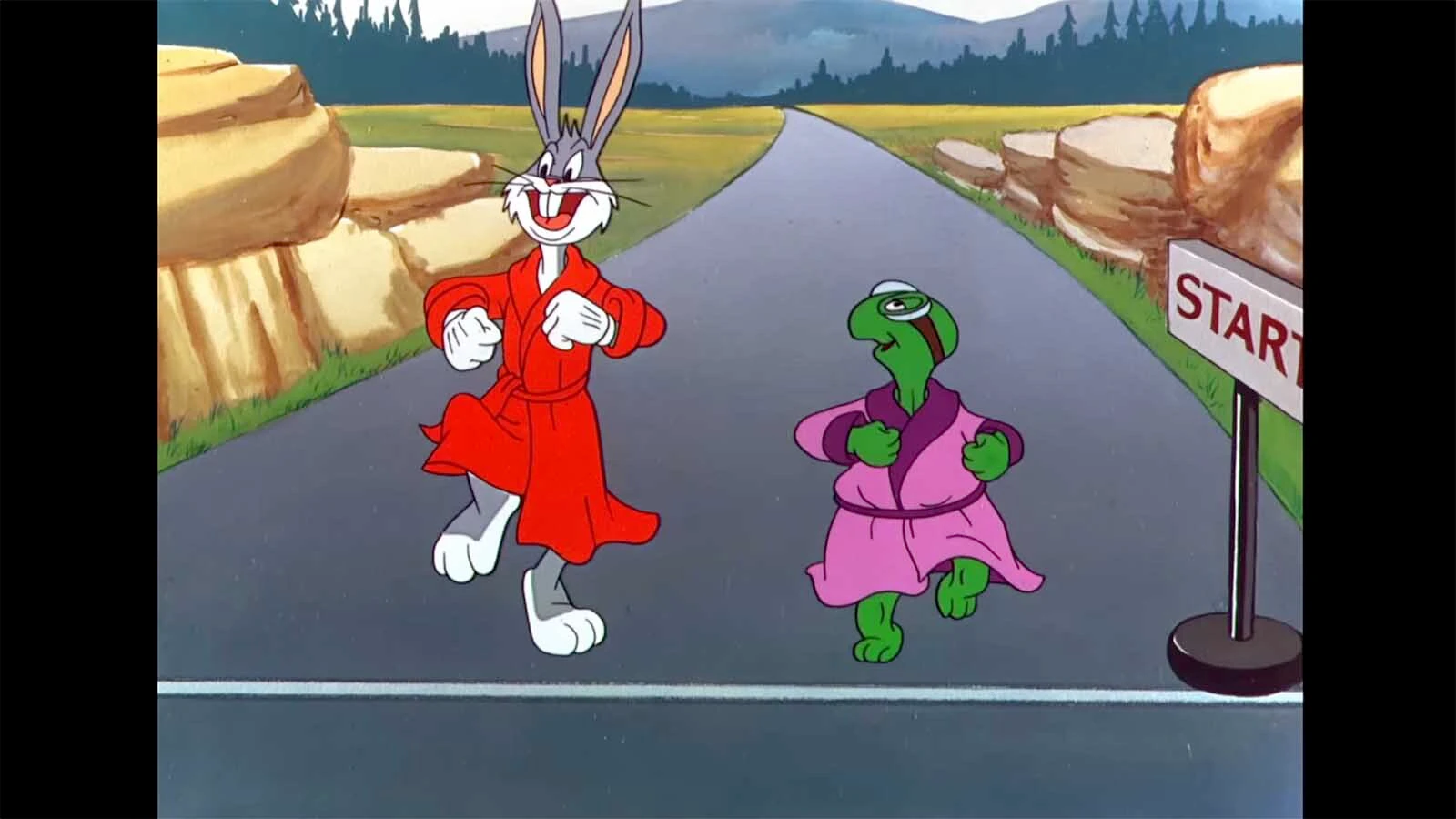
Bugs and Cecil decide to race from “here” in Yellowstone to Grant’s Tomb in New York City. Cecil finds that agreeable, so long as they agree not to cheat.
Cecil’s request sets Bugs off again, but he agrees to fair play while excising the roller skates he had concealed in his pre-race robe.
In the spirit of sportsmanship, Bugs aggressively shakes Cecil down until a motor scooter and a bicycle are dislodged from his shell. Cecil feigns ignorance.
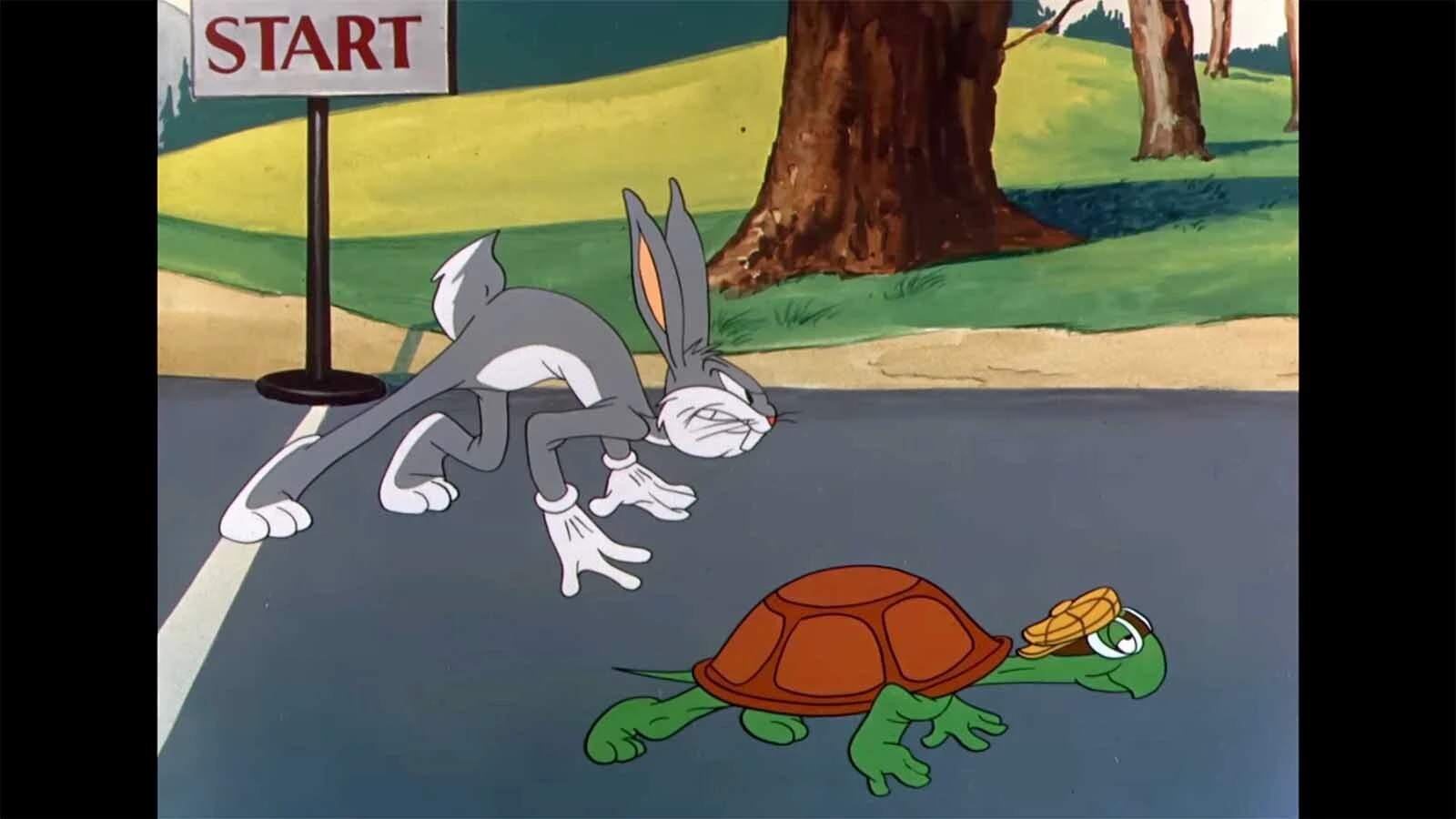
At the starting line, Bugs starts the countdown.
“One for the money, two for the show, three to get ready, and four to ...”
The last word is left hanging as Bugs disappears in a cloud of dust while Cecil immediately receives a telegram.
“Here,” according to the telegram, is 10 ½ Ave. E., Wyoming. It ends with a simple message for Cecil.
“Go!”
And with that, the race is on.
Not The First, Nor The Worst
“Rabbit Transit” is the third appearance of Cecil Turtle. It’s also the third time Bugs Bunny raced him.
Jerry Beck is an animation historian, professor, and former studio executive who’s written several books on the history of the Looney Tunes, its creators, and its characters.
Among his many published works is “Looney Tunes and Merrie Melodies: A Complete Illustrated Guide to the Warner Bros. Cartoons.”
According to Beck, “Rabbit Transit” was a creative way for animators to meet a cartoon quota mandated by the Warner Bros. executives.
“Bugs crystallized as a character in 1940’s ‘A Wild Hare’,” he said. “He was so popular that by 1941, everyone at Warner Bros. was quickly grabbing for story material because the orders from on high were to make more Bugs Bunny cartoons.”
In the early days of animation, fables and fairy tales were a common well for animators and directors to draw from.
Aesop’s “The Tortoise and the Hare” dates back to ancient Greece, but 1941’s “Tortoise Bears Hare” wasn’t even the first animated adaptation of the fable.
In 1935, United Artists released the Silly Symphony “The Tortoise and the Hare,” produced by Walt Disney.
It starred Max Hare and Toby Tortoise, who would become recurring characters in several Disney shorts, and went on to win an Oscar for Best Animated Short.
Beck went so far as to call Disney’s Max Hare “a forerunner” to Bugs Bunny. It’s never been confirmed, but the overconfident, jocular rabbits do have some similarities.
When Warner Bros.’ snarky rabbit became an instant audience favorite, it was only natural to put him in Aesop’s famous fable — and any other fairy tale where he could cause chaos.
“The first four years of Merrie Melodies constantly pulled from famous fairy tales, myths, and fables,” Beck said. “Everybody knew them, so they were stories everybody could relate to.
"Now they had Bugs Bunny, so they put him into a tortoise-and-hare situation.”
Where Disney’s cartoons succeeded through wholesome charm and heart, Warner Bros. went for bombast and irreverent, edgy humor.
Putting the wisecracking Bugs Bunny in “The Tortoise and the Hare” was a perfect opportunity to create comedic conflict by subverting thousands of years of expectations.
Except that isn’t what happened.
Beck said 1941’s “Tortoise Beats Hare” was deliberately written to give the audience the expected outcome while watching Bugs lose his composure and temper as he relentlessly raced to an inevitable outcome.
“You can see where they were going with that,” he said. “Bugs is a wise guy. He’s very confident in himself. He’s fast and funny. You expect him to turn the tables, but instead our popular hero loses.”
That gave the Warner Bros. animation department another dynamic to play with, and a different type of character for Bugs to bounce off.
Enter Cecil Turtle.
Fertile As A Turtle
A core character trait of Bugs Bunny is that he always comes out on top, regardless of his opponent.
Bugs at times instigates, but always prevails over the likes of Wile E. Coyote, Yosemite Sam, Nasty Cantasta, and Witch Hazel.
Elmer Fudd, arguably Bugs’s arch nemesis, can count the number of times he’s bested the bunny on one of his four-fingered hands.
That’s never been true for Cecil Turtle. Every time Bugs challenged Cecil, the turtle won.
“Cecil always seems the best of Bugs,” Beck said. “He doesn’t do it with a rifle or by being bombastic. He’s a timid little turtle that always wins.”
When Warner Bros. decided to do the loony version of "The Tortoise and the Hare," they needed a new character. Cecil was designed to fit that role while also being a funny antagonist to get Bugs going.
Cecil's deep, slow, drawling voice was provided by the masterful Mel Blanc, who voiced every prominent Looney Tunes character.
Cecil sounds uncannily like Barney Rubble of “The Flintstones," another character voice by Blanc decades after Cecil first spoke.
From the beginning, Cecil got on Bugs’ bad side in a way that nobody else could or has.
The slow-talking, unassuming turtle masquerades as a non-threatening simpleton while secretly being as crafty, slick, and creative as his opponent.
And when he gets caught cheating, Cecil replies with his famous line that feigns ignorance, “Well, uh, whaddaya know?"
In “Tortoise Beats Hare,” Cecil wins the race by a clever act of trickery. He enlists and strategically places his nine doppleganger cousins along the route to mess with Bugs’ head, which works and gets him the $10 prize they agreed on.
In 1943’s “Tortoise Wins By a Hare,” Bugs still hasn’t figured out how Cecil won the first race, but demands a second.
The triumphant Cecil is so sure of himself that he insults the rabbit’s intelligence to his face before agreeing.
This time, Bugs builds himself a streamlined metal shell because Cecil told him that was what allowed him to win the last race. Bugs believes him. Maybe he really isn’t that bright.
Bugs gets within “a hair” of winning, only to be sabotaged and beaten by a literal gang of mafioso rabbits who gambled everything on Bugs.
Cecil, who’s somehow deduced everything, leverages the chaos to his advantage and is literally carried over the finish line by the rabbit gang.
Once again, Cecil is triumphant and Bugs is humiliated. The cartoon ends in an inexplicable act of mass murder as the rabbit gang takes itself out with one bullet.
Such clever maneuvering and manipulation would be out of character for Elmer Fudd, but it’s perfect for Cecil. That’s why the studio kept bringing him back.
“The first cartoon was popular enough that the directors and writers asked themselves, ‘Do we want to do another one?’ So, they’d do another one,” Beck said.
Sustainable Cartooning
What Beck finds interesting about Cecil Turtle’s cartoons is that each had a different director. The same story is told three different times, reflecting the proclivities of their creators.
“Tortoise Beats Hare” was directed by animation legend Fred “Tex” Avery. “Tortoise Wins By a Hare” was directed by Bob Clampett, who designed and directed the first appearances of Looney Tunes icons like Daffy Duck, Porky Pig, and Tweety.
“Rabbit Transit” was directed by Friz Freleng, one of Warner Bros. most prolific and enduring directors.
In addition to creating Porky Pig and Tweety with Clampett, he went on to add Sylvester, Yosemite Sam, and Speedy Gonzales to the Looney Tunes roster.
“What’s interesting is that Clampett was a disciple of Avery,” Beck said. “He inherited a lot of Avery’s animators when he left the studio, including Freleng, and many people don’t know that Freleng really liked what Clampett’s cartoons.”
Beck knows about Freleng’s admiration for Clampett because he interviewed Freleng for one of his books.
Freleng admitted that he admired Clampett’s characters and creativity and would emulate his style when he came into his own at Warner Bros.
“When Bob left the studio, Freleng remade some of Bob's cartoons and characters,” he said. “Tweety was really Bob’s character, but he only made three cartoons with him. Freleng did his own thing with Tweety, paired him with Sylvester, and the rest is history.”
Today, the Looney Tunes characters all exist together.
In the 1940s and 1950s, most characters were confined to cartoons made by the directors and animators who created them and rarely, if ever, appeared in another team’s cartoons.
For example, the Road Runner and Wile E. Coyote only appeared in Chuck Jones cartoons. Foghorn Leghorn only appeared in cartoons by Robert McKimson, and Tweety, Sylvester, and Yosemite Sam were solely in Freleng’s cartoons.
Everyone shared Bugs, Daffy, Porky, and Elmer. And, apparently, Cecil.
Beck said the three appearances of Cecil are unique examples of the same character being used by three different directors.
While his personality remained consistent, Avery, Clampett, and Freleng each had their own ideas for using him in their retelling of “The Tortoise and the Hare.”
“They received the feedback from each appearance and updated the characters,” he said. “Cecil is funny because of Bugs’s reaction to him. It’s a completely different personality that doesn’t conform to established canon.
"It was funny for them, and always funny for the audience.
Yup, He Won One
The humor in “Rabbit Transit” revolves around Cecil.
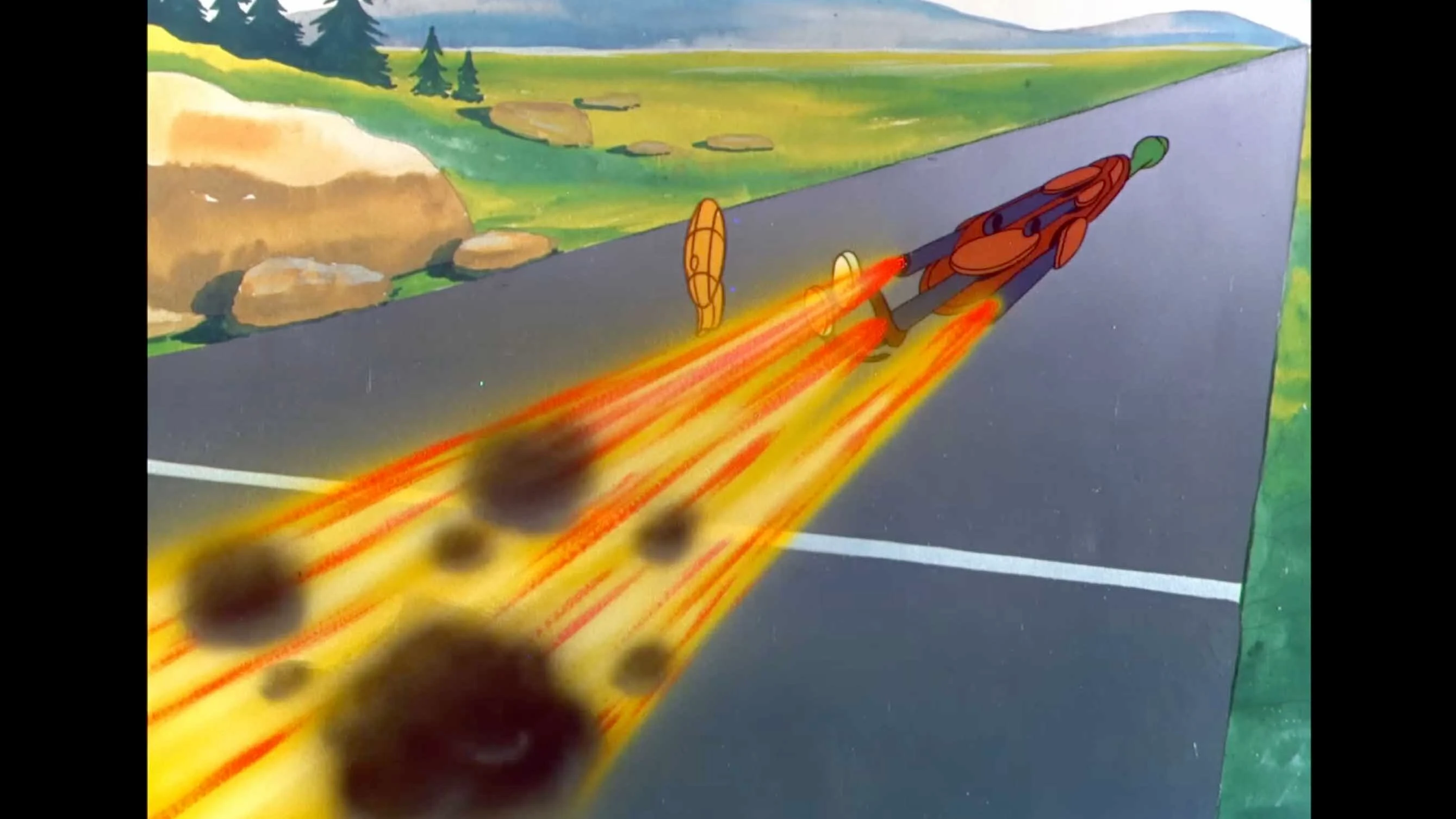
Most of the gags involve his turtle shell, as Cecil had the foresight to install rocket engines on the backend to beat Bugs to Grant’s Tomb.
“These cartoons aren’t taking place in some Disney-fable land,” Beck said. “They're taking place in the real world, where we have telephones and rocket engines. That’s what was fun about the Looney Tunes.”
Both Cecil and Bugs steal and sabotage the shell to race ahead of each other as various mishaps and antics ensue. More telegrams are sent, insults exchanged, Bugs mails himself to Cecil in Chicago, and blinding speeds are reached.
For Bugs, the third time’s the charm.
Despite both of them obviously cheating in their race, Bug finally crossed the finish line before Cecil. After 3,000 years, the hare finally beats the tortoise.
An exhausted Bugs gloats. Cecil takes his loss graciously, but he’s very keen to have Bugs repeat how fast he had to go — “I was doing a hundred, easy” — to beat him.
Bugs finally and frustratingly shouts his triple-digit top speed loud enough for the nearby police officers to hear.
Since Bugs was going well over the posted 30 mph speed limit, he’s arrested and carried away while overtly threatening to murder Cecil.
Cecil celebrates his besting of Bugs by stealing one of his catchphrases.
“Uh, ain’t I a stinker?” he slowly says as the cartoon ends.
Where's 10 ½ Avenue, Wyoming?
“Rabbit Transit” ends with Bugs’s arrest at the end of the race, Grant's Tomb in New York City, but it started at 10 ½ Ave. E., Wyoming.
Unsurprisingly, this isn’t an actual Wyoming address.
There’s a County Road 10 ½ in Burlington, and a County Lane 10 ½ in Lovell. Neither of those is an avenue, and neither leads to Yellowstone National Park.
Why does the third race of Bugs Bunny and Cecil Turtle start in Wyoming? The Looney Tunes answer would probably be a coy “why not?”
What’s unique about “Rabbit Transit” is that it firmly establishes Wyoming as the initial setting, via Bugs’ telegram to Cecil.
Yellowstone is never mentioned by name, but where else could Bugs and Cecil get steamed up next to active geysers?
Beck wasn’t aware of any specific reason why Freleng decided to start “Rabbit Transit” in Yellowstone, but the simplest explanation is that it was a fun place for antics to happen.
“The park was immortalized, even in 1947,” he said. “Setting was a key thing in the early Bugs Bunny cartoons, so they looked for settings that made sense for a rabbit to be in.
"But they’re comedians, so they’re parodying everything.”
One of Bugs Bunny’s earlier appearances, 1941’s “Wabbit Trouble,” was set in “Jellostone Park,” an obvious riff on Yellowstone. It came out the same year as "Tortoise Beats Hare," the first cartoon with Cecil Turtle.
Bugs spends the entirety of “Wabbit Trouble” being uncharacteristically cruel to “fat Elmer,” who just wants “a westful wetweat” in nature.
The cartoon ends with Elmer incarcerated for destruction of federal property, and Bugs jailing himself just for the love of the game.
“They figured out different ways to use the character in different places that would elicit laughs,” Beck said. “There didn’t need to be an underlying reason beyond that."
Bugs gets arrested at the end of “Rabbit Transit,” but that’s only for traveling at excessive speeds.
Logically, both he and Cecil Turtle should have been arrested for thermal trespass and vandalism for setting up a sauna, complete with plumbing, in a delicate thermal basin.
There are no winners in that race. At least they didn’t cause as much willful destruction as Donald Duck and his nephews did when they visited in 1938.
Corporate Decision
Bugs Bunny went on to become the corporate mascot for Warner Bros. and one of the most iconic cartoon characters of all time.
Cecil Turtle didn’t.
Outside of a single line in 1954’s “Devil May Hare,” the first appearance of the Tasmanian Devil, Cecil Turtle didn’t get anything beyond an occasional cameo for decades.
At least in "Devil May Hare," Bugs got some form of revenge by forcing Cecil’s head to collide into a frying pan.
Cecil didn’t have a prominent role in any Looney Tunes-related media until being featured in two episodes of “The Looney Tunes Show” in the early 2010s. He’s appeared, sparingly, in other projects since then.
Why did Cecil disappear? The official sources say the character was “retired” by executives, but there’s a possibility that Cecil was deemed as too disruptive to hang around the studio's star.
Bugs continued to vex Elmer Fudd, Yosemite Sam, and dozens of other foils for decades. He did so with his quick wit and humor.
“(The animators) figured out that they needed to give Bugs a reason for doing these things,” Beck said. “Elmer Fudd, Yosemite Sam, or whoever else would invade Bugs’ space and fire the first shot, and Bugs spends the rest of the cartoon retaliating, but he needed to be goaded into it.”
Much like Mickey Mouse, Bugs slowly lost his edginess as his core character traits was defined and he transcended from just another cartoon character to a pop-culture icon.
His less-appealing traits, such as his early propensities to anger, violence, and cruelty, were left to his co-stars, particularly Daffy Duck.
“People don't realize how popular these characters were at the time,” Beck said.
Cecil always brought out the worst in Bugs.
As Beck said, Bugs’ characterization in their cartoons was deliberately “beyond established canon,” which was part of the fun at the time.
The Bugs Bunny of the 1950s and beyond wouldn’t have been goaded into a race with Cecil, and he certainly wouldn’t let a turtle break his composure.
Without those visceral reactions from Bugs, Cecil didn't have much potential for comedic conflict.
Cecil was created to be the antagonist in a riff on “The Tortoise and the Hare.” If the hare’s not racing, there’s no need for a tortoise or a turtle.
What kind of entertaining, historic rivalry could a turtle have with a narcissistic duck, a pompous rooster, or a stuttering pig?
In this instance, Cecil might have won the battles but lost the war. Bugs was, and remains, ultimate Looney Tunes stinker.
Still, not everybody gets to say they’ve gone undefeated against Bugs Bunny.
Cecil Turtle has his place in animation and Looney Tunes history. He’s the only character to consistently get Bugs steamed up, which happened and led to a transcontinental foot race that started in northwest Wyoming.
Beck had dedicated his career to studying and advocating for the animated legacy of Warner Bros, Disney, and other studios.
That’s why he believes “Rabbit Transit” and Cecil Turtle are relevant now and for all time.
“These cartoons are the crown jewels for Warner Bros,” Beck said. “Cartoons are meant to entertain, and people want to be continually entertained.
"I’ve said that for years and said it to the people at Warner Bros. Animation doesn’t age, which makes these cartoons immortal.”
It’s A Turtle
It’s worth noting that out of the handful of native reptiles found in Yellowstone National Park, the only species in the Testudines family, which includes turtles and tortoises, is the North American painted turtle.
Every Bugs-Cecil conflict starts with Bugs being outraged by the tortoise beating the hare. And every time, Bugs loses to Cecil. The turtle.
There’s nothing that explicitly says Cecil Turtle lives in Wyoming.
However, since“Rabbit Transit” is written as if it were Bugs Bunny’s first encounter with Cecil, it’s within the realm of possibility that he found him at home.
If that’s the case, Bugs never had a chance of beating a tortoise, because he was never racing one.
You were racing a turtle, Bugs. A turtle.
What a maroon.
That’s all, folks.
Andrew Rossi can be reached at arossi@cowboystatedaily.com.