
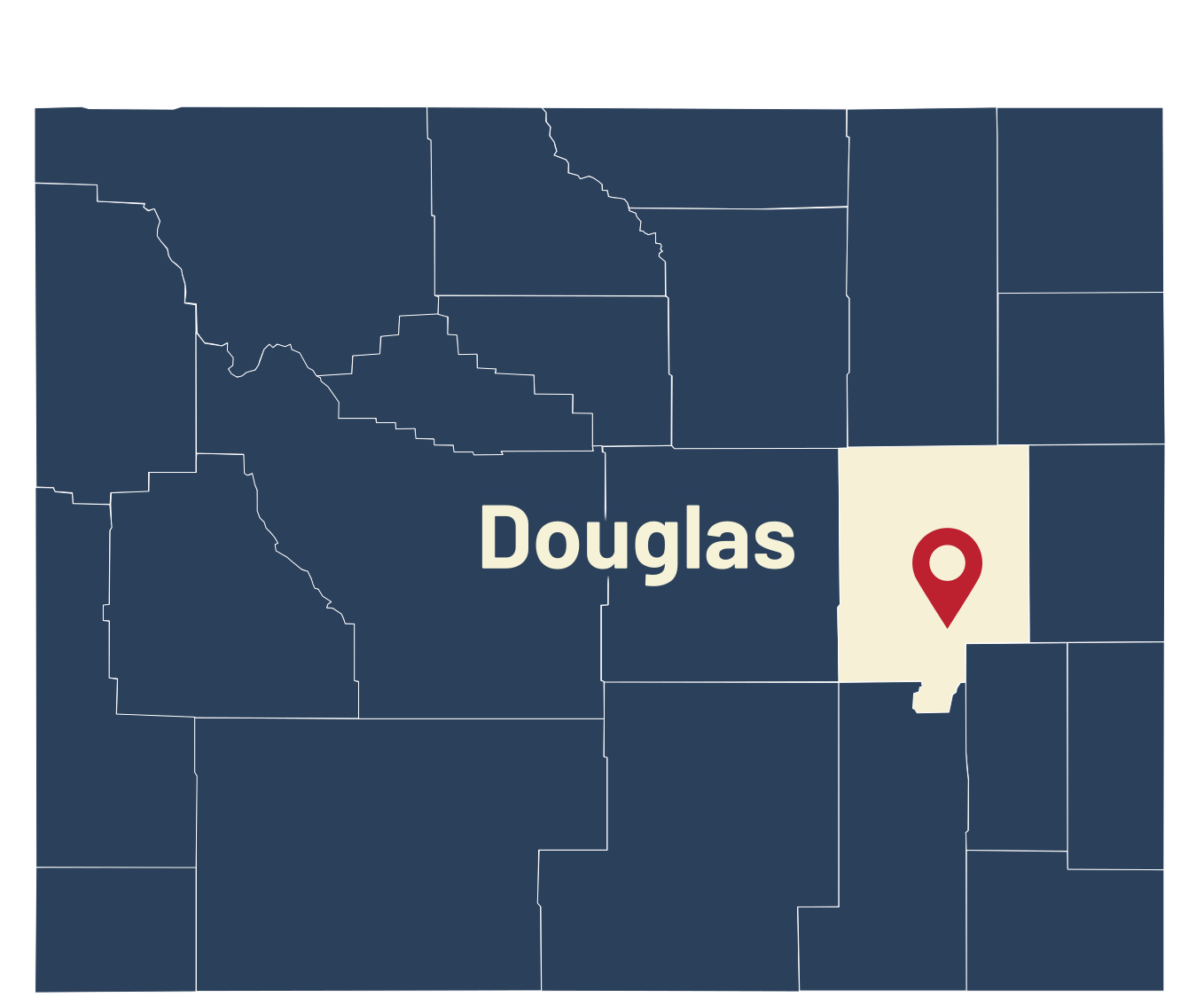
DOUGLAS — The Wyoming Republican Party is moving forward with suing the state to overturn state law that prevents the party from endorsing candidates while declaring their independence as a group.
GOP political candidates also will have to pass loyalty benchmarks for adhering to and “strongly” supporting at least 80% of the state party’s platform.
Those are a couple of the takeaways after the third and final day of the biennial Wyoming Republican Convention that was driven with an underlying theme of breaking away from state and federal rules that limit the party from acting as it feels best.
State GOP Chairman Bryan Miller set the tone early Saturday when he called out a procedural step governing how the meeting progressed.
“Anyone know why we have to do that?” he asked rhetorically. “It’s in our state statute telling us to do it.
“I’m OK with Robert’s Rules (of Order) doing it, not state statute.”
That dovetails into an update he gave the a delegate committee earlier in the convention: that the state party has agreed to pursue litigation through a Washington, D.C., law firm to overturn Wyoming’s laws banning endorsement of political candidates and party membership selection rules.
“Political parties have the right to organize, the right to express our own views,” Miller said Saturday. “We are not passive observers, we are participants.”
The delegates also passed an addition to the party’s bylaws declaring it “a private, voluntary association of its members” and as such the state can’t interfere in selecting party leadership and organizational structure.
As he had earlier in the convention, Miller again referenced the 1989 U.S. Supreme Court decision Eu v. San Francisco County Democratic Central Committee, which overturned California’s laws restricting endorsements, and delegate criteria for a major party.
Noting there had already been a vote to pursue litigation, state GOP attorney Caleb Wilkins said Wyoming is only one of two states that won’t allow parties to endorse candidates.
Technically the state bars the Wyoming GOP from backing one candidate financially over another when both are in the same primary contest. Over time, the law has been interpreted as a primary election ban on endorsements, Miller noted Thursday.
Also, the D.C. law firm is taking the case basically free, he said, adding the lawsuit has “a very high probability of success.”
Lance Oviatt, a Republican delegate from Lincoln County, voiced support of the move.
“My reading of this Supreme Court decision is we have the right of free speech and free association, which we have been denied since 1989,” he said in making a motion to support the litigation.
He said there are three ways to affect this type of change.
“Ballot box, the jury box and the ammunition box,” Oviatt said. “Hopefully, we don’t have to go to No. 3. We need to resort to the jury box, we need to go to the courts.”
The party also passed a bylaw allowing endorsement of statewide candidates by the Wyoming Central Committee, while county parties can endorse local hopefuls for office.
As for the loyalty tests, the new bylaw says candidates for non-judicial offices need to “strongly support” at least 80% of the state party’s platform line-items.
An amendment that would have provided an avenue for disqualifying a candidate or removing someone already in office for failure to meet that threshold didn’t make it to Saturday’s ratifying vote.
The state GOP is already fighting Wyoming’s restrictions on it, as a defense mechanism in a case where Hot Spring County Republican Party members say they were ousted from leadership positions in violation of state law.
‘Rumble Strips’
Another theme of Saturday’s final day was calling for unifying Wyoming Republicans during a time of overall political division and discord.
In remarks to open the meeting, state Rep. J.D. Williams, R-Lusk, said the GOP is driving out of its lane.
Instead of being within the lines on the political highway, the party has drifted into the “rumble strips,” he said.
“Thank goodness for the rumble strips,” Williams added, because that’s a warning that wakes you up.
“I’m not comfortable with the questionable behavior of this last (legislative) session,” he said, referencing that the GOP had the overwhelming majority of legislative districts. “Are you going to continue the tradition of Republican leadership in Wyoming?
“Just a smoke and a gallop from here is Niobrara County. The fewer neighbors you have, the more they mean to you.”
In his opening statement, Miller referenced Friday’s decision by a Natrona County District Court judge to suspend Wyoming’s new heartbeat abortion ban.
“We recently received news that really matters,” he said. “For many of us, this is deeply concerning. Without the right to life, the rest of our lives lose meaning.
“The challenge we face is not distance, it is not at the gates — it is here, it is present, it is in our own state.”
Saying that “a house divided cannot stand,” Miller called for unity.
“Candidly, we may not always agree on the small things, but then we come together and it matters,” he said. “If we need a reminder, we only need to look to the south. Colorado did not change overnight.
“It is time for us to be united for a common purpose.”
He then rallied the delegates, saying state Republicans still have work to do in spreading conservative values across Wyoming.
Miller challenged them to turn their attention to the state’s two politically blue blips on the map.
“Take back Teton County, take back Albany County,” he said. “This is the moment to rally around our principles.”
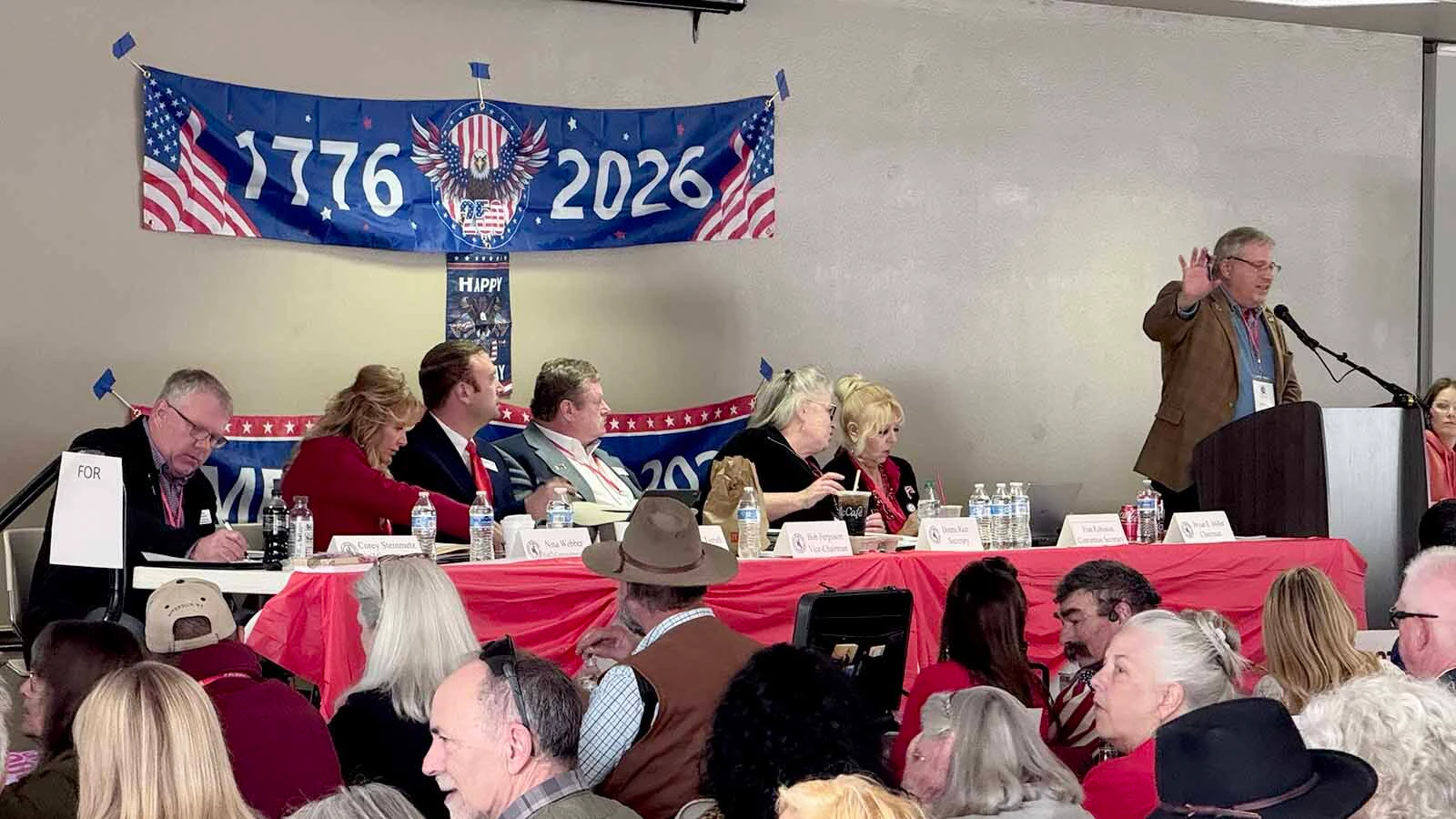
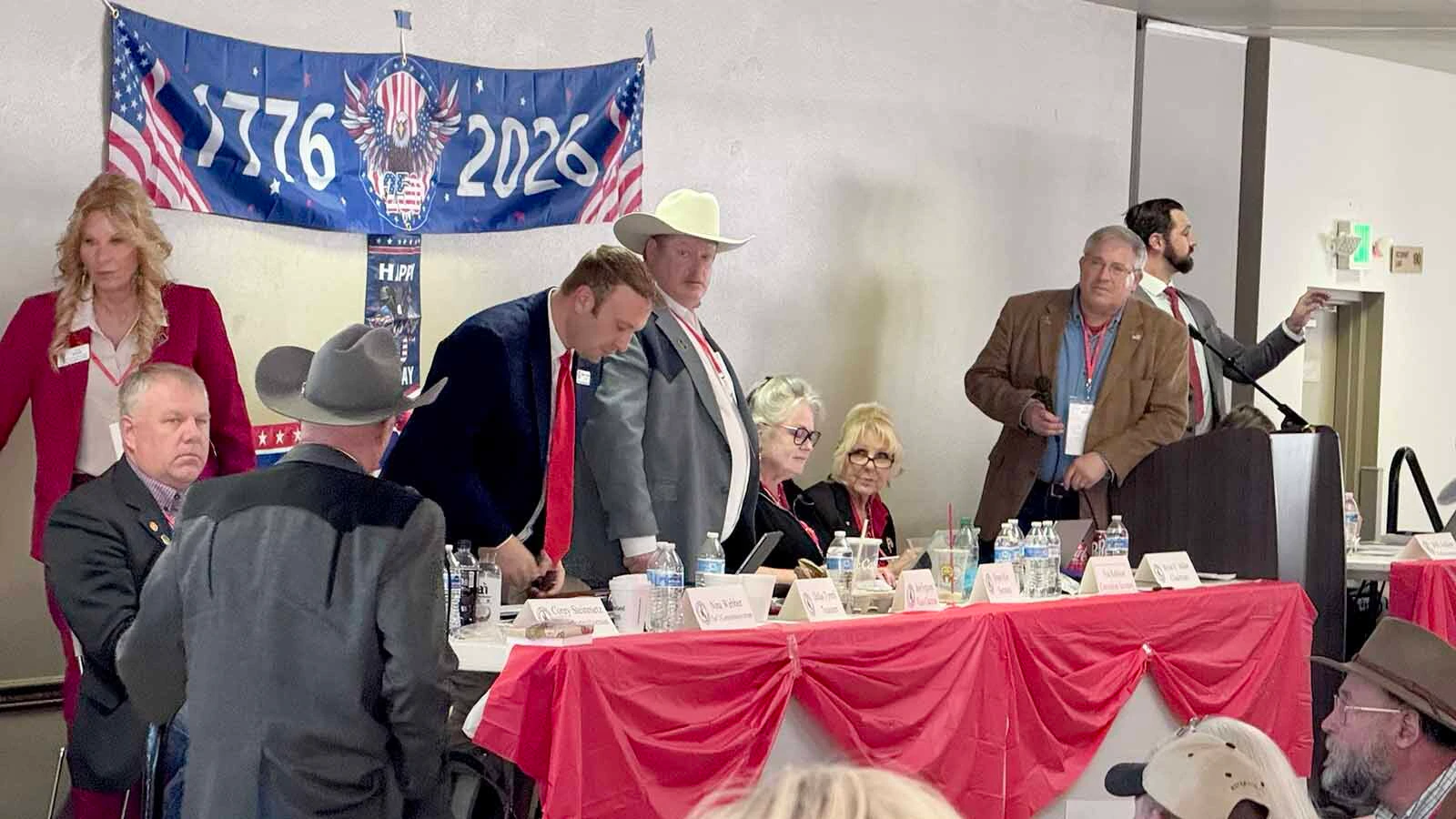
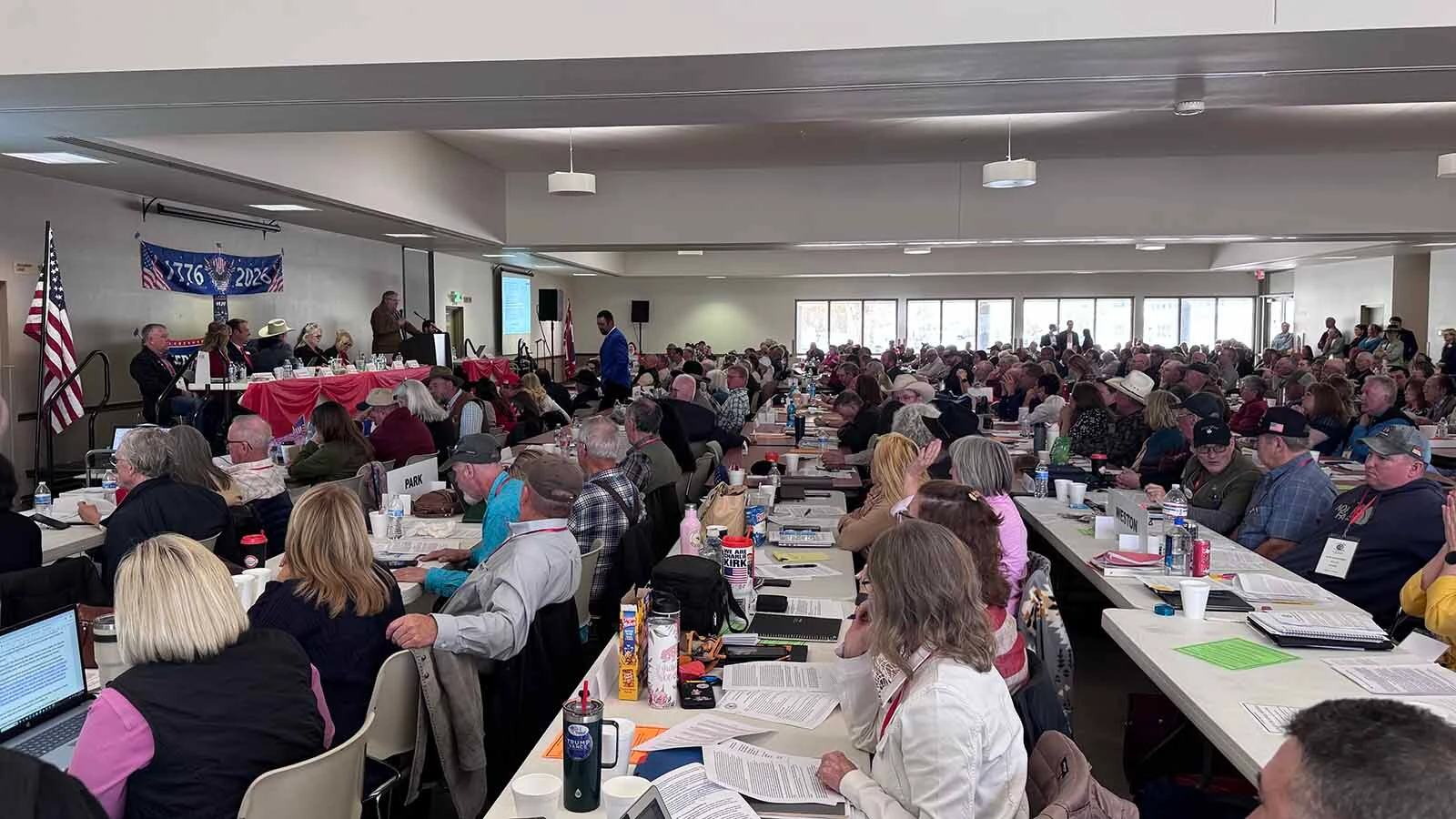
Wyoming Republican Party Chairman Bryan Miller, far right, on the final day of the 2026 Wyoming Republican Party Convention on the state fairgrounds in Douglas. (Greg Johnson, Cowboy State Daily) 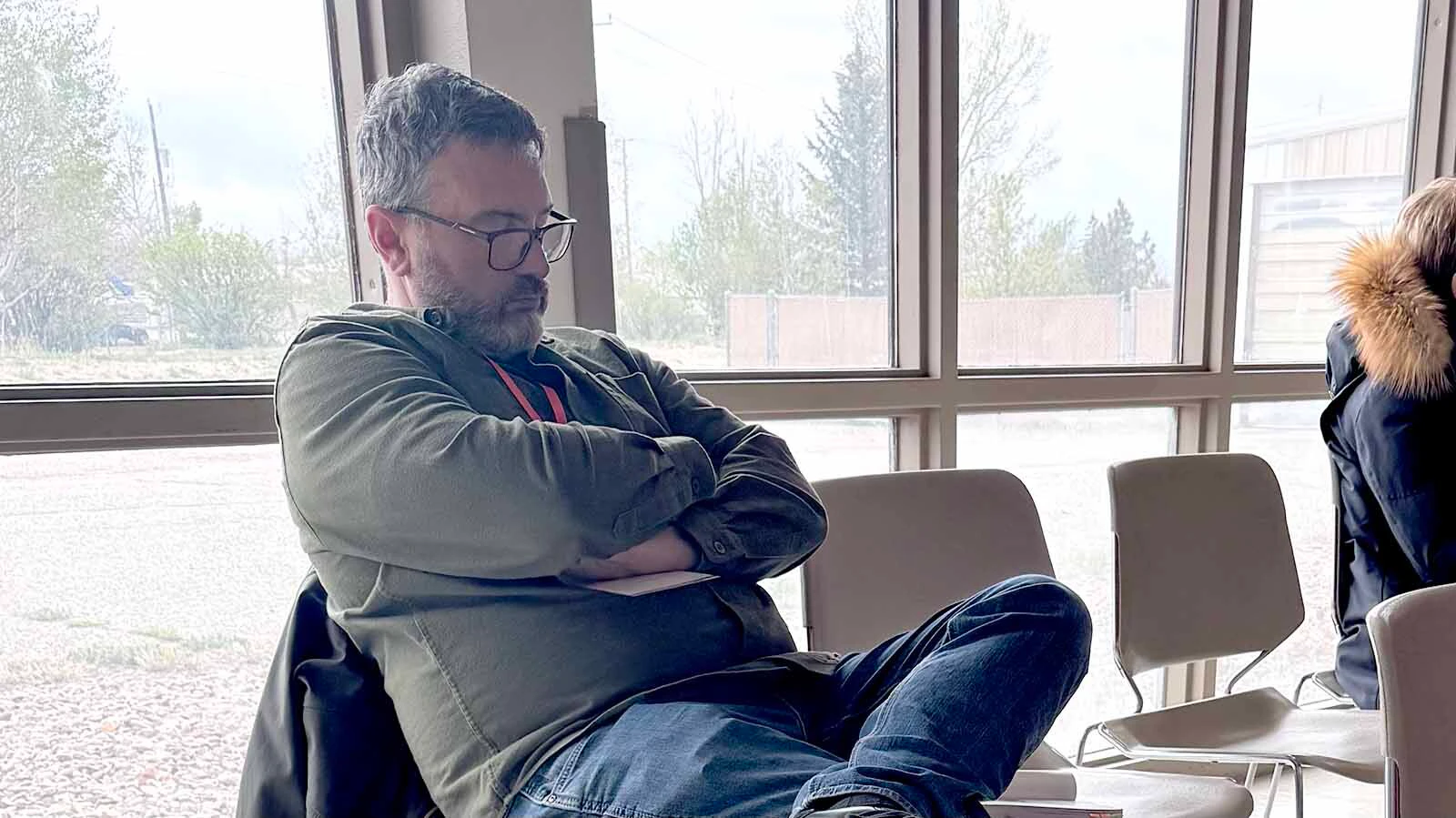
Some people at Saturday's meeting of the Wyoming Republican Party Convention in Douglas paced themselves to get through some long motion sessions. (Greg Johnson, Cowboy State Daily) 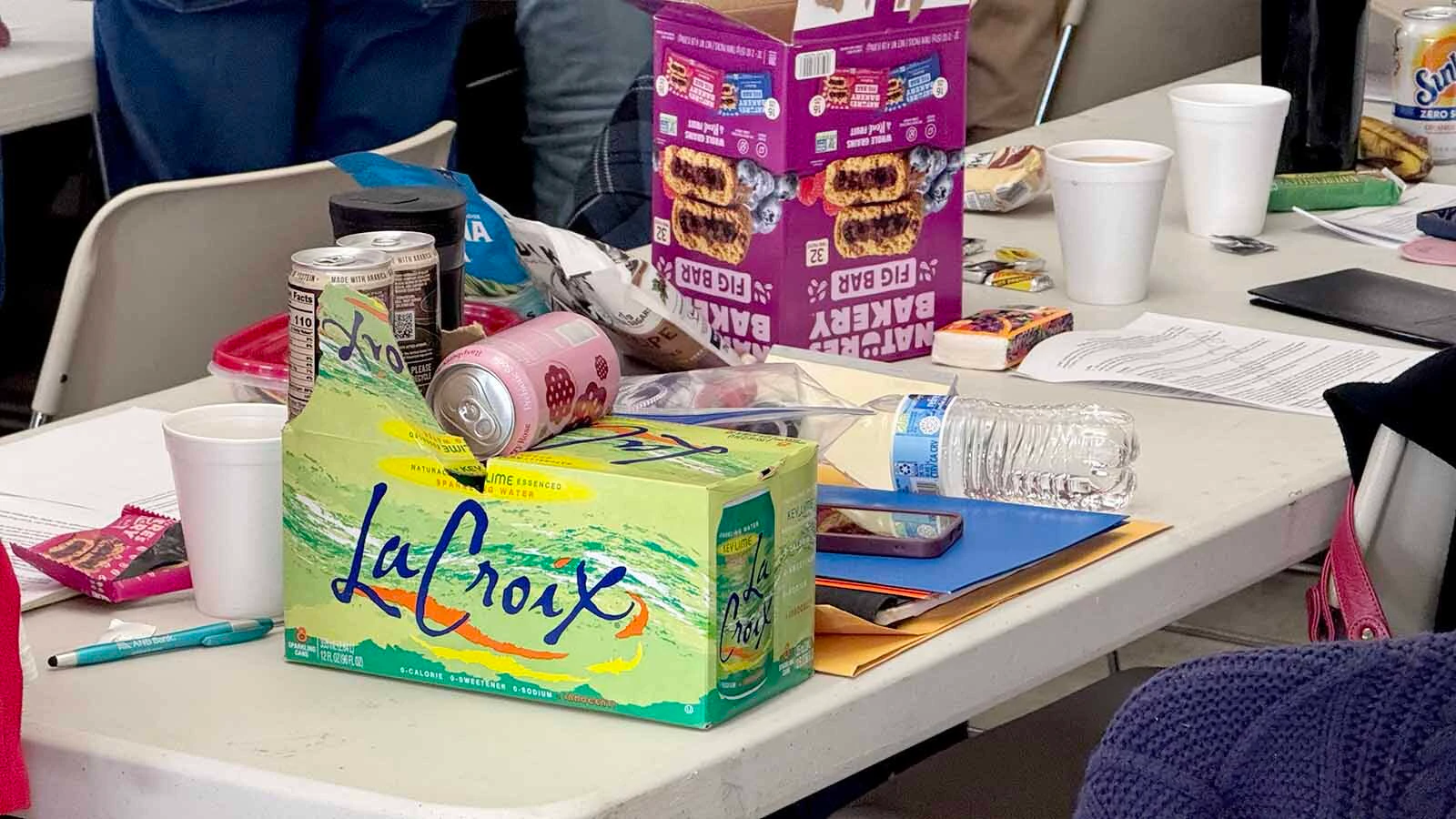
Some delegates came prepared for a marathon meeting of the 2026 Wyoming Republican Party Convention on the state fairgrounds in Douglas on Saturday. (Greg Johnson, Cowboy State Daily)
Devil’s In The Details
How many Republicans does it take to amend an agenda?
While that may sound like the start of a bad joke, the answer Saturday was 297, pretty much all of the delegates at the Wyoming GOP convention in Douglas.
It also takes nearly 50 minutes, as the delegates debated numerous rules, motions, and points of order to add the convention’s floor rules, which were inadvertently left off the agenda.
A motion to amend the floor rules then descended into confusion as party leaders, the party’s attorney and delegates debated fine points of Robert’s Rules of Order that at one point had Chairman Miller asking rhetorically, “Is that clear as mud?”
The confusion continued for about another 45 minutes until the party’s attorney, Caleb Wilkins, explained the process, which drew a loud round of applause and finally allowed Miller to circle “back to the original motion.”
An even louder explosion of applause erupted when the floor rules had finally been added to the agenda, then amended.
Some of those fine points of order carried over into other business of the day, as delegates and GOP leaders worked out the details of amending and approving bylaws, the party’s platform and resolutions.
“Because there’s lots of confusion here, let’s have our legal counsel explain things again,” Miller said as the nearly 300 delegates tried to finalize how to consider changes and amendments presented by the party’s Bylaws Committee.
At one point during debate, Miller expressed that much of the debate was over rules of order that had already been set.
“That’s the point, people are trying to modify the rules,” Miller said, later adding, “does everyone understand where we are?”
That drew an agitated buzz from the audience from those who did and those who didn’t, as Wilkins informed the meeting that 30 minutes of the two hours slotted for bylaws debate had already passed with delegates still hashing out how to debate the proposed bylaws.
The process finally got kick-started — somewhat — when Wilkins advised the group that “the purpose of Robert’s Rules is to be judicious,” he said. “I would ask the body to consider whether it’s worth our time to dig into the minutia ... or move on to substantive, productive debate.”
After another round of applause, a vote was finally taken.
“Now we’re back to the original motion,” Miller said. “Does everyone remember what the motion is?”
A Little Law
Private groups have a right to dictate their membership and express themselves.
On the other hand, Wyoming’s major political parties serve a quasi governmental function, of nominating contenders to fill vacancies in elected offices.
To some GOP party leaders, their right to shrug off state laws that tie their membership to the ballot box and ban their financial swaying of primary elections, is as good as won.
But the Wyoming Attorney General’s office last week pointed to another slate of cases which lay out a process by which a state can overcome a party’s associational rights, if the party only burdened those rights minimally.
Whether Wyoming’s laws are a minimal or significant burden to the party’s rights remains a pending issue.
Greg Johnson can be reached at greg@cowboystatedaily.com.


