Colorado’s wolves are wandering less as of late; some say it could be because the most far-ranging wolves have left the state.
But wildlife officials think it’s because packs are hunkering down close to dens, waiting for a new crop of pups this spring.
Either way, the dynamics of Colorado’s wolf recovery program seem to be changing as established packs become the rule, rather than the exception.
Less Movement
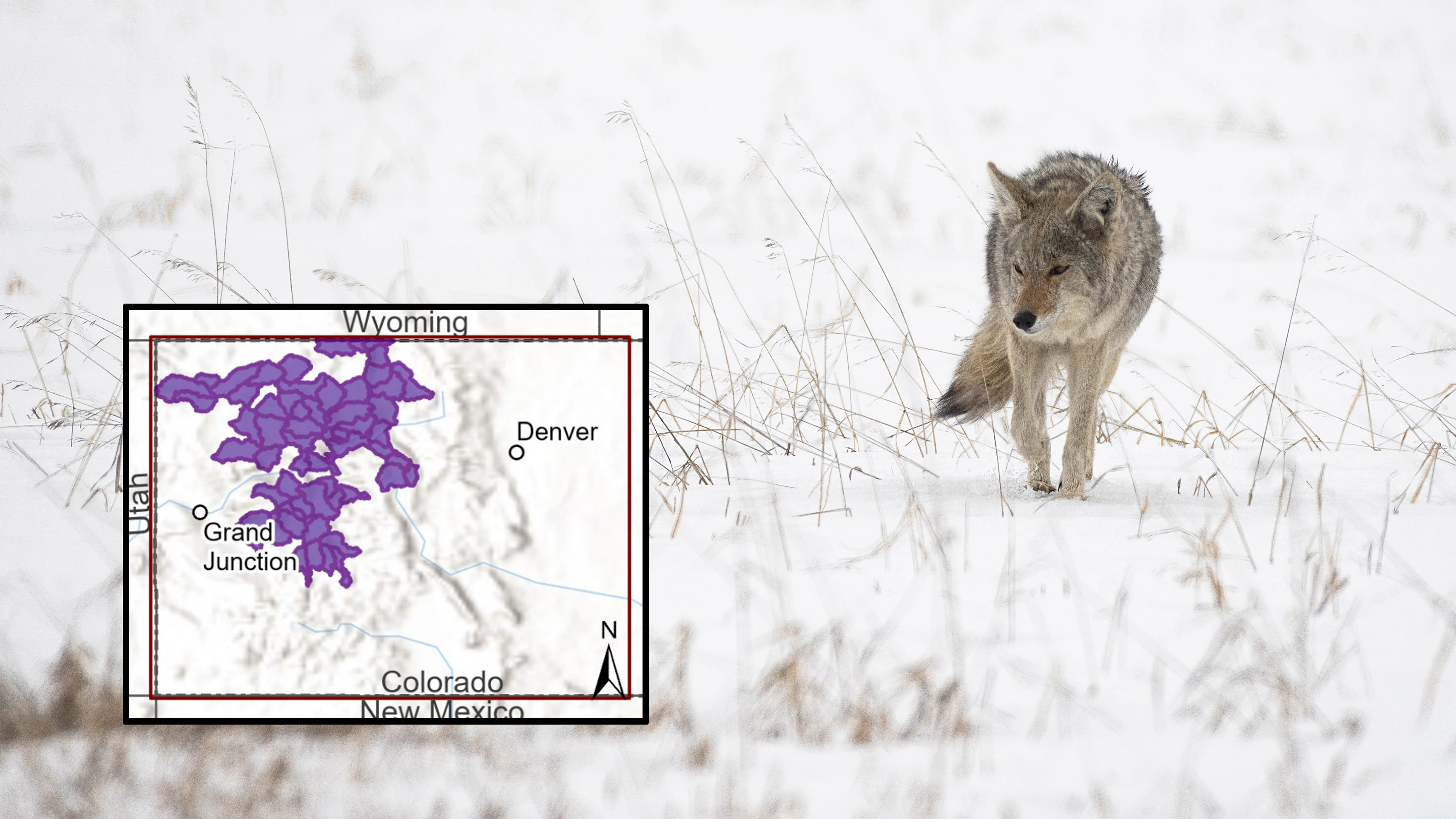
Colorado Parks and Wildlife (CPW) regularly releases maps showing the movements of the state’s wolves, based upon GPS tracking collar data.
The latest map, based on data from March 24 to April 21, indicates far less movement. Most notably, previous wolf wandering detected in south and southwestern Colorado doesn’t show up at all.
CPW has previously stated that a few wolves were making exploratory movements around the state. In December 2025, there were reports of wolves near the Denver metro area.
The latest maps shows that most of the wolf activity is happening in central and northwestern Colorado.
Colorado resident John Michael Williams said that there are still reports from “reliable sources” of wolves being spotted in southern Colorado.
There’s speculation those could be wolves that were either never fitted with tracking collars, or with collars that quit working, said Williams, who runs the Colorado Wolf Tracker social media page.
Pups On The Way
A downturn in wolf movement comes as no surprise to CPW, agency spokesman Luke Perkins told Cowboy State Daily.
“The wolves are denning” and likely expecting pups this spring, he said.
So, wolves are wandering less, and the GPS tracking data reflects that, he said.
Colorado now has four active established wolf packs, he said.
He wouldn’t speculate on the total number of wolves, noting that information should be available in the agency’s forthcoming annual wolf report.
And that number ebbs and flows, depending on how many pups are born, and how many wolves die.
During the “last biological year,” April 1, 2025 to March 31, nine wolves died of various causes. And one yearling wolf was killed by wildlife agents for preying on livestock, he said.
Leaving The State?
Williams said that he and others appreciate the wolf movement maps, but still think that CPW could be more transparent about where wolves are going.
“You wonder, what’s going on. Why did all that wolf activity down south stop?” he said.
It could be that some wolves might have left Colorado for Wyoming, Utah or other states.
There have been three verified cases of Colorado wolves wandering into Wyoming and dying, with at least two of them being shot.
Wolves are protected in Colorado and may not be hunted.
In the part of Wyoming along the Colorado state line, wolves are classified as a predatory species and may be shot on sight at any time, with no hunting license required.
Williams acknowledged that denning could account for at least some of the decrease in wolf movement across Colorado.
No More Reintroductions?
For Colorado wolf restoration advocates, more pups would be good news. Natural reproduction might be the only option to stabilize, or perhaps grow the state’s wolf population.
Colorado’s wolf restoration program began in December 2023, with the release of 10 wolves from Oregon. Another 15, from British Columbia, Canada, were flown in and released in January 2025.
However, reintroduction might have hit a dead end, at least for the foreseeable future. U.S. Fish, Wildlife and Parks (FWS) Director last year told Colorado Parks and Wildlife (CPW) that no more wolves could be brought in from Canada.
That’s because bringing in wolves from outside the United States violated an agreement between FWS and CPW, according to Nesvik, the former Wyoming Game and Fish Department director.