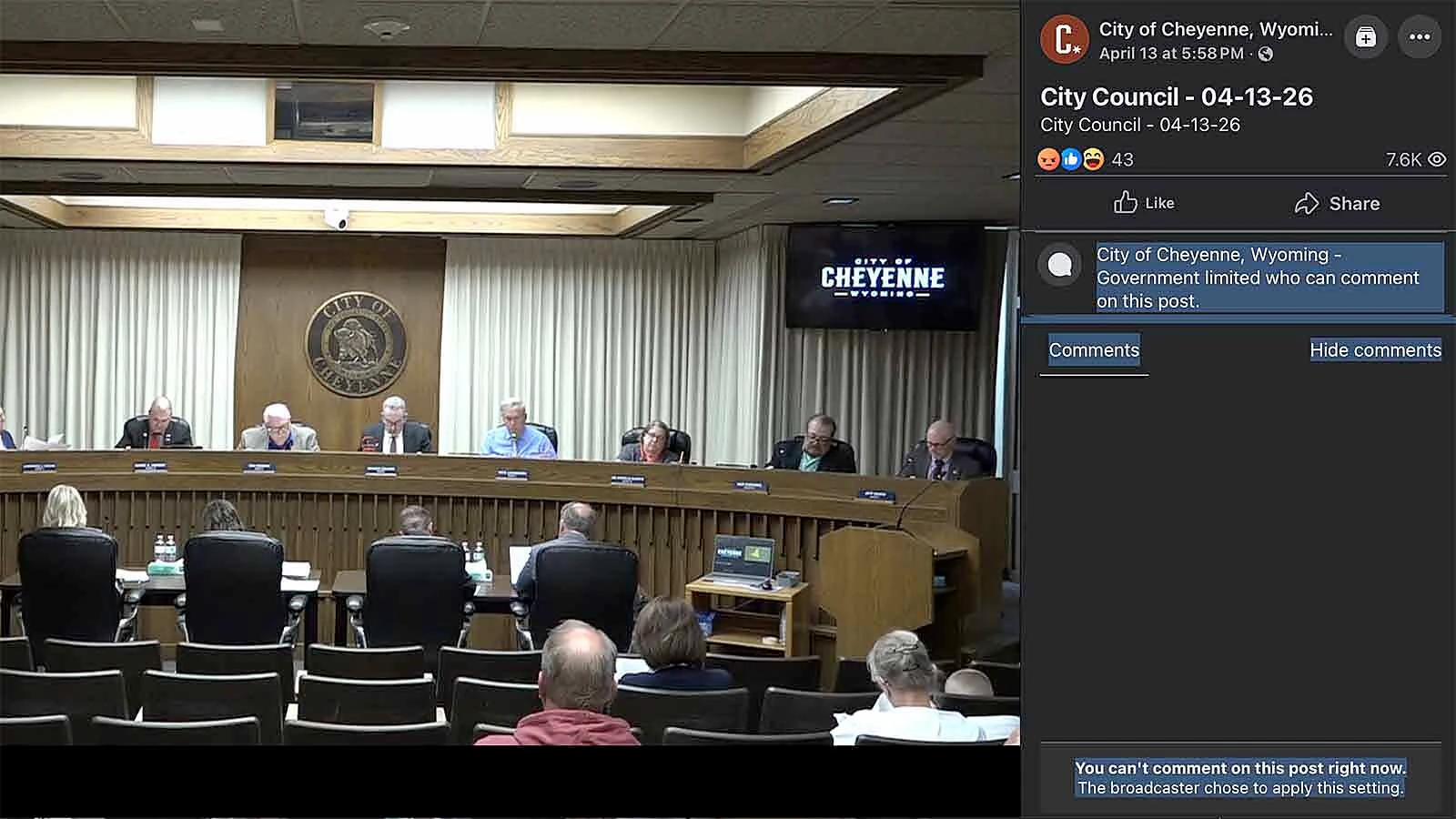
For the first time since the Cheyenne City Council started livestreaming its council meetings on Facebook several years ago, the ability for people to comment on the platform’s livestreams have been disabled.
Council member Jeff White said the decision was made after the March 9 regularly scheduled meeting, where the council postponed for eight months the annexation of a section of county land that includes WY Fresh Farm.
The comments section on Facebook during meetings had devolved into a cesspool of threarts, personal attacks and misinformation, city officials have said.
“Lately, we’ve had some very lengthy meetings where there were a lot of opinions expressed,” said Councilman Pete Laybourn.
The Cheyenne City Council has grappled with a lot of issues of late that include annexing and data centers, to preparing a sixth penny tax for the ballot, to public displays on private property.
Turning off the comments isn’t sitting well with many residents.
“I am troubled to see this trend because there are people who feel disenfranchised by the recent decisions by the City Council,” said Rep. Daniel Singh, R-Cheyenne.
Mayor Patrick Collins told Cowboy State Daily the comments were by and large “more of a background commentary on the meeting itself” and not constructive toward the intent of a public meeting.
Singh said if the city is using Facebook as a means to communicate with the public, the public should be able to communicate back on the same platform.
“It’s not a one-way street. It’s a two-way street,” Singh said.
Turns Nasty
Collins said he made the decision to turn off public comments on the Facebook livestream.
The council had been tracking the comments that were coming from the Facebook livestream, and they were not productive, he said.
“The comments weren’t going out to the governing body,” he said. “It was mostly people commenting on the meeting itself, to each other.”
The comments were never connected to the decisions the council was making, he said, adding that the tone of the people making them started to turn nasty.
The mayor referenced one comment in which he said the commenter suggested he and the council members start wearing bullet-proof vests.
“Those aren’t constructive comments we’re looking for in a public meeting,” he said.
The mayor said he does not believe the threats are serious and that he has not asked the police department to get involved.
“I just think that those are unfortunate comments that should never be made in a public setting,” he said.
Laybourn agreed, saying he wasn’t so much worried about the threats themselves as he was about the overall attitude.
Turning off public comments does not prevent residents from talking to the council, Collins said.
“If someone wants to talk to the governing body, they can raise their hand,” he said.
Raising a hand is a gesture on a live Zoom call, where people who join the meeting remotely can still ask questions and address the council directly.
“We take every one of those calls,” the mayor said, adding people also are welcome to attend meetings in person.
Multiple Ways to Access Meetings
The Cheyenne City Council livestreams its council meetings on both Facebook and YouTube.
Many local governments stream their meetings on just one platform — if they stream at all, the mayor said.
“I think we should be complimented,” he said. "But the thing we’re getting more than anyone else is being criticized.”
Being on multiple platforms ensures that information gets shared as widely as possible, said Laybourn.
“I feel like we have continually reached out and tried to spread the information,” he said.
Collins said the council meetings allow for unlimited public comment — in person and through Zoom.
“We take every person’s comments,” he said.
Singh said the public comment portion of public meetings is important and a “great part of our form of government.”
But those on the Facebook livestream of the council meetings are often negative and unproductive, say the mayor and council members.
“I am not in favor of any comments that harass staff, harass officials, or spread misinformation,” White said. “And that seems what the current system is doing.”
The Evolution Of Public Meetings
Incorporating social media and tuning in to public meetings remotely is relatively new territory for open government meetings.
When he was first elected in 2015, White said there were two ways a resident would view a council meeting — attend in person or watch the closed-circuit broadcast at a later date.
There were no live recordings, he said.
That changed with COVID.
“We wanted to be transparent,” he said. “We wanted to utilize the technology available.”
While livestreaming the meetings is not required, White said that, “We’ve kept doing it ever since, which I think is great.”
But comments can get quickly out of hand when people talk to each other online and not to the council directly.
“People are just running wild,” Laybourn said.
Collins added, “Diving into the Facebook rabbit hole just doesn’t work.”
Censorship?
Singh has been a vocal critic of the mayor’s decision to turn off public comments on Facebook during live meetings.
“As a public servant, you specifically open yourself up to scrutiny,” he said, “especially on the internet.”
Singh agreed that comments on social media are not always productive, but that’s not the point.
“I don’t expect the Facebook comments to always be friendly,” he said. “But that’s not a reason to shut them down.”
Singh said he has faced his fair share of scrutiny and criticism. People will abuse their speech to be hurtful without thought to being productive.
But people have the right to interact and voice their thoughts without fear of repercussion, he said.
“I understand the City Council members, even if we vehemently disagree on some issues, we want to make sure there is a level of decorum in our official meetings,” Singh said. "But the wholesale stop to public comment on Facebook, I disagree with.
“We’re going to get out of politics what we put into politics. We need to make sure we know what we’re saying and treat each other like neighbors, not enemies."
Talk To Us
Collins said he believes there has been a lot of feedback on his decision to close Facebook comments during public meetings, but he has not received any directly.
Neither has councilman Laybourn.
“I got zero feedback, which I think is very significant,” Laybourn told Cowboy State Daily. “This is the City Council. We are accountable to the people who elect us.”
Laybourn said he has always felt it was important to listen as much as possible to the people who disagree with him, because he often learns something in those conversations.
“I’m available. Always have been,” he said. “You might not agree with me, but then again, my wife doesn’t always agree with me.”
Laybourn called the mayor’s decision an “unnecessary controversy” that was “incredibly overblown.”
“I see this as a real unfortunate non-problem,” Laybourn said. “What is the problem? What are we hiding? What are we disrespecting? I don’t see it.”
Kate Meadows can be reached at kate@cowboystatedaily.com.