
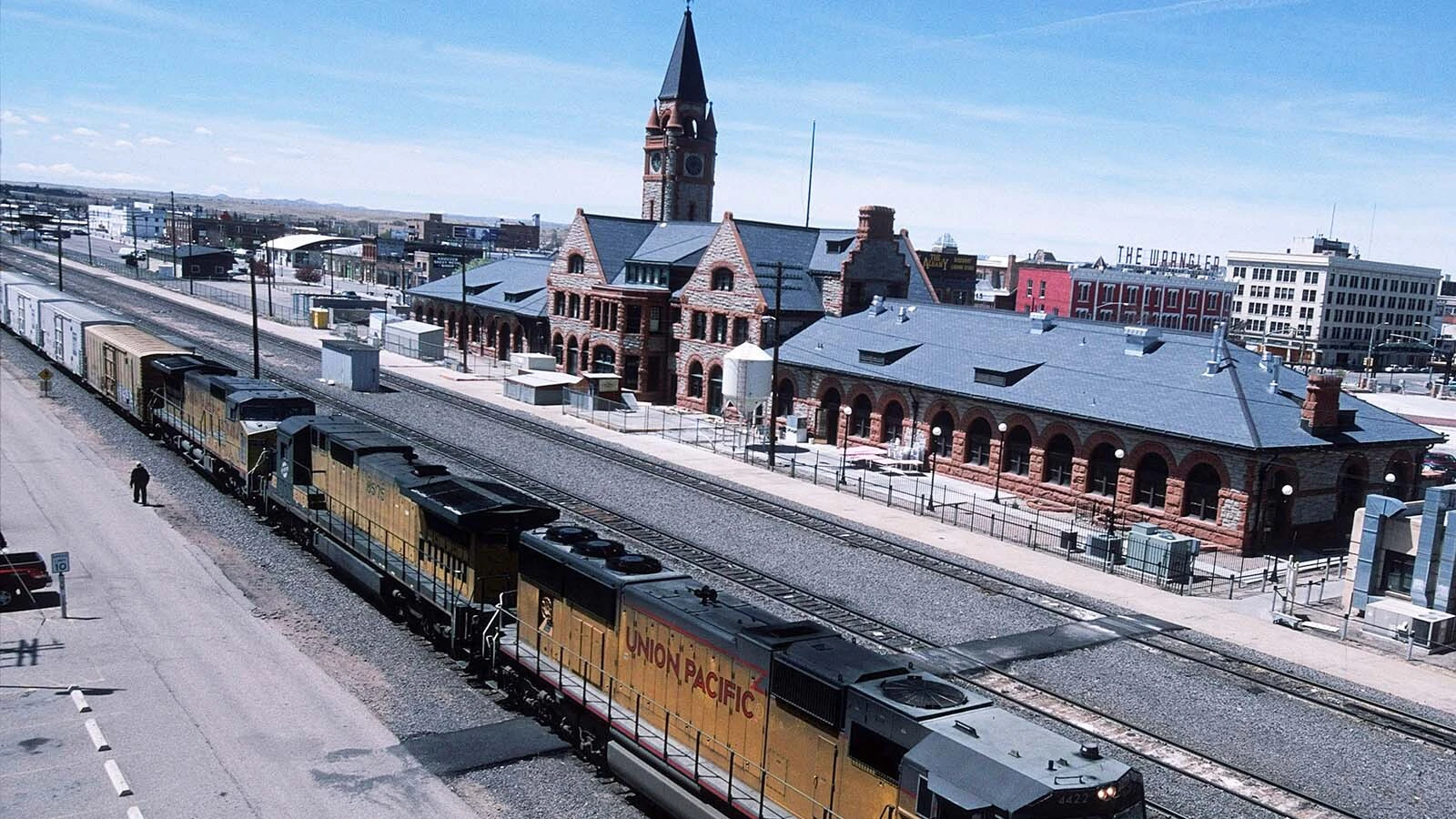
CHEYENNE — A Union Pacific train engineer facing a reckless endangerment charge for allegedly driving a 16,000-ton train loaded with hazardous materials through eastern Wyoming toward Cheyenne has been in a mental health facility since bonding out of jail.
Kristopher Richards, 47, was driving the train from North Platte, Nebraska, to Cheyenne on March 20 and reportedly acting aggressively and dangerously for about eight hours, according to court documents.
His behavior included trying to fight with his partner, the train’s conductor, to the point that the conductor locked himself in a bathroom near the engine compartment and called to report Richards.
Along with reckless endangering, Richards also was charged with being under the influence of a controlled substance and interference with a peace officer, all misdemeanors.
It was that influence his attorney referenced during what was to be a plea hearing in Laramie County Circuit Court on Wednesday.
“My client is currently in a psych unit in North Platte,” said his Gillette-based attorney Sara Lock. “He had to be taken to the ICU after his arrest.”
While she told Judge Timothy Forwood that Richards would likely plead either not guilty or not guilty due to mental illness or deficiency, that didn’t happen as scheduled Monday.
Instead, Forwood pushed the case forward for a status hearing in July.
“I don’t want this case to fall through the cracks,” he said.
In his hometown of North Platte, Richards has been doing better in the mental health facility, Lock said.
He appeared via video from the facility with two of his sisters sitting nearby.
He wore an open white dress shirt with a dark T-shirt underneath, and appeared attentive and engaged during the short hearing. His dark hair was shoulder-length and he wore dark eyeglasses.
The Conductor
During that harrowing ride across Nebraska and into Wyoming, Richards’ behavior upset the conductor on the train to the point that they fought, according to an affidavit of probable cause written by Deputy Shaun Teter.
While locked in the bathroom, the conductor called Union Pacific Railroad officials, who alerted the Laramie County Sheriff’s Office.
When authorities finally got Richards to stop the train before it rolled into the Cheyenne Depot, deputies found him to be “extremely impaired,” Sheriff Brian Kozak said at the time.
“The conductor noticed the engineer was in no condition to operate the train,” he said, adding that Richards was acting “violent and erratic.”
Richards could not be charged with driving under the influence because a definition under Wyoming law exempts any vehicle on rails from being part of a DUI allegation, Kozak said.
Kozak added that it’s possible a federal law enforcement agency could charge Richards with a felony.
A Union Pacific representative declined to comment on the situation with Richards, saying in a statement that the company does not "discuss specific personnel matters."
"Safety is Union Pacific's top priority," the statement adds. "We follow all Federal Railroad Administration drug and alcohol regulations."
‘Fear For His Life’
The potential danger to communities the train went through was real, according to the affidavit, made more pronounced because of the volatile nature of the flammable and hazardous materials it was carrying.
After the train was stopped, Richards told deputies he takes a number of prescription medications. They also observed the same bizarre behavior that concerned the conductor, the affidavit says.
When asked about his ability to control the train, Richards’ response “caused me concern,” Teter wrote.
“Richards stated that he was in full control of the locomotive during the trip, adding that at some point he had fallen asleep ‘a little bit’ and possibly ‘for the whole trip,’” the affidavit says.
Richards also said he didn’t know who had stopped the train, but it was later revealed that he did.
“I noted that Richards had a disheveled appearance,” the affidavit continues. “Richards had urinated in his pants twice throughout the incident, appeared to be using a length of rope as an improvised belt and his eyes appeared to be very bloodshot.”
Teter wrote that further discussion with Richards showed that he’s on a number of prescription medications, including one equivalent to Ambien, a Schedule IV controlled substance.
The conductor “stated that Richards had made statements regarding having killed his cats, mentioned deceased family members, and had attempted to give him multiple random objects out of his backpack,” the affidavit says.
Richards’ bizarre and aggressive behavior made the other man “fear for his life,” the affidavit says, “and that he planned for how he would make his escape.”
The conductor detailed that Richards also talked about atomic bombs being placed on a train “and that his family could help him make a smaller version of a bomb which would fit on the locomotive,” Teter wrote.
‘Prevented A Tragedy’
Along with the conductor fearing for his life, Richards’ alleged dangerous behavior also put tens of thousands of people at risk along the rail route across Nebraska and eastern Wyoming, the affidavit says.
The train was 12,755 feet long and made up of 127 loaded cars and 55 empty cars, UP officials told the LCSO. It weighed about 16,000 tons and could travel at a top speed of 45-48 mph.
“I spoke with (a UP official) regarding the contents of the locomotive,” Teter wrote. “The locomotive was carrying hazardous material to include diesel fuel, liquified petroleum gas residue, ammonia nitrate residue, and hot asphalt.”
All are potentially flammable, explosive, or dangerous to health, the affidavit says.
Along with the train’s cargo, Teter did some math to determine the number of people who could’ve potentially come into contact with the train allegedly driven by an impaired engineer.
In the 40 miles it traveled from the Nebraska border on its way to Cheyenne, “the locomotive appears to have passed town and areas with a total approximate population of 67,291 persons,” the affidavit says.
That includes Cheyenne, but may also exclude some smaller areas not accounted for and eight railroad crossings.
“The location where the locomotive was stopped during this incident was adjacent to a visible, populated neighborhood in Cheyenne,” according to the affidavit.
Kozak also at the time credited the conductor and UP officials for their efforts to get Richards off the train.
“What I want to say is, hats off to the railroad supervisor,” the sheriff said. “Hats off to the conductor who absolutely saved lives and a big tragedy from occurring in Cheyenne.
“I think he really could have really prevented a tragedy.”
Greg Johnson can be reached at greg@cowboystatedaily.com.


