
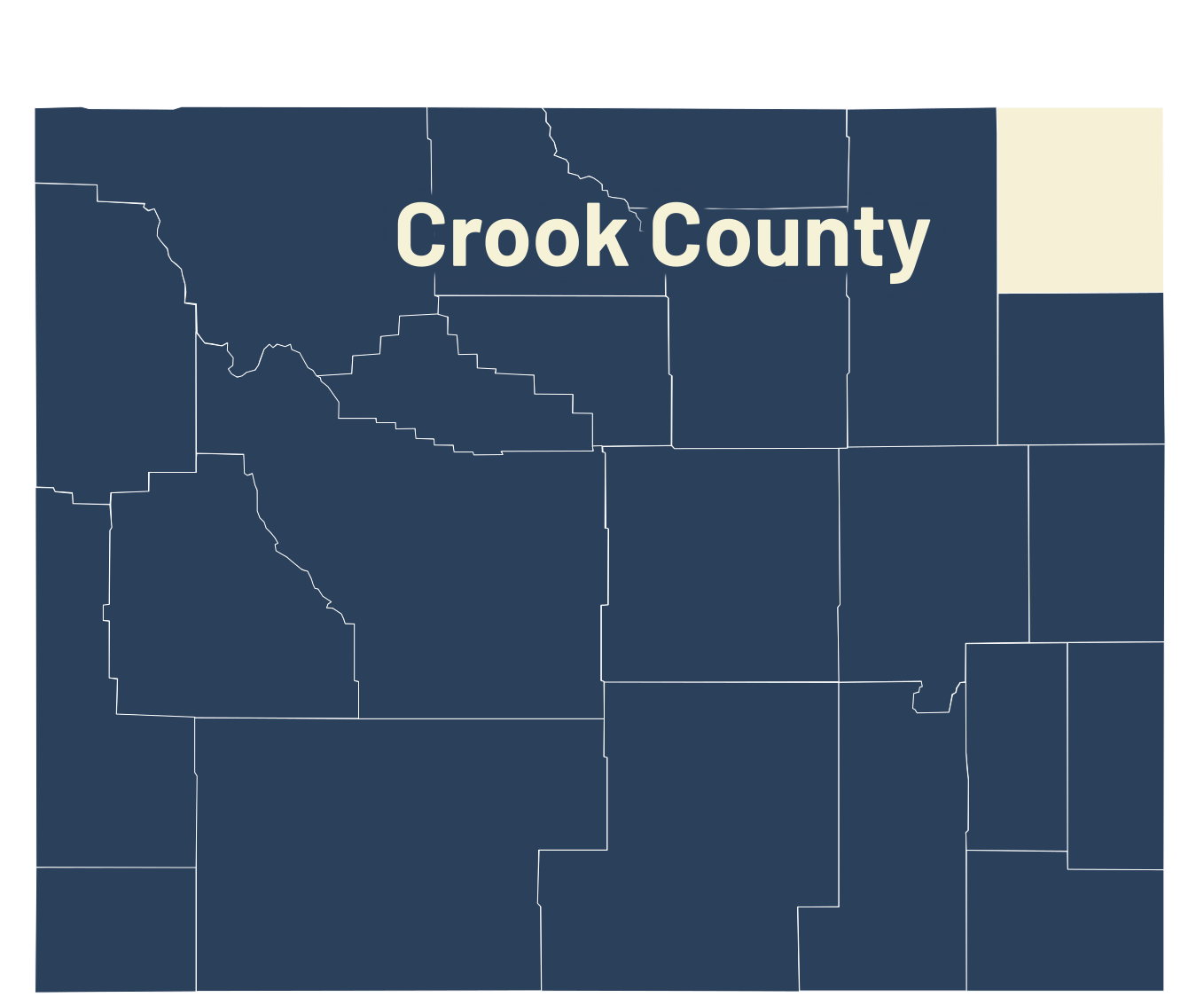

A new recreation district formed in Crook County folllowing a dip in property tax revenue is revealing a deep divide over taxes and how community amenities and programs get funded.
It also led to the creation of a failed House bill during this past Wyoming legislative session that, if passed, would have required voters across the state to approve mill levies for local recreational purposes every four years.
Crook County last year became the 47th of 48 school districts in Wyoming to assess a recreation mill.
A rec mill is a property tax levy that allows local governments to collect up to 1 mill — $1 per $1,000 of assessed property value — dedicated to paying public recreational facilities and programs.
For example, the Campbell County Recreation District collected the $38.5 million needed to build its new 50,000-square-foot aquatic center that includes an Olympic-sized swimming pool.
School districts that choose to levy a rec mill are required to form a recreation board to manage the money collected for the taxing district.
The formation of a recreational board in Crook County has faced fierce pushback from some local residents, including Crook County Republican Committee Chairman Mark Koep.
Koep, who told Cowboy State Daily he was acting as a private citizen and not in his role with the Crook County GOP, contends that the district was formed unethically, as members of the school board elect themselves to the rec board.
But Chase Williams, chairman of the Crook County School District 1 Board of Trustees who initiated discussions about assessing a rec mill, said a small group within the county “didn’t like that we had the authority to do this without putting it on the ballot.”
The unrest spurred House Speaker Chip Neiman, R-Hulett, to sponsor a bill during the 2026 legislative session that would have required voter approval every four years for local school districts to assess mill levies for recreational purposes.
“I knew there would be some pushback, living in this county. But I didn’t expect it to be so severe and nasty,” Williams said.

The Pinedale Aquatic Center is maintained with money collected by a mill levy from a local recreation district. (Courtesy Pinedale Aquatic Center) 
The Pinedale Aquatic Center is maintained with money collected by a mill levy from a local recreation district. (Courtesy Pinedale Aquatic Center) 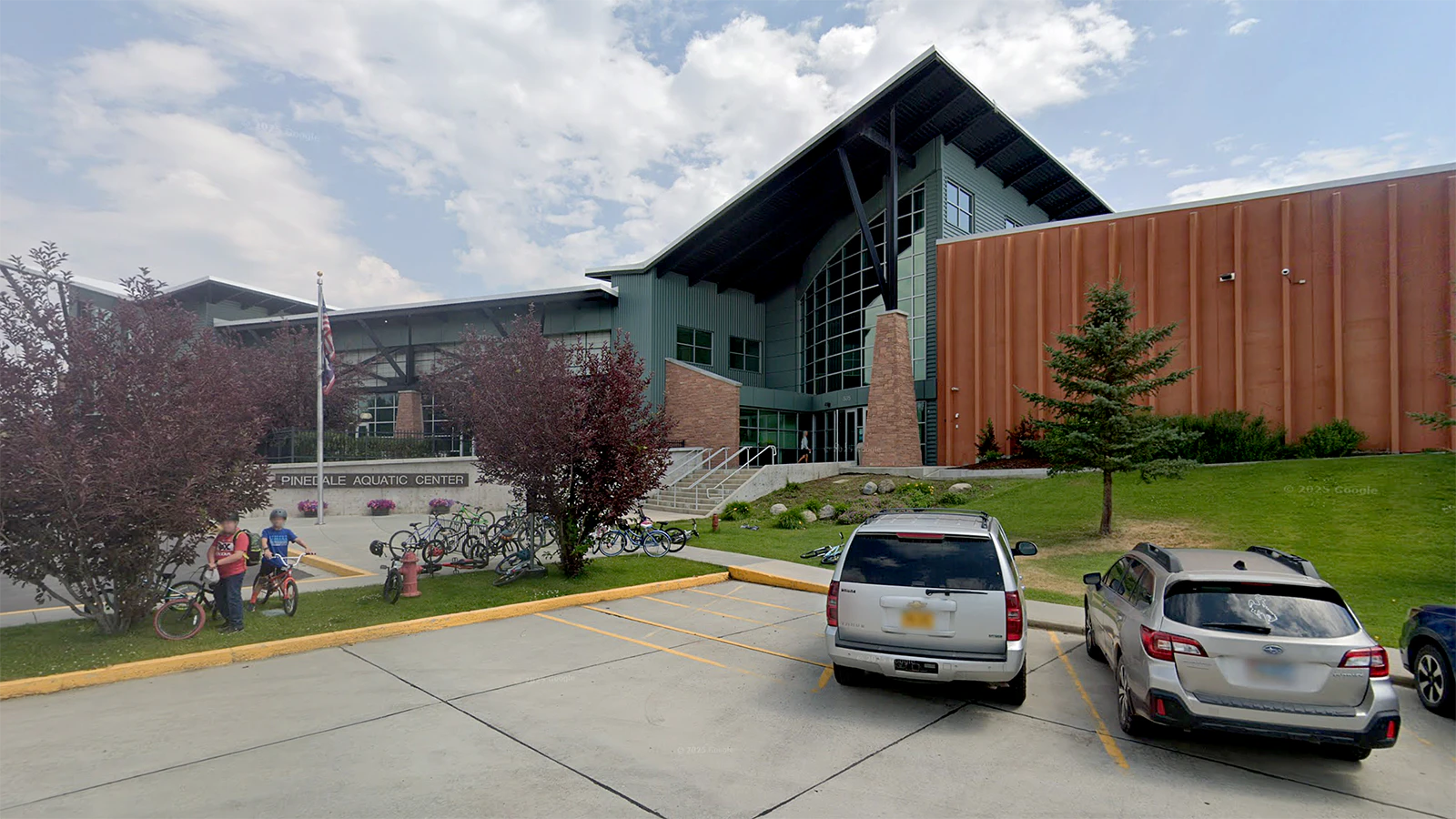
The Pinedale Aquatic Center is maintained with money collected by a mill levy from a local recreation district. (Google)
What Is A Rec Mill?
A recreation mill levy is often authorized to support special districts or local government initiatives. In Wyoming, school districts have authority to levy up to 1 mill of property tax.
Amber Anderson, president of the Wyoming Rec and Park Association, said recreational mills have been levied by most of the state’s school districts for many years, “with an intentional purpose, to build or sustain programs that already exist in our communities.”
Money collected from the levies commonly support operations and maintenance for public recreation, such as community centers, swimming pools, parks and recreational programs.
“Nearly every swimming pool in the state is supported by rec mills from the school district,” Anderson said.
In the mid 1990s, the rec mill became an option for legislators to give school districts local control, said Campbell County School Board member Mark Christensen.
In December 2025, Campbell County opened its new aquatic center, replacing a facility that was built in the 1970s. Construction was funded with rec mill money and through the school district’s maintenance fund.
Crook County Rec Mill
Williams told Cowboy State Daily that the state’s property tax cuts started the conversation at the Crook County School Board about assessing a rec mill.
The school district had recently matched donor money to pay for lights at the Hulett football field, which was one of the few fields in the state left that didn’t have lights, Williams said.
“That was part of the beginning talks of the rec mill,” he said.
But many locals didn’t like the idea of a new tax being introduced in the county, especially without voters approving it.
“The overall move in Wyoming is generally against property taxes,” Koep said.
Area residents filled the school board meeting room the night the school board was set to vote on assessing a rec mill levy. Williams said 14 people spoke against the measure while nine spoke in favor.
“The room was full,” he said.
Koep said many of those in attendance opposed the 1 mill tax.
“It kind of shows you where the county was leaning,” he said.
The Crook County School Board voted 6-3 to assess a rec mill and voted five school board trustees onto a newly formed rec board.
Koep took issue with that action, arguing that it violated Wyoming’s ethics statutes.
“You cannot vote for yourself to be a member of this board,” he said. “They never put out an application. They appointed themselves.
"This should be something people should be able to give a thumbs up or thumbs down on.”
Koep filed a complaint with the Crook County Attorney’s Office and later filed a complaint with the Wyoming Attorney General’s Office.
He said that Crook County officials are “ramming this tax down our throats with no votes. This goes against what I think the system of government should be.”
Koep sued in an effort to disqualify the board. A judge dismissed the lawsuit, claiming Koep had incurred no tax burden greater than any other county resident.
Enter House Bill 127
Following the school district’s vote to assess a rec mill, Neiman proposed House Bill 127.
The proposed bill would have required voter approval every four years for local school districts to assess mill levies for recreational purposes.
School boards and county governments can now pass recreational mill levies independently.
Anderson spoke in opposition of the bill as it was being considered by the Legislature, arguing that no recreation organization has the capacity to continue if its funding model has to be voted on every four years.
“If you take that (funding) away, you can’t guarantee that the funds are going to come from somewhere else,” she told Cowboy State Daily.
Anderson acknowledged a popular counter argument, that if rec districts are doing their job, the community will continue to support them.
“The challenge is, we live in a very conservative state and if you don’t truly understand what a tax applies to, the default answer is no,” she said. “People don’t always understand what they’re truly voting for.”
Christensen, who also testified, told Cowboy State Daily that, “The problem is, if you go to a vote every four years, you can’t build good programs.”
He added that a vote in favor of the bill would lead to job security concerns, because any position funded with rec mill money would be in jeopardy come every four-year election.
The bill passed in the House 34-27, and it was approved by the Senate Revenue Committee on a 3-2 vote. But it failed to advance through the Committee of the Whole.
“It’s truly the smaller communities that would have been hit,” Anderson said about if the bill had passed. "Meeteetse, Saratoga, Powell — these are the sizes of communities that would lose nearly all of their recreation funding.”
Williams, who is Neiman’s cousin, said he sees the bill as a direct retaliation against the Crook County School Board.
“They didn’t get their way,” he said, speaking of residents opposed to the rec district. “Now they will use the full power of the state of Wyoming to inflict their will on Crook County.”
Crook County Commissioners Weigh In
When HB 127 failed to pass, Koep met with Crook County Commissioners in a last-ditch effort to disqualify the Crook County rec board.
“After he failed (with the lawsuit), he took a run at having the county commissioners take the ax to it,” Crook County Commission Chairman Fred Devish told Cowboy State Daily.
Devish said the rec board’s attorney was also at the meeting and refuted all of Koep’s findings.
The county commissioners took no action on Koep’s request to have the board disqualified.
Koep said he has gone as far as he believes he can.
“Where we’re at, based on where this case ended up, is that taxpayers in Wyoming have zero ability to stop any action by a board or government entity that increases everyone’s taxes,” he said. “It’s a small county. It’s a rural county. I’ve taken it as far as I can take it.”
Williams conceded there is a lot of fear in Crook County over taxes.
“It is the word ‘tax,’” he said, adding that to some people, “it’s a bad word.”
But, Williams, said, “I would challenge that. These local taxes are the good taxes. They’re controlled by local officials who are elected.”
Williams said the opponents, who constitute “a small group in our county,” didn’t like that the school board had the authority to do this without putting it on a ballot.
“They do have that opportunity (to influence local taxes) when they vote in their school board,” Williams said.
“I don’t believe passing a rec mill is unconservative or unrepublican when basically every other county in the school district has one,” he said. “Why can’t we benefit, too?”

The Campbell County Aquatic Center opened in December, built with $38.5 million from mill levy money collected by the local recreation district. (Courtesy Campbell County School District 1 via Facebook) 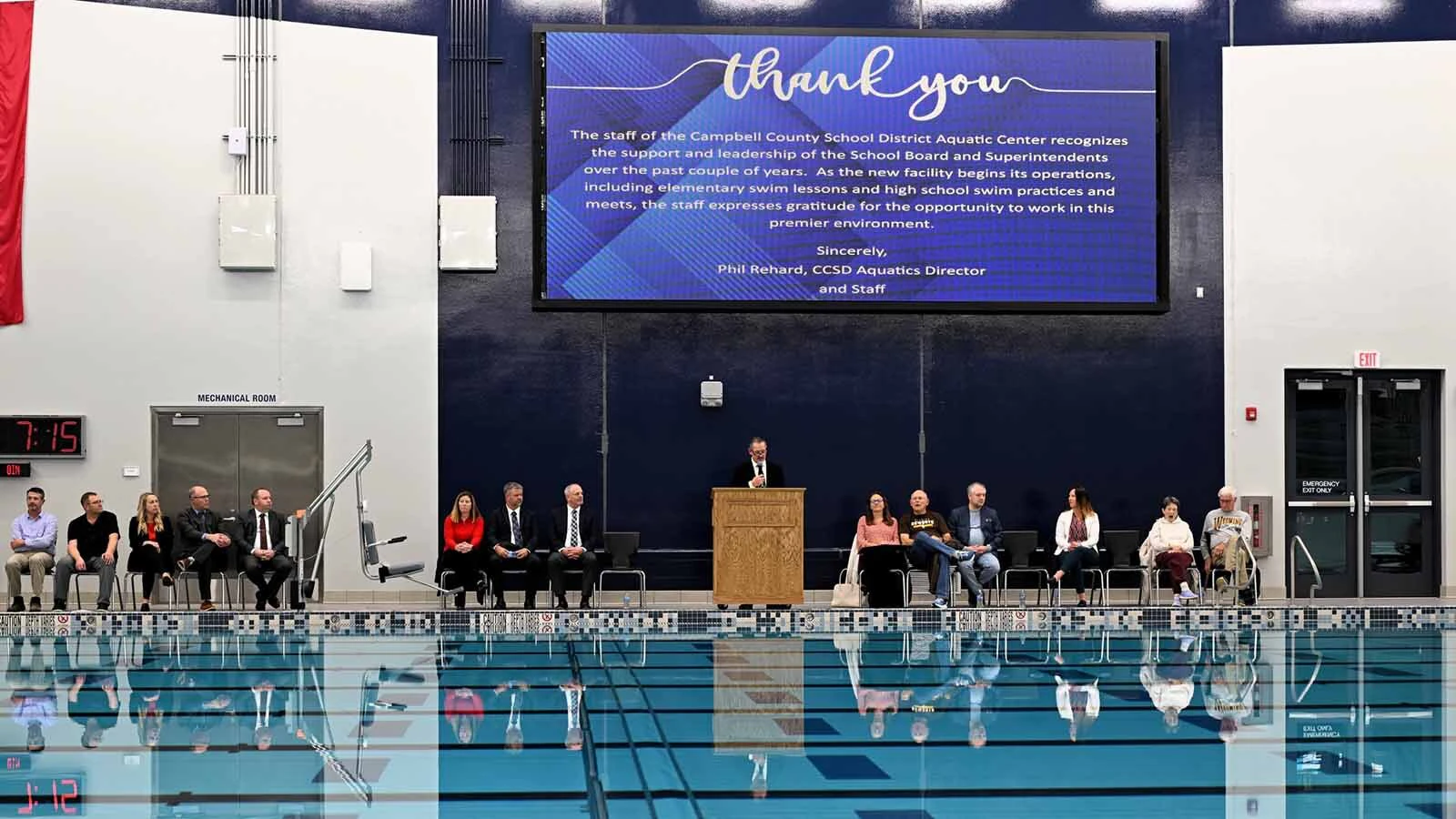
The Campbell County Aquatic Center opened in December, built with $38.5 million from mill levy money collected by the local recreation district. (Courtesy Campbell County School District 1 via Facebook) 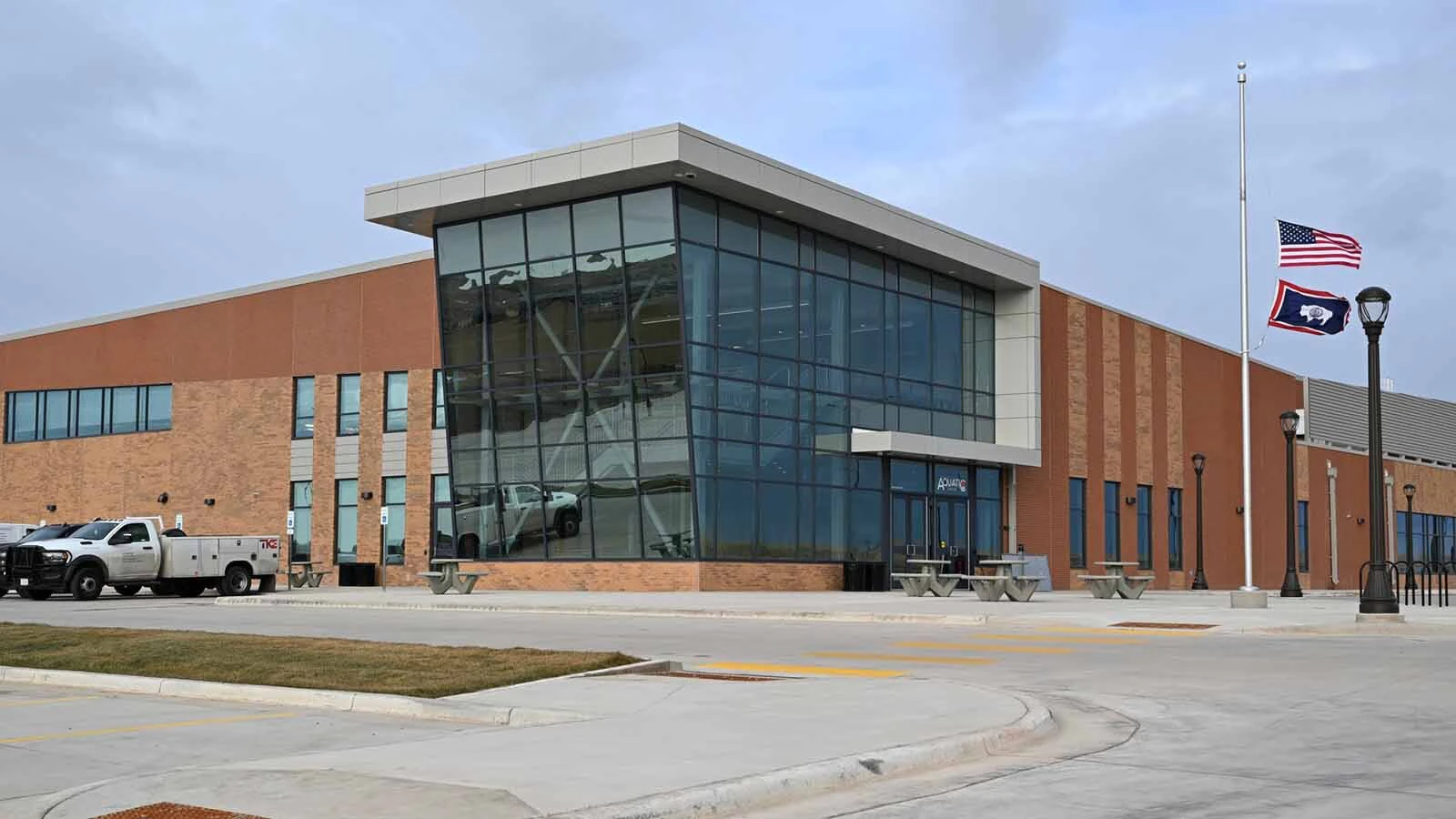
The Campbell County Aquatic Center opened in December, built with $38.5 million from mill levy money collected by the local recreation district. (Courtesy Campbell County School District 1 via Facebook) The Campbell County Aquatic Center opened in December, built with $38.5 million from mill levy money collected by the local recreation district. (Courtesy Campbell County School District 1 via Facebook)
Elsewhere In Wyoming
Crook County is the 47th of Wyoming’s 48 school districts to levy a rec mill.
In Campbell County, the rec mill pays for a smattering of community programs, including 4-H events, after-school programming and largeprint books for seniors.
“There’s rec mill money everywhere,” Christensen said. “Here, that’s the least controversial money there is. And the money spreads so well.”
Rec mill money also pay for things like bleachers and locker rooms for the track and football fields at schools.
Christensen said the school district saved money for a decade in anticipation of the new aquatic center.
“You’re either growing or you’re dying,” he said.
The Sublette County School District No. 1 rec mill is the primary funding mechanism for the Pinedale Aquatic Center.
Roughly 60% to 75% of the Pinedale Aquatic Center’s funding comes from the rec mill, said Anderson of the Wyoming Rec and Park Association.
Over the past two years, the Pinedale Aquatic Center has received about $1.5 million annually from the Sublette County School District No. 1 rec mill. Last year, 75% of that money came through mineral taxes.
What Happens Next
Both Christensen and Williams said they don’t believe the battle over rec districtrs is finished in the Legislature.
“They have kind of indicated that they’re going to keep pushing this,” Christensen said.
Williams said he expects legislators will bring the bill back if Neiman gets reelected.
“I have no doubt,” he said, adding that he thinks “it’s kind of dirty politics.”
Back in Crook County, Williams said, “We were never contentious with our neighbors like this.”
“I want these people to know that I’m not in a battle with them,” he said. “We need to have an open debate and keep big city politics out of it.”
Kate Meadows can be reached at kate@cowboystatedaily.com.


