
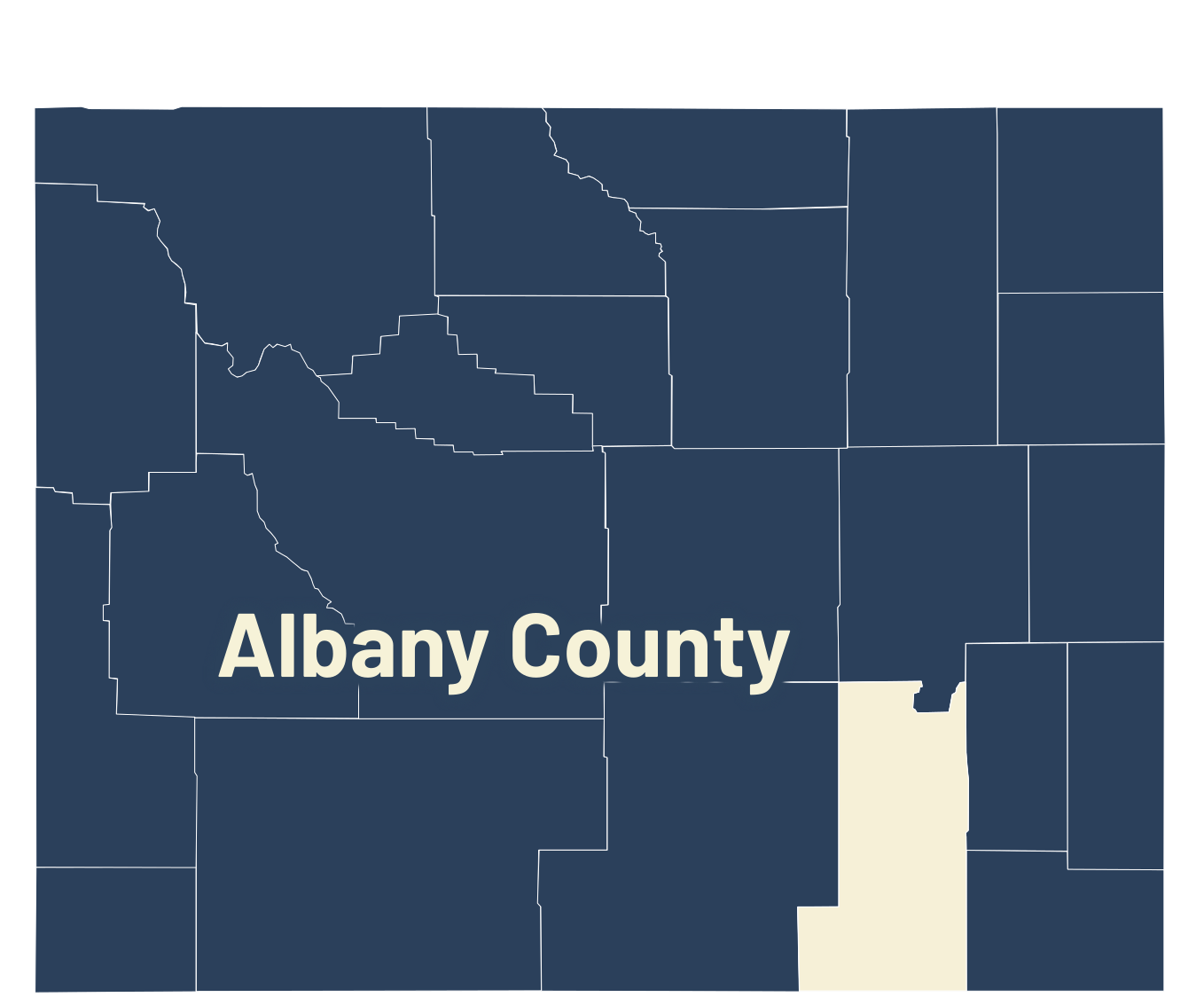
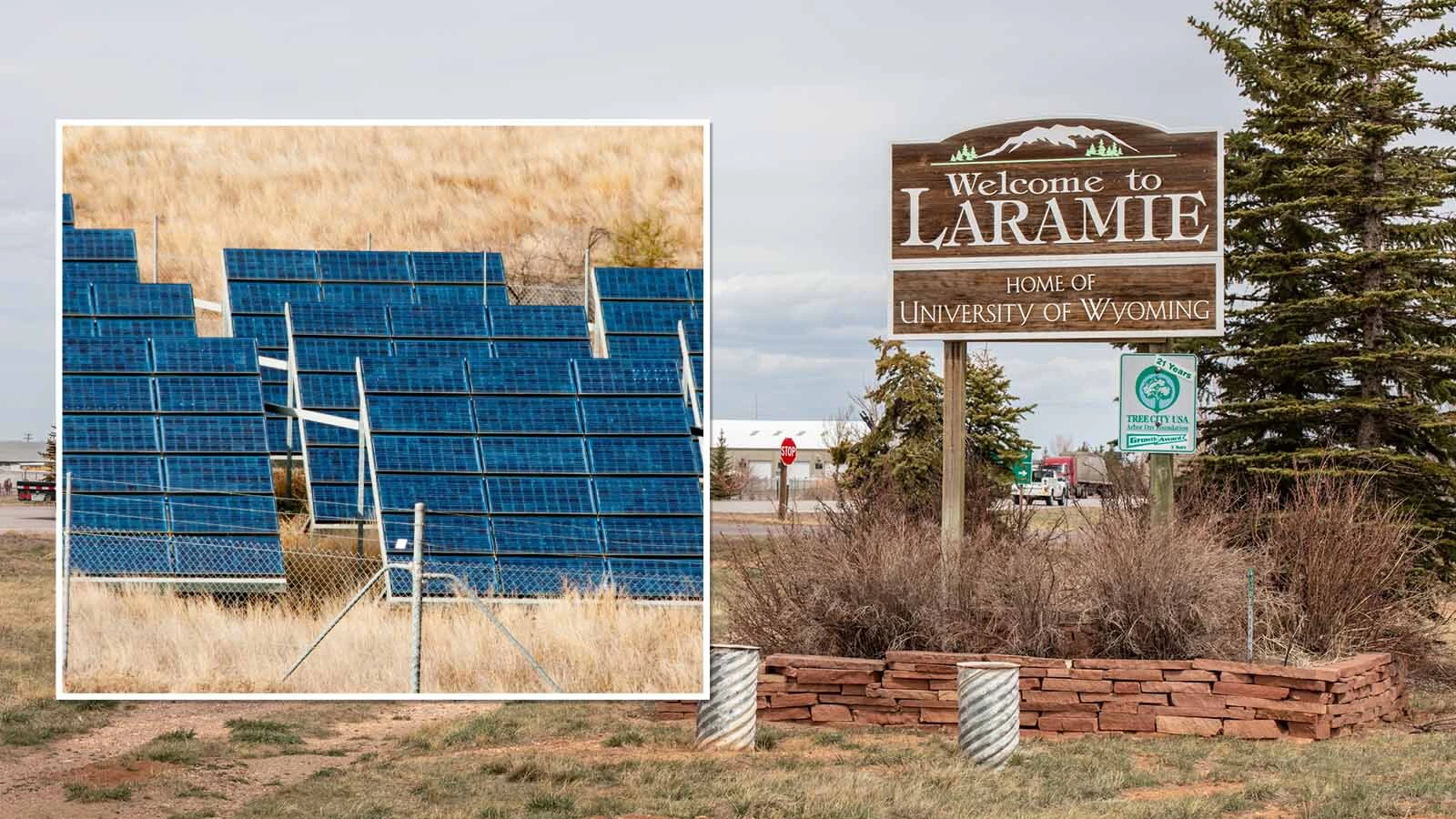
A 160-megawatt solar project on Laramie city-owned land has reached a milestone with NextEra Energy Inc. signing an agreement with Black Hills Power Inc. to deliver electricity to the power grid.
The agreement comes two months after NextEra cancelled a 600-megawatt wind farm project in Sweetwater County following President Donald Trump’s efforts to reduce federal approvals for wind and solar projects.
Laramie’s Sailors Solar Project has been in the works for six years after the city entered into a lease-purchase agreement with NextEra, opening the door for the Florida-based energy company to potentially generate solar electricity on 1,300 acres of the city’s 11,000-acre Monolith Ranch.
NextEra reports the project is expected to generate $37.1 million in tax revenue and bring 275 construction jobs.
Sailors Solar And The Monolith Ranch
City manager Todd Feezer told Cowboy State Daily the lease agreement is part of the city’s commitment to pursue efficient renewable energy sources and that the project could put more electricity on the grid for the area.
Opponents are questioning the timeline of the project, saying it is slow to move forward. They also express concern over solar panels’ impact on birds and the project’s overall environmental impact.
The Monolith Ranch is located along the Laramie River about 2 miles southwest of the city, which bought it in 1981.
“What has NextEra developed on the Monolith? Nothing,” said Anne Brande, who owns a photography studio in downtown Laramie and is executive director for the Albany County Conservancy, a nonprofit that aims to protect, preserve and promote habitat, history and wildlife in southeast Wyoming.
Feezer said the city’s agreement with NextEra was understood to be a long-term deal with the potential — not certainty — of someday generating solar power.
“I don’t know that we had any specific timeline,” Feezer said. “What we signaled by signing the lease is that we were open to carbon emission reductions.”
Large projects such as this take a long time to develop, Feezer said.
Jackalope Wind Project Axed
Meanwhile, a NextEra wind project in Sweetwater County is no longer moving forward following permitting delays and President Trump’s focus on reducing wind and solar projects.
Last year, Trump announced a shift in focus toward oil, gas and coal and issued an order to stop approvals for wind and solar projects on federal lands.
The Jackalope Wind Project, which would have spanned an area roughly the size of Chicago, was scheduled to be operational by June 2027.
The project had a buyer for its power, but in September that buyer, Idaho Power, canceled its deal with NextEra, citing delays and uncertainties related to the federal permitting process.
That was after federal tax credits for solar and wind projects took a hit in Trump’s One Big Beautiful Bill Act, which was signed into law on July 4, 2025.
Sweetwater County Commissioner Robb Slaughter told Cowboy State Daily the commissioners learned that NextEra had ceased work on its permitting at a recent commission meeting.
The project, which was proposed in 2024 near the Jim Bridger Power Plant, was still in the planning phases, Slaughter said. He added that no infrastructure work had been done.
“They were still working with the property owners and things of that nature,” Slaughter said.
Cowboy State Daily was unable to reach a NextEra spokesperson for comment on the project.
Interconnections, Power Buyers, Pendulum Timelines
Back in Laramie, while the Sailor Solar Project now has an interconnect agreement with a major power supplier, it still does not have a buyer for the power it would generate.
Nor has it secured necessary permitting with the Wyoming Industrial Siting Council, Feezer said.
That, said Brad Enzi, president and CEO for the Laramie Chamber Business Alliance, is par for the course.
“Waiting for a buyer is absolutely a normal part of the process,” he said.
Enzi likened the process to pendulum swings on an old clock, with each swing representing a project milestone.
“You have the timing of the hookups. You have the timing of the buyer of the power,” he said. “They’re all going at different rates, and they’re all trying to come to one spot and come into alignment.
“Everyone expects you’re going to have all those things in alignment, but it doesn’t work that way. We have a very thorough process in Wyoming,” Enzi added. “We look at water use and environmental impact and wildlife impact. It’s not an easy process to get through.”
Environmental Pushback
Brande told Cowboy State Daily she is relieved the solar project doesn’t have a power purchase agreement because of its close proximity to the Laramie River.
Wyoming used to have the highest concentration of breeding pairs of golden eagles in the Lower 48, she said. Now she doesn’t see golden eagles anymore.
She said solar panels are threatening to birds because they see the reflection of the sky in a panel and think the reflection is a body of water.
“Then they dive, and they kill themselves and they kill the panels,” she said.
“People come here to see wildlife,” she continued. “They come here because we have a healthy outdoor lifestyle.”
Brande said she believes Wyoming is at a precipice.
“We’ve always thought we are so vast we can put up anything for profit,” she told Cowboy State Daily. “But I don’t think we’re that vast anymore. Habitat’s habitat.”
Feezer said discussions about wildlife mitigation will come through the industrial siting permitting process, which hasn’t happened yet. But, he added, he doesn’t foresee any problems.
“I don’t know why the project would have any impact on the Laramie River,” he said.
City-Owned Ranchland
The city of Laramie has owned the Monolith Ranch for years, Feezer said, addin that the solar developmnt is on under-producing agricultural land.
“It’s not the most productive prairie land,” he said, adding there is no livestock on it.
City-owned ranchland is common in Wyoming.
Revenue earned from NextEra’s lease goes to the city’s water enterprise fund, Feezer said.
Enzi said the city did its due diligence in partnering with the right company for the project.
“So much of good power development is having a good power source,” he said. “NextEra is a great partner.”
Enzi added that the company has “a pretty stellar environmental community record.”
Other NextEra projects in Wyoming include the Roundhouse Wind Energy Center in Laramie County, the Cedar Springs Wind Project in Converse County and the Chugwater Energy Project in Platte County.
Kate Meadows can be reached at kate@cowboystatedaily.com.


