If prairie dogs had a department of transportation, Wyoming's grasslands might be littered with orange construction cones, detour signs and warnings about delays at major underground intersections.
There’d be rush-hour traffic, infrastructure projects that never seem to get finished and, inevitably, a few inconsiderate drivers barreling through the work zones.
"Despite the network's sophistication, enforcement remains inconsistent," reads a recent satirical article about the rodents in the Black Hills Gazette, a regional humor and deadpan parody website that publishes fictional, tongue-in-cheek news stories about everyday life, quirks, and local culture across the Black Hills region of South Dakota and Wyoming.
"One male has repeatedly been seen merging into busy tunnels without looking, then standing upright at the entrance as though everyone else is the problem,” it continues.
It's a funny image, particularly for anyone who has watched prairie dogs scurry between burrows, pop their heads above ground and chatter incessantly at their neighbors.
But how much of the fictional prairie dog highway system resembles the real thing?
Not much, according to John Hoogland, a biologist who has devoted more than four decades to studying the furry little rodents.
There are no underground highways, no freight corridors and certainly no traffic enforcement.
Nothing shows that better than the crowded and seemingly chaotic scenes revealed by BurrowScope TV, which straps tiny cameras to the backs of prairie dogs and turns them loose inside their burrows.
Underground, prairie dogs have no privacy, with dozens running in and out through the round tunnels studded with roots from the plants they dig through.
Sometimes the tunnels take exits, like a highway, and at other times little areas widened along the tunnels are packed with prairie dogs like they’re taking advantage of a rest area.

A Lifetime Of Prairie Dogs
When it comes to the complicated social lives of prairie dogs, Hoogland said the animals have a surprising amount in common with humans.
They're cooperative, family-oriented and protective of their homes.
They're also territorial, quarrelsome and sometimes downright murderous.
"Anything we do, they do as well — and usually more often," Hoogland said.
And in Wyoming, where prairie dog towns occupy land that ranchers depend on to graze their cattle, the relationship between the rodents and their human neighbors can be just as contentious.
Hoogland never set out to spend his career studying prairie dogs.
In 1974, he was a graduate student looking for an affordable research subject.
"I wanted to study a mammal that lived in colonies, that you could easily watch and mark," he said. "Prairie dogs came to the top pretty quickly."
He had no idea the decision would turn into a lifelong pursuit.
For the past 45 years, Hoogland has studied the animals’ behavior, including 16 years observing prairie dogs at Wind Cave National Park in South Dakota's Black Hills.
What he discovered was a society far more complicated than the seemingly carefree creatures that stand upright on dirt mounds and whistle at passing motorists.
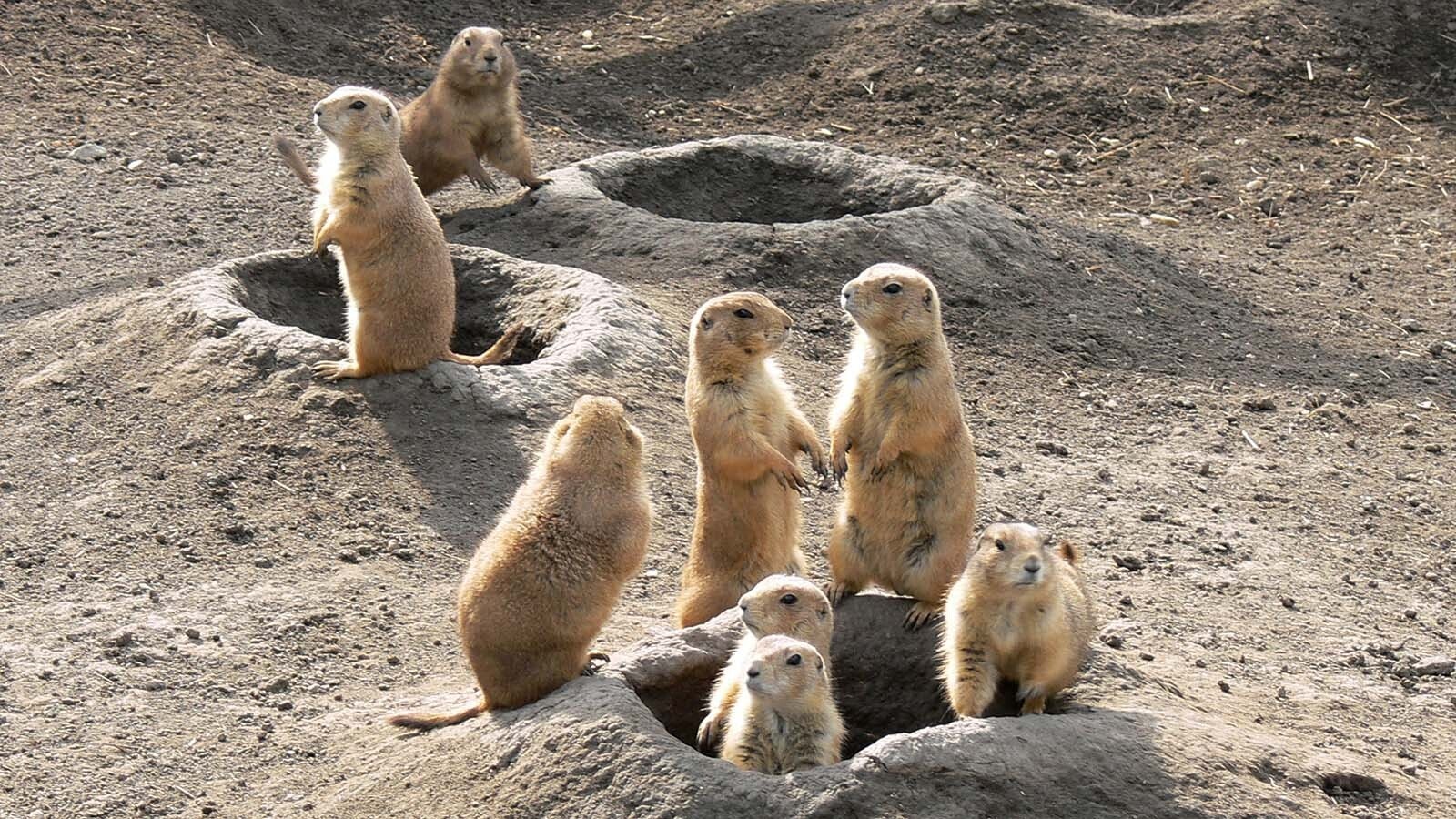
Prairie dogs are highly social animals that live in sprawling communities called towns.
Of the five prairie dog species native to North America, two live in Wyoming: black-tailed and white-tailed prairie dogs.
Black-tailed prairie dogs, found primarily in the state's central and eastern grasslands, are responsible for many of the conflicts with agriculture, according to Sublette County Weed and Pest.
Some of Wyoming's best-known prairie dog habitat is found in the Thunder Basin National Grassland in northeastern Wyoming, where colonies occupy portions of the open prairie.
And while their underground communities may not have designated lanes or traffic signals, they are impressive feats of excavation.

The Underground Neighborhood
A prairie dog town is much more than a collection of holes in the ground.
Beneath the surface is a network of burrows that provide shelter from predators, protection from extreme weather and places to raise young.
Sublette County Weed and Pest reports that individual burrow systems can include multiple entrances, branching tunnels and chambers used for different purposes.
Some are used for sleeping, others serve as nurseries, and older burrows may be reused or refurbished.
Prairie dogs also pile excavated soil around entrances, creating the familiar dirt mounds that dot their colonies. The mounds serve as lookout posts, giving the animals a better vantage point to watch for predators.
Anyone who has spent time watching a prairie dog town knows there's plenty of activity.
Above ground, the animals scurry between burrows along paths worn through the vegetation.
They're almost always busy, Hoogland said.
And just like human neighborhoods, some residents get along better than others.

Family Feuds And Deadbeat Dads
Black-tailed prairie dogs live in family groups called coteries, typically consisting of a breeding male and several females, often related to one another.
Prairie dogs recognize members of their own social groups, cooperate in watching for predators and use alarm calls to warn others of danger. Living together offers protection from predators such as coyotes, badgers and hawks.
But don't mistake their social nature for universal goodwill.
Prairie dogs fight over territory, compete for mates and sometimes kill one another's young.
Hoogland's research has documented remarkably high rates of infanticide in some prairie dog populations, with prairie dogs themselves responsible for killing a substantial share of pups.
According to Hoogland’s research, 39% of prairie dog babies are killed by other prairie dogs — a grim reminder that life in Prairie Dog Town isn't always as charming as it looks from the highway.
And then there are the males.
Hoogland doesn't have much praise for their parenting skills.
Male prairie dogs generally do little to groom or care for their offspring, he said. They may occasionally play with young prairie dogs, but much of their contribution to reproduction ends after mating.
They do, however, help defend their territories.
"They're pretty much stud machines," Hoogland said.
In a 2018 interview with The Nature Conservancy, Hoogland offered an even less-flattering description.
"Males are sort of like beer-drinking, couch-sitting, lazy studs," he said at the time.
For all their complicated social behavior, prairie dogs also have a serious purpose.
Their colonies, warning calls and constant vigilance help them survive in an environment where an assortment of predators would gladly make a meal of them.
And their presence shapes the grassland around them.
That's where things get complicated for Wyoming ranchers.
Not Everyone Loves The Neighbors
Cheyenne-area rancher Mark Eisele doesn't mince words when it comes to prairie dogs.
"They are a nuisance. They are a real problem," he told Cowboy State Daily.
For ranchers, the trouble isn't the prairie dogs' social behavior or their underground engineering skills.
It's what happens to the land above those tunnels.
Eisele said prairie dogs strip grazing areas of vegetation, leaving less forage for cattle and horses.
"They completely denude grazing areas," he said.
According to Sublette County Weed and Pest, an individual prairie dog may consume up to 2 pounds of forage per month.
That might not sound like much until a colony grows to hundreds or thousands of animals.
The burrows themselves create another problem, Eisele said.
"We've had livestock that have broken their legs in burrows," he said about cattle stepping into the holes.
He also described four-wheeler accidents caused by wheels catching on prairie dog mounds.
Eisele said he avoids riding horses through pastures riddled with burrows because of the danger to both the horse and rider.
Prairie dog towns also can attract other unwelcome residents.
He said rattlesnakes may use the burrows for shelter or to hunt in and around the colonies, adding another concern for people working on the land.
For Eisele, prairie dogs aren't harmless little creatures providing entertainment along the highway. They're animals that can make ranching more difficult, more expensive and sometimes more dangerous.
A Different View From The Burrow
Hoogland has heard those complaints before.
He told Cowboy State Daily he’s interviewed scores of ranchers over the years, and he doesn't dispute that prairie dogs compete with livestock for some of the same food.
But he questions how frequently cattle and horses actually suffer serious injuries from stepping into prairie dog holes.
“Theoretically, it can happen, but it is exceedingly rare," he said.
Prairie dog burrow entrances are surrounded by mounds of dirt, making them easier for livestock to see and avoid, he said.
Of course, animals don't always move slowly and carefully, Hoogland acknowledged.
Hoogland also conceded that prairie dogs eat the same plants that cattle eat. But he said their effect on vegetation is more complicated than simply consuming grass.
By clipping vegetation, digging and depositing waste, prairie dogs alter the composition and structure of plant communities. He said their waste fertilizes the soil, creating richer vegetation for livestock.
But for a rancher trying to make a living on land occupied by hundreds of hungry rodents, the ecological benefits may be difficult to appreciate.

The Keystone Of The Prairie
Wildlife biologists like Hoogland often describe prairie dogs as a keystone species, meaning their influence on the surrounding ecosystem is disproportionately large compared with their size.
Prairie dogs are both food and landlords for an assortment of other animals.
Coyotes, badgers, hawks and other predators hunt them.
Burrowing owls take advantage of abandoned burrows, while other creatures — including insects, spiders and some amphibians and reptiles — also use prairie dog habitat for shelter.
Take prairie dogs away, Hoogland said, and the ecosystem changes.
Hoogland said prairie dogs once occupied enormous stretches of the American West, with populations numbering in the billions.
Today, he estimates they occupy less than 2% of their former range.
It's a dramatic decline for an animal that was once among the most abundant mammals on the Great Plains.
But the prairie dog's ecological importance doesn't erase the challenges it creates for people trying to raise livestock.
An Old Wyoming Dispute
Wyoming's disagreement with prairie dogs is nearly as old as the state's ranching industry.
According to Sublette County Weed and Pest, the Wyoming Territorial Legislature first recognized prairie dogs as nuisance rodents in 1886.
In 1973, prairie dogs were designated as pests under Wyoming's weed and pest laws.
That designation reflects the longstanding economic concerns of landowners who have watched colonies expand across grazing areas.
Eisele said some ranchers in the northeastern United States have turned prairie dog shooting into a source of income.
Sports shooters travel to ranches for two or three days at a time, paying for access to land where they can shoot prairie dogs, he said.
“Ranchers come to rely on it for income they’ve lost on grazing,” Eisele said.
Other control methods have included specialized equipment designed to remove prairie dogs from their burrows, like giant vacuums that literally suck the rodents out of their burrows.
For those who want them off the land, the solid “thunk” prairie dogs make when sucked up is satisfying.
Others take the “Caddyshack” approach, pumping propane into the burrows and detonating it.
But despite decades of efforts to reduce their numbers, prairie dogs have continued to survive on the plains.
For ranchers, the issue is often about protecting their livelihoods and the land they depend on. For wildlife biologists, it's about maintaining a grassland ecosystem in which prairie dogs play an important role.
Both are looking at the same landscape, but they aren't necessarily seeing the same thing.
Kate Meadows can be reached at kate@cowboystatedaily.com.