

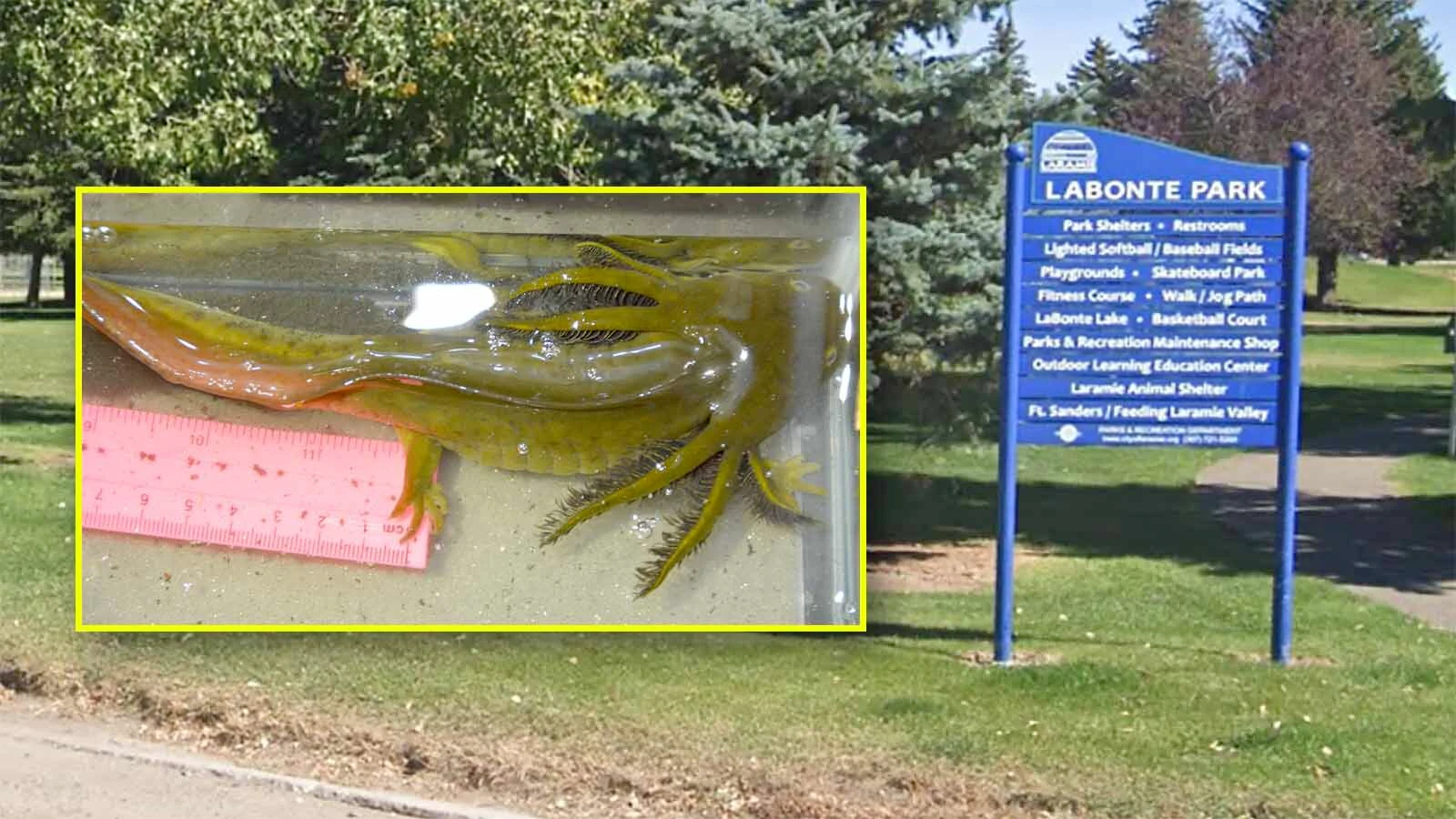
Some salamanders living beneath the surface of a shallow Laramie pond will never grow up.
Unlike their siblings and neighbors that lose their feathery gills, crawl onto land and spend much of their adult lives underground, these western tiger salamanders keep the body they had as tadpoles.
Despite their gills and fin running along their tails, they aren't babies.
They're sexually mature adults that can grow to as long as a foot — known to scientists as a paedomorph and perhaps better understood as the Peter Pans of Wyoming's amphibian world.
Until last week, University of Wyoming researchers didn't know whether any were lurking in LaBonte Lake.
Now they do.
“We did, yes,” Mason Lee, senior project coordinator with the University of Wyoming Biodiversity Institute, told Cowboy State Daily when asked whether researchers caught any adults during a recent trapping effort.
That means two different versions of the western tiger — Wyoming’s only native salamander — lives in Laramie.
Some metamorphose into a land creature, others don't — and scientists have spent decades trying to understand why.
Fishing For Answers
The salamanders of LaBonte Lake were hardly strangers to Lee and the Biodiversity Institute.
Every spring, they emerge from underground around Laramie and begin making their way toward the water to breed.
Their ancient commute now involves streets, curbs and cars, and on the right wet spring nights, salamanders can suddenly appear on pavement around LaBonte Park.
UW's Salamander Migration Initiative trains volunteers to go out with buckets and safety gear, collect the animals from roadways and help them across before they are flattened by traffic.
Lee said ahead of the spring migration, volunteers had counted 89 live migrating salamanders in 2024 and 79 in 2025. In 2023, they tallied 117.
Those are the ones most people think of when it comes to western tiger salamanders.
Their gills disappear, their bodies change, and they leave the water and take up a largely terrestrial existence.
The more recent discovery retains its juvenile characteristics and is fully aquatic, Lee said.
“We've known about this population of tiger salamanders for a very long time,” Lee said. “What we didn't know was whether we had paedomorphs in our population here in LaBonte.”
The City of Laramie and UW Biodiversity Institute went fishing for an answer.
Set The Traps
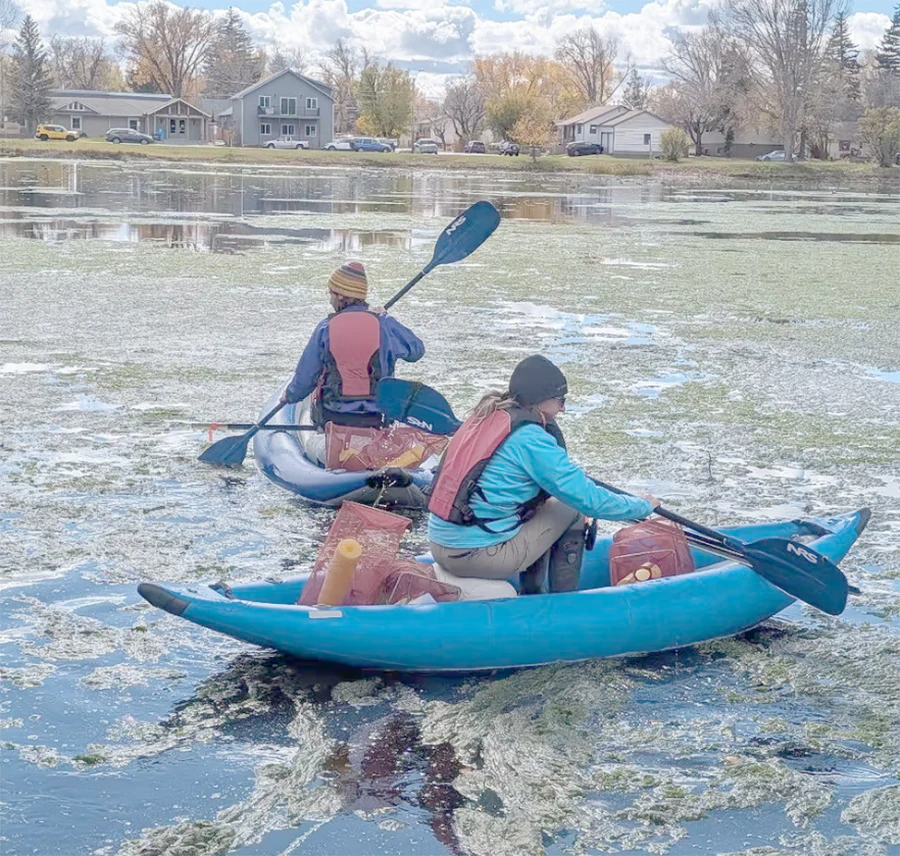
The City of Laramie announced Oct. 23 that researchers would place 16 mesh minnow traps in LaBonte Lake beginning last week.
Researchers set the traps from a kayak, secured them with metal stakes and baited them with glow sticks. They checked them every 12 hours, with any salamanders caught to be measured, weighed, photographed and returned to the pond.
The study had two questions.
Researchers wanted to know whether some salamander larvae were attempting to remain in the pond through the winter, and, for the first time, they wanted to establish whether LaBonte contained sexually mature adults that had simply skipped metamorphosis.
The answer to the second question is yes.
“It's pretty cool that there's this kind of plasticity in their life forms,” Lee said, with metamorphs and paedomorphs able to exist in the same population.
It's also somewhat surprising given the pond itself.
“LaBonte is known for being fairly shallow,” Lee said, but it has a couple of things going for a salamander determined to spend its whole life underwater.
There aren't large predatory fish waiting to eat it, Lee said, and there's enough aquatic invertebrate life to keep the salamanders fed.
That makes the pond capable of supporting animals that never have to make the leap onto land.
Peter Pan With Gills
The technical term for what's happening is “facultative paedomorphosis.”
It's a mouthful for an idea that's wonderfully simple: An animal capable of metamorphosis doesn't necessarily have to do it.
A normal terrestrial western tiger salamander in Wyoming is roughly 5.5 to 8 inches long, according to the UW Biodiversity Institute.
A paedomorphic adult can reach roughly 8 to 12 inches.
It looks something like a baby sea dragon — dark green or olive, sometimes spotted or blotched, with those unmistakable external gills.
Yet internally and reproductively, it has crossed into adulthood.
Howard Whiteman, a longtime tiger salamander researcher who has studied facultative paedomorphosis for more than 30 years, has described it as an example of “phenotypic plasticity” — essentially the ability of the same species to produce strikingly different forms depending on a combination of genes and environmental conditions.
Research by Whiteman and others has shown there isn't necessarily one simple explanation for why a salamander chooses one developmental road over the other.
One longstanding idea is the “paedomorph advantage.” If life in the water is good — plenty of food, permanent water and conditions favorable for reproduction — why undergo the enormous biological expense of rebuilding your body and leaving?
Another possibility has been dubbed the “best of a bad lot.” Research on wild tiger salamanders has found that in some populations, slower-growing larvae facing crowding and competition might become paedomorphs rather than delaying reproduction while waiting to grow enough to metamorphose.
Scientists have found that genes matter, too. A major review of salamander paedomorphosis by University of Kentucky researchers Carlena Johnson and S. Randal Voss describe metamorphosis as being controlled in large part through thyroid hormone signaling.
That hormone helps switch on the biological program that causes larval traits to regress and adult traits to emerge.
Evolution has tinkered extensively with that system in salamanders. Some species, including the famous Mexican axolotl, are obligate paedomorphs. They normally remain in their gilled aquatic form throughout their lives.
Western tiger salamanders can go either way.
Same Pond, Two Lives
Lee is cautious about saying exactly what causes a LaBonte salamander to choose one route over the other.
There are theories, she said, but she isn't aware of recent research identifying a single cause for this particular species.
“When you have both of them exist from the same population, both metamorphs and paedomorphs, that kind of goes out the window, right?” Lee said.
Perhaps, she said, having both forms gives the population a hedge against change.
Some of its gene pool remains in the pond. Some moves onto land.
“Maybe it's just a way to kind of fill that ecological niche and be more adaptive to change,” she said, emphasizing that it's a possibility rather than a settled explanation.
Then there's the obvious question. If a salamander has spent its adult life swimming around with the body of a larva, can it change its mind?
Maybe.
“I know for axolotls, which are a closely related species, that they can be induced to metamorphose, typically with hormones,” Lee said.
That's not something commonly seen happening naturally, however, and Lee said she hadn't reviewed the literature closely enough to say how that question applies to western tiger salamanders.
See You In The Spring
Finding them was only the beginning.
The Biodiversity Institute intends to keep monitoring LaBonte's newly confirmed aquatic adults, Lee said.
Next fall, researchers may trap them again and begin individually marking the animals.
That would allow scientists to recognize salamanders when they're caught again and start following individuals through time.
The work is part of a much larger effort to figure out what's happening with Wyoming's only native salamander.
The western tiger salamander is found across the state, and UW's Biodiversity Institute asks Wyoming residents to report sightings of both adults and larvae. Those reports can help researchers map populations in cities and rural areas — and potentially identify other places where the permanently young-looking aquatic adults are hiding.
“The Biodiversity Institute relies on volunteers for all of our different projects,” Lee said. “We couldn't do any of this kind of research without community input.”
Kolby Fedore can be reached at kolby@cowboystatedaily.com.


